






Jump rope vs walking: Which one should you choose to improve your fitness, burn calories, and build a lasting routine?
Walking is simple. Put on your shoes, step outside, and start moving. There's no complicated technique or special equipment.
But maybe you want something different. Something that raises your heart rate quickly and makes cardio feel less repetitive.
That's where a jump rope comes in.
Both activities can improve cardiovascular fitness. Both can help you become more active. And both can support long-term health.
The difference is how they challenge your body.
Walking is generally easier to start and maintain for longer sessions. Skipping can provide vigorous cardio and a coordination challenge in less space.
So which workout is better?
The answer depends on your goals, fitness level, comfort, and what you'll actually keep doing.
This guide compares both activities without exaggerated calorie claims or unrealistic promises.
What You'll Learn
- The main differences between jump rope and walking
- Which activity offers a greater cardio challenge
- How calories burned compare
- Which workout better supports weight-loss efforts
- How both activities affect your knees, ankles, and feet
- Which option suits complete beginners
- How to combine walking and skipping in a seven-day routine
1. Jump Rope vs Walking: The Main Differences
The biggest difference between jump rope and walking is how you move.
Walking uses a familiar movement pattern. Skipping combines repeated jumps with the timing of a rotating rope.
That changes the learning curve, exercise intensity, and physical demands.
| Category | Jump rope | Walking |
| Typical intensity | Often vigorous during continuous skipping | Light to moderate, depending on pace |
| Learning curve | Requires timing and coordination | Minimal for most people |
| Joint impact | Repeated jumping and landing | Generally lower impact |
| Space needed | Small area with overhead clearance | Suitable route or treadmill |
| Workout variety | Footwork, intervals, and tricks | Routes, inclines, and pace changes |
| Beginner accessibility | Short practice sets | Usually easy to start immediately |
| Main advantage | Challenging cardio and skill development | Simplicity and accessibility |
Neither activity automatically wins.
Walking is practical and familiar. Skipping offers an additional movement challenge and greater potential intensity.
Quick answer: Walking is usually easier to begin. Jump rope can provide more vigorous cardio and coordination practice.
2. Jump Rope vs Walking for Cardiovascular Fitness
Both activities can strengthen your cardiovascular fitness when performed regularly.
The key difference is exercise intensity.
Walking for cardiovascular fitness
Walking at a relaxed pace helps increase daily movement.
Brisk walking can become moderate-intensity exercise when your breathing and heart rate increase.
You can make a walk more challenging by increasing your pace, choosing hills, or extending your route.
Many people can maintain brisk walking for longer periods than continuous skipping.
That makes walking useful for accumulating activity throughout the week.
Jump rope for cardiovascular fitness
Continuous skipping can become vigorous exercise.
A jump rope workout combines repeated lower-body movement with rope control and coordinated timing.
Your breathing may increase quickly during faster intervals.
However, beginners often need frequent breaks.
A ten-minute practice session might contain only a few minutes of actual jumping. That's completely normal.
Compare active movement time, not just the total workout duration.

How hard are you working?
The CDC's exercise intensity guide explains a simple method called the talk test.
During moderate activity, you can generally talk but not sing comfortably.
During vigorous activity, speaking more than a few words without pausing becomes difficult.
This can help you judge your effort without expensive equipment.
Verdict: Jump rope often delivers higher intensity. Brisk walking is usually easier to sustain for longer sessions.
3. Jump Rope vs Walking: Which Burns More Calories?
One of the most common questions is whether jump rope burns more calories than walking.
Vigorous skipping generally uses more energy per minute than comfortable walking.
But total calorie burn depends on the workout you actually complete.
Why intensity matters
Consider two different sessions.
- Walking: Thirty minutes at a comfortable, continuous pace.
- Skipping: Ten minutes of technique practice with frequent breaks.
The skipping session might feel harder during each attempt. Yet the longer walk includes more continuous movement.
You cannot accurately compare total calories without considering the details.
What affects calories burned?
Several factors influence exercise energy expenditure:
- Body weight and individual characteristics
- Walking speed or skipping pace
- Exercise intensity
- Total workout duration
- Time spent resting
- Movement efficiency
- Terrain and training conditions
Walking uphill may be much more demanding than walking slowly on flat ground.
Similarly, continuous skipping differs from practising isolated jumps.
Calories per minute versus total calories
A high-intensity workout may burn more calories each active minute.
However, a lower-intensity activity may last considerably longer.
That difference matters when comparing actual sessions.
For weight-management context, the CDC's physical activity guidance explains how movement and energy balance work together.
Verdict: Jump rope often has a higher calorie-burning rate. The total depends on how long and how intensely you exercise.
4. Jump Rope vs Walking for Weight Loss
If your goal is weight loss, choosing the hardest workout may seem logical.
But sustainable weight management involves more than one exercise session.
Your overall eating habits, energy balance, activity, sleep, and consistency all matter.
Neither jump rope nor walking guarantees weight loss.
Why walking can support weight loss
Walking is accessible for many people.
You can add a short walk after lunch, during a work break, or after dinner.
Those opportunities can make daily activity easier to maintain.
You also don't need to learn a new technique before getting started.
Why skipping can support weight loss
A jump rope workout adds another way to increase physical activity.
You can begin with short intervals and build your active jumping time gradually.
Some people also enjoy learning new footwork and skills.
That enjoyment can make regular exercise easier to maintain.
Don't chase maximum calorie burn
Trying to make every workout exhausting can undermine consistency.
Instead, choose a manageable weekly routine and adjust it as you improve.
The WHO physical activity recommendations emphasise regular movement rather than one specific workout.
For adults, they recommend 150–300 minutes of moderate activity weekly, or 75–150 minutes of vigorous activity.
Verdict: Both can support weight-loss efforts. The better workout is one you can repeat alongside sustainable eating habits.
For more practical guidance, explore our jump rope weight-loss advice in the related articles below.
5. Which Is Easier on Your Knees, Ankles, and Feet?
Joint impact is an important difference between jump rope and walking.
Walking is generally considered a lower-impact activity.
Skipping includes repeated takeoffs and landings.
That creates different demands on your muscles, tendons, and joints.
Walking and joint comfort
Walking normally involves continuous ground contact through the walking cycle.
For many people, this makes walking a manageable way to become more active.
However, lower impact does not mean zero stress.
Footwear, terrain, existing health conditions, and activity volume can still affect comfort.
Skipping and lower-body demands
Jumping rope involves repeated loading during takeoff and landing.
Your calves, ankles, feet, and other lower-body muscles help control those movements.
If you're new to jumping, these demands may feel unfamiliar.
Doing too much too soon can increase soreness or contribute to overuse problems.
Is jump rope bad for your knees?
Not automatically.
Repeated jumping isn't inherently harmful for everyone. Your body still needs to tolerate and adapt to the workload.
Start with short sessions. Keep your jumps controlled and use a stable, non-slip surface.
Your shoes and recovery time also matter.
If you have ongoing knee, ankle, or foot pain, avoid pushing through symptoms.
Consider a more comfortable activity and seek qualified medical advice when needed.
Verdict: Walking is generally gentler. Jump rope can be appropriate when your body tolerates repeated jumping and progression is gradual.
6. Jump Rope vs Walking: Which Is Better for Beginners?
Imagine you haven't exercised consistently for several months.
You want to become more active, but you don't know where to begin.
Which activity should you choose?
Why walking is easier to start
Walking has a low learning barrier for most adults.
You don't need specialised equipment or complicated coordination.
Begin with a short, comfortable route. Gradually increase the duration as movement becomes easier.
That makes walking practical when returning after a long break.
Why skipping requires more practice
Learning to jump rope introduces a new skill.
Your wrists control the rope while your feet respond to its rotation.
You may trip several times before finding a steady rhythm.
That's part of learning.
Start with one controlled jump. Then try three consecutive jumps. Work toward five when you're ready.
Can beginners do both?
Yes, provided your physical condition allows it.
Walking can build regular activity while you learn rope technique in small amounts.
You don't need to perform continuous skipping to begin benefiting from an active routine.
If you're choosing your first rope, read our best jump rope for beginners guide.
Verdict: Walking is usually easier for complete beginners. Jump rope adds a rewarding skill as your confidence grows.
7. What If You Find Walking Boring?
Here's something that rarely appears in exercise comparisons.
Boredom.
Maybe you understand that walking is good for you.
But another walk doesn't sound exciting.
You postpone it. Then you postpone it again.
Eventually, your routine disappears.
Sometimes, finding a more enjoyable activity can change that pattern.
Walking offers freedom and simplicity
For some people, walking is genuinely enjoyable.
They listen to music, enjoy the outdoors, talk with friends, or discover new places.
If walking helps you unwind, there's no reason to replace it.
Skipping offers skill-based progress
A jump rope gives you something new to practise.
Your first five consecutive jumps.
Your first alternating-foot step.
Your first smooth combination.
These small achievements can make cardio feel rewarding.
You're no longer measuring progress only by time or calories.
You're also noticing what you've learned.
Enjoyment helps shape consistency
Different people enjoy different challenges.
Some prefer calm, predictable movement. Others enjoy learning skills and seeing visible progress.
Neither preference is better.
Choose something that gives you a reason to return.
Verdict: If walking feels repetitive, skipping may add excitement. If walking already works for you, keep enjoying it.
8. Can Jump Rope Replace Your Daily Walk?
Sometimes. But it depends on what you gain from walking.
The activities overlap in some ways. They aren't identical.
For cardiovascular exercise
Both can contribute to your aerobic activity goals.
Brisk walking may be easier to sustain over longer sessions.
A jump rope workout can create a demanding challenge in a shorter active period.
However, ten minutes of beginner practice won't automatically replace a longer walk.
For everyday movement
Walking supports more than structured exercise.
It helps you travel between places, interrupt sitting, and spend time outside.
A short skipping workout doesn't necessarily replace those everyday benefits.
For mental relaxation
A walk can offer a change of environment and a chance to unwind.
Skipping may feel more stimulating because it demands attention and coordination.
Both experiences can be valuable.
Why combining them makes sense
Some days, a comfortable walk may be exactly what you need.
Other days, you might prefer an energetic rope session.
Using both creates flexibility without making every workout demanding.
You don't have to replace walking with jump rope. You can use both to build a stronger routine.
9. A Simple 7-Day Walking and Jump Rope Plan
Want to try both activities?
This simple beginner workout plan combines easy movement, technique practice, and recovery.
It suits people who can already walk comfortably and are ready to try short jumping sessions.
| Day | Activity | Goal |
| Monday | 15-minute comfortable walk | Easy movement |
| Tuesday | 5-minute jump rope technique practice | Learn timing |
| Wednesday | 20-minute comfortable walk | Build regular activity |
| Thursday | Rest or gentle mobility | Recovery |
| Friday | 5-minute jump rope technique practice | Improve coordination |
| Saturday | 20-minute comfortable walk | Enjoy movement |
| Sunday | Rest and weekly review | Plan next week |
Your rope sessions don't need continuous jumping
A five-minute practice can include individual jumps, short sequences, and plenty of rest.
You might complete three jumps, pause, and try again.
That's still valuable practice.
Adjust the plan to your ability
If repeated jumping isn't comfortable, continue walking instead.
If the routine becomes easier, increase your activity gradually.
Don't immediately double your exercise volume.
Notice how your body feels between sessions.
For a longer training progression, see our jump rope workout plan.
The purpose of this week is to build momentum, not complete the hardest possible workouts.
10. How to Start Jumping Rope After Mostly Walking
Walking may have helped you develop a useful cardiovascular foundation.
But skipping introduces different physical and coordination demands.
Follow these five beginner-friendly steps.
Step 1: Choose a suitable rope
Start with a manageable jump rope that provides useful rotation feedback.
A beaded rope can help you feel and hear the timing of each turn.
A flexible PVC speed rope is another option.
Choose a design you can control comfortably.
Step 2: Find a stable training surface
Use a flat, non-slip area with enough room around you.
Check for overhead obstacles.
Wear comfortable athletic shoes and avoid slippery or uneven ground.
Step 3: Practise without chasing speed
Begin with slow, controlled rope rotations.
Try one jump at a time.
Once that feels comfortable, aim for three consecutive jumps.
Then try five.
You don't need to match experienced jumpers.
Step 4: Keep your jumps small
Lift your feet only enough for the rope to pass underneath.
Keep your elbows relatively close to your sides.
Use relaxed wrist movements and controlled landings.
Avoid exaggerated jumps or large shoulder movements.
Step 5: Allow time to adapt
Skipping challenges your calves, ankles, and feet differently from walking.
Begin with short sessions and leave enough recovery time.
Stop if you experience pain or unusual symptoms.
Your first successful jump rope session doesn't need to be long. It needs to feel manageable enough to repeat.

Ready to add something new to your cardio routine?
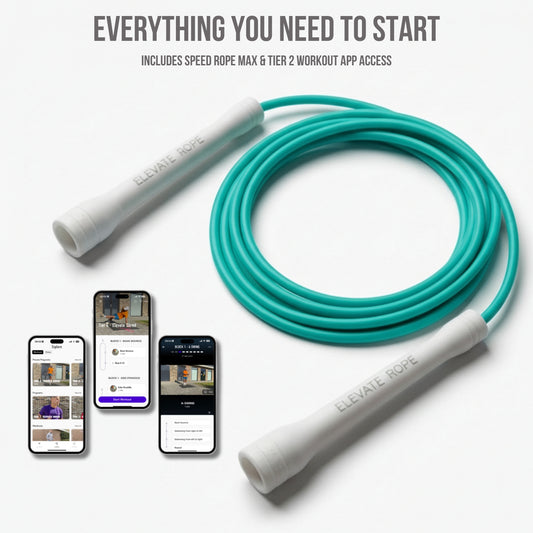
The Elevate Ascent Bundle combines a Beaded Rope and Speed Rope MAX.
Use the beaded rope to practise rhythm. Explore quicker cardio intervals with the speed rope as your technique develops.
Start small. Learn your timing. Build from there.
11. Jump Rope or Walking: How to Choose for Your Goals
Still deciding?
Consider what matters most to you.
Choose walking when:
- You want an accessible way to become more active.
- You prefer a generally lower-impact activity.
- You enjoy fresh air, longer routes, or relaxed movement.
- You are returning to exercise after a break.
- You want physical activity that fits naturally into your day.
Consider jump rope when:
- You want to explore more vigorous cardio.
- You enjoy practising movement skills.
- You have enough space for safe jumping.
- You want variety in your workouts.
- You're comfortable introducing repeated jumping gradually.
Choose both when:
- You enjoy switching between different activities.
- You want easier days and more demanding sessions.
- You like walking but also want to develop coordination.
- You need flexible exercise options for different schedules.
There's no requirement to choose one activity forever.
Your abilities and preferences may change.
Your routine can change with them.
Final Thoughts: You Don't Have to Choose Just One
Walking and skipping don't need to compete.
Walking makes movement accessible.
Jump rope adds rhythm, coordination, and a different cardio challenge.
One activity might help you relax.
The other might give you a new skill to master.
Both can support a more active lifestyle.
If walking works for you, keep doing it.
If you're looking for variety, try a rope and give yourself permission to learn.
You don't need a perfect workout.
You don't need to burn a certain number of calories every day.
You need a starting point you can return to.
The goal isn't to win one workout. It's to build a habit you can keep.
One walk. One jump. One promise kept.
Together We Elevate.
Frequently Asked Questions
Is jump rope better than walking for cardio?
Jump rope can create a vigorous cardiovascular challenge during continuous skipping. Brisk walking typically provides moderate-intensity exercise and may be easier to sustain longer. Neither workout is universally better. Choose based on your fitness, preferred intensity, and ability to maintain consistent activity. Both can contribute to weekly aerobic goals.
Does jump rope burn more calories than walking?
Vigorous jump rope workouts generally use more energy per active minute than comfortable walking. However, total calories burned depend on body weight, intensity, duration, and rest periods. Ten minutes of beginner rope practice may contain substantial recovery time. Compare actual sessions rather than assuming the harder activity always burns more overall.
Is 10 minutes of jump rope better than 30 minutes of walking?
Not automatically. Ten minutes of continuous, vigorous skipping differs greatly from ten minutes of beginner practice. A thirty-minute walk provides longer continuous movement, while skipping may offer greater intensity. Both sessions can be worthwhile. Judge them by your actual effort, recovery, fitness goals, and ability to repeat the routine.
Is jump rope better than walking for weight loss?
Neither guarantees weight loss. Both activities can contribute to exercise energy expenditure, but overall energy balance matters most. Walking may be easier to perform regularly, while skipping offers more intensive intervals. Choose a routine you enjoy and can maintain. Combine it with sustainable nutrition and appropriate recovery.
Is walking safer than jumping rope for beginners?
Walking is generally lower impact and easier for most beginners to start. Skipping adds repeated landings and requires coordination, which can create unfamiliar demands. That doesn't make skipping inherently unsafe. Begin gradually, use suitable footwear, and stop if pain occurs. Seek professional advice when existing conditions affect your exercise choices.
Can I combine walking and jump rope in one workout?
Yes. You could start with a comfortable walk, practise a few short rope intervals, and finish walking. This provides both familiar movement and new skill practice. Keep the jumping volume manageable while learning. You can also alternate walking and skipping days across the week, allowing recovery between demanding sessions.
About Elevate Rope
Elevate Rope helps people make movement part of everyday life.
We believe lasting progress comes from small actions repeated consistently.
Our jump ropes support beginners, freestyle jumpers, and people building cardiovascular fitness.
The goal is bigger than one workout. It's about building trust in yourself through promises kept.
Together We Elevate.