





Jump rope vs running: which cardio workout suits your goals, energy, and routine?
Running is familiar. Put on your shoes, go outside, and start moving. But some people find it boring. Maybe you promised yourself three runs each week. Then week two arrived, and getting outside felt harder than the workout.
Jump rope offers another option. You stay in one place, but rhythm, timing, and footwork keep your mind involved. Both activities can challenge your heart and lungs. Neither automatically wins. The useful question is which fits your goals, ability, and life.
What You'll Learn
- How each activity supports cardiovascular fitness
- How calorie burn and weight management compare
- What changes for your knees, ankles, and muscles
- Which option suits beginners and busy schedules
- Whether skipping can replace running
- A 10-minute beginner workout and a realistic weekly plan
1. Jump Rope vs Running: The Quick Comparison
Before choosing a jump rope cardio workout, compare what each activity actually asks from you.
| Category | Jump rope | Running |
| Cardio fitness | Can provide vigorous aerobic exercise | Can provide moderate or vigorous aerobic exercise |
| Equipment | Rope, supportive shoes, safe space | Supportive shoes, suitable route or treadmill |
| Space | Small, clear area with overhead clearance | Route, track, or treadmill |
| Learning curve | Rope timing and footwork take practice | Familiar movement; pacing still takes practice |
| Impact | Repeated small jumps and landings | Repeated strides and landings |
| Variety | Footwork, tricks, combinations, intervals | Routes, hills, pace changes, intervals |
| Progress tracking | Technique, interval time, rhythm, consistency | Pace, distance, duration, perceived effort |
The biggest difference is not simply how hard you work. It is how the activity feels.
Running moves you through a route. Skipping keeps you in place while your hands and feet coordinate each rotation. Both can become enjoyable habits.
Short answer: Both activities can improve cardiovascular fitness when intensity and training frequency fit your abilities.
Why it matters: A demanding workout only helps when you can return to it.
Best next step: Consider your goal, space, recovery, and preferred training style.
The best comparison is the one you can repeat next week.
2. Which Is Better for Cardiovascular Fitness?
Both running and jump rope can give you an effective cardio workout. Your breathing and heart rate rise as working muscles need more oxygen. The challenge depends on your pace, training time, and recovery.
How running challenges your cardiovascular system
Running makes steady movement relatively simple. You can jog comfortably, add faster intervals, or increase your distance over time. A beginner might alternate walking and jogging. An experienced runner might train for longer continuous efforts.
Speed, terrain, and current fitness affect how demanding each session feels.
How skipping challenges your cardiovascular system
Skipping combines repeated jumping with controlled rope rotations. At a challenging pace, it becomes vigorous aerobic exercise. New jumpers may breathe hard after a short interval.
That does not automatically make skipping better than running. A fast runner may work harder than someone practising slow jumps with frequent stops.
Does a shorter workout mean better results?
Not necessarily. You've probably heard that ten minutes of skipping equals thirty minutes of running. That statement leaves out intensity, rest, experience, and training goals.
A challenging ten-minute session is not automatically equivalent to a relaxed thirty-minute run. Nor does it replace every benefit of longer endurance training.
The World Health Organization's activity guidance recommends regular moderate or vigorous movement. Both activities can contribute toward those weekly goals.
Verdict: Neither exercise wins automatically. Match the intensity and duration before comparing results.
3. Jump Rope vs Running: Which Burns More Calories?

Calorie burn is a common reason people compare these workouts. But there is no fixed winner.
Why calorie comparisons are complicated
Your energy expenditure depends on several factors:
- Body weight
- Workout duration
- Actual exercise intensity
- Movement efficiency
- Rest periods and missed jumps
- Individual differences
Vigorous skipping may demand more energy per minute than easy jogging. Fast running may demand more than slow jump rope practice. Neither example proves a universal rule.
Why calorie calculators disagree
The 2024 Compendium of Physical Activities assigns different intensity values to different running and skipping speeds. This is useful for comparing activities. It does not measure your personal calorie burn.
A watch or calculator also gives an estimate. Use it as context, not a guaranteed result.
Does jumping faster always help?
Higher intensity can raise energy expenditure per minute. But rushing may cause more trips. Repeated stops can reduce your total active time.
For beginners, smooth technique usually matters more than chasing maximum speed.
Verdict: Both workouts can use substantial energy. Compare similar effort and actual active minutes, not dramatic online claims.
4. Which Is Better for Weight Loss?
If you want to manage your weight, you might be searching for the fastest cardio workout. But exercise is only one part of the picture.
Body weight changes depend on energy intake, energy expenditure, and individual circumstances. Neither running nor jump rope guarantees weight loss.
Consistency beats one exhausting session
Imagine completing one brutal workout. You feel drained and avoid training for the next two weeks. Now imagine a manageable session you enjoy and repeat.
The repeatable option gives you more chances to stay active. That is why enjoyment matters.
Choose what you can sustain
Some people love running outdoors. They enjoy discovering routes and tracking distance. Others prefer shorter workouts with footwork and skill progression.
Neither preference is better. Your best option is the one you can perform regularly.
Recovery and nutrition still matter
Start with a realistic schedule. Eat in a way that supports your needs. Rest between demanding sessions. Avoid judging progress by one weigh-in or estimated calorie number.
Short answer: Neither activity guarantees faster weight loss.
Why it matters: Results depend on more than a single workout.
Best next step: Choose manageable sessions and review your progress across several weeks.
5. Which Workout Is Easier on Your Knees and Ankles?
This comparison needs care. Both activities involve repeated impact, but they load your body differently.
Impact during running
Running involves alternating single-leg landings as you move forward. Muscles and joints handle force during each stride. Speed, terrain, footwear, technique, and training volume all matter.
Running is not automatically harmful to healthy knees. Too much workload without enough recovery can still cause problems.
Impact during skipping
A basic bounce uses repeated small jumps and landings. The calves, feet, and ankles manage much of that work. These demands may feel unfamiliar when you first learn jump rope technique.
Some muscle soreness can occur after an unfamiliar session. Sharp, persistent, or worsening pain deserves attention.
Is jump rope lower impact than running?
Not for everyone. A controlled low bounce may feel comfortable for one person. Another person might tolerate gentle jogging better.
Rope speed, jump height, surface, footwear, and health history all affect the experience.
What if your joints already hurt?
Do not push through existing pain. Seek appropriate professional guidance for persistent symptoms or a previous injury. Walking, cycling, or swimming may be better temporary choices.
Verdict: Neither activity is universally safer. Start gradually and judge comfort, recovery, and total workload.
6. Which Workout Uses More Muscles?
Running and jump rope both involve more than your legs. They simply ask your body to move differently.
Muscles involved in running
Running mainly challenges your glutes, quadriceps, hamstrings, and calves. Your core and upper body help you maintain posture and control. Hills and faster running change the demands.
Muscles involved in skipping
The legs and calves manage takeoff and landing. Your wrists, forearms, and shoulders turn and control the rope. Your trunk helps keep your movement stable.
A heavier rope can increase rotational resistance, but that does not turn every session into strength training.
Is skipping a full-body strength workout?
Not necessarily. Using several muscle groups is different from training them with enough resistance for major strength gains. Standard rope skipping is primarily conditioning and coordination work.
For balanced fitness, include dedicated strength exercises. The CDC adult exercise guidelines also recommend muscle-strengthening activity during the week.
Verdict: Both activities involve multiple muscles. Skipping adds rope-handling demands, while running emphasises forward movement.
7. Which Is Better When You Have Little Time?
Sometimes the hardest part of a cardio workout is fitting it into your day.
Running needs a route or treadmill
Outdoor running needs a suitable route and safe conditions. You might also need time to reach your preferred location. A treadmill removes some barriers but requires access to equipment.
Skipping works in a compact area
You can use a garden, garage, court, or another clear space. Check overhead clearance and your surroundings first. Wear suitable shoes and choose a safe surface.
A short jump rope workout can be convenient without travelling across town.
Short does not mean easy
Ten minutes can feel demanding, especially while learning. Beginners do not need to jump continuously. Short practice sets with generous recovery are completely valid.
If you want a simple progression, try our 10-minute jump rope routine.
Verdict: Skipping may suit tighter schedules. Running can be just as convenient when a safe route is nearby.
8. Which Is More Enjoyable: Jump Rope or Running?
Enjoyment is not a minor detail. It influences whether you return when motivation fades.
Why people love running
Running can offer fresh air, changing scenery, and time to think. Some people enjoy a steady pace. Others love training for a distance goal.
If running gives you that feeling, there is no reason to stop.
Why people enjoy skipping
Jump rope adds a skill to cardio. You can learn basic bounce, alternating-foot steps, boxer step, and crossovers.
Maybe you start with five clean jumps. Later, twenty feels possible. Then you try another movement.
The workout becomes practice, not just a countdown.
What if repetitive cardio bores you?
Experiment before deciding. A long run might feel repetitive to you. Or the challenge of rope timing might feel frustrating.
You do not need to force yourself to love either activity.
Verdict: The better workout often feels worth repeating. Choose the kind of movement you genuinely enjoy.
9. Can Jump Rope Replace Running?
For general aerobic fitness, jump rope can replace some running sessions. Both can contribute to an active week. The answer changes when your goal becomes specific.
If your goal is general cardio fitness
You do not have to run. Skipping, cycling, swimming, and other aerobic activities can help you move more.
If you are training for a race
Keep running in your plan. You need practice with pacing, running technique, and your target distance. Skipping may complement that work, but it cannot fully replace it.
If your goal is better coordination
Rope skipping challenges your hands and feet to follow a shared rhythm. That offers useful coordination practice. It does not guarantee improvement in every other sport.
If your goal is lasting consistency
Choose what fits your week. That might mean two short rope sessions. It might mean three easy runs. Or it could mean a mixture.
Short answer: Skipping can replace running for some general cardio goals, not for race-specific preparation.
Why it matters: Training should match what you want to improve.
Best next step: Identify whether fitness, running performance, skill, or consistency matters most.
10. A Beginner Jump Rope Workout to Try
If running has never suited you, start with a simple rope session. No advanced tricks or high-speed turns are required.
This ten-minute beginner jump rope workout prioritises timing and control.
| Time | Activity | Focus |
| 0:00–2:00 | Gentle warm-up | Prepare your body |
| 2:00–3:00 | Basic bounce intervals | Timing |
| 3:00–4:00 | Rest and reset | Recovery |
| 4:00–5:00 | Basic bounce intervals | Control |
| 5:00–6:00 | Rest and easy steps | Recovery |
| 6:00–7:00 | Alternating-foot practice | Coordination |
| 7:00–8:00 | Rest and reset | Recovery |
| 8:00–9:00 | Favourite beginner drill | Technique |
| 9:00–10:00 | Gentle cooldown | Finish comfortably |
During each practice minute, jump for ten to twenty seconds. Rest for the remainder as needed. These are technique intervals, not nonstop jumping targets.
If you cannot string several jumps together, practise one rotation at a time. Keep your bounce low and shoulders relaxed. Stop for pain, dizziness, or unusual symptoms.
The aim is to finish feeling capable of returning.
11. How to Combine Running and Jump Rope

You do not have to choose between running and jump rope forever. Mixing them can add variety to your cardio routine.
The important part is managing your overall workload.
Example beginner weekly schedule
| Day | Activity |
| Monday | Short jump rope technique session |
| Tuesday | Rest or comfortable walking |
| Wednesday | Easy walk-jog session |
| Thursday | Recovery or gentle movement |
| Friday | Short rope technique session |
| Saturday | Optional walking or another suitable activity |
| Sunday | Rest and weekly review |
This is an example, not a requirement. Start with less impact if both activities are new. Avoid increasing running distance and skipping volume aggressively together.
Keep total impact manageable while your body adapts.
As your fitness develops, adjust the week around recovery and your goals.
12. What Equipment Do You Need to Start Skipping?
A jump rope workout needs a suitable rope, supportive shoes, and enough safe space. Different rope types can make the learning experience feel different.
Beaded Rope for learning timing
A beaded rope provides noticeable feedback during rotation. That can help you feel the rhythm while practising basic bounce and simple footwork.
Speed Rope for cardio sessions
A speed rope offers a quicker rotation feel. It may suit faster intervals once you have reliable basic technique. You do not need maximum speed to benefit.
Heavy Rope for added resistance
A heavy rope requires more effort to rotate. It can challenge your upper body differently. It is not necessary for learning your first basic jumps.
Which rope should you choose?
Start with one you can control comfortably. Check the fit before cutting or adjusting anything. Our rope sizing guide explains the starting point.
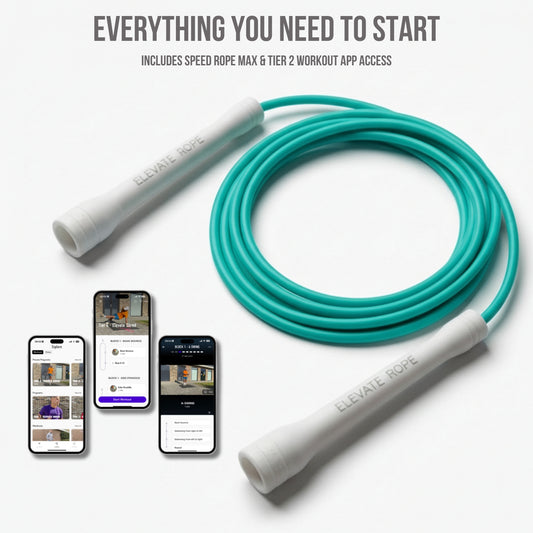
If you want both rhythm practice and quicker intervals, explore the Elevate Ascent Bundle. It pairs a Beaded Rope with a Speed Rope.
You can also see the Ascent overview before choosing. Equipment supports consistency, but it cannot replace practice and recovery.
13. How to Decide Which Workout Is Right for You
Still unsure? Ask yourself five questions.
Do I enjoy the outdoors? Running may suit you if exploring new routes keeps you motivated.
Do I like learning skills? Skipping may be more enjoyable if you like mastering small movements.
Is space limited? A rope can work in a compact, clear area with enough overhead room.
Am I training for a race? Keep running central and use rope sessions as optional support.
Do I struggle to stay consistent? Try both and notice what you actually look forward to.
Your best jump rope or running routine is not always the one with the boldest calorie claim. It is the one that fits your real life.
Final Verdict: The Best Cardio Is the One You'll Keep Doing
So, jump rope or running?
Running is useful for steady aerobic work, covering distance, and race preparation. Skipping combines cardio with timing, coordination, and skill practice.
Neither exercise is automatically better for everyone. You can enjoy both without turning fitness into a competition.
If you love running, keep running. If it bores you, give jump rope a fair try. Begin with controlled jumps. Build short intervals. Add new footwork when ready.
Fitness does not come from one perfect workout. It grows through manageable sessions you return to.
Choose movement you enjoy. Make it realistic. Then keep showing up.
Want guided practice? Try the free Elevate26 challenge and adapt each session to your level.
Watch Geraldo Alken's 20-minute jump rope workout to explore beginner-friendly intervals and practise cardio at your own pace.
Frequently Asked Questions
Is jump rope better than running for cardio?
Both activities can provide a strong cardio workout. Running suits longer continuous efforts, while skipping also develops rhythm and timing. Neither automatically wins at every intensity. Compare your actual effort, training time, and recovery. Choose a routine you can practise consistently instead of judging one demanding session.
Does jump rope burn more calories than running?
It depends on body weight, pace, time, and rest breaks. Vigorous rope skipping can use more energy than easy jogging. Faster running can also use more energy than slow technique practice. Online calorie burn estimates are approximations. Compare similar sessions and avoid treating one number as a universal rule.
Is ten minutes of jump rope equal to thirty minutes of running?
Not automatically. Different sessions create different workloads, even when both raise your heart rate. Intensity, rest, technique, and personal fitness all change the comparison. Ten minutes of challenging skipping can be useful. It does not replace every benefit of a longer run, especially when you need race-specific endurance.
Is jump rope easier on the knees than running?
Not for everyone. Both activities include repeated impact, and comfort depends on technique, surface, shoes, fitness, and training volume. A small controlled bounce may suit some people. Others tolerate jogging better. If you have persistent pain or a recent injury, speak with a qualified healthcare professional before increasing impact.
Can beginners replace running with rope skipping?
Yes, for some general fitness goals. Beginners can start with single rotations and short practice intervals. Running may be easier when you want uninterrupted movement without learning rope timing. If you are preparing for a running event, keep running in your training. Build either activity gradually and allow recovery.
Should I buy a beaded or speed rope for cardio?
A beaded rope gives more noticeable rotation feedback, which can help when learning timing. A speed rope may suit faster cardio intervals once your basics feel reliable. You do not need both to start. Choose a rope that fits your height, ability, and goals. Good technique matters more than expensive equipment.
About Elevate Rope
Elevate Rope helps people build movement into everyday life. We believe a manageable workout can become a promise you keep to yourself. Our ropes and training guidance support beginners, regular jumpers, and people searching for enjoyable cardio. Together We Elevate.