







Sizing a jump rope takes two minutes. Stand on the middle of the rope, pull the handles straight up, and check that the handle tops reach somewhere between your armpits and your shoulders. That is the correct starting length. Everything in this guide explains what to adjust from there, and why getting it wrong is the most common reason beginners quit.
Most people who struggle with a jump rope are not uncoordinated. They are using a rope that is the wrong length. Too long, and the rope drags and slaps the floor early, breaking rhythm and confidence. Too short, and you clip your feet on nearly every rotation, no matter how good your timing gets. Neither is a technique failure. Both are a sizing failure.
This article covers the standard height-to-length chart for each Elevate jump rope product, how to adjust each type, and when to intentionally size shorter as your skill builds.
What You Will Learn
- The standard height-to-length chart for jump rope sizing
- How rope type changes the sizing rules
- How to adjust a speed rope using the snaplock system
- How to adjust a beaded rope using the washer system
- When to shorten your rope as technique improves
- Does jump rope length affect injury risk?
- FAQ on jump rope length and sizing
How Long Should a Jump Rope Be?
The standard starting rule: stand on the midpoint of the rope, pull both handles straight up, and the tops of the handles should reach your armpits. For most adults, that puts total rope length somewhere between 270 cm and 300 cm, handle to handle.
The armpit rule is the right starting point for a beginner. It gives you enough clearance to clear your feet without demanding precise timing, and enough tension to feel the rope through the full rotation.
As technique improves, shorter is better. Advanced jumpers often size down to chest-height or even nipple-height, because a tighter arc means faster rotation and fewer trips. But for day one, armpit height is where you start.
Jump Rope Length by Height: The Chart
This table gives the recommended starting length for each height range. All measurements are total rope length including handles. Adjust from there based on rope type and technique level.
| Your Height | Recommended Total Rope Length |
| Under 152 cm (5'0") | 250 cm |
| 152–165 cm (5'0"–5'5") | 270 cm |
| 165–175 cm (5'5"–5'9") | 280 cm |
| 175–183 cm (5'9"–6'0") | 290 cm |
| 183–190 cm (6'0"–6'3") | 300 cm |
| 190–198 cm (6'3"–6'6") | 310 cm |
| Over 198 cm (6'6"+) | 320 cm or custom |
If you are between sizes, go longer first. It is always easier to shorten a jump rope than to wish you had not cut it.

Short answer: Stand on the midpoint. Pull the handles up. Armpit height is your starting point.
Why it matters: Wrong length is the primary reason beginners trip and quit. Too long means the rope contacts the floor before completing the arc. Too short means clipped feet regardless of timing. Neither is a coordination problem.
Best next step: Find your height in the chart above, set your jump rope to that length, jump for five minutes, then adjust 5 cm at a time if anything feels off.
Does Rope Type Change the Sizing Rules?
Yes. Each jump rope type in the Elevate Rope range has different sizing behaviour because of weight, diameter, and arc dynamics. The armpit rule applies to all of them, but the tolerance for errors differs.
Speed Ropes
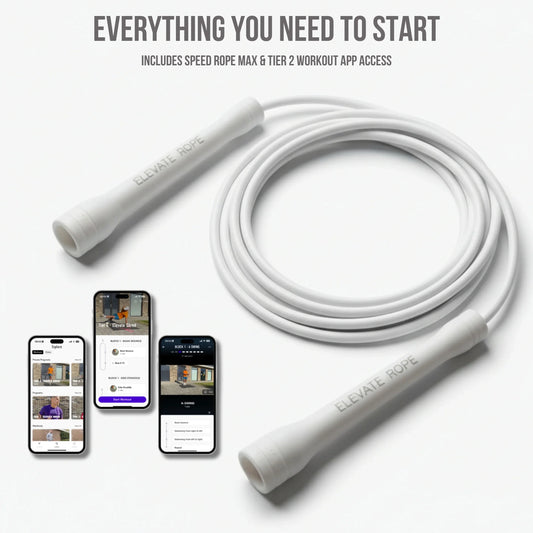
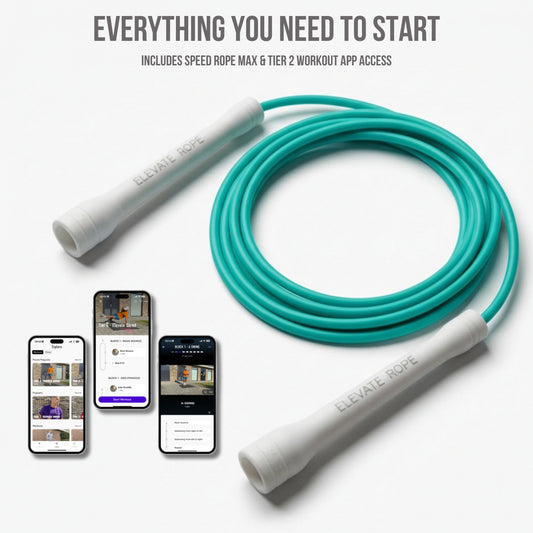
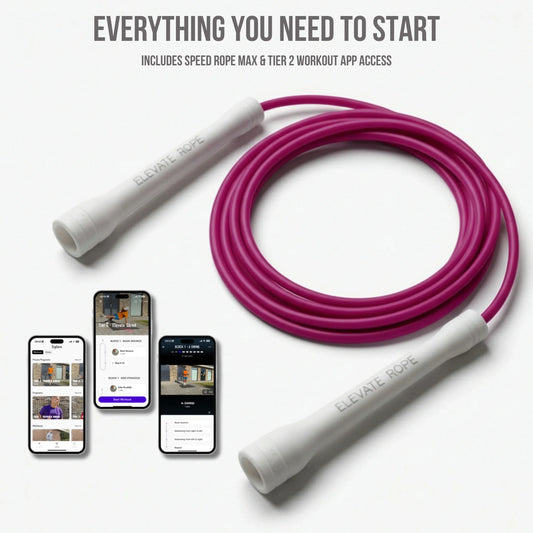
The Speed Rope and Speed Rope MAX are lightweight and fast-turning. A lighter jump rope is more sensitive to length errors. Too long, and the arc goes loose and unpredictable. Start at armpit height, then shorten by 5 cm at a time until the arc feels taut and controlled under your feet.
→ Speed Rope and Speed Rope MAX:elevaterope.com/collections/speed-ropes
Beaded Ropes
The Dignity Beaded Rope is heavier than a speed rope. The extra weight creates a slower, more predictable arc, which is exactly why it is the recommended jump rope for beginners. A beaded rope that is slightly long is more forgiving than a speed rope at the same length, because the weight keeps the arc defined even with a small amount of slack.
Start at armpit height. You have more room to work with before length errors become disruptive.
The beaded jump rope adjusts via the washer system. No tools needed. Slide the beads back, reposition the washer, cut excess cord with scissors. The same rope can be resized for shorter family members or adjusted as technique develops.
→ Dignity Beaded Rope:elevaterope.com/collections/beaded-ropes
Titan 7mm Weighted Rope
The Titan 7mm is heavier still. The extra weight generates its own momentum through the rotation, which partly compensates for minor length errors. Even so, follow the chart. A weighted jump rope that is too long creates real resistance problems on the return arc and starts forcing awkward wrist angles.
→ Titan 7mm Weighted Rope:elevaterope.com/collections/weighted-speed-rope-7mm
Long Handle Ropes
Long handle ropes have extended handles that shift the effective arc geometry. Measure from the midpoint as normal, but expect to size the cable slightly shorter than the standard chart suggests. The added handle length compensates for the shorter cable length.
→ Long Handle Ropes:elevaterope.com/collections/long-handle-ropes
How to Adjust an Elevate Speed Rope
The Speed Rope uses a snaplock system. No tools required.
- Pull the rope cord out through the open end of the handle.
- Locate the snaplock stopper on the cord.
- Slide the stopper to your target length marker.
- Pull the cord back through the handle and snap the lock into place.
- Stand on the midpoint and lift to verify the length.
Trim excess cord with scissors if you want a clean setup. Leave a small buffer if you are still dialling in your preferred jump rope length. You can always trim more later.
How to Adjust an Elevate Beaded Rope
The beaded jump rope uses a washer system.
- Remove the handle cap on one or both sides.
- Slide the beads back to expose the cord near the handle entry point.
- Move the washer along the cord to your target position.
- Replace the beads and the handle cap.
- Cut excess cord if you have confirmed your preferred length.
The washer holds the rope at the set position during jumping. It will not shift under normal use. The adjustment is stable for ongoing training.
When Should You Shorten Your Jump Rope?
Most beginners start at the correct length and never adjust from there. That is fine initially. But as timing improves, a shorter jump rope becomes noticeably more efficient.
Three signals that it is time to shorten by 5 cm:
- You are clearing the rope consistently but the arc feels loose and unpredictable at the top of the rotation.
- You want to progress towards double-unders. That requires sizing down towards chest height.
- You are training speed intervals and want tighter ground contact time.
Shorten incrementally. Five centimetres at a time is enough to feel the difference without over-correcting. Most people end up 10–20 cm shorter than their beginner starting length once they are training consistently.
Short answer: A jump rope that is too long drags before completing the arc, forcing you to jump higher to compensate.
Why it matters: Jumping unnecessarily high is where bad form and excess fatigue come from. Your rhythm breaks on nearly every rotation. This is not a fitness problem. It is a length problem.
Best next step: Shorten by 5 cm at a time until the arc feels taut and the rope clears your feet at one to two inches of height.

Does Jump Rope Length Affect Injury Risk?
A jump rope that is too long changes body mechanics. You compensate by jumping higher than necessary, which increases landing impact on each rep. Over weeks of training, that places unnecessary load on the knees and ankles.
Getting the jump rope length right is not only about rhythm. It is about keeping the jump height required to clear the rope as small as possible. One to two inches off the ground is the correct target. Anything more, and either the rope is too long or the technique needs a review.
If you have existing knee concerns, read more about joint mechanics and impact in our guide on joint-friendly cardio options.
Sizing for Taller Users
If you are over 185 cm, confirm rope length options before purchasing. Most standard jump ropes top out at around 300 cm total length, which covers most adults up to roughly 188–190 cm. The Dignity Beaded Rope comes in a 3-metre adjustable configuration that covers the majority of tall users. For very tall users above 190 cm, the adjustable design lets you set a custom effective length without needing a custom-cut rope.
Review data from Elevate's own customers on Bol.com shows that rope length is among the most common complaints for users above 180 cm. The fix is sizing correctly before you start, not after your first frustrated session.
For the full Elevate jump rope range across all heights and types, the collections are linked above by category. If you are unsure which type suits your goal, the comparison article covers all options side by side.
→Beaded vs Speed vs Weighted Rope: Which Should a Beginner Buy?
FAQ: Jump Rope Length and Sizing
What size jump rope do I need for my height?
Use the armpit rule as your starting point. Stand on the midpoint of the rope, pull both handles straight up, and check that the tops reach your armpits. Then cross-reference with the height chart above. For most adults between 165 cm and 183 cm, a 280–290 cm rope works well as a first setting.
How do I know if my jump rope is too long?
If the rope slaps the floor before completing its arc, or if you find yourself jumping higher than one to two inches off the ground consistently, the rope is too long. Shorten by 5 cm and retest. The floor contact point should be cleanly underneath you, not out in front.
How do I know if my jump rope is too short?
If you keep clipping your feet even after your timing and form feel correct, the rope is likely too short. Add length if your model allows it, or move to the next size. With a beaded rope, you can simply reposition the washer.
Does rope type change the sizing?
Yes. A beaded jump rope is more forgiving of a few extra centimetres because the weight holds the arc shape. A lightweight speed rope shows length errors faster. Start at the same armpit baseline for all types, but expect to shorten a speed rope sooner as your technique develops.
Can I make my jump rope longer after cutting it short?
No. Once cord is removed, it cannot be added back. Always size conservatively at first. Leave extra length in place until you are confident in your preferred setting. Cut only when you have tested the length across multiple sessions.
What rope length is correct for double-unders?
Most people size down to chest height or nipple height for double-unders. A tighter arc creates faster rotation. Do not size that short as a beginner. Start at armpit height, build consistent single-bounce timing first, then shorten gradually over weeks.
Is a 3-metre jump rope long enough for tall users?
A 3-metre rope suits most adults up to around 188–190 cm. Above that height, look for a rope with extended adjustable range or contact the Elevate Rope team directly to confirm the right option for your height.
Sources
- Trecroci A, et al. (2015). Jump Rope Training: Balance and Motor Coordination in Preadolescent Soccer Players. Journal of Sports Science and Medicine. ncbi.nlm.nih.gov/pmc/articles/PMC4672839/
- American Council on Exercise. Jump Rope Exercise Overview. acefitness.org
- National Strength and Conditioning Association. Equipment Guidelines for Jump Rope Training. nsca.com
You May Also Like
- How to Jump Rope: Step by Step for Complete Beginners
- Beaded vs Speed vs Weighted Rope: Which Should a Beginner Buy?
- Best Jump Rope for Beginners in 2026 (No App, No Subscription)
- Your First 30 Days: A Beginner Jump Rope Plan Without the Streak Pressure
- Jump Rope for Beginners: The Complete Guide
About the author: This article was produced by the Elevate Rope content team with input from certified fitness professionals and based on customer sizing data gathered from 50,000+ jumpers across Europe and internationally. Elevate Rope is a Dutch brand specialising in premium jump ropes for beginners and trained athletes.