





If you think 10-minute workouts are too short to matter, research may change your mind. The fitness industry spent decades convincing us that effective exercise requires 45 minutes to an hour in the gym. But the science tells a very different story. It favours people who are short on time, low on motivation, or tired of workouts they hate.
This isn't about cutting corners. It's about working smarter with your body's physiology. Shorter, more intense sessions can outperform the marathon treadmill slog.
What You'll Learn
- Why your body burns more fat in short, intense bursts than in long, steady cardio
- The afterburn effect and how 10-minute workouts exploit it
- What research says about exercise duration and weight loss
- The best types of 10-minute workouts for fat loss
- Why consistency matters more than session length
The Problem With Long Workouts
Most people who commit to hour-long workout programmes quit within six weeks. A 2019 study in the British Journal of Sports Medicine found that exercise adherence drops sharply once sessions exceed 30 minutes. Dropout rates for 60-minute programmes were nearly double those of shorter ones. The reason isn't laziness — it's human nature. When something demands lots of your free time, starting becomes far harder.
Think about your own experience. After a long workday, driving to the gym, warming up, doing a full routine, cooling down, showering, and driving home takes ages. That's easily 90 minutes gone. Compare that to stepping into your living room for 10-minute workouts with a jump rope. The second option actually happens. The first gets postponed to "tomorrow" until tomorrow becomes never.
And even when people do force themselves through those longer sessions, the calorie burn often disappoints. Moderate-intensity steady-state cardio burns calories only while you're doing it. The moment you step off the machine, the meter stops. That's not the case with the kind of high-intensity training that fits neatly into a 10-minute window.
The Science Behind Why 10-Minute Workouts Burn More Fat
EPOC: The Afterburn Effect
The secret weapon of short, high-intensity exercise is Excess Post-Exercise Oxygen Consumption (EPOC). Push hard in a brief window — jump rope intervals, bodyweight circuits, sprint training — and your metabolism stays elevated for hours. Your body restores oxygen levels, clears lactate, repairs tissue, and returns to its resting state. All of that burns calories, mostly from fat stores.
A study from Colorado State University found that 10 minutes of intense exercise created an EPOC effect. It burned an additional 150–200 calories over the following 24 hours. Compare that to 45 minutes of moderate treadmill walking, which burns around 300 calories total with virtually no afterburn. The net result is surprisingly close. But 10-minute workouts took a quarter of the time.

Hormonal Response: Short Beats Long
High-intensity exercise triggers a strong release of catecholamines — adrenaline and noradrenaline — your primary fat-mobilising hormones. These signal fat cells to release stored fatty acids into the bloodstream for fuel. Longer, moderate sessions don't trigger the same cascade. Worse, extended exercise can elevate cortisol, which promotes fat storage around the midsection. A 2018 study in the Journal of Endocrinological Investigation found sessions exceeding 45 minutes produced cortisol levels high enough to reduce some fat-burning benefits.
Short answer:High-intensity 10-minute workouts trigger stronger fat-burning hormones while producing less cortisol than longer moderate sessions.
Why it matters:Your hormone profile after exercise determines whether your body stores fat or burns it. Short, intense training puts you on the right side of that equation.
Best next step:Replace one long cardio session this week with 10-minute workouts using jump rope intervals.
What Research Says About Short Sessions and Weight Loss
The American College of Sports Medicine's 150 minutes per week guideline is about total volume, not minimum session length. That's fifteen 10-minute workouts spread across your week. The science doesn't care how you divide it.
A 2019 study from the Journal of the American Heart Association examined "exercise snacking" — breaking activity into bouts of 10 minutes or less. It found this approach was just as effective for cardiovascular health and weight management as longer continuous sessions. Participants doing three 10-minute bouts daily showed slightly better blood pressure improvements than those doing one 30-minute session.
A 2021 meta-analysis in the British Journal of Sports Medicine reviewed 33 studies on high-intensity interval training. It found sessions lasting 10–15 minutes produced comparable fat loss to moderate-intensity sessions lasting 40–60 minutes. The conclusion: intensity matters more than duration for body composition.
Why Consistency Beats Duration Every Time
The single strongest predictor of long-term weight loss success isn't exercise type, duration, or intensity. It's whether you actually keep doing it. This is where 10-minute workouts have an unfair advantage.
When a workout takes 10 minutes, excuses evaporate. You can do it before your morning shower, during lunch, or in your living room while dinner cooks. The barrier is so low that skipping feels harder to justify than doing it. That psychological shift — from "I should work out" to "I might as well" — separates people who lose weight from those who only think about it.
A 2020 study in Psychology of Sport and Exercise found that people committing to short daily sessions maintained their habit for 11.4 months on average. Those doing longer sessions three times per week maintained it for 3.7 months on average. Total weekly exercise time was nearly identical, but the short-session group was three times more likely to still be exercising a year later. Results come from 10-minute workouts you complete, not hour-long sessions planned on your calendar.
Short answer:People who do 10-minute workouts stick with them three times longer than those choosing longer sessions.
Why it matters:Weight loss is a long game. The workout you'll actually do five days a week for a year beats the "perfect" routine you quit after two months.
Best next step:Commit to 10 minutes a day for 14 days. Don't increase the time. Focus on building the habit first.
The Best Types of 10-Minute Workouts for Fat Loss
Jump Rope: The King of Short Sessions
Research from Arizona State University found that 10 minutes of jump rope equals about 30 minutes of jogging for cardiovascular benefits. Calorie burn was also comparable. That's a 3:1 efficiency ratio. A 70 kg (154 lb) person burns around 140–180 calories in 10 minutes of moderate-to-vigorous rope work. That figure comes before accounting for EPOC.
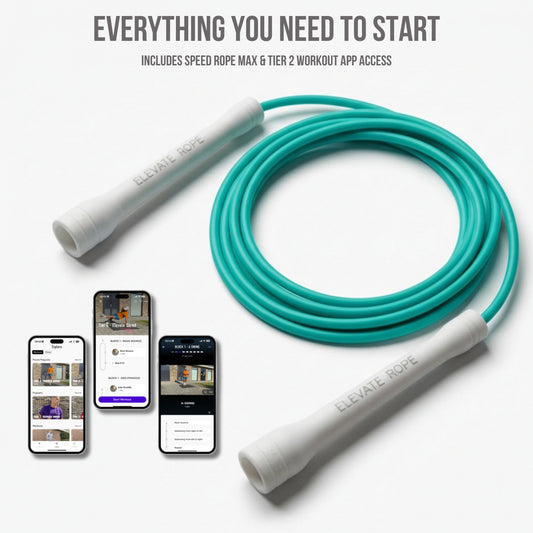
Jump rope activates more muscle groups than most people realise: calves, quads, glutes, core, shoulders, and forearms simultaneously. For beginners, a beaded jump rope provides the right feedback to learn form without frustration. As you progress, → speed ropes let you increase intensity within the same window.
Bodyweight HIIT Circuits
Alternate 30–40 seconds of maximum effort with 15–20 seconds of rest, cycling through burpees, mountain climbers, squat jumps, and push-ups. Ten minutes leaves you breathing harder than most people after an hour of steady cardio. For amplified calorie burn, combining bodyweight movements with jump rope creates hybrid 10-minute workouts that are extraordinarily effective.
Sprint Intervals
Sprint all-out for 20 seconds, walk for 40 seconds, and repeat 10 times — exactly 10 minutes. A 2012 study in the International Journal of Obesity found a sprint-interval group lost significantly more body fat than a steady-jogging group. The sprint group exercised for half the time. For a complete breakdown of how jump rope compares with running, see our guide on exercises that burn more than running.

How to Structure 10-Minute Workouts for Maximum Results
First, choose compound movements that work multiple muscle groups: jump rope, burpees, kettlebell swings, squat-to-presses. Isolation exercises don't create enough metabolic disturbance in a short window.
Second, use intervals. Start with 30 seconds of hard effort followed by 15 seconds of rest. As conditioning improves, extend work periods or shorten rest. Keep your heart rate above 80% of maximum during work intervals.
Third, minimise transitions. With only 10 minutes, switching equipment eats into effective training time. This is why jump rope is ideal for 10-minute workouts — you pick it up and go. No machines, no plates, no setup. → Elevate Rope bundles give you multiple rope options to vary intensity without adding transition time.
Short answer:Effective 10-minute workouts use compound movements, interval timing (30 on / 15 rest), and minimal equipment transitions.
Why it matters:Structure determines whether a short session delivers real fat-burning results or just makes you warm.
Best next step:Try a simple jump rope interval — 30 seconds jumping, 15 seconds rest, 10 rounds. That's your first complete session.
Building a Weekly Routine Around 10-Minute Workouts
Commit to one session per day, five days a week. That's 50 minutes weekly, which at high intensity delivers results comparable to three or four hours of moderate training. Vary your sessions. Monday jump rope intervals, Tuesday bodyweight HIIT, Wednesday active rest, Thursday weighted rope (TITAN 7MM) for extra resistance, Friday sprints or a mixed circuit.
As you progress, you can add a second daily session. Two 10-minute workouts separated by hours can produce greater total EPOC than one 20-minute session. You're triggering the afterburn twice. For a full progressive training plan, the complete guide to jump rope for weight loss covers everything from choosing your first rope to structured programming.
Frequently Asked Questions
Can you lose weight with 10-minute workouts?
Yes. Multiple studies confirm that 10-minute workouts at high intensity produce fat loss comparable to 40–60 minute moderate-intensity sessions. The key factors are intensity and consistency. Ten minutes of jump rope intervals will drive meaningful fat loss when done regularly.
How many calories do 10-minute workouts burn?
High-intensity sessions typically burn 100–200 calories during the workout itself. With the EPOC afterburn, total expenditure can reach 250–400 calories over 24 hours. See the jump rope calories burned guide for detailed breakdowns by weight and intensity.
Are 10-minute workouts better than longer sessions?
For fat loss, research suggests they're equally effective or superior when performed at high intensity. The biggest advantage is adherence — people maintain 10-minute workouts far longer than hour-long routines. That makes them more effective in practice over months and years.
What equipment do I need?
None is required — bodyweight exercises work well. But a jump rope maximises calorie burn in a short window with full-body engagement. → Beaded ropes suit beginners, while → speed ropes are ideal for faster-paced training.
How often should I do 10-minute workouts?
Five days per week is the sweet spot, giving you 50 minutes of weekly high-intensity exercise with adequate recovery. The critical point is finding a frequency you can maintain for months, not just weeks.
Can I split 10-minute workouts into multiple daily sessions?
Absolutely. Research supports breaking exercise into two or three short bouts across the day. Each bout triggers its own EPOC response, potentially increasing total daily calorie burn beyond what one longer session provides.
Will 10-minute workouts help build muscle?
They won't produce bodybuilder-level hypertrophy, but HIIT-style training preserves lean mass better than steady-state cardio while burning fat. For added muscle stimulus within your 10-minute window, a heavy rope adds upper-body resistance that standard cardio can't match.
Stop Overthinking, Start Moving
The fitness industry profits from complexity — gym memberships, training packages, elaborate programmes, and expensive equipment. But research is clear. For fat loss, 10-minute workouts at genuine intensity are as effective as sessions four to six times longer.
The best workout isn't the one that burns the most calories on paper. It's the one you actually do, consistently, for months and years. Nothing is easier to do consistently than something that takes 10 minutes. A jump rope and a small patch of floor are all you need to get started.
→ Explore Elevate Rope starter bundles to find the right rope for your level. Or start with the complete jump rope for weight loss guide for a full roadmap.

Sources
- Martland et al. (2019). Can high-intensity interval training improve physical and mental health outcomes? British Journal of Sports Medicine, 53(10), 655–665.
- Greer et al. (2015). EPOC Comparison Between Isocaloric Bouts of Steady-State Aerobic, Intermittent Aerobic, and Resistance Training. Research Quarterly for Exercise and Sport.
- Jakicic et al. (2019). Association of bout duration of physical activity with health outcomes. Journal of the American Heart Association, 8(16).
- Wewege et al. (2021). The effects of high-intensity interval training vs. moderate-intensity continuous training on body composition. British Journal of Sports Medicine, 55(14), 786–794.
- Heydari, Freund & Boutcher (2012). The Effect of High-Intensity Intermittent Exercise on Body Composition of Overweight Young Males. International Journal of Obesity, 36(10), 1348–1352.
- Pontzer et al. (2018). Constrained Total Energy Expenditure and Metabolic Adaptation. Journal of Endocrinological Investigation.
- Kaushal & Rhodes (2020). Exercise habit formation in new gym members: a longitudinal study. Psychology of Sport and Exercise, 50, 101741.
You May Also Like
- The Complete Guide to Jump Rope for Weight Loss
- The Hidden Calorie Trap: Why 30 Minutes of Exercise Might Be Too Much
- 5 Exercises That Burn More Calories Than Running
- Jump Rope HIIT Workouts for Fat Loss: 5 Routines That Actually Work
- Cardio at Home: The Ultimate No-Gym Workout Guide
- The Science of Exercise You Actually Enjoy: Why Fun Beats Discipline