





Jump rope weight loss is one of the most time-efficient, space-efficient, and genuinely enjoyable ways to burn fat — and the science backs it up. Research from Arizona State University suggests that 10 minutes of jumping rope delivers cardiovascular benefits comparable to 30 minutes of jogging. That's not a marketing claim. That's metabolic efficiency at work.
Most people associate jump rope with childhood playgrounds or boxing gyms. The reality is simpler: a rope, a flat surface, and 10 focused minutes create a calorie deficit that most treadmill sessions can't match in twice the time.
The challenge isn't whether jump rope works for weight loss. The research is clear on that. The challenge is knowing which rope to use, how to structure your sessions, and how to build the consistency that turns daily 10-minute sessions into visible results within 30 days.
What you'll learn:
Why jump rope burns 2–3x more calories per minute than jogging
How much weight you can realistically lose in 30, 60, and 90 days
Which rope type matches your experience level and weight loss goals
Three beginner-friendly workouts you can start today
A 30-day jump rope weight loss plan with weekly progression
Nutrition basics that accelerate your results without restrictive dieting
Real transformation stories from people who started where you are

Why Most Weight Loss Approaches Fail (And What Jump Rope Changes)
The pattern is familiar. You sign up for a gym, go three times the first week, twice the second week, and by week four the membership sits unused. Or you start running, your knees protest, and you're back on the couch wondering what went wrong. Or you try a 45-minute HIIT class that leaves you so sore you can't walk for three days.
The problem isn't motivation. It's friction.
Long workouts require large time blocks that compete with work, family, and sleep. Gym sessions add commute time, changing, waiting for equipment. Running accumulates joint stress that sidelines people within months. The exercises that burn the most calories often demand the most time, equipment, or recovery — which is exactly why most people quit before results appear.
The Time-Efficiency Problem
Most adults overestimate how much time they need to exercise. The assumption that weight loss requires 45–60 minute sessions comes from an era of steady-state cardio and treadmill culture. Current research tells a different story.
High-intensity, full-body movements create metabolic demands that slower, isolated exercises can't match minute-for-minute. Jump rope weight loss works because the movement engages your calves, quads, core, shoulders, and forearms simultaneously. Every rotation demands coordination between your hands and feet. Every landing requires your core to stabilize your spine. The result is a calorie burn that approaches 15–20 calories per minute at moderate intensity — roughly double what jogging produces.
That efficiency changes the math entirely. Ten minutes of focused jumping creates a calorie deficit comparable to 25–30 minutes of jogging. For someone who genuinely can't find an hour for the gym, that difference isn't trivial. It's the difference between a sustainable habit and another failed attempt.
The Consistency Equation
Weight loss isn't a single decision. It's a series of small commitments repeated over weeks and months. The exercise that works best is the one you actually do — consistently, without dreading it, without rearranging your entire schedule to accommodate it.
Jump rope succeeds where other approaches fail because the barrier to entry is almost nonexistent. You need a rope, a flat surface roughly two metres by one metre, and enough ceiling clearance to swing. The habit of picking up a rope for 10 minutes is dramatically easier to maintain than the habit of driving to a gym for an hour.
This matters more than calorie burn rates or MET values. The best workout in the world produces zero results if you stop doing it after two weeks. Jump rope weight loss compounds over time because the sessions are short enough, convenient enough, and engaging enough that most people actually stick with them.
The Science Behind Jump Rope Weight Loss
Understanding why jump rope burns fat so effectively requires looking at two mechanisms: per-minute calorie expenditure and the afterburn effect. Together, they explain why a 10-minute session can outperform much longer cardio workouts.
The Calorie-Burn Math
The MET (Metabolic Equivalent of Task) value for jump rope ranges from 8.8 to 12.3 depending on intensity. For comparison, jogging sits at 7.0, cycling at 6.8, and brisk walking at 3.8. A higher MET value means your body burns more calories per minute of activity.
Here's how jump rope weight loss compares to other popular cardio exercises:
| Exercise | MET Value | Cal/Min (70 kg) | Cal in 10 Min |
| Jump Rope (moderate) | 8.8–12.3 | 15–20 | 150–200 |
| Running (8 km/h) | 7.0 | 10–12 | 100–120 |
| Cycling (moderate) | 6.8 | 8–10 | 80–100 |
| Swimming (moderate) | 6.0 | 7–9 | 70–90 |
| Brisk Walking | 3.8 | 4–5 | 40–50 |
A study at Arizona State University found that 10 minutes of jumping rope produced equivalent cardiovascular improvements to 30 minutes of jogging. The American Journal of Cardiology confirmed similar findings: 10 minutes of rope work reduced heart disease risk factors as effectively as 30 minutes of running. (Source: Arizona State University; American Journal of Cardiology)
This isn't about shortcuts. It's about energy system efficiency. Jump rope's combination of full-body engagement, continuous movement, and adjustable intensity creates a metabolic demand that slower, isolated cardio methods can't match minute-for-minute.
The Afterburn Effect (EPOC)
Beyond raw calorie burn during your session, jump rope triggers a powerful afterburn effect known as EPOC — Excess Post-Exercise Oxygen Consumption. After a high-intensity jump rope session, your metabolism stays elevated for hours as your body works to restore oxygen levels, clear lactate, and repair muscle tissue.
Research published in the Journal of Strength and Conditioning Research found that HIIT-style sessions increased metabolic rate for up to 24 hours post-workout. That means you continue burning calories long after you put the rope down — an effect that steady-state jogging produces at a significantly lower level.
This is why jump rope fat loss is so effective for people short on time. You get the calorie burn of a 30-minute jog packed into 10 focused minutes, with an afterburn bonus that keeps working while you go about your day.
Answer Block: The Science of Jump Rope Weight Loss
Short answer: Jump rope burns roughly 15–20 calories per minute — about double the rate of jogging — while triggering an afterburn effect that keeps your metabolism elevated for up to 24 hours.
Why it matters: Time-efficient calorie burn means you can create a meaningful daily deficit in 10 minutes. Combined with EPOC, jump rope weight loss produces results that much longer cardio sessions struggle to match.
Best next step: Try a single 10-minute session at moderate intensity. Note how breathless you feel compared to 10 minutes of jogging. That intensity gap is the efficiency advantage.

How Much Weight Can You Lose Jumping Rope?
The amount of weight you lose jumping rope to lose weight depends on three factors: your current body weight, session duration and intensity, and whether you maintain a calorie deficit through nutrition. Here's a realistic breakdown assuming 10 minutes per day, five days per week, with jump rope as the only added exercise:
| Body Weight | 10 Min/Day Burn | Weekly Deficit | Monthly Loss (est.) |
| 60 kg (132 lbs) | 130–170 cal | 910–1,190 cal | 0.5–0.7 kg |
| 70 kg (154 lbs) | 150–200 cal | 1,050–1,400 cal | 0.6–0.8 kg |
| 80 kg (176 lbs) | 170–230 cal | 1,190–1,610 cal | 0.7–0.9 kg |
| 90 kg (198 lbs) | 190–260 cal | 1,330–1,820 cal | 0.8–1.0 kg |
| 100 kg (220 lbs) | 220–300 cal | 1,540–2,100 cal | 0.9–1.2 kg |
These figures represent jump rope alone, without additional dietary changes. When you combine 10 minutes of daily jumping with a moderate calorie deficit (300–500 kcal/day from nutrition), realistic results are 2–4 kg (4.5–9 lbs) of fat loss per month.
A study cited by the American Council on Exercise found that participants who added jump rope to their routine five days per week lost an average of 1.5 kg more per month than those doing steady-state jogging for the same duration.
The key takeaway: jump rope weight loss doesn't require hours of training. Consistency beats volume. Ten minutes a day, five days a week, creates a compounding deficit that delivers visible results within 30 days.
Choosing the Right Rope for Jump Rope Weight Loss
Not all ropes are created equal — and the rope you choose directly impacts how effectively you burn fat, how quickly you learn, and whether you stick with it long enough to see results. The difference matters more than most beginners realize.
Beaded Ropes — Best for Beginners
If you're new to jump rope for weight loss, a beaded rope is where you should start. The segmented beads create auditory and tactile feedback with every rotation — you can hear the rhythm and feel the rope's arc. This feedback loop dramatically reduces tripping, which is the number one reason beginners quit before results appear.
Rope weight matters more than most people realize. Ultralight ropes give almost no feedback about position. Your brain can't track where the rope is because there's insufficient sensory information. A beaded rope provides the weight and feedback that accelerate learning. Most adults achieve basic competence — continuous bouncing without frequent trips — within one to two weeks of daily 10-minute practice with a beaded rope.
Elevate Rope's beaded ropes use a bearing-free design that offers smooth, consistent rotation without the mechanical failure points of traditional bearing-based ropes. The bearing-free mechanism is specifically important for beginners because it eliminates the tangling and inconsistent spin that cheap ropes produce — problems that make an already challenging learning curve needlessly frustrating.
Speed Ropes — Best for HIIT and Maximum Calorie Burn
Once you can maintain a steady basic bounce for two to three minutes without tripping, a speed rope unlocks faster rotations and higher-intensity intervals. Speed ropes are lighter and thinner, allowing rapid double-unders and sprint intervals that spike your heart rate and maximize EPOC.
Speed ropes excel as the primary tool for HIIT-based jump rope fat loss. The lightweight cable allows high rep counts and sustained sessions without upper body fatigue. A 10-minute speed rope HIIT session — alternating 30 seconds of maximum effort with 30 seconds of rest — creates a calorie burn and afterburn effect that approaches what most people achieve in 30 minutes of steady-state cardio.
Weighted Ropes — Best for Breaking Plateaus
A weighted speed rope (like the Elevate TITAN 7MM) adds resistance to every swing, engaging your shoulders, arms, and core more intensely. This turns a cardio session into a hybrid strength-cardio workout, increasing total calorie expenditure by 15–25% compared to a standard speed rope.
Weighted ropes are ideal for intermediate jumpers who've adapted to their speed rope and need a new stimulus to continue losing weight. The added resistance also builds grip endurance and shoulder stability — benefits that extend well beyond your jump rope sessions.
→ Shop Elevate Weighted Ropes (TITAN 7MM)
Heavy Ropes — Best for Strength-Cardio Combos
Heavy ropes demand significant upper body effort with each rotation. They're slower but build functional strength while burning fat. A 10-minute heavy rope session activates muscles you won't hit with a standard rope, making it excellent for body recomposition — losing fat while building lean muscle simultaneously.
The physics are straightforward: heavier cables generate greater centrifugal force with each rotation. Your forearms, shoulders, and core must work continuously to control the rope's path. This increased demand creates training effects that lighter ropes simply cannot match.
Not sure which rope to start with? Elevate Rope's bundles pair the right ropes together based on your fitness level and goals — so you have a progression path built in from day one.
Answer Block: Choosing Your Rope
Short answer: Start with a beaded rope if you're a beginner (the feedback prevents tripping and quitting). Move to a speed rope for HIIT once you can jump continuously for 2–3 minutes. Add a weighted or heavy rope to break plateaus and build strength.
Why it matters: The wrong rope makes learning harder and quitting more likely. The right rope accelerates both skill development and jump rope weight loss results.
Best next step: If you've never jumped rope as an adult, start with a beaded rope or beginner bundle. If you can already do basic bounces, a speed rope will maximize your calorie burn per session.
Beginner-Friendly Jump Rope Weight Loss Workouts
You don't need to be coordinated, athletic, or fit to start. These three routines are designed for absolute beginners and progress in difficulty. All you need is a rope and 10 minutes.
Starting expectations should be modest. Five consecutive jumps is a reasonable first-session goal. Ten jumps without tripping is a solid day-two achievement. Within a week, most people can string together 30–50 jumps consistently. Within two weeks, minute-long sets become achievable. The coordination benefits begin immediately, not after mastery — even tripping and resetting trains the neural pathways that improve body awareness.
Workout A: The 10-Minute Starter (Week 1–2)
Format: 30 seconds jump / 30 seconds rest × 10 rounds
Movement: Basic bounce — both feet, small jumps, soft knees
Goal: Build rhythm and confidence. Don't worry about speed.
Estimated burn: 80–120 calories
Workout B: The Fat Burner (Week 3–4)
Format: 45 seconds jump / 15 seconds rest × 10 rounds
Movement: Alternate basic bounce and boxer step
Goal: Increase work-to-rest ratio. You should feel breathless by round 7.
Estimated burn: 120–170 calories
Workout C: The HIIT Shredder (Week 5+)
Format: 60 seconds jump / 15 seconds rest × 10 rounds (12 min total)
Movement: Speed sprints, crossovers, high knees
Goal: Maximum calorie burn. Push intensity each round.
Estimated burn: 170–240 calories
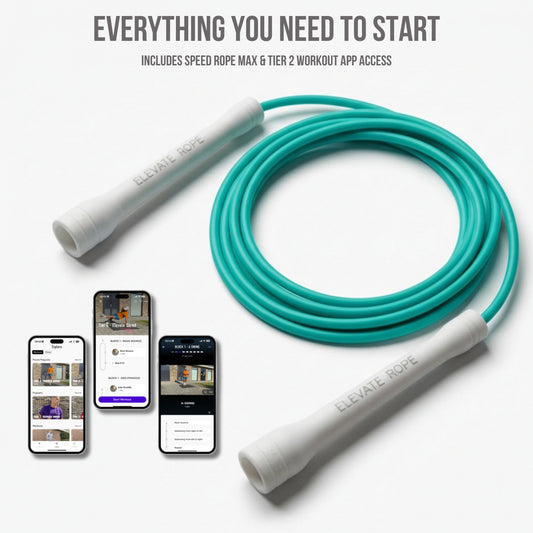
All three routines are available for free in the Elevate Rope App, which includes guided audio coaching, a workout timer, and progress tracking.
→ Download the Free Elevate Rope App
The 30-Day Jump Rope Weight Loss Plan
Consistency is the single biggest predictor of jump rope weight loss success. Not intensity. Not duration. Consistency. This 30-day plan builds gradually so your body adapts without burnout or injury.
| Week | Daily Volume | Workout | Focus |
| Week 1 | 10 min, 5 days | Workout A | Build rhythm, reduce tripping |
| Week 2 | 10 min, 5 days | Workout A | Increase consecutive jumps |
| Week 3 | 10 min, 5 days | Workout B | Add boxer step, push tempo |
| Week 4 | 12 min, 6 days | Workout B + C mix | HIIT intervals, max effort |
By the end of 30 days, most people see 2–4 kg of fat loss (combined with a moderate calorie deficit), improved cardiovascular endurance, and noticeably better coordination. More importantly, you'll have built a daily habit that sticks — because 10 minutes is a commitment you can keep.
Every broken fitness promise erodes your belief that you can follow through. Jump rope rebuilds that trust in 10-minute daily commitments. You said you'd do 10 minutes. You did 10 minutes. That cycle of kept promises compounds into genuine self-trust — and self-trust is what sustains weight loss long after motivation fades.
Want a guided version? The Elevate 26 Challenge provides daily structured workouts, accountability tracking, and a community of people doing it alongside you.
→ Join the Elevate 26 Challenge
Nutrition Basics for Maximizing Jump Rope Fat Loss
Exercise alone rarely produces dramatic weight loss. Jump rope weight loss accelerates when paired with a sensible nutrition approach — not a restrictive diet, but a sustainable calorie deficit.
A calorie deficit means consuming fewer calories than your body burns each day. For sustainable fat loss, aim for a daily deficit of 300–500 calories from food. Combined with 10 minutes of daily jump rope (burning 150–200 calories), your total daily deficit approaches 450–700 calories. That's enough for steady, visible results without the hunger, irritability, and muscle loss that crash diets produce.
Prioritize protein. Aim for 1.6–2.0 g per kilogram of body weight daily. Protein preserves muscle while you lose fat and keeps you feeling full longer, reducing the urge to snack between meals.
Hydrate around sessions. Jumping rope produces significant sweat. Drink 500 ml of water 30 minutes before your workout and another 500 ml within an hour after. Dehydration impairs performance and recovery.
Time your meals. Avoid jumping on a full stomach. A light snack — banana, handful of nuts — 60–90 minutes before your session provides energy without discomfort.
Track progress weekly, not daily. Body weight fluctuates based on water retention, sleep, stress, and hormonal cycles. Weigh yourself once per week, at the same time, under the same conditions. Weekly trends tell you whether your approach is working. Daily fluctuations tell you nothing useful.
Real Jump Rope Weight Loss Transformations
Data is compelling. But nothing proves that skipping rope weight loss works like real results from real people.
Kathy — Lost 45 kg (100 lbs)
"I knew after the first week that jumping rope was something I could really stick with. It was fun, it was challenging, and I was seeing results. I started with a beaded rope because I tripped constantly with a regular one. The feedback from the beads taught me the rhythm. Within six months, I had lost 45 kg and moved on to a speed rope for HIIT sessions."
Marco — Lost 12 kg in 90 Days
"I cancelled my gym membership after three months of not going. A friend suggested jump rope. I thought it was a joke — until I tried 10 minutes and was completely gassed. I followed a 30-day plan, bought an Elevate Rope bundle, and lost 12 kg in three months. The best part? I actually look forward to my daily session."
Sarah — Lost 8 kg as a Busy Mum
"With two kids under five, I had zero time for the gym. My jump rope sits by the back door. I do 10 minutes while the kids eat breakfast. It's not glamorous, but I've lost 8 kg in four months and I feel like myself again. The Elevate App workouts keep things interesting — I never do the same routine twice."
Answer Block: Real Results
Short answer: Real people lose 2–4 kg per month with consistent 10-minute daily jump rope sessions combined with moderate nutrition changes. Larger transformations (12–45+ kg) happen over 3–12 months.
Why it matters: Seeing results from people with similar starting points — busy schedules, no gym access, previous failures with other exercise — proves that jump rope weight loss works outside laboratory conditions.
Best next step: Take a "before" photo and record your starting weight. Commit to the 30-day plan above. Revisit both at day 30.
Common Mistakes That Sabotage Jump Rope Weight Loss
Going too hard too soon. The instinct is to jump fast and push intensity from day one. This leads to frequent tripping, frustration, and quitting. Start slower than feels productive. Build rhythm before building speed. The calorie burn comes from consistency across weeks, not from destroying yourself on day one.
Using the wrong rope. Cheap ropes with stiff cables, kinked sections, or uneven weight distribution make learning unnecessarily difficult. Ultralight ropes designed for speed records provide insufficient feedback for beginners. Invest in a quality rope with enough weight to track position — it accelerates the learning curve significantly.
Jumping too high. One to two inches of clearance is sufficient. The rope needs barely enough space to pass beneath your feet. Higher jumps waste energy, increase landing impact, and disrupt rhythm. Watch skilled jumpers — their feet hardly leave the ground.
Wrong rope length. Stand on the centre of the rope with one foot. The handles should reach your armpits. A rope that's too long requires exaggerated arm movements and slaps the ground. Too short and you're fighting for clearance. Most quality ropes are adjustable — take time to dial in the length before your first session.
Expecting instant results. Fat loss happens through accumulated deficits over weeks, not from a single session. The scale might not move in week one. Your body is adapting — building coordination, improving cardiovascular capacity, establishing the habit. Trust the process. The results follow the consistency.

Frequently Asked Questions
How long should I jump rope to lose weight?
Ten minutes per day, five days per week is enough for most beginners to see results within 30 days. As your fitness improves, increase to 15–20 minutes or add a second daily session. You don't need hour-long sessions — the efficiency of jump rope means shorter durations produce substantial results.
Is jump rope better than running for weight loss?
Jump rope burns 15–20 calories per minute compared to running's 10–12 calories per minute at moderate intensity. Jumping rope also produces significantly less joint impact than running — a 2019 study in the Gait & Posture Journal found that properly performed jump rope creates less knee stress than running. For time efficiency and joint health, jump rope has a clear advantage.
Can I lose belly fat by jumping rope?
You can't spot-reduce fat from any specific body area. However, jump rope creates a high calorie deficit that reduces overall body fat, including abdominal fat. Combined with the core engagement that happens during every jump, it's one of the most effective exercises for reducing waist circumference over time.
What type of jump rope is best for weight loss?
For beginners, a beaded rope provides rhythm feedback that prevents tripping. For intermediate jumpers, a speed rope enables HIIT intervals that maximize calorie burn. For advanced users, a weighted rope or heavy rope adds resistance for strength-cardio hybrid training.
Is 10 minutes of jump rope enough exercise?
Yes. Research from Arizona State University confirms that 10 minutes of jump rope produces cardiovascular benefits equivalent to 30 minutes of jogging. For weight loss specifically, 10 minutes burns 150–200 calories depending on body weight and intensity — enough to create a meaningful daily deficit when combined with moderate nutrition changes.
How many calories does 1,000 jump ropes burn?
At a moderate pace, 1,000 jumps takes approximately 10–12 minutes and burns 150–200 calories for a 70 kg person. Heavier individuals burn more. Using a weighted rope increases the burn by 15–25%.
Can beginners lose weight with jump rope?
Absolutely. The beginner workouts in this guide start with just 30 seconds of jumping followed by 30 seconds of rest. The goal is to build consistency, not intensity. A beaded rope makes learning significantly easier because you can hear and feel the rope's rhythm — which is why it's included in Elevate Rope's beginner bundles.
Do I need a special surface to jump rope?
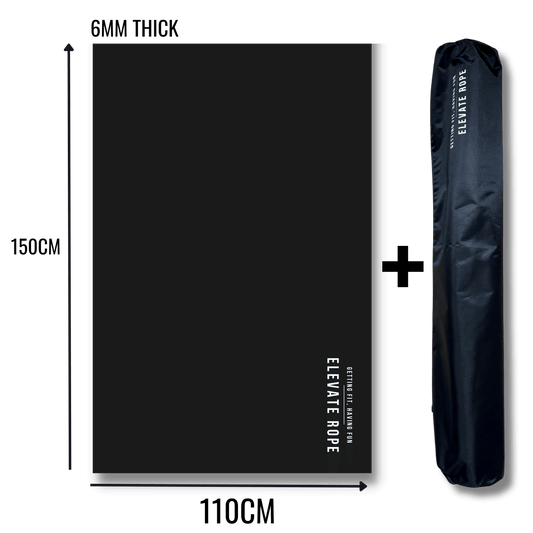
A flat, firm surface works best. Rubber mats, gym floors, short grass, and concrete are all suitable. Avoid deep carpet or uneven ground. You need roughly 2 metres by 1 metre of space with adequate ceiling height. If you're jumping on hard surfaces regularly, consider a dedicated jump rope mat for cushioning.
Start Your Jump Rope Weight Loss Journey Today
Jump rope weight loss isn't a gimmick or a trend. It's a science-backed, time-efficient, and genuinely enjoyable way to burn fat — whether you have 10 minutes or 30. The data shows it, the transformation stories prove it, and the only thing missing is your first session.
The coordination comes faster than you expect. The conditioning benefits accumulate faster than traditional cardio delivers them. The visible changes appear within weeks, not months. All from a tool that costs less than a month of gym membership and fits in a bag.
Start simple. One rope. Ten minutes. Tomorrow morning.
Next Steps
If you're new to jump rope, start with a beginner-friendly routine that builds skill while developing conditioning. Five to ten minutes daily for two weeks establishes the foundation everything else builds on.
If you're ready to choose equipment matched to your goals, understanding the differences between rope types prevents wasted money and frustration:
→ How to choose the right jump rope for your goals
If conditioning and fast calorie burn are your priority, a quality speed rope delivers efficient cardio without upper body fatigue.
If you're a complete beginner who wants to learn without frustration, a beaded rope provides the feedback that makes the learning curve dramatically shorter.
If you want everything in one kit — ropes, app access, nutrition guidance — a bundle gets you started with a clear progression path.
Sources to Cite
1. Arizona State University Study (John A. Baker) — Research demonstrating cardiovascular equivalence between 10 minutes of jump rope and 30 minutes of jogging
2. Gait & Posture Journal (2019) — Comparative analysis of joint loading between jump rope and running, finding lower knee stress with proper rope technique
3. NIH / PMC — Bounce Rope-Skip vs Run & Walk — Research describing jump rope as "hip and knee joint-protective" due to lower joint loads compared to running
4. CNN — Jump Rope Fitness Trend — Coverage featuring Elevate Rope founder Geraldo Alken and the Arizona State University calorie equivalence findings
5. PubMed — Comparative Training Responses to Rope Skipping and Jogging — Study comparing physiological adaptations to six-week programs of jogging and rope skipping
6. Jump Rope Dudes — Jump Rope vs Running — Detailed breakdown of the Baker study and calorie burn comparisons between jump rope and running
You May Also Like
→ Jump Rope Calories Burned: The Complete Guide to How Many Calories You Actually Burn
→ How to Lose Weight Without Running: 7 Proven Cardio Alternatives
→ Best Jump Rope for Weight Loss: A Complete Buyer's Guide (2026)
→ Jump Rope vs Running for Weight Loss: Which Burns More Fat?
→ Jump Rope HIIT Workouts for Fat Loss: 5 Routines That Actually Work
→ Jump Rope Transformation: Real Results From Real People (Before & After)