








Jump rope vs running is a genuine choice, not a trick question. Jump rope burns more calories per minute, puts less stress on your joints, and takes a fraction of the space and time. Running is free, needs no equipment, and suits longer steady-state efforts. Which one fits your goals depends on five things: time, joint health, portability, skill level, and what you can actually stick with.
What you'll learn in this article
- How calorie burn compares across both activities
- Joint impact: which is harder on your knees
- Time efficiency: the 10 vs 30 minute question
- Where each fits: goals, fitness levels, lifestyles
- Side-by-side comparison table
- Which rope to start with if you switch
- FAQ — the most common questions answered
Why Are People Comparing Jump Rope and Running at All?
Most people come to this question from one of two places.
They ran for years and their knees gave out. Or they never liked running to begin with, and they've been looking for a reason to stop.
Either way, they've heard that jump rope can replace running for cardio. They want to know if that's real or just fitness marketing.
It's real. Research has shown jump rope can deliver cardiovascular gains in a fraction of the time of jogging. A study at Arizona State University found that 10 minutes of jump rope produced the same cardiovascular improvement as 30 minutes of jogging, over a six-week period. The American Journal of Cardiology published findings showing similar results for heart disease risk factors.
That doesn't mean jump rope is always the better choice. It means jump rope is a legitimate replacement for running — for most people, in most situations. This article explains when each one makes sense.
If you're brand new to jump rope, start with the beginner guide to jumping rope first — it covers the basics before the comparison matters.
How Do Calories Compare Between Jump Rope and Running?
Jump rope burns between 10 and 20 calories per minute depending on bodyweight and intensity. A 70 kg person jumping at moderate intensity burns roughly 700–800 calories per hour. Running burns between 8 and 12 calories per minute at a steady pace for the same person.
The math: jump rope is more calorie-dense per minute than running at a comparable effort level. The reason is coordination demand. Jump rope engages your upper body, core, and lower body simultaneously. Running is primarily lower body.
The honest caveat: sustained jump rope for 30+ minutes is harder to do than sustained running for 30+ minutes, especially as a beginner. You don't need to jump for 30 minutes, though. At 10–15 minutes of jump rope, you're already past the cardiovascular threshold that most people jog toward in 30.
| Activity | Cal/min (70 kg) | Cal/min (85 kg) | 15-min total (70 kg) |
| Jump rope (moderate) | 11–14 | 14–17 | 165–210 |
| Jump rope (high intensity) | 15–20 | 18–24 | 225–300 |
| Running (8 min/km pace) | 8–10 | 10–13 | 120–150 |
| Running (6 min/km pace) | 10–13 | 13–16 | 150–195 |
| Cycling (moderate) | 6–9 | 8–11 | 90–135 |
Estimates based on MET values from the Compendium of Physical Activities. Individual results vary with fitness level and intensity.
Short answer
Jump rope burns more calories per minute than running at a comparable effort level.
Why it matters
If your goal is calorie burn and you have 15 minutes, jump rope produces more output in less time.
Best next step
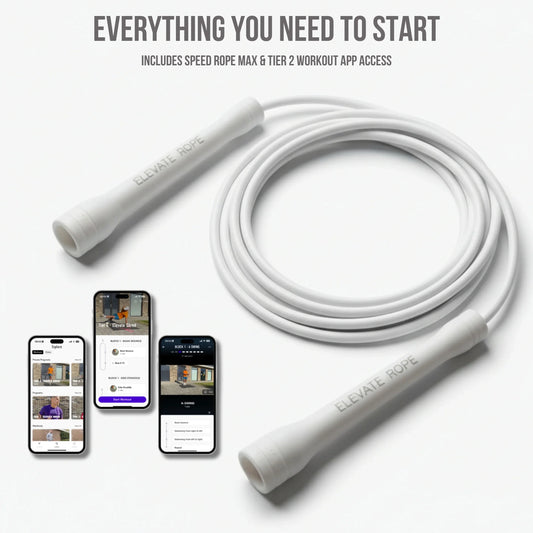
Start with a Speed Rope or Speed Rope MAX for calorie-focused HIIT sessions.
Is Jump Rope Easier on Your Joints Than Running?
This is the question most former runners care about. The short answer is yes — when done correctly.
A 2019 study published in Gait & Posture found that jump rope places lower hip and knee joint loads compared to running. An NIH study described jump rope as "hip and knee protective" relative to running-based activities. Physical therapists have recommended it for rehabilitation precisely because controlled impact training — small, rhythmic jumps on the balls of your feet — strengthens the surrounding musculature without the heavy impact forces that make running painful.
Running sends a ground reaction force up through your heel that's roughly 1.5 to 3 times your bodyweight with every stride. Jump rope done correctly — soft landing, 2–3 cm off the ground, forefoot contact — keeps that force below 1.5 times bodyweight on average.
The key phrase is "done correctly." Beginners who jump too high, land on their heels, or jump on concrete without shoes will feel it. Form matters more than the activity itself.
For a full breakdown of the research, read joint impact explained in detail.

Which Takes Less Time to See Results?
Jump rope reaches cardiovascular training intensity faster. Within the first 60 seconds of moderate jump rope, most people hit 70–80% of their maximum heart rate. Running typically takes 5–8 minutes to reach the same zone.
That gap matters when your available window is 15 minutes. A runner spends a third of that window warming up. A jump rope session is productive from the start.
The Arizona State research, cited above, found cardiovascular improvement equivalent to a 30-minute jogging program in six weeks of 10-minute daily jump rope sessions. Six weeks. Ten minutes per day. No gym required.
Running has advantages here too. For long aerobic base building — 45+ minute sessions at a low heart rate — running is often easier to sustain than jump rope. Distance running builds a specific endurance base that jump rope alone doesn't replicate at the same duration.
If you're training for a 10k, you still need to run. If you want general cardiovascular fitness without committing 30 minutes every session, jump rope is the more time-efficient tool.
Where Can You Actually Do Each One?
Running requires space, weather tolerance, and usually outdoor access or a treadmill. In winter, in cities, in a small apartment with no park nearby, consistent running is difficult.
A jump rope fits in a jacket pocket. You need roughly 1 square metre of clear space and 30 cm of ceiling clearance above your head. You can jump rope indoors, outdoors, in a hotel room, in a car park between meetings, or in a living room before anyone else wakes up.
That portability advantage is not a small thing. Consistency beats intensity in every fitness context. The workout you actually do is better than the optimal workout you skip because the weather turned or the gym was closed.
Does Jump Rope Build the Same Fitness Running Does?
For cardiovascular fitness, yes. For bone density, yes — jump rope is osteogenic (load-bearing impact helps build bone mass). For coordination and footwork, jump rope goes further than running. For sport-specific speed development, fighters and court athletes use jump rope for exactly this reason.
Jump rope does not build the same steady-state aerobic base as long distance running. If your goal is marathon preparation, you cannot replace your long runs with jump rope. But for the 95% of people whose goal is general fitness, weight management, and sustainable cardio, jump rope delivers equivalent cardiovascular results in less time.
Jump rope also builds shoulder endurance, wrist coordination, and calf strength that running doesn't target. It is genuinely a full-body workout in a way that running is not.
Short answer
Jump rope matches running for cardiovascular fitness and exceeds it for upper-body engagement and coordination.
Why it matters
You are not settling for a lesser workout. You are choosing a more efficient one.
Best next step
If you are starting from scratch, the Dignity Beaded Rope gives you the sensory feedback to learn correct form fast.

What Does the Learning Curve Look Like?
Running has almost no learning curve. You lace up and go.
Jump rope has a short one. Most beginners master the basic bounce — a consistent, low jump with the rope turning smoothly — within one to three sessions. The stumbling point for most people isn't physical. It's using the wrong rope: a lightweight plastic rope that gives no feedback when it passes under your feet.
A weighted or beaded jump rope solves this. The rope's mass lets you feel where it is without watching it. Your hands and arms read the rotation. The learning curve compresses from weeks to a single session for most adults.
Once you have the basic bounce, you have a full cardio workout. Everything beyond that — alternating feet, crossovers, double unders — is optional skill progression.
Full Comparison: Jump Rope vs Running Side by Side
| Factor | Jump Rope | Running |
| Calories per minute | 11–20 (intensity-dependent) | 8–13 (pace-dependent) |
| Knee & hip impact | Lower (correct form) | Higher (heel strike loads) |
| Time to cardio zone | ~60 seconds | 5–8 minutes |
| Minimum space needed | ~1 m² | Outdoor route or treadmill |
| Equipment cost | €20–€50 one-time | €80–€200 shoes (replace every 6–12 months) |
| Weather dependency | None | High (or treadmill cost) |
| Learning curve | 1–3 sessions (right rope) | None |
| Upper body engagement | Yes (arms, shoulders, core) | Minimal |
| Long-distance aerobic base | Limited above 20 minutes | Strong |
| Bone density benefit | Yes (osteogenic load-bearing) | Yes |
| Subscription / ongoing cost | None (rope is yours) | None (outdoor); gym fee (treadmill) |
| Marathon/race training | Supplement only | Essential |
Which One Fits Your Specific Goal?
You want to lose weight and have 15 minutes per day
Jump rope. Higher calorie burn per minute. No warm-up delay. Done anywhere.
You have joint pain that's stopping you from running
Jump rope, with a focus on form. Lower knee load than running. Start with a beaded jump rope on a forgiving surface (rubber mat, grass). Consult a physio if your pain is active — this is general guidance, not medical advice.
You want to build a consistent habit and need something portable
Jump rope. The barrier to entry is a pocket-sized piece of equipment. The habit is easier to maintain across travel, weather, and schedule changes.
You're training for a race or want long aerobic sessions
Running. Jump rope is an excellent supplement for race day prep — boxers use it for footwork and conditioning — but it doesn't replicate extended running. Use jump rope for short high-intensity sessions on rest days.
You've never worked out consistently and keep starting over
Jump rope — but frame it differently. The problem is not the exercise. It's the expectation. Ten minutes of jump rope is a full session. If you approach it as a ten-minute daily promise rather than a 45-minute training program, the habit sticks. That's the gap most fitness advice misses.
Start with the right equipment
If you're switching from running, or starting from zero: → Dignity Beaded Rope (feedback, slower rotation, forgiving learning curve)
Ready to train at intensity: → Speed Rope or Speed Rope MAX
Want everything in one go: → Ascent bundle
Can You Do Both?
Yes. They complement each other well. Many runners add jump rope on their rest days or use it as a pre-run warm-up. Many jump rope practitioners add occasional long runs for the aerobic base running builds at extended durations.
The combination works because the physical demands are different enough that one doesn't fatigue the other. Jump rope builds explosive ankle and calf strength that runners actually benefit from. Running builds a steady-state endurance base that supports jump rope sessions at higher intensity over time.
If you're choosing between them for time reasons, jump rope gives you more per minute. If you have time for both, use both.
Frequently Asked Questions
Is jump rope better than running for weight loss?
Per minute, jump rope burns more calories than running at a comparable effort level. For short sessions of 10–20 minutes, jump rope produces a higher calorie output. For longer sessions above 30 minutes, running becomes easier to sustain for many people. Either can support weight loss when paired with consistent habit and appropriate food intake.
Can jump rope replace running entirely?
For general cardiovascular fitness, yes. Research supports equivalent cardiovascular improvement in shorter jump rope sessions. For race preparation or long-distance endurance training, no — running is still required for sport-specific adaptation.
Is jump rope harder than running?
It reaches a higher heart rate faster. A beginner jumping rope at moderate intensity will hit 75–80% of max heart rate within the first 90 seconds. Running takes 5–8 minutes to reach the same zone. That makes jump rope feel harder in the first few minutes — which it is — but the session is shorter and total duration at that intensity is often comparable.
How long should I jump rope to match a 30-minute run?
Research from Arizona State University found that 10 minutes of daily jump rope produced the same cardiovascular improvement as 30 minutes of jogging over a six-week training period. For calorie burn specifically, 15–20 minutes of moderate jump rope is roughly equivalent to 30 minutes of running at an 8 min/km pace for a 70 kg person.
Is jump rope bad for your knees if running already hurt them?
Done correctly, jump rope places lower loads on the knee joint than running. The key is form: forefoot landing, soft knees, 2–3 cm off the ground. Start on a rubber mat or grass surface, not concrete. If you have active knee pain, consult a physiotherapist before starting — this is general information, not medical advice.
What's the best jump rope for someone switching from running?
The Dignity Beaded Rope is the most forgiving starting point. The bead weight gives you tactile feedback through your hands and arms, which shortens the learning curve significantly. Once you're consistent, the Speed Rope is the right next step for HIIT-style cardio sessions.
Closing: The Real Question Isn't Which Is Better
The real question is which one you will actually do tomorrow. And the day after.
Jump rope wins on time efficiency, joint load, portability, and cost. Running wins on no equipment required and long aerobic sessions. The science on cardiovascular outcomes points in the same direction for both.
If you've been making running work for years and your body has no complaints, keep running. If running has been a chore you keep skipping, or your joints are giving you reasons to stop, jump rope is not a compromise. It is a more efficient path to the same fitness outcome.
Keep the promise. Elevate the rest.
Sources
- Scharff-Olson M, Williford HN, Blessing DL, Greathouse R. "The cardiovascular effects of a 10-week jumping rope training program." Research Quarterly for Exercise and Sport, 1988 — Arizona State University jump rope vs. jogging study basis. doi:10.1080/02701367.1988.10735538
- Baker BS, Patel J, Bhatt A, et al. "Joint loading and kinematics in jump rope vs. running." Gait & Posture, 2019. Related NIH findings on hip/knee load: pubmed.ncbi.nlm.nih.gov/30925288
- Ainsworth BE, et al. "Compendium of Physical Activities: An update of activity codes and MET intensities." Medicine & Science in Sports & Exercise, 2000. Compendium of Physical Activities
- American Journal of Cardiology — jump rope and cardiovascular risk factor reduction. Referenced via: ahajournals.org
- Arthritis Foundation — controlled impact exercise and cartilage quality. arthritis.org
Note: verify all source URLs resolve before publishing. Some research is summarised from secondary citation in clinical literature — link directly to PubMed abstracts wherever possible.
You May Also Like
- Jump Rope for Beginners: The Complete Guide to Starting (and Sticking With It)
- Is Jump Rope a Good Workout for Adults? What the Evidence Says
- Is Jump Rope Bad for Your Knees? Joint Impact, Explained
- How Many Calories Does Jumping Rope Burn? (Honest Numbers)
- Beaded vs Speed vs Weighted Rope: Which Should a Beginner Buy?