






A family jump rope challenge 30 days long is one of the rare home routines that actually survives the second week, because it does not ask anyone to wake up earlier, drive anywhere, or block off an hour. Ten minutes after dinner. One rope passed between three people. A wall calendar with a tick mark for every day someone in the household showed up. That is the entire structure, and it works because it is small enough that the busiest parent and the most reluctant child can both clear the bar.
The trouble with most family fitness plans is that they treat parents and children as separate problems. The parent needs cardio, so they go to the gym. The child needs movement, so they get signed up for a sport club on Wednesdays. Two schedules. Two costs. Zero shared time. By the third week of January, the gym membership has been used twice and the child has decided football is boring. The household is back where it started, only with more guilt.
A 30-day challenge built around one rope and one decision a day removes both problems at once. Below is the full structure, the daily plan, the science that explains why 30 days is enough to change something real, and the small choices that make the difference between a challenge that finishes on day 7 and one that finishes on day 30.
What you'll learn in this guideWhy 30 days is the right length for a family challenge (and what the research actually shows about habit formation)The exact daily structure, week by week, that works for a household with mixed ages and fitness levelsHow to handle the four moments that kill most family challenges (and how to design around them)The single rope that adjusts from a 6-year-old to an adult, so the whole family shares one piece of equipmentHow to track progress without making it feel like schoolWhat to do on day 31, when the challenge ends and the habit is supposed to begin
Why a 30-day jump rope challenge works for families
The popular wisdom that habits form in 21 days has been thoroughly disproven. A 2010 study by Phillippa Lally and colleagues at University College London tracked 96 people forming new daily habits and found the average time to reach automaticity was 66 days, with a range from 18 to 254 days depending on the person and the behaviour. The takeaway most articles miss is buried in the same paper: early repetitions produce the biggest gains in automaticity. The first 30 days do most of the work of breaking the inertia, even if the habit is not fully wired yet.
That is exactly what a 30-day family jump rope challenge is designed to do. It is not a finishing line. It is the bridge between deciding to be an active family and becoming one. The 30 days establish the cue, the action, and the reward in a way that day 31, 60, and 90 build on naturally. Miss a day in the middle of the challenge and the data show you have not undone anything. Lally's research found that a single missed day does not materially affect habit formation. What matters is that you start again the next day, not that you never miss.
Why jump rope is the right tool for a family-level habit
Jump rope is one of the few activities a 6-year-old, a 12-year-old, and a 40-year-old can do in the same six square metres of garden, garage, or living room. The same rope, adjusted in 60 seconds, sizes for all of them. The skill ceiling is high enough that everyone has somewhere to progress. The skill floor is low enough that the first session takes 20 seconds to learn.
The portability matters more than it sounds. A family jump rope challenge does not collapse when the weather turns. It does not collapse when one parent is travelling for work and the other has the kids alone. It does not collapse on Sunday night when the planning energy is gone. The rope is in the same drawer it was in yesterday, and the only decision required is whether to pick it up.
Research published in the journal Children in 2020 followed adolescents through a 12-week jump rope-based after-school programme and recorded measurable gains in cardiorespiratory fitness, muscular endurance, and lower-body power. Crucially, the structured short-format sessions produced compliance rates much higher than longer or more complex programmes. Short, repeatable, and shared is the format that survives.
Short answer: A 30-day family jump rope challenge works because it pairs the shortest viable daily commitment (10 minutes) with the lowest possible equipment barrier (one shared rope), at a length proven by research to produce meaningful automaticity gains without requiring perfect adherence.
Why it matters: Family fitness plans fail because they ask too much of busy parents and too little of disengaged children. A 30-day structure with one rope reverses that. It asks 10 minutes of everyone and gives every age something to work toward.
Best next step: Pick the start date. Sunday is the most common choice because Monday morning gives the first session a clear cue. Anchor the rope to a fixed time, such as right after dinner or right before bath time, and the rest follows

The 30-day plan, week by week
The structure below is built for households where at least one adult and one child are participating. It scales up to two adults and three children, and scales down to one parent and one child. The session is always 10 minutes. What changes is the work-to-rest ratio and the moves used. Children under 8 should do half-time intervals and stop when tired. There is no medal for pushing a 6-year-old through a full Tabata.
Week 1: Foundation (days 1 to 7)
The job of week 1 is to make sure everyone in the household can complete a basic bounce for 30 seconds without tripping. That is the entire technical goal. Anyone who lands week 1 having done 7 sessions of 30 seconds on, 30 seconds off, for five rounds, is exactly where they need to be. The beaded rope is essential here. The audible tick of the bead hitting the floor gives every member of the family the rhythm reference they need to find their timing. Silent ropes punish beginners by leaving them to guess.
Children who have never jumped rope before will trip a lot in the first three days. That is not failure. That is the nervous system learning a new skill. By day 5, most children will land their first 10 consecutive bounces, and the change in their face when it happens is the entire reason this challenge works.
Week 2: Build (days 8 to 14)
Now the work-to-rest ratio shifts to 40 seconds on, 20 seconds off, for 8 rounds. The basic bounce is still the main move, but you can start introducing the alternate-foot step, which is the jump rope version of jogging in place. For children, this is also the week to introduce one small game. The most reliable one is the basic bounce count, where everyone goes for a personal best on consecutive bounces and announces the number at the end. No competition between family members. Just everyone trying to beat their own previous number.
Day 14 is the midpoint, and it is the day the most people stop. The novelty has worn off and the results are not yet visible. The fix is not motivation. The fix is to make sure the rope is somewhere visible, the time is anchored to an existing routine, and the streak is being tracked somewhere everyone can see. The wall calendar with a tick for every day works better than a phone app, because the parent sees it every time they walk past it.
Week 3: Variety (days 15 to 21)
Week 3 introduces variety to prevent the rhythm from becoming repetitive. The session is still 10 minutes. The structure shifts to four 2-minute blocks with 30 seconds of rest between them. Each block is a different move: basic bounce, alternate-foot step, side-to-side hops, and high knees. For households with younger children, drop high knees and replace with bell jumps (forward and back) which are easier on developing knees.
This is also the week to introduce a family score. The simplest version is total consecutive bounces by the household across the week. Everyone contributes. The number on Sunday night becomes the target to beat in week 4. Children find this format motivating because their contribution counts equally with the adults, which is rare in family activities.
Week 4: Performance (days 22 to 30)
The last 9 days extend the session structure to 50 seconds on, 10 seconds off, for 10 rounds. By now the family has roughly 200 minutes of cumulative rope time and the conditioning is real. Children can usually link 30 consecutive bounces. Adults can usually sustain 90 seconds of continuous jumping. The technical foundation is in place for whatever comes next, whether that is the structured Elevate26 challenge, the introduction of a second rope for variety, or the simple decision to keep going at 10 minutes a day indefinitely.
Day 30 should not be an ending. It should be a checkpoint with a small celebration. A family photo with the rope. A new number written on the calendar. A simple acknowledgment that for 30 days the household decided to move together, and that decision can be made again tomorrow.
| Week | Work / Rest | Rounds | Main moves | Goal |
| Week 1: Foundation | 30 sec on / 30 sec off | 5 rounds | Basic bounce only | 30 consecutive bounces by day 7 |
| Week 2: Build | 40 sec on / 20 sec off | 8 rounds | Basic bounce, alternate-foot step | Personal best on consecutive bounces |
| Week 3: Variety | 2 min blocks / 30 sec rest | 4 blocks | Basic, alternate-foot, side-to-side, high knees | Family total bounces, weekly |
| Week 4: Performance | 50 sec on / 10 sec off | 10 rounds | Mix and match all moves | Sustain 90 sec continuous jumping |

The four moments that kill most family challenges (and how to design around them)
Every family challenge fails for one of four predictable reasons. None of them are about motivation. All of them are about design.
Moment 1: The unanchored start
A challenge that begins on "whenever we feel like it" ends on day 2. The fix is to anchor the daily rope session to an existing fixed routine. After dinner. Before bath. Right when the youngest gets home from school. The anchor has to already exist in the day. You are not adding a new slot. You are bolting jumping rope onto a slot that already happens.
Moment 2: The first week of resistance from a child
Some children are immediately enthusiastic. Others fight the rope for the first three sessions because tripping feels embarrassing. The design fix is to let them watch the parent fail first. The parent intentionally trips on the first round, laughs, and keeps going. This signals to the child that tripping is part of the activity, not evidence of incompetence. The auditory feedback of the Dignity Beaded Rope compounds the effect because the child can hear when they are about to step in, before they actually trip, and self-correct. Confidence research on children's physical skill acquisition shows that visible mastery in short progressions is one of the strongest predictors of continued engagement.
Moment 3: The travelling parent
One parent goes away for three days. The challenge collapses because the household momentum was built around that parent's involvement. The design fix is to make sure the rope works without the absent person. The challenge belongs to whoever picks up the rope that day, not to the household as a unit. A child who jumps rope while one parent is in another city is the child who has internalised the habit. That is the win.
Moment 4: The plateau at day 14
Two weeks in, the novelty is gone and the results are not yet visible. This is when most challenges quietly stop. The design fix is to put a visible streak somewhere in the kitchen. A piece of paper with 30 boxes. Each day everyone in the household who jumped that day puts their initial in the box. The streak becomes the engine. The rope is the tool. The streak is what pulls the family through day 14 to day 21.
Short answer: Family challenges fail because of design flaws, not motivation problems. Anchor the session to an existing routine, normalise tripping in front of children, make the streak survive a missing parent, and put the tracking somewhere everyone sees every day.
Why it matters: Most parents blame themselves when a family fitness plan dies. The truth is the plan was designed to die. Fix the design and the plan survives without requiring more willpower.
Best next step: Before day 1, decide the anchor time, print the 30-day calendar, and tape it somewhere central. The next time the rope ends up in a drawer instead of on the wall hook, the challenge has already started losing.

One rope, the whole family
Most jump rope challenges fail at the equipment stage. Parents buy three different cheap ropes from a supermarket, one is too short for the adult, one is too long for the 7-year-old, and the third tangles within a week. The challenge dies because the equipment was wrong.
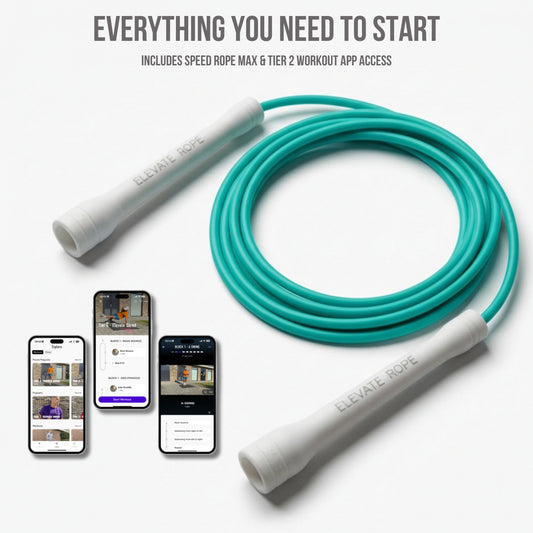
The fix is one adjustable rope that sizes from a small child to a tall adult in sixty seconds. The 3-metre adjustable Dignity Beaded Rope covers a height range from roughly 110 cm to over 200 cm. A 6-year-old, an 11-year-old, and a 180 cm parent all use the same rope. The rope is adjusted by sliding the beads, not by cutting wire, which means it goes back and forth between users in the time it takes to switch turns.
The other piece worth considering is a small mat for indoor sessions, especially in apartments or houses with neighbours below. The Jump Rope Mat absorbs impact and reduces noise to a level that does not become an argument with the people downstairs. For households planning to do most of the challenge indoors, the mat is the second purchase that matters.
The complete family setup, rope plus mat plus the free Elevate App for follow-along sessions, comes in at well under what a single child would pay for a sports club term. For comparison, the average sport club in the Netherlands, Germany, Belgium, or France runs 200 to 400 euros per child per year for two sessions a week. The family rope setup is a one-time purchase that covers every member of the household, indefinitely, with a lifetime warranty on the handles. The economics make the family challenge a serious alternative, not a supplementary one. The Ascent Bundle is the package most families end up choosing for this reason, because it includes the beaded rope alongside a speed rope for the parent who eventually wants more intensity.

How to track the challenge without making it feel like school
The tracking system has to be visible, fast, and shared. A complicated app that one parent has to manage will not last past day 10. The systems that survive 30 days are almost always low-tech.
The single most reliable tracker is a piece of A4 paper with a 30-box grid, taped to the fridge or the inside of a kitchen cupboard. Each box gets the initial of every household member who jumped that day. That is the entire system. The visible streak does the work. Children look forward to writing their initial in the box. Parents see the gaps when someone misses and know to ask gently the next day.
The second layer, optional, is a number. Total household bounces for the week. Each Sunday everyone adds their best round and the family writes the total under that week's row. The number does not matter in any absolute sense. What matters is that it goes up, and that children see their contribution counts equally with the adults. The Elevate App can run timers and play audio cues for the rounds, but the tracking should stay on the wall where everyone walks past it.
The third layer, for households that enjoy it, is a small ritual on Sunday evening. The rope sessions for the week are complete. Someone announces the weekly total. Whoever set a personal best that week names it. Three minutes. Done. The ritual costs nothing in time but creates a memory marker that anchors the habit in family identity rather than individual discipline.

What happens on day 31
The challenge ends on day 30. The decision starts on day 31. The data from habit formation research is clear: 30 days creates significant automaticity gains, but it does not create full automaticity. The 30-day mark is the natural moment to choose what the routine becomes next.
Three options work well. The first is to repeat the challenge with new variables: same 10 minutes, but introduce one new move every week, or shift to a different time of day, or add a Sunday family game session. The second is to graduate into the structured Elevate26 programme, which provides a 26-day daily progression with follow-along video sessions for parents who want more variety and structure. The third is to keep the same 10-minute slot but stop counting. The rope simply becomes what the family does after dinner. No tracking. No challenge. Just the activity, which is the actual goal.
For children, day 31 is also the moment to introduce the next skill milestone. Most children who complete 30 days are technically ready to attempt their first criss-cross, or their first faster speed rope rotation. The skill progression keeps the activity interesting, and the visible learning curve is what keeps the child engaged through the months that follow. The deeper guide to that progression is in our guide to building confidence in children through jump rope, which covers how visible skill mastery wires self-efficacy in children aged 5 to 14.
One rope. Every age. 30 days that change a household.
The Dignity Beaded Rope adjusts from a 6-year-old to a 200 cm adult in 60 seconds. Audible tick for beginners. Durable for daily family use. Free app with follow-along sessions.

Frequently asked questions
How long should each session be in a family jump rope challenge 30 days plan?
Each daily session should be 10 minutes total, including a short warm-up. Within that, the work-to-rest ratio shifts week by week, starting at 30 seconds on and 30 seconds off in week 1 and progressing to 50 seconds on and 10 seconds off by week 4. Younger children should do half-time intervals and stop when tired.
What age can children join a family jump rope challenge?
Children from around age 5 or 6 can participate in a family jump rope challenge when the rope is correctly sized. Younger children can join the warm-up and the basic bounce attempts without expectation of completing full rounds. The adjustable beaded rope sizes down to roughly 110 cm of user height, which covers most children from age 5 onwards.
Can a family jump rope challenge replace sports for kids?
For most families, jump rope works as a complement to sport rather than a complete replacement. It develops the cardiovascular base, coordination, and bilateral motor skills that improve performance in almost every sport. Children who do 10 minutes of jump rope daily for 30 days typically show measurable gains in agility and endurance that transfer to football, basketball, athletics, and gymnastics.
Do we need different ropes for each family member?
No. A single 3-metre adjustable beaded rope sizes from a small child to a tall adult by sliding the beads along the cord. One rope per household is sufficient for the 30-day challenge. Some families add a second rope in week 3 or 4 to allow simultaneous jumping, but it is not required to complete the challenge.
How do we keep kids motivated for the full 30 days?
The two most reliable motivators are visible tracking and the family score. A 30-box grid taped to the fridge, where each household member writes their initial each day, creates a visible streak that pulls children through the middle weeks. A weekly family total of consecutive bounces, where everyone's contribution counts equally, gives children a sense that their participation matters to the household, which is rare in family activities.
What if we miss a day?
Missing one day does not derail the challenge. Habit formation research published in the European Journal of Social Psychology found that a single missed opportunity has no measurable effect on the development of automaticity, as long as the behaviour resumes the next day. The risk is missing two days in a row, which can start to break the pattern. If two days are missed, the response is simply to start again, not to restart from day 1.
Is jump rope safe for kids on hard floors?
Jump rope is safe on most surfaces for children when they wear supportive shoes and use a beaded or lightweight rope. Hard floors such as tile or concrete increase impact, which is why a small jump rope mat is recommended for indoor sessions, especially for children under 10. Outdoor surfaces like a garden lawn or a wooden deck are typically forgiving enough not to require a mat.
How does the 30-day family challenge connect to the Elevate26 programme?
The 30-day family challenge is the onramp. It builds the basic habit and the foundational fitness. The Elevate26 programme is the structured next step for households that want a guided 26-day progression with follow-along video sessions, more advanced workout formats, and a community of other participants. Many families run the family challenge first, then graduate one or both parents into Elevate26 in month 2.
Starting this week
The simplest version of the plan is the one most families end up using. Pick a start date this week. Tape a 30-box grid to the fridge tonight. Anchor the daily session to an existing routine such as after dinner or before bath. Order one adjustable beaded rope that covers every member of the household. Decide who will go first on day 1 and let them announce it at breakfast. That is the entire setup.
By day 7, the basic bounce will feel automatic for everyone. By day 14, the household will know whether the anchor time is the right one. By day 21, the streak will be the engine pulling the challenge forward. By day 30, the rope will be a piece of household equipment rather than a novelty, and the decision to keep going will feel like an obvious next step rather than a separate commitment.
For a deeper context on jump rope for children, including age guidance, rope sizing, and skill progression, see our pillar guide on jump rope for kids and the complete parent's guide. For parents specifically researching whether jump rope is the right family choice versus other sport options, the comparison piece on choosing the best jump rope for kids in 2026 walks through the buying decision in detail.
Sources
1. Lally P, van Jaarsveld CHM, Potts HWW, Wardle J. How are habits formed: Modelling habit formation in the real world. European Journal of Social Psychology, 2010, 40: 998-1009. https://onlinelibrary.wiley.com/doi/abs/10.1002/ejsp.674
2. University of Surrey. Does it really take 66 days to form a habit? We asked the expert, Dr Pippa Lally. 2026. https://www.surrey.ac.uk/news/does-it-really-take-66-days-form-habit-we-asked-expert-dr-pippa-lally
3. Chen C, Sun H, Lemon S, et al. Physical fitness promotion among adolescents: effects of a jump rope-based physical activity afterschool program. Children, 2020. https://pmc.ncbi.nlm.nih.gov/articles/PMC7463663/
4. World Health Organization. WHO Guidelines on Physical Activity and Sedentary Behaviour: Recommendations for Children and Adolescents. 2020. https://www.ncbi.nlm.nih.gov/books/NBK566046/
5. Guthold R, Stevens GA, Riley LM, Bull FC. Global trends in insufficient physical activity among adolescents: a pooled analysis of 298 population-based surveys with 1.6 million participants. The Lancet Child & Adolescent Health, 2020. https://www.ncbi.nlm.nih.gov/pmc/articles/PMC6919336/
6. Singh AS, et al. Are we underestimating the impact of COVID-19 on children's physical activity in Europe? European Journal of Public Health, 2022. https://www.ncbi.nlm.nih.gov/pmc/articles/PMC9159340/
7. Lally P, Gardner B. Promoting habit formation. Health Psychology Review, 2013. https://www.tandfonline.com/doi/abs/10.1080/17437199.2013.876551