


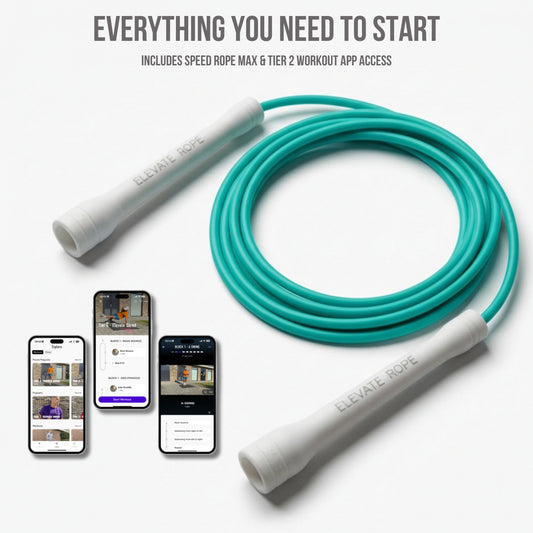




Exercise for mental health is real, but it is not a cure, and it is not a willpower test. On the days motivation is gone, the goal is not a workout. It is movement small enough to start. A jump rope, ten minutes, no plan required.
If you are new to all of this, our complete guide to starting (and sticking with it) covers the basics. This page is about the harder days — the ones where getting up feels like the workout.
What this covers
- Does exercise really help your mental health?
- Why motivation vanishes exactly when you need it
- How to use exercise for mental health without the pressure
- How much movement is actually "enough"
- When movement is not the answer
- FAQ
Does exercise really help your mental health?
Short answer: Yes — regular movement is linked to better mental health. But the research describes a tendency, not a guarantee.
The World Health Organization lists reduced symptoms of depression and anxiety among the benefits of regular physical activity.¹ A 2018 review of 49 studies, following more than 260,000 people, found higher activity linked to lower odds of developing depression.²
A separate study of 1.2 million adults tied exercise to about 1.5 fewer days of poor mental health each month.³ That is meaningful. It is also modest, and worth saying plainly.
None of this means a jump rope fixes a hard week. It means movement is one lever among several. Sleep, food, people, and professional care are the others. A jump rope is simply a low-cost lever you can reach on your own.
Why it matters: "Exercise cures low mood" sets you up to fail. The honest version is gentler — movement nudges the dial, and some days that nudge is enough.
Why does motivation vanish exactly when you need it?
Most advice assumes motivation comes first, then action. Usually it runs the other way. You move a little, and the wanting tends to show up afterward.
That is why "wait until you feel like it" rarely works on a flat day. The feeling is downstream of the doing. So the task is not to summon motivation. It is to lower the cost of starting until starting is almost free.
A jump rope helps here for a dull, practical reason. There is no commute, no class, no changing room, no audience. You pick up the jump rope, you do a minute, you stop if you want. The barrier is about as low as exercise gets.
Short answer: Motivation usually follows action, not the other way around.
Why it matters: It removes the guilt of "not feeling motivated enough."
Best next step: Shrink the first step until it is too small to refuse.

How to use exercise for mental health without turning it into pressure
The risk is real: a coping tool can quietly become another stick to beat yourself with. Here is how to keep exercise for mental health on the helpful side of that line.
Make the win absurdly small
Decide the day is a success at one minute. Not ten, not thirty. One minute of jump rope counts as done. If more happens, fine. If not, you still kept the promise.
Detach it from results
Do not weigh it, count calories, or grade it. This is movement for your head, not your waistline. A jump rope session that lifts your mood ten percent did its job.
Use feedback, not willpower
A heavier, slower rope gives you a rhythm to follow. That makes the first minute easier to stay inside. The sensory feedback is why a beaded rope suits beginners and low-energy days.
→ A forgiving place to start: the Dignity Beaded Rope. The weighted beads give a steady rhythm, so the rope does some of the thinking for you on days you have none to spare. No app, no subscription — it is just yours.
| How you feel today | A realistic option | Why it still counts |
| Flat, no energy | 60 seconds of slow jump rope, or just stepping in place with the rope | You broke the stillness. The dial moved. |
| Restless or anxious | 5 minutes of steady jump rope to take the edge off | Rhythmic movement helps settle a busy head. |
| Okay, a bit low | 10 minutes at an easy pace | Enough to shift mood without becoming a chore. |
| A good day | 15–20 minutes if you want it | Bank the momentum. Don't force it. |
How much movement is actually "enough"?
The official guideline gives a number. The WHO suggests adults aim for 150 to 300 minutes of moderate activity a week.¹ That is useful context, not a verdict on your week.
Two things matter more on a low-motivation day. First, any amount counts — short bouts of 10 to 15 minutes add up.⁴ Second, more is not always better. In the 1.2-million-person study, the people who exercised the most reported worse mental health, not better.³ The sweet spot sat near 45 minutes, a few times a week.
So you do not owe anyone a long jump rope session. A few honest minutes most days beats a punishing hour you dread and skip. If routines keep falling apart for you, that is normal — and there are reasons workouts stop sticking that have nothing to do with discipline.
Short answer: Any movement counts. You don't need the full guideline to benefit.
Why it matters: Huge targets cause skipping, which feeds the guilt loop.
Best next step: Pick a floor so low you'll clear it even on a bad day.

When movement is not the answer
A jump rope is a tool, not treatment. If your low mood lasts more than two weeks, gets heavier, or starts shrinking your daily life, that is a signal to get support — not to jump harder.
There is no shame in needing more than a rope. Persistent low mood is common, and it responds to care. Talking to someone trained is a strength move, not a failure.
If you are struggling: please speak to your doctor or a mental health professional. If you are in crisis or thinking about harming yourself, contact a local crisis line now — you can find one for your country at findahelpline.com. The rope will still be there afterward.
Frequently asked questions
Can jumping rope replace therapy or medication?
No. A jump rope can support your mental health, but it is not a substitute for professional care. Use it alongside, not instead of, the help a clinician recommends.
What if I have no energy to exercise at all?
Then aim for one minute, or even just picking up the jump rope and standing with it. On a flat day the goal is to break the stillness, not to train.
How fast will I feel better?
Honestly, it varies, and some days you won't. Many people notice a small lift soon after moving. But movement is a slow, cumulative tool — not a switch.
Is a jump rope better than walking for my mood?
Neither wins. The best movement for your mental health is the one you will actually do. A jump rope just happens to be cheap, quick, and weather-proof.
I always quit after a few days. What now?
Drop the streak idea. Missing days is normal, not failure. A gentle restart helps more than pressure — see our first-30-days approach without the streak guilt.
Where to go from here
If today is heavy, do the one-minute version and stop. That is a complete success.
If you want a structure that forgives missed days, the gentle first-month plan removes the streak pressure entirely.
If you are choosing your first rope, a forgiving beaded rope is the easiest place to begin.
And if the low mood is bigger than a workout, reach for support first. Everything else can wait.
You may also like
- Jump Rope for Beginners: The Complete Guide to Starting (and Sticking With It)
- The Real Reason You Can't Stick to a Workout Routine
- Cardio That Doesn't Feel Like Punishment
- Your First 30 Days: A Beginner Plan Without the Streak Pressure
- Is Jump Rope a Good Workout for Adults? What the Evidence Says
- How to Jump Rope: Step by Step for Complete Beginners
Sources
- World Health Organization. Physical activity (fact sheet). who.int
- Schuch FB, et al. (2018). Physical Activity and Incident Depression: A Meta-Analysis of Prospective Cohort Studies. American Journal of Psychiatry, 175(7), 631–648. PubMed
- Chekroud SR, et al. (2018). Association between physical exercise and mental health in 1.2 million individuals in the USA. The Lancet Psychiatry, 5(9), 739–746. PubMed
- Mayo Clinic. Depression and anxiety: Exercise eases symptoms. mayoclinic.org