






Unused gym memberships are one of the most expensive habits in modern fitness, and the numbers are not flattering. A widely cited industry figure puts the share of memberships that go largely unused at around 67%, and roughly half of new members stop going within their first six months (Source: Health & Fitness Association, 2025). The money keeps leaving your account long after the motivation does.
If you have a card that charges you every month for a building you have not walked into since spring, you already know the feeling. It is not really about the money. It is the quiet sense that you said you would do something and did not. That gap between intention and action is the actual problem, and it has very little to do with willpower.
This piece looks at why people quit the gym, what the dropout data actually shows, and the friction-free alternative that tends to survive the months when a gym card does not.
Why roughly 67% of gym memberships go unused, and how fast people drop off
The real reasons people quit the gym (it is rarely laziness)
The hidden cost of an unused membership that has nothing to do with money
What quietly works instead when motivation runs out
How to start again without repeating the same cycle
How Many Gym Memberships Actually Go Unused
The headline number is genuinely large, even if it gets passed around without much context. Several industry trackers report that about 67% of gym memberships go unused or are rarely used, with only around 18 to 20% of members attending regularly, meaning three or more times a week (Source: Glofox, 2026). That 67% figure is often attributed to older IHRSA data and some analysts call it directional rather than precise, so treat it as a strong signal rather than a hard law. The pattern underneath it is consistent across sources.
The dropout happens fast
The fall-off is front-loaded. In one UK survey, 27% of people who joined stopped going within just three to four months, and a notable share kept paying for many months after they had effectively quit (Source: Live Football Tickets survey, 2025). Members who do not show up at all in their first 30 days are far more likely to cancel within six months (Source: industry retention research, 2024). The first month is where the habit is won or lost, not the first year.
The waste adds up across Europe
The financial side is blunt. In the UK alone, one analysis estimated that unused gym memberships would waste in the region of half a billion pounds across a single year (Source: Live Football Tickets, 2025). In the United States, the commonly quoted estimate sits near 1.3 billion dollars annually, though the methodology varies enough that it is best read as a ballpark (Source: Finder.com estimate). Across the wider European market, the same retention gap shows up in club data year after year (Source: EuropeActive and Deloitte European Health & Fitness Market Report, 2025).
Short answer: Around 67% of gym memberships go largely unused, and roughly a quarter of new members stop attending within three to four months.
Why it matters: The dropout is fast and front-loaded, which means the standard advice to simply try harder next month is fighting the data. Most people are not failing at the gym so much as quietly leaving it.
Best next step: Before renewing or re-committing, look at why the routine broke last time, which is exactly what the next section covers.

Why People Quit the Gym (It Is Rarely Laziness)
The story we tell ourselves is about discipline. The data tells a story about friction. When ex-members are asked why they left, the top reasons are cost and simply not using the place enough to justify it, with one analysis finding roughly 38% citing high fees and 23% citing low usage (Source: industry membership survey). Underneath those answers sits a stack of small obstacles that quietly drain the will to go.
Friction is the real opponent
Every gym session has hidden steps. The drive there and back. Packing a bag. The wait for equipment. The self-consciousness of being a beginner in a room of regulars. None of these is large on its own, but stacked together they raise the cost of every single workout. On a low-energy evening, that stack is enough to keep you on the sofa, and one skipped session makes the next one easier to skip.
The perfectionism trap
There is also a mental trap that hits returners hard. People tell themselves they need to get back in shape before they go back to the gym, which is backwards, and the longer the gap grows the more intimidating the return becomes. The membership keeps charging while the imagined comeback keeps getting postponed. It is a cycle that feeds on guilt, and guilt is a poor motivator.
It compounds quietly
This is why the dropout curve is so steep in the first months. The friction does not announce itself. It just makes the easy choice slightly easier every day until the card is paying for a building you drive past. The fix is not more motivation. It is less friction.
The Hidden Cost of an Unused Membership
The wasted money is the part everyone counts, but it is not the part that does the real damage. The deeper cost of an unused gym membership is what it teaches you about yourself. Every month that charge lands, it quietly reinforces a story: that you do not follow through, that your word to yourself does not hold.
Broken promises erode self-trust
Fitness is rarely just about the body. When you repeatedly set an intention and watch yourself not act on it, the cost is self-belief. That is why cancelling can feel strangely heavy, like admitting defeat rather than making a sensible financial decision. The membership became a symbol of the person you meant to be.
The way out is evidence, not pressure
The good news is that self-trust rebuilds the same way it erodes, one kept promise at a time. A small action you actually complete is worth more than an ambitious plan you abandon, because it gives you proof. The goal is not a perfect routine. It is to become someone who shows up, even briefly, and then shows up again. That shift, from chasing results to collecting small kept promises, is the quiet engine behind anything that lasts.
Short answer: The real cost of an unused membership is the dent it puts in your self-trust, not the monthly fee.
Why it matters: Each broken promise to yourself makes the next one easier to break, which is how a fitness goal quietly becomes a source of guilt. Rebuilding starts with small actions you can actually keep.
Best next step: Pick the lowest-friction movement you can do at home, and aim only to repeat it, not to perfect it.

What Quietly Works Instead
If friction is the opponent, then the thing that works is whatever removes it. The most durable home routines tend to share four traits: they need no commute, they are quick, they are private, and they cost once rather than every month. Skipping rope happens to tick all four, which is a large part of why people who hate the gym often stick with it.
The case for rope skipping
A jump rope needs about a square metre of space and ten honest minutes. There is no drive, no booking, no audience, and no recurring charge. Research from Arizona State University has long been cited to suggest jumping rope can deliver cardiovascular benefit comparable to jogging in a fraction of the time, though it comes from a small, dated study, so it is fair to treat it as directional rather than proven. What is not in doubt is the efficiency per minute, which matters most to the person who quit the gym over time, not effort.
Gym membership versus a rope at home
| Factor | Typical gym membership | Skipping rope at home |
| Ongoing cost | Around €25–€50 per month, indefinitely | One purchase, no subscription |
| Time per session | 60–90 min including travel | 10–20 min, start to finish |
| Commute | Required, weather dependent | None |
| Privacy | Public, can feel intimidating | Your own space, no audience |
| Drop-off risk | High, around half quit within 6 months | Lower, friction is minimal |
| Equipment that gets used | Often not | Sits by the door, easy to grab |
A rope that does not fight you
One caveat matters for anyone who tried a cheap rope as a kid and gave up. Thin, tangling ropes are the reason many beginners trip and quit within minutes. A bearing-free, beaded rope turns at a steady, readable pace and gives you feedback you can feel, which shortens the frustrating early phase. A good starting option is the → Dignity beaded rope, which is built for exactly that learning curve. If you want the full how-to before buying anything, the complete beginner jump rope guide walks through sizing, form, and your first sessions.
How to Start Again Without Repeating the Cycle
The mistake most people make on the comeback is going too big, which recreates the exact friction that broke the last attempt. The data is clear that the first 30 days decide the outcome, so the early goal is consistency, not intensity. Treat it like rebuilding a habit, because that is what it is.
Start absurdly small
Commit to a few minutes, not an hour. In week one the only target is to pick up the rope and do a short set, then put it down. A handful of minutes you actually complete beats a long plan you abandon, because it gives you the proof that you do follow through.
Count returns, not streaks
Plan to miss days, because you will, and decide in advance that a missed day simply means you start again tomorrow. Track how many times you came back rather than how many days you strung together. That single reframe removes the all-or-nothing thinking that turns one skipped session into a quit.
Borrow structure when you want it
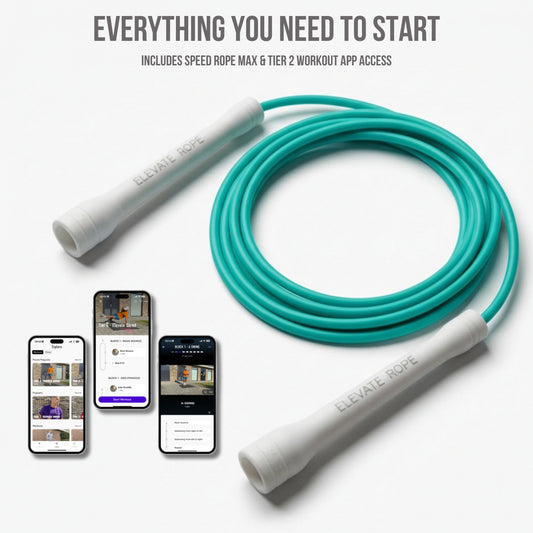
Some people thrive with a plan and a bit of accountability without wanting another monthly bill. Elevate's free app includes guided sessions, a timer, and progress tracking at no recurring cost, which is a different model from app subscriptions that can run well over 100 euro a year. If you want a faster, higher-intensity rope as your conditioning improves, the → Speed Rope MAX is a natural next step once the basic rhythm is automatic.

Frequently Asked Questions
What percentage of gym memberships go unused?
A widely cited industry figure is around 67%, meaning roughly two in three memberships are unused or rarely used, while only about 18 to 20% of members attend regularly. The exact number varies by source and some analysts treat it as directional, but every dataset shows a large utilisation gap.
Why do most people quit the gym?
The top stated reasons are cost and not using the place enough to justify it, but underneath that sits friction: the commute, the time, the self-consciousness, and the perfectionism trap of waiting to get fit before going. These small obstacles stack up until the easy choice is to stay home.
How quickly do people stop going to the gym after joining?
Fast. One UK survey found 27% stopped within three to four months, and roughly half of new members quit within six months. People who never show up in their first 30 days are the most likely to cancel, which is why the first month matters most.
Is jumping rope a good replacement for the gym?
For cardio and conditioning, it is a strong fit because it removes the friction that breaks gym routines: no commute, short sessions, full privacy, and a one-time cost. It will not replace heavy strength training, but for the person who quietly stopped going, a rope that gets used beats a membership that does not. The beginner guide covers how to start.
How much money do unused gym memberships waste?
Estimates are large. UK analysis has put annual waste in the region of half a billion pounds, and US estimates sit near 1.3 billion dollars a year, though methods vary. The average individual spends a meaningful sum each year on access they do not use.
Should I cancel my gym membership?
If you have not used it in months and the charge is mostly producing guilt, cancelling is a reasonable financial decision rather than a failure. What matters more is replacing it with something low-friction you will actually do, so the habit continues even when the membership stops.
Where to Start From Here
If you recognised yourself in the dropout data, the takeaway is not that you lack discipline. It is that the gym model carried more friction than your motivation could outlast, and almost anyone in that situation would quit eventually. The fix is a routine that asks far less of you on a tired evening.
If you are starting from scratch, begin with the basics and a forgiving rope. The complete beginner jump rope guide shows you how to size a rope and land your first jumps, and the → Dignity beaded rope is the easiest place to learn because the weighted beads make the timing feel obvious. Elevate's ropes are backed by more than 1,200 verified reviews, many from people who had quit every other routine first.
If you would rather start with structure and a clear path, the → Ascent bundle pairs a beginner-friendly rope with the gear to build from, so you are not guessing what to buy next. Either way, the point is the same: pick the lowest-friction option, keep it by the door, and let small kept promises do the work the gym membership never could.
Sources to Cite
- Glofox, Gym Membership Statistics (2026) — 67% unused or rarely used, attendance and retention figures.
- Gymdesk, 100 Gym Membership Statistics (2026) — sources include HFA 2025 reports and IHRSA retention research; first-30-day cancellation risk.
- PA Life / Live Football Tickets survey (2025) — UK dropout timing and annual waste estimate.
- MMCG, US Fitness Industry Trends (2026) — reasons for quitting (38% fees, 23% low usage) and the 67% figure in context.
- WodGuru, Gym Membership Statistics (2026) — unused membership and financial-waste figures.
- EuropeActive and Deloitte, European Health & Fitness Market Report (2025) — EU club retention data. [Add publisher URL once confirmed.]
- Arizona State University jump rope research — cite the original study directly and frame as directional. [Add URL once confirmed.]