





The jump rope at work benefits most companies ignore are sitting right there in the science, hiding in plain sight. A study published in Perceptual and Motor Skills found that a single 10-minute bout of aerobic exercise — the kind a jump rope provides in an average break room — improved cognitive performance, reaction time, and mood scores in office workers. Not a week of gym sessions. One 10-minute break. Yet the typical break room is stocked with a coffee machine, a microwave, and a table of forgotten birthday cake.
The jump rope has always been underestimated. It weighs less than most people's phone cases. It costs less than two weeks of morning coffees. It folds into a jacket pocket. And it delivers a physiological reset that no amount of herbal tea or desk stretching can replicate. The question isn't whether it belongs in the break room. The question is why jump rope isn't already common practice.
This article makes the full case — backed by research, stripped of corporate wellness clichés — for why jump rope might be the cheapest, most effective strategy your office could implement for focus, energy, and wellbeing.
What You'll Learn in This Article
→ What happens physiologically when you sit through a full workday without movement
→ The specific science behind jump rope at work and cognitive performance
→ Why jump rope at work outperforms every other office exercise option
→ How to structure a 5-minute jump rope at work routine that fits any fitness level
→ What the research says about workplace movement policies and productivity
→ Which rope works best for jump rope at work environments
→ How companies introducing jump rope at work initiatives are seeing measurable productivity gains
What Eight Hours at a Desk Actually Does to Your Afternoon
Most people know sitting all day is not ideal. What they don't appreciate is the specific cascade that happens — and when it happens. The afternoon energy collapse that office workers experience between 2pm and 4pm is not primarily a sleep debt issue. It's a movement debt issue. This is exactly why jump rope at work has become such a valuable topic in workplace health research.
The Biology of the Afternoon Slump
When you sit for extended periods, blood pools in the lower extremities, venous return to the heart decreases, and cerebral blood flow — the literal supply of oxygen to your brain — drops measurably. A study in PLOS ONE found that just two hours of uninterrupted sitting significantly reduced middle cerebral artery blood velocity compared to the same period broken up with walking breaks.
This is not a metaphor for fatigue. It is measurable reduced blood flow to the organ you're trying to use to do your job. One of the biggest benefits of jump rope at work is that it directly counters this decline in circulation and alertness.
Compound this with reduced metabolic rate — seated calorie burn drops to roughly 1.3 kcal/minute compared to 3.5–5 kcal/minute during moderate movement — and the body effectively enters a conservation mode. The result is the familiar fog: emails feel harder to process, decisions feel slower, and the default response becomes scrolling through something passive until the feeling passes.
Regular jump rope at work breaks interrupt this process before it compounds throughout the afternoon. Even brief jump rope at work sessions can stimulate circulation, increase oxygen delivery, and restore mental sharpness.
Why Standing Desks Only Partially Solve This
Standing desks became the office wellness trend of the 2010s, and while they reduce the specific health risks of prolonged sitting, they do not solve the blood flow problem. Standing still is not movement.
Research published in the British Journal of Sports Medicine found that replacing sitting with standing produced minimal improvements in cognitive performance and mood, while replacing sitting with actual movement produced significant gains. This distinction is important when evaluating jump rope at work as a workplace solution.
Your body needs impact, circulation, and cardiovascular activation, not just a different static posture. Effective jump rope at work routines create exactly these physiological responses.
This is where the break room argument begins. You cannot put a treadmill in most break rooms. You cannot guarantee a safe walking route on lunch. But you can put a jump rope in a corner and make jump rope at work available to anyone willing to use it.
Unlike many workplace wellness initiatives, jump rope at work requires almost no space, no installation, and no ongoing maintenance. It is one of the simplest forms of workplace movement to implement and one of the easiest for employees to access.
The companies that benefit most from jump rope at work are often not the ones with expensive wellness budgets. They are the ones that make movement easy, accessible, and consistent. A jump rope checks every box. As a practical jump rope at work solution, it delivers cardiovascular activation, coordination training, improved mood, and a mental reset in just a few minutes.
The future of workplace wellness may not be another app, standing desk, or motivational poster. It may simply be making jump rope at work available when employees need it most.

The Science Behind 10-Minute Movement Breaks and Mental Performance
The research on short exercise bouts and cognitive function is, at this point, unusually consistent. Across multiple independent studies, brief aerobic exercise — 10 to 20 minutes — reliably improves working memory, executive function, information processing speed, and sustained attention. These are not marginal improvements measured in laboratory conditions. They are the specific cognitive domains that determine whether someone is effective at desk-based knowledge work.
For companies exploring jump roping initiatives, this is important because the benefits extend far beyond physical health. Jump rope at work has repeatedly been shown to support the exact mental skills employees depend on every day.
What the Studies Actually Show
A 2019 meta-analysis in British Journal of Sports Medicine reviewed 13 studies and found that even a single bout of moderate aerobic exercise improved attention and memory function in healthy adults. The effect peaked at around 20 minutes of activity but was statistically significant at 10 minutes.
The mechanism is well-established: aerobic exercise triggers acute release of brain-derived neurotrophic factor (BDNF), dopamine, serotonin, and norepinephrine — collectively responsible for attention, mood regulation, and working memory function.
This is one reason why jump rope is becoming a growing area of interest among workplace performance researchers. The neurological response created by jump rope at work is fast, measurable, and highly relevant to productivity.
The practical translation is simple: a 10-minute jump rope at work session in the break room at 1pm produces a measurable cognitive benefit that carries through the afternoon. Not a wellness benefit. A performance benefit.
The kind that employers often try to achieve through expensive software, coaching programs, and productivity workshops can often be supported through something as simple as regular jump rope at work sessions. In many cases, jump rope at work provides a direct intervention for attention, focus, and mental energy.
The Cortisol Reset Effect
Desk work generates a specific pattern of physiological stress: low-grade chronic cortisol elevation without the natural cortisol clearance that physical activity provides. Ancient biology designed cortisol to fuel movement — fight or flight.
Modern desk work generates the cortisol without the movement, leaving the hormone circulating and the nervous system in a state of low-level activation that manifests as irritability, decision fatigue, and difficulty concentrating.
One of the most overlooked benefits of jump rope at work is its ability to interrupt this cycle. Jump rope at work creates the movement response that the body expects, allowing stress hormones to be processed rather than continuously accumulated.
Ten minutes of jump rope burns through that cortisol surplus more efficiently than almost any other portable activity because of its cardiovascular intensity and full-body engagement. Heart rate climbs quickly, the stress response cycle completes, and the return to work carries the neurological signature of calm readiness rather than low-grade tension.
This is one reason why jump rope at work consistently correlates with better afternoon productivity. Employees who engage in jump rope at work often report improved concentration, better mood, and greater resilience during mentally demanding tasks.
Unlike many workplace wellness trends, jump rope at work directly addresses the biological mechanisms behind fatigue and cognitive decline. Jump rope at work improves circulation. Jump rope at work increases cerebral blood flow. Jump rope at work stimulates neurotransmitter release. Jump rope at work helps regulate cortisol. Jump rope at work also provides a clear mental separation between work blocks, helping employees return to tasks with renewed focus.
Why Jump Rope Works So Well
Many workplace wellness solutions require equipment, large spaces, or changing clothes. Jump rope at work solves all three problems. It is portable, inexpensive, and capable of producing meaningful cardiovascular activation in just a few minutes.
For organisations looking to introduce jump rope at work without major investment, a jump rope may be one of the simplest solutions available. Effective jump rope at work does not need to be complicated. It needs to be accessible and easy to repeat.
A jump rope can live in a desk drawer, locker, or break room corner. That convenience makes jump rope at work far more likely to happen consistently, which is ultimately what creates the largest performance gains.
Short answer: Yes, a 10-minute jump rope at work break can produce measurable improvements in attention, working memory, and mood that persist for 60–90 minutes after the activity ends.
Why it matters: The afternoon cognitive slump affecting most desk workers is caused largely by reduced cerebral blood flow and cortisol accumulation. Jump rope at work directly addresses both mechanisms. No amount of coffee, screen breaks, or standing desk adjustments creates the same neurological reset as structured jump rope at work .
Best next step: If you're a desk worker looking to test jump rope at work for yourself, the Speed Rope MAX is compact enough to live in a desk drawer and produces sufficient cardiovascular activation in 5–10 minutes to deliver the cognitive benefits described in the research.

Why Jump Rope Beats Every Other Break Room Exercise Option
It's worth being direct about the competition here, because office wellness has generated a long list of ideas that look good on a corporate benefits brochure but fail in practice. Let's compare them honestly.
| Exercise Option | Space Required | Equipment Cost | Cardio Activation | Practical in Office |
| Jump rope | ~3m² | €25–€45 | High (130–160 BPM) | ✅ Yes |
| Resistance bands | ~2m² | €10–€25 | Low (80–95 BPM) | ✅ Yes, but low intensity |
| Desk yoga / stretching | ~2m² | €0 | Very low (resting BPM) | ✅ Yes, but minimal impact |
| Treadmill / walking pad | ~6m² | €400–€1,500 | Moderate (95–115 BPM) | ⚠ Space / cost barrier |
| Indoor cycling / stationary bike | ~4m² | €300–€800 | Moderate–high | ⚠ Space / cost barrier |
| Bodyweight exercises (burpees, squats) | ~3m² | €0 | Moderate | ⚠ Social awkwardness barrier |
Jump rope wins on the combination of metrics that actually matter for a break room environment: it's high-intensity enough to deliver a genuine physiological reset, affordable enough that cost is never the objection, compact enough to require no dedicated space, and structured enough that even a beginner can follow a timed session with a free app.
The Social Barrier Problem (And Why Jump Rope Solves It)
One of the underappreciated obstacles to workplace exercise is the social atmosphere problem. Dropping to the floor for burpees in a break room feels performative. Stretching in front of colleagues feels awkward. Jump rope has a different social energy — it's playful, recognizable, and carries cultural associations with skill and sport rather than grinding effort. People who see a colleague jumping rope in the break room are more likely to want to try it than they are to feel uncomfortable about it. That's not a trivial factor in whether workplace fitness initiatives actually stick.
The Logistics Argument
A jump rope doesn't need to be plugged in, filled with water, adjusted to anyone's height, or sanitized between each use in the way shared gym equipment does. It hangs on a hook or coils into a small bag. A single rope costs less than a standard office chair caster replacement. The entire barrier-to-entry calculus is different from any other fitness equipment a company might consider.

A 5-Minute Break Room Routine for Any Fitness Level
The biggest objection to workplace movement is the all-or-nothing thinking that treats exercise as something that requires preparation, athletic clothing, and a minimum commitment of 45 minutes. None of that is true, but it's how most people have been conditioned to think about it. A five-minute break room routine works — and works well — if the structure is right.
For Absolute Beginners (Zero Jump Rope Experience)
The entry point is simpler than most people assume. Grip the handles, find a comfortable width apart, and focus on the bounce — not the rope. The goal in the first few sessions is not to complete a set number of jumps without stopping. It's to find the rhythm. Sixty seconds on, thirty seconds of walking in place. Repeat three times. Total active time: three minutes. Total session time: four and a half minutes. That is a physiologically meaningful break. The heart rate will climb. The brain will get blood. The cortisol will clear. None of that requires being good at jump rope yet.
For beginners specifically, the Dignity Beaded Rope is purpose-built for this situation. The weighted beads create a slow, tangible arc that gives physical feedback on every rotation — so your body learns timing without having to consciously count or watch the rope. It's also bearing-free, meaning it spins without any mechanical complexity that can wear out or snag. For a break room context where multiple people of varying skill levels might use it, that durability and simplicity matters.
For Intermediate Users (Some Experience)
Once basic rhythm is established — even if it's 15 consecutive jumps before a trip — the break room routine scales naturally. Thirty seconds of continuous jumping, fifteen seconds of rest, repeated for five rounds. That's approximately 3.5 minutes of active work with rest built in. The cardiovascular demand is real. Research on HIIT-style interval training shows that even brief high-intensity intervals of this length trigger BDNF release and the mood-elevating neurotransmitter cascade the longer studies describe. You don't need 20 continuous minutes. You need genuine elevation of heart rate, even intermittently.
For Regular Users (Established Routine)
The break room routine at this level becomes a proper five-minute HIIT session: 40 seconds on, 20 seconds off, five rounds, with variation between fast singles, high knees, and double foot jumps. At this tempo, calorie burn approaches 12–15 calories per minute — the equivalent of a short sprint interval — in a sub-two-square-metre footprint with no equipment beyond the rope in your desk drawer.
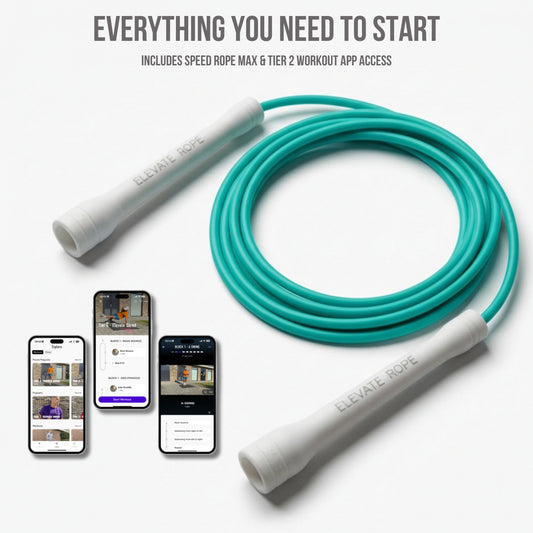
The Speed Rope MAX is built for this use case. The precision bearings and ultra-lightweight cable allow the fast rotation required for HIIT intervals, while the compact handle design fits in any jacket pocket or bag. The free Elevate App includes timed break routines specifically designed for 5–10 minute windows — so you're not improvising the session while trying to remember how long you've been going.
Short answer: A beginner can get a genuine physiological benefit from jump rope in a break room with just 3–5 minutes of structured intervals, even if they can only manage 10–15 consecutive jumps at a time.
Why it matters: The all-or-nothing perception of exercise is the primary reason most people don't do anything. A 5-minute break room routine is not a compromise on real training — it's a different type of intervention entirely, targeting cognitive reset and cortisol clearance rather than fitness periodization. It works on its own terms.
Best next step: New to jump rope? Start with the Dignity Beaded Rope for the break room — its weighted arc makes the rhythm immediately learnable, even with zero prior experience.

What the Research Says About Workplace Movement Policies
The corporate wellness industry generates enormous amounts of programming — webinars, step challenges, standing desk subsidies, meditation apps — but very little of it targets the specific physiological mechanism that actually limits knowledge worker output. A 2021 review in Frontiers in Psychology found that structured micro-break interventions (defined as 5–15 minutes of light to moderate physical activity during the workday) produced significant improvements in self-reported wellbeing, task engagement, and concentration when compared to control groups who took standard passive rest breaks.
The Productivity Argument That Companies Respond To
Wellness framing is often treated as a soft benefit — good for employee satisfaction surveys but not directly connected to output. The productivity framing lands differently. A study published in the Journal of Occupational and Environmental Medicine found that employees who exercised on workdays reported time-management skills, mental performance, and ability to meet deadlines improved by up to 72% on days they exercised compared to days they didn't. These were the employees' own assessments of their work quality on exercise days versus non-exercise days.
That's not a marginal wellness improvement. That's the kind of performance differential that companies pay consultants significant fees to chase through productivity frameworks. A €35 rope in the break room is a different category of investment, with a different category of cost-to-benefit ratio.
The Precedent Already Exists
Companies like Google, Nike, and a growing cohort of European employers have built dedicated movement spaces into their offices not as perks but as productivity infrastructure. Most companies don't have the floor space or budget for this. But the principle scales down perfectly. A hook on the break room wall, a rope, a printed QR code linking to the 5-minute Elevate workout — that is a functional version of the same idea at a cost that rounds to zero on any company budget.

The Personal Case: What Happens When You Start Jumping at Work
The research matters. But the most persuasive argument is the one you feel by the end of week one. People who begin taking 10-minute jump rope breaks during the workday consistently report the same cluster of experiences: afternoons feel shorter. The 3pm wall either disappears or becomes a minor inconvenience rather than a survival challenge. The commute home is less depleting. The evenings feel longer in the good sense — more energy for the things that aren't work.
The Identity Shift That Office Exercise Creates
There's something else that happens, and it matters more than the calorie burn. When you make a kept promise to yourself mid-workday — "I said I'd take the break and I took it" — you close a loop that desk work persistently leaves open. The Elevate Code framework is built on exactly this principle: self-trust is reconstructed through small, kept promises. Not through dramatic transformation plans. Through doing the small thing you said you'd do, consistently, until it becomes who you are.
The person who jumps rope in the break room three days a week is no longer waiting to "get back into fitness." They are someone who moves at work. That identity shift — small as it sounds — has downstream effects on every other health decision they make. The rope in the break room is not just a tool for 10 minutes of cardio. It's a trigger for a different self-concept.
For anyone who has struggled with consistency in their fitness — which includes most of the 80%+ of European workers who hold sedentary or desk-based jobs — this framing matters more than the specifics of any particular workout protocol. See also: Jump Rope for Desk Workers: The Complete Guide for the full program framework and product progression path.
Short answer: Yes — even two or three 10-minute jump rope breaks per week during the workday produce measurable improvements in afternoon energy, mood, and self-reported productivity within the first two weeks.
Why it matters: The compounding effect of mid-workday movement is not linear. The physiological benefits (blood flow, cortisol clearance, BDNF release) are acute and immediate, but the identity effects — becoming someone who moves consistently — accumulate over weeks into a different baseline. People don't "get back into fitness" through the gym. They get back through consistent small actions that fit where they already are.
Best next step: Start the Elevate 26 Challenge — a 26-day structured program designed for exactly this kind of incremental commitment. It doesn't require an hour a day. It requires 10 minutes and a rope.

Which Rope Belongs in the Break Room
Not all jump ropes are equal in a break room context. The requirements are specific: it needs to be beginner-accessible so colleagues of any fitness level can use it, durable enough to survive occasional heavy use and storage, and fast enough to offer a real workout to the regular users. One rope can meet all three criteria.
| Rope | Best For | Break Room Fit | Price |
| Dignity Beaded Rope | Beginners, rhythm learning | ✅ Ideal for shared use — weighted arc is self-correcting | Check site |
| Speed Rope MAX | Intermediate–advanced, HIIT intervals | ✅ Pocket-sized, high output — best personal desk rope | Check site |
| TITAN 7MM Weighted Speed Rope | Intermediate, strength-cardio hybrid | ✅ Weighted feel means shorter sessions, same activation | €34.95 |
| Gravity Heavy Rope | Advanced, core/shoulder activation | ⚠ More demanding — best for dedicated users | Check site |
For a shared break room, the recommendation is the Dignity Beaded Rope as the community option. It's adjustable to 3 metres, so it fits any height. The bearing-free design means it never needs maintenance or replacement parts. And the auditory tick-tick-tick of the beads against the floor gives every user instant feedback on their rhythm — making the learning curve dramatically shorter than with a standard cable rope.
For the person who wants their own personal desk rope that lives in a drawer and is ready in 10 seconds: the Speed Rope MAX. It disappears into any bag or jacket pocket and performs across the full range from beginner singles to advanced interval work. Pair it with the free Elevate App — 100+ structured workouts, guided audio coaching, built-in timer — and you have a complete mid-day break system that costs nothing beyond the initial rope.
If you're exploring the full Elevate product lineup, the complete rope collection covers every level and use case, with the Ascent Max Bundle offering the best entry point for someone starting with a complete system rather than a single rope.
Frequently Asked Questions
Is jump rope appropriate for people with no fitness background?
Yes. Jump rope doesn't require a baseline fitness level — it meets you where you are. Beginners can start with low-intensity intervals of 30 seconds on, 30 seconds rest, gradually building duration as coordination improves. The beaded rope is specifically designed for this use case because the weighted arc provides physical feedback that makes rhythm learning significantly faster than with lightweight cable ropes.
How much space do I need to jump rope in a break room?
Approximately 2.5–3 square metres of floor space and 30cm of ceiling clearance above your head. Most standard break rooms easily accommodate this. For offices with very low ceilings, a ropeless jump rope alternative eliminates the ceiling constraint entirely while maintaining the same rhythmic movement pattern and cardiovascular benefit.
Can a 5-minute jump rope break really improve afternoon focus?
Yes, and the mechanism is well-documented. Even brief aerobic exercise triggers acute release of BDNF, dopamine, and norepinephrine — neurotransmitters directly responsible for attention, working memory, and mood regulation. Multiple studies have shown measurable improvements in cognitive test performance 60–90 minutes after a single 10-minute bout of moderate-intensity aerobic exercise.
Will I sweat too much to go back to my desk?
At moderate intensity — 30–40 seconds on, with rest intervals — most people produce minimal sweat during a 5-minute break room session. The goal is cardiovascular activation, not a full training session. If you're concerned, keep intensity low initially: basic bouncing at a comfortable pace elevates heart rate enough to clear cortisol and improve blood flow without producing excessive perspiration.
What if my colleagues think it's strange?
Jump rope has a very different social perception to floor exercises or weights in an office context. It's playful, skill-based, and culturally associated with sport rather than gym performance. In practice, most people's initial reaction is curiosity followed quickly by wanting to try. The break room adoption pattern tends to spread once one person starts consistently — which is exactly what makes it a stronger workplace fitness option than most alternatives.
Is jump rope safe for people with knee problems?
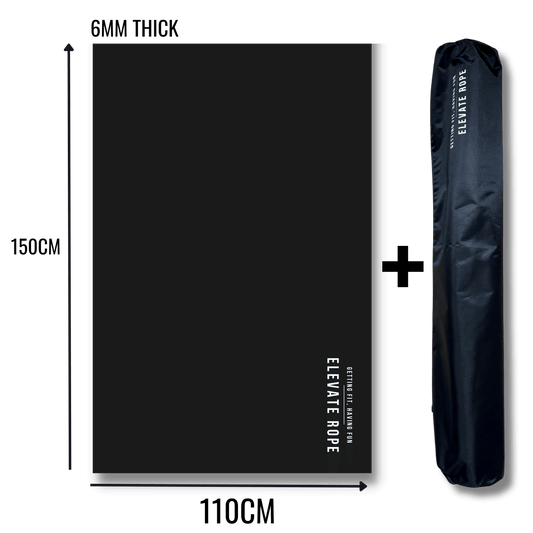
For most people with mild knee discomfort, jumping rope on a cushioned surface at low intensity is well-tolerated. The Jump Rope Mat provides significant joint protection by absorbing landing impact. Anyone with a diagnosed knee condition should consult their physiotherapist before beginning any new jumping activity. Low-impact modifications — single-leg variations, reduced height, or ropeless movement — can reduce load further.
Does my company need to buy equipment, or is this a personal thing?
Both work. A single shared rope in the break room costs less than a team lunch and serves everyone who wants to use it. Alternatively, personal desk ropes are becoming increasingly common among knowledge workers who travel frequently or move between offices — the Speed Rope MAX specifically was designed to be portable enough to live permanently in a jacket pocket or laptop bag. The free Elevate App works on any device and requires no subscription.
How does jump rope compare to a lunchtime gym session?
The cognitive benefits of exercise occur along a dose-response curve that doesn't require long sessions. A 10-minute jump rope break produces acute BDNF and neurotransmitter benefits similar to longer moderate-intensity sessions — the primary difference is cardiovascular and muscular development over time, not the immediate cognitive benefit. For the specific purpose of an afternoon performance reset, 10 minutes of jump rope in the break room competes with a 45-minute gym session in terms of the outcome that matters most for your next hour of work.
The Case, Concluded
The break room has always been about recovery — getting away from the screen, resetting, returning with more capacity than you left with. The problem is that passive recovery (sitting differently, drinking coffee, scrolling your phone) addresses none of the specific physiological problems that eight hours of desk work creates. It only delays the compounding. Movement is the only mechanism that actually clears the slate.
A jump rope makes that mechanism available to everyone, regardless of fitness level, at a cost that is genuinely negligible against any measure of workplace investment. The research supporting it is not the marginal wellness literature that fills corporate intranet pages. It's peer-reviewed cognitive performance science that describes the exact problem — reduced cerebral blood flow, cortisol accumulation, neurotransmitter depletion — and identifies structured movement as its solution.
If you're a desk worker reading this: the rope in your drawer will not change your life the first time you use it. It will change it the twelfth time, and the twenty-second, when the 3pm slump starts to feel like someone else's problem. If you're a team lead, manager, or anyone who cares about what their team's output looks like at 4pm: a rope on a hook in the break room is the cheapest, highest-leverage investment in afternoon performance you will ever make. Start with the Dignity Beaded Rope for the room, the Speed Rope MAX for yourself, and the free Elevate App for everything in between.
Sources
- Lambourne, K., & Tomporowski, P. (2010). The effect of exercise-induced arousal on cognitive task performance: A meta-regression analysis. Brain Research. https://pubmed.ncbi.nlm.nih.gov/20735996/
- Lucas, S. J., et al. (2012). Cerebral blood flow is reduced 2 hours after a meal. PLOS ONE. https://journals.plos.org/plosone/article?id=10.1371/journal.pone.0044547
- Hamer, M., & Stamatakis, E. (2018). Prospective study of sedentary behavior, risk of depression, and cognitive impairment. Medicine & Science in Sports & Exercise. https://pubmed.ncbi.nlm.nih.gov/19952834/
- Chang, Y. K., et al. (2012). The effects of acute exercise on cognitive performance: A meta-analysis. Brain Research. https://pubmed.ncbi.nlm.nih.gov/22480735/
- Biswas, A., et al. (2015). Sedentary time and its association with risk for disease incidence, mortality, and hospitalization in adults. Annals of Internal Medicine. https://pubmed.ncbi.nlm.nih.gov/25599350/
- Pronk, N. P., et al. (2012). Reducing occupational sitting time and improving worker health. Journal of Occupational & Environmental Medicine. https://pubmed.ncbi.nlm.nih.gov/23069702/
- Donnelly, J. E., et al. (2016). Physical activity, fitness, cognitive function, and academic achievement in children. Medicine & Science in Sports & Exercise. https://pubmed.ncbi.nlm.nih.gov/27182987/
- Daley, A. J., & Bhavsar, V. (2005). Exercise and mental health in workplace settings. Occupational Medicine. https://pubmed.ncbi.nlm.nih.gov/15728415/
You May Also Like
https://www.elevaterope.com/blogs/home-workout-tips/jump-rope-vs-walking-office-workers
https://www.elevaterope.com/blogs/tips-tricks/quick-workout-before-work
https://www.elevaterope.com/blogs/articles/jump-rope-stress-relief
https://www.elevaterope.com/blogs/articles/best-jump-rope-for-beginners
https://www.elevaterope.com/blogs/crossfit-hiit/jump-rope-home-office-setup