






You already know you should be doing cardio. That's not the problem. The problem is that every home cardio option you've tried has failed—not because the workout didn't work, but because you couldn't make yourself do it more than twice.
The dusty treadmill in the garage. The YouTube HIIT video you bookmarked and never opened again. The running shoes still in the box. You don't need another workout plan. You need something you'll actually do when the alarm goes off and every cell in your body says "not today."
This article isn't a list of complicated routines requiring equipment you don't own or motivation you can't manufacture. It covers what actually works for home cardio when you're starting from zero—zero equipment, zero motivation, and zero interest in pretending you love burpees.
What you'll learn:
- Why motivation-dependent workouts always fail (and what to use instead)
- The real reason most home cardio routines don't stick
- Five approaches that work when you have nothing—ranked by effectiveness
- How to build consistency without relying on willpower
- The one home cardio method that research shows delivers gym-level results in ten minutes
Why Most Home Cardio Fails Before It Starts
Home cardio has an attrition problem that has nothing to do with the exercises themselves. Research shows that 80% of people who start a new fitness routine quit within weeks—not because the workouts are ineffective, but because the approach demands more motivation than any human can sustain.
The pattern looks the same almost every time. Monday: fired up, complete a 45-minute YouTube workout, feel amazing. Wednesday: sore, tired, try again but quit at minute 20. Friday: skip entirely. Next Monday: guilt. The Monday after that: the routine is dead.
This happens because most home cardio programs are designed for people who already exercise consistently. They assume motivation, available time, existing fitness, and a tolerance for discomfort. If you had all four of those things, you wouldn't be searching for solutions at 11pm on a Tuesday.
The real barrier isn't fitness knowledge—it's friction. Every point of friction between you and a workout creates an opportunity to quit. Equipment you need to set up. Apps you need to open. Videos you need to queue. Space you need to clear. Clothes you need to change into. Each one is a tiny exit ramp your brain will take when motivation runs low.
As you build your cardio habit, comfort and simplicity are essential for making your routine stick. Small adjustments, like wearing breathable leggings, soft cotton socks, or using a lightweight jump rope, can help minimize distractions and enhance your workout experience. Having a water bottle nearby also ensures you stay hydrated throughout. By making these simple changes, you reduce friction and allow yourself to focus on consistency, rather than being distracted by discomfort or unnecessary obstacles.
Answer Block: Why Home Workouts Fail
Short answer: Most home cardio routines fail because they require sustained motivation, not because the exercises don't work. Research indicates that 80% of new fitness routines are abandoned within weeks, primarily due to friction—setup requirements, time demands, and complexity that create opportunities to quit.
Why it matters: Understanding that the problem is structural, not personal, changes the solution. You don't need more discipline. You need less friction.
Best next step: Choose a workout method with near-zero setup time, minimal space requirements, and a duration short enough that "I don't have time" stops being a valid excuse.

What Actually Works: Ranking the No-Equipment Options
Not all home cardio is created equal. What follows is an honest comparison of the most common bodyweight cardio approaches—ranked not by how hard they are, but by how likely you are to actually do them consistently.
The High-Effort Options (Effective But Hard to Sustain)
Burpees, mountain climbers, high knees, squat jumps, and similar high-intensity bodyweight movements deliver real cardiovascular results. The physiology is solid. A 20-minute circuit of these exercises burns significant calories and elevates your heart rate into zones that produce meaningful adaptations.
The problem is adherence. These movements are genuinely unpleasant for most people—especially those who aren't already fit. The discomfort-to-enjoyment ratio is terrible when you're starting from zero. You feel clumsy, exhausted, and frustrated within the first few minutes. That's not a recipe for consistency.
High-intensity bodyweight circuits work well for people who already exercise and need a travel option. For someone trying to build a home cardio habit from nothing, they create too much dread.
The Low-Effort Options (Easy to Start, Limited Results)
Walking in place, marching, and gentle step-touch routines reduce friction almost completely. You can do them in your pyjamas while watching television. The barrier to entry approaches zero.
The trade-off is effectiveness. These approaches produce minimal cardiovascular stimulus for most adults. They're better than sitting, but they won't meaningfully improve your fitness, change your body composition, or deliver the post-exercise mood elevation that makes you want to come back.
Low-effort options serve as a bridge—something to do while you build the identity of someone who moves daily. But calling them a home cardio workout stretches the definition.
The Middle Ground (Moderate Effort, Moderate Results)
Dance workouts, shadowboxing, stair climbing, and similar moderate-intensity activities balance effort and enjoyment better than either extreme. They're more engaging than marching in place and less punishing than burpee circuits.
The limitation is variability. Some days a dance video feels fun and effortless. Other days the same video feels like a chore. Your results depend on finding content you enjoy, which means constantly searching for new routines when the old ones lose their appeal. This creates a maintenance burden that compounds over time.
Moderate options work for people with a natural affinity for the specific activity. For those without that affinity, the search for "something I don't hate" becomes its own form of friction.
The Outlier: Jump Rope
Jump rope occupies a unique position in the home cardio landscape. Research from Arizona State University found that ten minutes of jumping rope delivers cardiovascular benefits equivalent to thirty minutes of jogging. A 2019 study in the Gait & Posture Journal showed that proper rope jumping creates less joint stress than running—the National Institutes of Health has described it as "hip and knee protective."
What makes rope jumping unusual isn't the research. It's the psychology.
Jump rope forces what neuroscientists call "active attention." Your brain must coordinate timing, rhythm, and foot placement simultaneously. There's no space for clock-watching because missing a beat means tripping. This engagement effect means ten minutes feels like two—not because you're suffering less, but because you're actually present in the movement.
Every other home cardio method on this list allows your brain to disengage and count down the minutes. Jump rope doesn't. That neurological engagement is why people who hate every other form of cardio consistently describe rope jumping as "the only cardio I don't hate."
The practical advantages compound the psychological ones. A rope costs less than a single month of gym membership. It stores in a drawer. Setup time is zero—pick it up and go. You need roughly two metres of ceiling clearance and a flat surface. The entire workout, including warm-up and cool-down, fits into fifteen minutes.

The Motivation Myth: Why Discipline Fails and Systems Work
The fitness industry sells motivation as the missing ingredient in your home cardio routine. If you just wanted it badly enough, you'd do it. If you found the right playlist, the right app, the right influencer, you'd finally stick with something.
This is a lie—and not a small one. Motivation is an emotion. Emotions are temporary by nature. Building a cardio habit on motivation is like building a house on sand. It holds until the first storm, then collapses.
What actually works is reducing friction until the workout requires less effort to do than to skip.
The principle is simple: make the default action exercise, not rest. When you remove enough barriers, consistency becomes nearly automatic. You don't need to feel motivated to pick up a rope that's sitting next to your coffee maker and jump for five minutes. The decision cost is so low that skipping actually requires more mental effort than doing it.
This is why equipment-free home cardio sounds appealing but often backfires. Bodyweight workouts have zero equipment friction but massive complexity friction—you need to remember exercises, count reps, track sets, and make decisions throughout the workout. Each decision is an opportunity for your brain to say "this is hard, let's stop."
The most effective approach combines minimal equipment with minimal decision-making. One tool. One movement pattern. One timer. Start, move, stop. No decisions required during the workout itself.
Building the Habit: The First Two Weeks That Change Everything
The first fourteen days of any home cardio routine determine whether it survives. Not the first workout—the first two weeks. Here's what the research says about making those fourteen days count.
Start Embarrassingly Small
Behavioural scientist BJ Fogg's research at Stanford demonstrates that habit formation depends on starting below your ability level. If you can jump rope for ten minutes, start with three. If you can do a bodyweight circuit for twenty minutes, start with five.
The goal during week one isn't fitness. It's identity construction. Every completed session—no matter how short—builds neural pathways that associate you with the identity of "someone who works out." That identity shift matters more than any calorie burn because it's what carries you through the days when motivation disappears.
Anchor to an Existing Habit
Habits form fastest when attached to existing routines. "After I make my morning coffee, I jump rope for five minutes" is dramatically more effective than "I'll work out sometime in the morning." The existing habit (coffee) becomes the trigger for the new one (movement).
This anchoring technique works for any home cardio approach, but it works best when the new habit requires near-zero setup. If "after coffee" means "change clothes, clear space, set up equipment, queue a video," the anchor breaks under the weight of friction. If it means "pick up the rope next to the coffee maker," the anchor holds.
Track Completions, Not Performance
During the first two weeks, the only metric that matters is whether you showed up. Forget duration, intensity, and calorie counts. One question: did you do it? Yes or no.
A wall calendar with X marks is more effective than any fitness app during this phase. The visual streak creates its own motivational gravity—you don't want to break the chain. This simple accountability tool has helped more people build lasting home cardio habits than any piece of technology.

The Ten-Minute Protocol: Proof That Less Is More
The biggest lie in fitness is that effective workouts require significant time. This belief kills more home cardio routines than any other factor.
Here's what the research actually shows: ten minutes of moderate-to-vigorous activity produces measurable cardiovascular improvement, mood elevation, and metabolic benefits. The American Heart Association's minimum recommendation for cardiovascular health is 150 minutes per week—that's approximately twenty minutes a day, five days a week. But even half that amount produces meaningful benefits compared to inactivity.
A ten-minute home workout performed six days a week delivers sixty minutes of cardiovascular activity. That's 40% of the recommended minimum. For someone currently doing zero minutes, that's an infinite improvement. And it's achievable because ten minutes doesn't trigger the dread response that longer sessions create.
The key is intensity, not duration. Ten minutes of jump rope—where your heart rate stays elevated throughout because the movement demands continuous effort—produces more cardiovascular stimulus than thirty minutes of walking or gentle bodyweight movements with rest periods between sets.
This is why the "I don't have time" excuse dissolves when the workout genuinely fits into ten minutes. You have ten minutes. Everyone has ten minutes. The question was never time—it was whether those ten minutes would feel like a waste or produce real results. With the right approach to home cardio, they produce real results.
What About Motivation on the Bad Days?
Every honest conversation about home cardio must address the days when you'd rather do literally anything else. The alarm goes off, you look at your workout setup, and your brain generates twelve compelling reasons to skip.
This is normal. It never fully stops. The difference between people who exercise consistently and people who don't isn't that consistent exercisers feel motivated every day. It's that they've built systems that carry them through the days when motivation is absent.
Three principles help:
The five-minute rule works because your brain can negotiate with any length of time over five minutes. "Just start, and if you want to stop after five minutes, you can." Most days, once you start, you finish. The hardest part is always the first thirty seconds.
Environmental design matters more than willpower. Leave your rope where you'll see it. Put your workout shoes next to your bed. Remove every physical barrier between you and the workout. Your future unmotivated self will thank your current self for making the default action easy.
Identity over outcomes changes the game. "I'm someone who moves every day" is more powerful than "I'm trying to lose weight" or "I want to get fit." Identity-based habits survive bad days because skipping feels like a contradiction of who you are, not just a missed workout.

Frequently Asked Questions
Can I really get a good cardio workout at home with no equipment?
Yes. Bodyweight exercises like burpees, high knees, and jump squats provide legitimate cardiovascular training. However, adherence is the limiting factor—most people don't sustain bodyweight-only routines long-term because the complexity and discomfort create friction. The most sustainable home cardio approaches use minimal, inexpensive equipment (like a jump rope) to reduce decision-making and increase engagement during the workout.
How long should a home cardio workout be?
Start with whatever duration feels almost too easy—typically five to ten minutes. Research shows that ten minutes of moderate-to-vigorous activity produces measurable cardiovascular benefits. As the habit solidifies over two to four weeks, you can gradually increase duration. Most people find fifteen to twenty minutes sufficient for meaningful fitness improvements without the dread that longer sessions create.
What if I live in a small apartment?
Most home cardio options require less space than you think. Jump rope needs roughly two metres of ceiling clearance and a two-by-three-metre floor area. Bodyweight exercises like high knees, shadowboxing, and squat jumps fit in even smaller spaces. If you can stand with your arms extended without touching walls, you have enough room for an effective workout.
Is home cardio as effective as going to the gym?
For cardiovascular fitness, yes. Your heart doesn't know whether it's beating fast in a gym or in your living room. The cardiovascular stimulus from a well-structured home workout matches what you'd get on a treadmill or elliptical. The advantage of home cardio is that you're dramatically more likely to actually do it consistently because the friction of commuting, changing, and navigating crowds is eliminated.
How do I stay consistent when I have zero motivation?
Stop relying on motivation entirely. Build systems instead: anchor your workout to an existing daily habit (like morning coffee), start with a duration so short it feels almost silly, and track simple yes/no completion rather than performance metrics. The consistency creates the motivation—not the other way around. Most people find that after two weeks of daily five-minute sessions, the habit has enough momentum to sustain itself.
What's the single best exercise for home cardio?
Jump rope, based on the combination of cardiovascular effectiveness, time efficiency, low friction, and neurological engagement. Research shows ten minutes of jumping produces equivalent cardiovascular benefits to thirty minutes of jogging, with less joint impact than running. The coordination demand keeps your brain engaged, which addresses the boredom problem that kills most home cardio routines.
The Bottom Line: Stop Searching, Start Moving
You've read enough articles about home cardio. Bookmarked enough workout plans. Compared enough options. The search for the perfect routine has become its own form of procrastination—and somewhere inside, you already know that.
The best workout is the one you'll actually do. Not the one that burns the most calories on paper. Not the one your favourite influencer recommends. The one that fits into your life with so little friction that skipping it takes more effort than doing it.
For most people, that means something short, something engaging, and something that requires minimal setup and zero decisions during the workout itself. A jump rope and ten minutes checks every one of those boxes—and the science confirms it delivers results that match or exceed what traditional cardio offers.
You don't need to overhaul your life. You need five minutes tomorrow morning and the willingness to start smaller than feels productive. That's it. Five minutes. One session. The home cardio habit that actually sticks doesn't start with a dramatic transformation—it starts with a kept promise so small your brain can't argue with it.
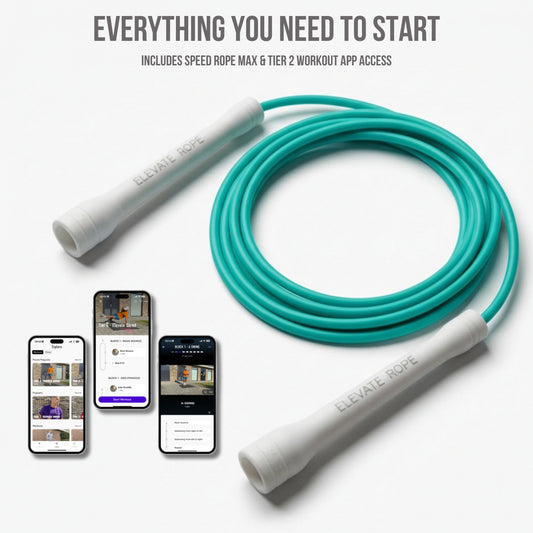
If you're new to jump rope, our complete guide to jump rope for home cardio covers everything from choosing your first rope to building a sustainable routine. For those ready to start, the Elevate Dignity Beaded Rope is designed specifically for beginners—the beads provide rhythmic timing feedback that makes learning faster and more intuitive than traditional speed ropes.
Sources
The cardiovascular equivalence between ten minutes of jump rope and thirty minutes of jogging references research conducted at Arizona State University comparing energy expenditure and cardiovascular adaptations across exercise modalities. Joint impact data draws from a 2019 study published in Gait & Posture Journal that compared loading patterns between jump rope and running, with the National Institutes of Health providing supporting biomechanical analysis describing rope jumping as "hip and knee protective."
Habit formation principles reference BJ Fogg's behavioural research at Stanford on tiny habits and friction reduction as drivers of sustainable behaviour change. The 80% attrition rate for new fitness routines draws from longitudinal exercise adherence studies tracking dropout patterns across multiple exercise modalities. The American Heart Association's minimum cardiovascular activity recommendations of 150 minutes per week inform the time-efficiency analysis throughout this article.