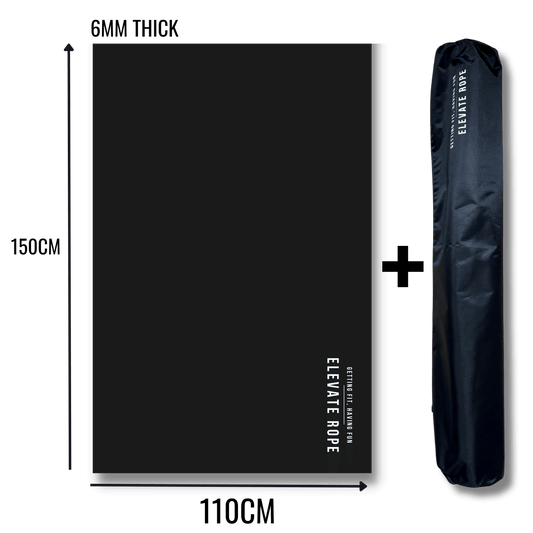







A jump rope mat for concrete needs to be wider than your rope arc and firm rather than soft. 150 by 110 centimetres covers a standard arc with room to move. Firmness beats thickness, because a soft mat takes away the push-off you need for a clean hop.
Most mat buying goes wrong on the same two points. People buy something thick and squashy because it sounds protective, and they buy something narrow because it looks like enough. Both work against you.
Why concrete is the surface that needs one
The cable touches the ground once per rotation. At 130 revolutions a minute, a ten minute session is around 1,300 contacts.
Concrete has grit in it. Every one of those contacts drags coating across that grit and takes a little off. You will not notice it for weeks. Then one day the cable has a dull flat patch on one side and it starts to kink in that spot, because the wall is thinner there than everywhere else.
This is the most common durability complaint we see, and it is almost always a surface problem rather than a rope problem.
Your joints are the other half of it. Concrete returns nearly all of the landing energy back up your leg. That is manageable for short sessions and less manageable at twenty minutes a day, five days a week.
Size: what a mat for concrete has to cover
This is the part almost nobody gets right.
Your rope arc is wider than your body. When the cable passes under your feet it is travelling out to the side. It touches down in a band roughly a metre and a half across for most adults. A mat that only covers your feet does nothing for the cable.
We sized ours at 150 by 110 centimetres against the arc rather than against a person. A standard yoga mat is around 60cm wide. The cable clears that on both sides and lands on bare concrete anyway, which is why people who train on a yoga mat still get the flat patch.

If you are tall, or you are working on crossovers where the arc widens, go wider rather than longer. The extra length behind you does nothing.
Thickness: firm beats thick
A soft mat feels like the safe choice. It is not.
Your hop comes from pushing into the ground and getting something back. A thick foam mat absorbs the push instead of returning it, so you work harder for a slower turn and your timing goes flat. It is the same reason deep carpet is a bad surface.
What you want is density. Enough material to take the edge off the landing, firm enough that the floor still pushes back. Somewhere in the range of 4 to 8 millimetres of dense rubber or PVC does that job. Thick foam tiles do not.
The second thing that matters is whether it stays put. A mat that slides on a landing is worse than no mat.
Setting up a two by two metre spot
You need less room than people expect. Two metres by two metres is enough for almost everything short of a long handle freestyle session.
Lay the mat down and stand on the middle of it. Turn the rope slowly, without jumping, and watch where the cable touches down. If it is landing on concrete either side of the mat, either the mat is too narrow or the rope is too long. Check the rope first.
To check the length, stand on the middle of the cable and pull the handles up along your chest. For most people the handle tops should land somewhere between the armpit and the shoulder. Longer than that and the cable spends more time on the ground than it needs to, which is more wear on every rotation.
Our cables size with a snaplock and a pair of scissors, and the beaded ropes with washers. There is no metal in the rope, so there is nothing to cut through. Take a centimetre at a time and re-check.
Outdoors, and a note for Australia and New Zealand
A mat for concrete outdoors has one extra job: it has to travel.
If your concrete is a driveway, a garage floor or a court, the mat has to roll or fold and go back inside. Leaving PVC in direct sun for a season will harden it, and a hardened mat cracks along the fold line.
Same for the rope. Heat softens PVC and a hot cable stretches. If you train outdoors through a southern hemisphere summer, keep the rope in the shade between sets and expect a shorter cable life than an indoor jumper gets. That is not a defect, it is what the surface and the sun do.
What we do about it on the rope side
The reason a worn cable warns you before it fails is the nylon core.
Our speed cables are 5mm PVC over a nylon core, with no metal anywhere. The PVC is the wear layer and the core holds the shape. A cable that has lived on concrete thins first and kinks later, which gives you time to replace it. A bare steel cable does not do that, and neither does plain PVC without a core.
On the beaded ropes the beads take the ground contact instead of the cord, so they handle rough ground better than a thin speed cable. The trade is that the beads wear flat, and on concrete they wear quickly. Several of our reviewers have said exactly that, usually while ordering a mat.
The handles carry a lifetime warranty. The cable does not, and we say so, because on concrete the cable is a consumable and pretending otherwise would be dishonest.
Geraldo Alken is the founder and CEO of Elevate Rope. He designs jump ropes and works daily with jumpers from beginner to professional.