





Finding the right rope length for double unders can make each rotation feel smoother and more controlled. But the ideal setup is different for every jumper.
You know the feeling. Your single unders are steady. You attempt a double under, and the cord catches your toes. You jump higher, spin faster, and miss again.
Is your jump rope length wrong? Or is your timing the real problem?
Double unders demand two rope rotations during one jump. The right rope length, relaxed hand position, and consistent timing must work together. Shortening the cable alone will not fix every missed attempt.
This guide explains how to measure your rope, recognise poor fit, and test small adjustments without cutting too much. You'll also learn how to develop repeatable double under technique.
What You'll Learn
- Why rope length matters during double unders
- How to measure jump rope length before training
- When a shorter rope helps and when it causes mistakes
- How to spot a rope that's too long or too short
- How hand position changes usable clearance
- Which speed rope design suits your experience
- A five-minute rope adjustment test
- Five technique errors that sizing won't fix
1. Why Does Rope Length Matter for Double Unders?
A double under sends your rope beneath your feet twice before you land. That gives you one jump to complete two rotations.
The path of the cord matters. A long cable travels around a wider arc. This can make fast rotations less efficient, especially when excess cable strikes the floor. A very short cable travels a smaller arc but leaves less room around your body.
The goal is efficient rotation with comfortable clearance. You need enough space to keep your posture relaxed and your jumps repeatable.
A longer rope can create extra drag
If the cable repeatedly slaps the floor far in front of you, check its usable length. Excess floor contact can interrupt rhythm and make acceleration feel harder. Cable weight and hand movement also affect the sensation.
A shorter rope reduces your margin for error
Shortening the cable may help you spin faster, but it changes the space available for your feet. Small changes in hand height can cause a miss. That is especially frustrating while you're still learning.
Quick answer: Ideal rope length balances speed and clearance. Start with a comfortable basic-jump setting, then refine it through actual double-under attempts.
2. Should Your Jump Rope Be Shorter for Double Unders?
Sometimes. Experienced jumpers often prefer a shorter setup because their hands stay steady. But shorter is not automatically better.
Beginners need a forgiving setup
If you're learning double unders, your wrists and hand position may change between attempts. A cable cut for an expert's compact technique can feel too short for you. Start with enough clearance to maintain comfortable single unders.
Experienced jumpers can prioritise efficiency
As your double under technique improves, you may need less spare cable. A small adjustment can reduce ground contact and make the rotation feel quicker. Keep the change only if your movement stays relaxed.
When is it worth shortening?
Review rope length when these three conditions are true:
- Your single unders are consistent.
- Your hands stay in a repeatable position near your hips.
- The cable still makes excessive contact with the ground.
If you miss only occasionally, work on timing before removing more cable. You can read our Speed Rope Length guide for additional sizing considerations.
3. How to Measure Jump Rope Length for Double Unders
A standing measurement is a useful starting point, not a universal rule. Your arm length, rope type, and movement also affect the fit.

Step 1: Find the middle of the cable
Place the rope on the floor and straighten any twists. Identify the cord's midpoint.
Step 2: Stand on the midpoint
Place one foot over the middle. Stand upright and keep your shoulders relaxed.
Step 3: Pull the handles upward
Hold one handle in each hand. Raise them alongside your body until the cable is straight. Keep both sides even.
Step 4: Check the handle height
For many beginners, handles reaching around the lower chest to armpits provide a practical baseline. More experienced jumpers sometimes prefer a shorter setting. No single handle height works for everybody.
Be clear about what you measure. Cable length is not the same as total handle-to-handle length. Different handle designs can change the reading.
Step 5: Test the movement
Complete a few basic jumps, then make controlled double-under attempts. Watch how the cord clears your feet and where it touches the ground. Adjust only after checking your technique.
For a broader sizing reference, see our complete jump rope sizing guide. The final rope length should suit how you actually jump.
4. How to Tell If Your Double-Under Rope Is Too Long
A rope that's too long often feels less responsive. Still, technique can create the same symptoms.
Sign 1: Excessive ground contact
A small floor tap can be normal. Repeated, heavy slapping across a long section of cable suggests you may have excess length.
Sign 2: Slow-feeling rotations
You struggle to speed up without making large arm movements. The cable's weight and construction may contribute, so don't blame rope length immediately.
Sign 3: An unnecessarily wide arc
The rope swings in a large, unpredictable path. Check whether your wrists are rotating evenly before shortening the cord.
Sign 4: You keep spreading your hands
You may be compensating for the setup. But wide hands are also a common technique habit. Bring them into a stable position and retest.
What to do: Reduce usable rope length a little if your model allows it. Retest basic jumps before double unders. Leave permanent trimming until you've found a setting that works.
5. How to Tell If Your Double-Under Rope Is Too Short
A very short cable may feel quick during a few rotations. That speed is useless without enough clearance.
Sign 1: The rope repeatedly clips your toes
Toe catches can signal insufficient length. They can also come from jumping at the wrong moment. Look for a repeated pattern before adjusting.
Sign 2: Your hands rise unusually high
If you constantly lift your hands to make the rope pass, the setup may be too restrictive. Relax your shoulders and check the fit.
Sign 3: Your body feels cramped
You shouldn't need to hunch, pull your elbows tightly inward, or twist your posture to complete a rotation.
Sign 4: Tiny hand changes cause immediate misses
A very short rope leaves little tolerance for movement. That makes learning double unders harder, even if the cable spins quickly.
What to do: Restore a little rope length if possible. Repeat single unders, then attempt controlled doubles. If the rope was already cut, replacement may be necessary.
6. Why Hand Position Changes Your Effective Rope Length
Your rope can measure perfectly while you stand still. Once you start jumping, your hands may drift apart or rise. That changes the cable's path.
Keep your hands close, but not cramped
Relax your elbows near your sides. Hold your hands at a comfortable distance from your hips. Moving them too far outward reduces the clearance beneath your feet.
The CrossFit Journal's double-under coaching guide explains how hand spacing changes rope shape and timing. Check your position before blaming the cord.
Turn with your wrists
Large shoulder circles make the path inconsistent. Instead, use small wrist rotations while your arms maintain a steady position. Keep both sides moving together.
Maintain a consistent height
Hands that rise and fall change your effective rope length with every jump. Look forward, keep your shoulders relaxed, and maintain a repeatable rhythm.
Imagine cutting the cable because it keeps catching your feet. If wide hands caused the problem, that change makes things worse. Fix hand position first. Adjust rope length second.
7. Which Type of Jump Rope Is Best for Double Unders?
Rope length isn't the only variable. Cable construction affects feedback, rotation speed, and comfort. Choose a design that supports your current technique.
| Rope type | How it feels | Double-under use |
| Flexible PVC speed rope | Noticeable feedback with responsive turns | Useful for learning and regular practice |
| Thin wire-cable speed rope | Light, quick rotations with less feedback | Often favoured for speed-focused sets |
| Beaded rope | Clear sound and tactile feedback | Possible for doubles, but less suited to fast repeated sets |
| Heavy rope | Greater resistance and shoulder demand | Better for conditioning than first-time double-under practice |
PVC speed ropes
A flexible PVC speed rope can balance quick rotation with noticeable feedback. That feedback may help you recognise the cord's position as you practise.
Wire-cable speed ropes
Thin wire cables can rotate very quickly. Some beginners find them harder to feel and less forgiving when they strike the legs. Choose based on control, not speed alone.
Beaded ropes
A beaded rope gives a noticeable rhythm and can develop coordination. You can perform doubles with it, but it may not be ideal for long high-speed sets.
Heavy ropes
A heavy rope adds resistance to every turn. That makes it useful for conditioning, but less suitable when fast repeated doubles are your primary goal.
What about the Elevate Speed Rope MAX?
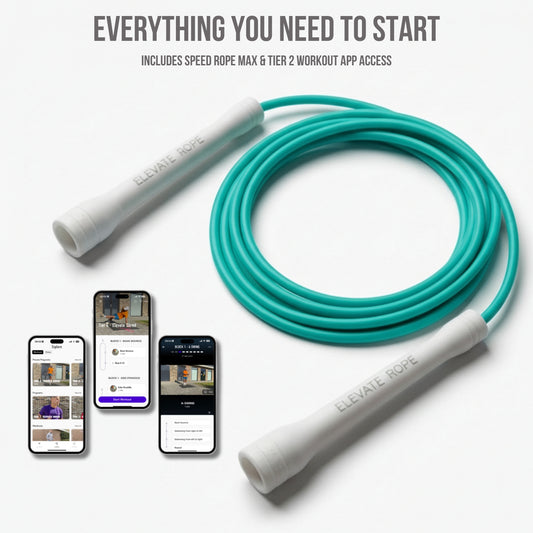
The Elevate Speed Rope MAX uses a flexible 5 mm PVC cable with a nylon core. Its adjustable design supports cardio, basic skipping, and double-under practice.
If you're learning rhythm and speed together, the Elevate Ascent Bundle combines a beaded rope with a speed rope. Each has a different job as your skills progress.
8. How to Adjust a Speed Rope for Double Unders
Once you've checked technique, adjust the cable carefully. Different ropes use snaplocks, clips, screws, or other systems. Follow your model's instructions.
- Identify the mechanism. Check how the cable attaches to each handle.
- Release the connection. Open it carefully without damaging the cord.
- Adjust in small increments. Change the usable cable length a little on both sides.
- Secure both handles. Make sure each connection locks firmly before jumping.
- Test single unders. Check that the rope clears your feet naturally.
- Test double unders. Make a few controlled attempts and observe the arc.
- Trim only when certain. Once you cut the cable, you may not be able to restore its length.
Best practice: Make one rope adjustment at a time. If you change your technique and rope length together, you'll struggle to identify what helped.
9. A Five-Minute Test to Find Your Double-Under Rope Length
You don't need five minutes of uninterrupted doubles. This is a short assessment that helps you identify the next change.
| Minute | Drill | What to notice |
| 1 | Easy single unders | Ground contact and natural hand position |
| 2 | Slightly faster singles | Whether the cable stays responsive |
| 3 | Singles followed by isolated doubles | Toe catches, clearance, and timing |
| 4 | Stop and review your form | Hands, shoulders, jump height, and rhythm |
| 5 | Make one small adjustment, then retest | Whether the new rope length improves control |
Minute 1: Start with your baseline
Jump comfortably and notice where the cable taps the floor. Keep your shoulders relaxed.
Minute 2: Increase speed gradually
Accelerate slightly without lifting your arms or changing posture. Look for consistent rotation rather than maximum speed.
Minute 3: Try isolated double unders
Perform a few singles, then one double under. Rest between attempts. Note whether the rope clips your feet or drags heavily.
Minute 4: Check your technique
Ask yourself: Are my hands too wide? Am I making large shoulder circles? Am I jumping at a repeatable moment? Is the rope hitting far ahead of my toes?
Minute 5: Adjust and compare
If rope length is clearly the problem, make one small change. Repeat the same drills. Keep the adjustment only if the movement improves.
Remember: A standing measurement starts the process. Actual jumping confirms the fit.
10. Five Double-Under Mistakes That Rope Length Won't Fix
Sometimes the equipment is fine. Your next breakthrough comes from technique rather than another cut.
Mistake 1: Jumping too early
If your feet leave the ground before the rope reaches the right point, you'll miss despite correct sizing. Practise a patient, repeatable rhythm.
Mistake 2: Swinging your whole arms
Large shoulder movements create inconsistent rotations. Keep the elbows steady and turn the rope with small wrist circles.
Mistake 3: Kicking your feet backward
Excessive heel kicks change the clearance your rope needs. Stay upright and focus on a controlled vertical bounce.
Mistake 4: Changing rhythm between attempts
Inconsistent speed makes learning harder. Build steady single unders, then introduce an isolated double without completely changing your pattern.
Mistake 5: Practising while exhausted
Fatigue affects control. A study of trained athletes performing double unders found changes in upper-body technique as participants tired. Use short, focused rounds and rest before form deteriorates.
If misses continue, review these mistakes before changing rope length again.
11. Should You Change Rope Length as You Improve?
Possibly, but not after every session. Your preferred setup can evolve as your technique becomes more compact.
Start with consistency
When you can perform occasional doubles, practise repeating them with the same hands and timing. Keep a familiar rope length while building that skill.
Adjust for a clear reason
Later, you may notice excess cable still dragging despite controlled technique. That is a sensible time to test a slightly shorter setup.
Avoid constant changes
If you resize after every miss, you never learn whether the improvement came from practice or equipment. Make a change, test it, then give yourself time to adapt.
The best rope length is the one that supports relaxed, repeatable reps at your current level.

12. How to Build Double-Under Consistency
Finding the right rope length removes one obstacle. Repetition builds the rest.
Master comfortable single unders
Start with basic bounces that feel easy and predictable. Keep the rope and your hands under control.
Practise controlled acceleration
Turn the wrists a little faster without swinging your entire arms. Stay tall and land softly.
Introduce one clean double
Try several singles followed by one controlled double. Don't chase long sets yet. One successful attempt gives you something specific to repeat.
Build gradually and recover
Progress from isolated doubles to short sequences when your timing improves. Pause if you feel pain or unusual discomfort.
For training volume, Harvard Health's jump rope guidance recommends beginning with manageable intervals and resting between efforts.
Your next step: Once rope length feels right, stay with one practice routine long enough to notice progress. Keep each promise small and achievable.
Ready to Work on Your Double Unders?
A comfortable setup gives you one less thing to worry about. The adjustable Elevate Speed Rope MAX supports speed work and steady technique practice.
If you want both rhythm training and faster rotations, explore the Ascent Bundle. Its beaded and speed ropes support different stages of your progression.
Final Thoughts: Find the Length That Supports Your Technique
Double unders can feel frustrating when the rope keeps catching your toes. But don't assume that every miss means your cable is too long.
First, check your hand position. Then watch your rope's ground contact and timing. Adjust rope length only when there's a clear reason.
You don't need ten perfect doubles today. Start with one. Notice what made it work. Then show up and practise again.
Find your rhythm. Trust the process. Together We Elevate.
Frequently Asked Questions
What rope length should I use for double unders?
There is no universal rope length for double unders. Start with a comfortable basic-jump setting, often around lower-chest to armpit handle height. Then test your hand position and clearance. Adjust gradually if the cable drags or catches despite controlled timing. Your jumping style matters more than copying another athlete's measurement.
Should jump rope length be shorter for double unders?
A slightly shorter jump rope length may support faster, more efficient rotations once your technique is consistent. However, cutting too short reduces clearance and makes small hand movements more punishing. Beginners usually benefit from a forgiving setup. Shorten only when your rope repeatedly drags despite stable posture and timing.
Why does my rope hit my feet during double unders?
Toe catches can come from incorrect rope length, early jumping, wide hands, or inconsistent wrist speed. First, try relaxed single unders with your hands near your hips. Then attempt isolated doubles. If the cord still catches with controlled technique, test a small length change rather than cutting immediately.
Is a speed rope necessary to learn double unders?
No. You can perform double unders using several rope types. A speed rope supports quick rotations. Some PVC cables offer more noticeable feedback than very thin wire. Select a model you can control comfortably. Equipment should help your technique, not force you into awkward movements.
Can I learn double unders using a PVC rope?
Yes. A flexible PVC speed rope is a practical choice for developing double under technique. It can balance speed and sensory feedback during practice. Start with steady singles, then introduce one double at a time. Check your rope length and hand position before assuming you need a different cable.
When should I adjust my rope length again?
Revisit rope length when your technique improves but you still notice heavy ground contact or limited clearance. Avoid changes after every missed rep. Make one small adjustment, repeat the same drills, and compare how the rope feels. If you need to trim the cable, confirm the setting before cutting.
About Elevate Rope
Elevate Rope helps people build movement into everyday life. We create jump ropes for beginners, freestyle jumpers, and athletes refining their skills. Our approach goes beyond one successful workout. Each session is a chance to build consistency and self-trust through promises you keep.