





A quick workout before work is the highest-leverage 10 minutes in a desk professional's day — and most people are spending that window scrolling their phone. If you sit for eight or more hours, your body is accumulating damage at a rate no amount of weekend exercise fully reverses. The research on this is unambiguous: prolonged sitting slows metabolism, compresses the spine, shortens hip flexors, and blunts the cognitive sharpness you need to actually do your job well.
The good news is that you do not need to become a morning gym person. You need a short, structured protocol at either end of the workday — one that counteracts what sitting does and costs you nothing but ten minutes of real effort. Jump rope is the only tool that delivers full-body cardio, coordination training, and impact-based bone loading in that window. A single session burns the caloric equivalent of a 30-minute jog, according to research from Arizona State University, and it fits in a drawer next to your keyboard.
This article gives you the exact routines — morning activation, evening deload, and everything in between — with specific rope recommendations for each context. Whether you are stepping out the door at 7 AM or winding down after a ten-hour day at the screen, there is a protocol here that works.
What you'll learn in this article:
→ Why before-work exercise produces different results than after-work for desk professionals
→ The exact 10-minute morning activation routine and why it starts with jump rope
→ An evidence-based evening deload that releases physical tension from sitting
→ Which rope to use in the morning versus the evening (and why the answer is different)
→ How to time your sessions around meals, commutes, and energy levels
→ A comparison of four popular desk-worker workout windows so you can pick the right one
→ The single habit shift that determines whether this routine actually sticks
Morning vs. Evening Exercise: What Actually Changes for Desk Workers
The debate about morning versus evening exercise has been studied extensively, and the findings are more nuanced than most fitness content suggests. For sedentary professionals specifically, timing matters — not because one time is universally better, but because the physiological purpose of each session is entirely different.
What a Morning Session Actually Does
Morning exercise performed before sustained sitting activates the systems that sitting will suppress throughout the day. A 2019 study published in the British Journal of Sports Medicine found that short bouts of morning exercise significantly improved attention, memory, and decision-making throughout the subsequent workday. This is not a motivation story — it is a neurochemical one. Brief intense activity floods the prefrontal cortex with brain-derived neurotrophic factor (BDNF), a protein that enhances focus and cognitive processing for hours post-session.
Beyond cognition, morning movement fires up metabolic rate before it is suppressed by prolonged chair time. When you skip the morning session and go straight to sitting, your metabolism drops to approximately 1 calorie per minute and stays there. A 10-minute activation session before you sit keeps the metabolic rate elevated longer, contributes to EPOC (excess post-exercise oxygen consumption), and means your body is processing energy more efficiently all morning.
The other morning advantage is psychological. Completing a quick workout before work is a kept promise to yourself made before the day has had a chance to steal your intention. Research on self-efficacy consistently shows that small wins early in the day raise the baseline of willpower and follow-through for the hours that follow. It is not willpower you need to exercise in the morning — it is identity. The person who exercises before work is not waiting to "feel motivated." They have decided who they are.
What an Evening Session Does Differently
Evening exercise for desk workers serves a fundamentally different purpose: it is decompression, not activation. After eight or more hours of sustained sitting, the body has accumulated specific physical consequences — compressed discs, shortened hip flexors, suppressed circulation in the lower limbs, and elevated cortisol from the psychological weight of the workday. The goal of the evening session is to reverse those consequences, not to add more physiological stress on top of them.
This distinction matters because the wrong evening approach — say, a high-intensity interval session at 8 PM — can spike cortisol and adrenaline in ways that interfere with sleep onset. Research published in Sports Medicine (Stutz et al., 2019) found that high-intensity exercise within four hours of sleep raised cortisol levels and reduced sleep quality in subjects. For a desk worker already carrying work stress, this is a compounding problem. The evening session should be intense enough to drive blood flow and break up physical tension, but structured to avoid the cortisol spike that sabotages recovery.
Jump rope, particularly weighted rope at moderate rhythm, hits this sweet spot precisely. It drives circulation and warms the posterior chain without the spike-and-crash hormonal pattern of all-out HIIT.
Short answer: Morning sessions activate cognition and metabolism before sitting suppresses both. Evening sessions decompress physical tension without spiking cortisol before sleep.
Why it matters: Using the wrong protocol at the wrong time produces the wrong result. A high-intensity evening workout can ruin sleep quality. A slow morning session misses the cognitive activation window entirely. Matching the protocol to the physiological context is what makes desk-worker routines actually work.
Best next step: Start with the morning protocol below. It takes 10 minutes, requires a rope, and delivers measurable energy and focus benefits within three sessions. → Speed Rope MAX is the recommended tool for morning activation.

The 10-Minute Before-Work Activation Routine
The goal of a before-work routine for desk professionals is not to exhaust yourself — it is to wake up the systems that sitting will shut down. The design principle is simple: raise heart rate, engage the posterior chain, activate the nervous system, and be done before the shower. Ten minutes is the target. Not because more would not help, but because ten minutes is the threshold that most people can realistically protect from their morning schedule on a consistent basis.
Consistency produces more results than occasional intensity. A 10-minute session done five days a week produces better outcomes than a 45-minute session done once a week, both from a metabolic standpoint and from a habit-formation standpoint. The goal is to make this unavoidable — not a big event, just the thing you do before work.
Morning Protocol: The 10-Minute Desk Activator
Use a speed rope for this session. The bearing-free design of the Speed Rope MAX means the rope responds directly to your cadence, not the inertia of a mechanical bearing — which is exactly what you want for quick, reactive morning movement when your nervous system is still waking up.
Morning Activator — 10 Minutes Total
0:00–1:00 — Easy two-foot jumps. Pace yourself at 60–70 jumps per minute. Let the body wake up. Focus on landing softly.
1:00–2:00 — Alternate foot (running step). Brings your heart rate up gradually and activates hip flexors in a lengthened position.
2:00–4:00 — 20 seconds on / 10 seconds rest (Tabata structure). Basic two-foot jump at full effort. Repeat 4 rounds.
4:00–6:00 — High knees with rope. Drive each knee toward hip height. Wakes up the hip flexors that sitting shortens.
6:00–8:00 — Return to Tabata: 20 seconds full effort, 10 seconds rest. 4 rounds of alternate foot.
8:00–9:00 — Easy jumps. Recover but keep moving. Breathe through the nose if possible.
9:00–10:00 — 20 body-weight squats, slow and controlled. Counteracts gluteal amnesia from the day ahead.
This protocol takes up 2×2 metres (6×6 feet) of space — enough for a spare corner in a bedroom, a hallway, or a small balcony. The Elevate App includes guided audio coaching for sessions exactly like this, with automatic interval timing so you do not need to watch a clock while jumping.
Morning Rope Recommendation
The Speed Rope MAX is the right choice for morning activation. It is lightweight, fast-responding, and set up in seconds. If you are new to jumping rope and still building rhythm, the Dignity Beaded Rope is worth considering — the auditory tick of the beads on the floor gives you real-time rhythm feedback, which helps beginners build consistent cadence faster than any other approach.

Comparing Your Four Desk-Worker Workout Windows
Not everyone can move a workout before 8 AM. The table below gives you an honest comparison of the four timing windows that desk professionals realistically have available — including the trade-offs of each and which rope protocol fits best.
| Timing Window | Primary Benefit | Physiological Purpose | Best Protocol | Rope |
| Before work (6–8 AM) | Cognitive activation, metabolic head start | BDNF release, EPOC, circadian alignment | 10-min Tabata / activation | Speed Rope MAX |
| Lunch break (12–1 PM) | Midday energy reset, fights afternoon crash | Blood glucose regulation, cortisol reset | 8-min EMOM | Speed Rope MAX |
| After work (5–7 PM) | Physical decompression, tension release | Posterior chain activation, cortisol clearance | 12-min weighted deload | Gravity Heavy Rope |
| Evening (8–9 PM) | Gentle mobility, stress reset | Parasympathetic shift, sleep preparation | 10-min slow rhythm | Dignity Beaded Rope |
Each window serves a different biological purpose. Trying to replicate your morning Tabata session at 9 PM is a mistake — not because effort is wrong, but because the goal shifts from activation to recovery as the day progresses. Design your week across these windows and your body will reward you with better energy, better sleep, and less structural damage from sitting.

The 12-Minute After-Work Deload Routine
You have been sitting since nine o'clock in the morning. Your hip flexors are shortened and held. Your thoracic spine is rounded. Your glutes have been compressed for hours without firing. Your lower back is bearing load it should not be bearing. This is the physical state you are bringing into your evening — and the worst thing you can do is either ignore it entirely or pile intense HIIT on top of it.
The after-work session is designed around one objective: reversing the physical compression of an eight-hour day. It uses the Gravity Heavy Rope because the added weight forces slower rotation, naturally slowing your tempo and keeping your heart rate in the aerobic zone rather than pushing into anaerobic territory that would spike cortisol before bed. The rhythmic resistance of a heavier rope also demands core engagement throughout the session, which is therapeutic for a spine that has been sedentarily loaded all day.
Evening Protocol: The 12-Minute Desk Deload
Desk Deload — 12 Minutes Total
0:00–2:00 — Easy two-foot jumps with the heavy rope. Let the weight of the rope teach you a slow, deliberate rhythm. There is no rush here. The goal is to get blood moving into the legs.
2:00–4:00 — Alternate foot (slow march tempo). Drive each knee up. This actively extends the hip flexors that have been shortened all day — the clinical equivalent of a standing hip flexor stretch, but dynamic and more effective.
4:00–6:00 — 30 seconds jump / 30 seconds rest. Two rounds. Moderate intensity — 70% effort maximum. You are not training to failure; you are training to circulate.
6:00–8:00 — Side-to-side shuffle jumps. Lateral movement engages the glutes in abduction, firing muscles that have been dormant in a chair. 30 seconds on / 30 seconds rest. Two rounds.
8:00–10:00 — Return to alternate foot at easy pace. Heart rate dropping. Keep moving but slow the rhythm deliberately.
10:00–12:00 — Easy two-foot jumps followed by 90-second static cool-down: standing forward fold (hamstrings), kneeling hip flexor stretch, seated piriformis stretch. These three stretches directly address the muscles most damaged by prolonged sitting.
The complete after-work session including cool-down runs 12 minutes. For those who want to extend it, the Elevate App includes 15-minute follow-along sessions with guided audio instruction at this exact intensity level — categorised by evening recovery, not HIIT.
Why the Heavy Rope Belongs in the Evening
The Gravity Heavy Rope was designed for strength-cardio crossover — resistance from the rope weight means your upper body, shoulders, and core work during every rotation. But for desk workers specifically, its most important property is that it physically prevents the rushed, twitchy cadence that causes cortisol spikes. The weight forces you to slow down. That is not a limitation — for an evening session, it is the entire point.
Short answer: The after-work session should use a heavier rope at moderate intensity for 10–15 minutes, focused on mobility and blood flow rather than peak output.
Why it matters: High-intensity training within four hours of sleep raises cortisol and disrupts sleep quality. Desk workers already carry elevated cortisol from the workday. The evening session that helps most is one that drives circulation and releases physical tension without adding hormonal stress on top of the day's existing load.
Best next step: Pair the → Gravity Heavy Rope with the 12-minute deload protocol above for three weeks. Most people notice reduced lower back stiffness and better sleep quality within the first two weeks.

The One Habit Shift That Determines Whether This Actually Sticks
You can have the perfect protocol and still abandon it within two weeks. Most desk professionals do not fail at exercise because of the exercise itself. They fail because they attach it to motivation rather than identity. Motivation is a weather pattern — it comes and goes, it is unpredictable, and it always seems to be overcast on the mornings you need it most. Identity is structural. It does not fluctuate.
The shift is this: stop thinking of your morning or evening session as exercise you are choosing to do today, and start thinking of it as something that people like you simply do. The person who jumps rope before work does not negotiate with themselves about whether they feel like it. They put on their shoes, pick up the rope, and go. Ten minutes later they are done. That version of identity is not born — it is built through repetition of small kept promises.
Practical Friction Reduction for Desk Workers
Leave the rope on the floor next to your desk the night before a morning session. Physical visibility converts intention into action. Research in behavioral psychology consistently shows that making a target behavior the default — the thing you see first, the thing requiring no decision — dramatically increases follow-through. Do not put the rope away. The slight inconvenience of having it out is the very mechanism that makes you use it.
For the evening session, attach it to an existing trigger. The most reliable one: the moment you close your laptop. Not "sometime after work." The moment the screen goes dark, you pick up the rope. This behavioral chaining is how two-minute habits get installed. What you are building is not a workout — it is a conditioned response to a cue. Once the chain is established, it no longer requires willpower to activate.
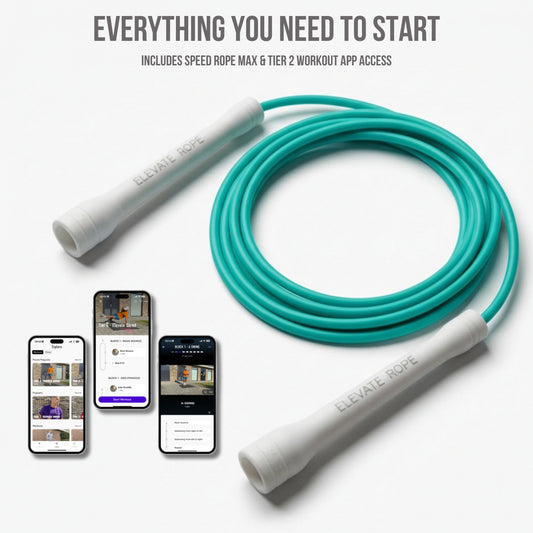
The Ascent Bundle includes both a Speed Rope MAX and a Dignity Beaded Rope, plus access to the Elevate App — which means you have both morning and evening tools in one package, with guided programming already built in. For desk professionals starting both protocols simultaneously, this removes the barrier of needing to purchase separately and figure out what to do with each one.
The Lunch Break Protocol (For When Morning and Evening Are Both Taken)
Not every week allows for morning and evening training windows. Some days the alarm was set too late. Some evenings there are children, partners, dinner, and a hundred competing demands. For those days, the lunch break is the pressure valve — and it is underutilised by nearly every desk worker who has access to it.
A 20-minute lunch break, with eight minutes of actual jumping rope, produces meaningful results. You need a space the size of a car parking bay. You need your rope. You do not need a gym, a change room, or a shower if you keep the intensity controlled. The research on midday exercise for cognitive workers is particularly compelling: a 2020 review in Frontiers in Psychology found that brief midday exercise improved afternoon cognitive performance more reliably than caffeine in subjects doing sustained cognitive work.
The 8-Minute EMOM Lunch Protocol
EMOM stands for "every minute on the minute" — you complete a fixed number of reps at the start of each minute and rest for whatever time remains. This structure is self-pacing, keeps intensity manageable, and is easy to repeat without counting calories or tracking heart rate zones.
Minutes 1, 3, 5, 7: 40 jumps (two-foot, basic bounce). Start each minute at the minute mark. Rest for whatever time remains.
Minutes 2, 4, 6, 8: 30 alternate-foot jumps at moderate pace. Keep shoulders relaxed, elbows close to the sides.
Eight minutes. Done before you have opened a sandwich wrapper. The Speed Rope MAX fits inside a laptop bag and weighs less than a phone charger, which means it goes everywhere your bag goes.

Which Rope Is Right for Your Routine?
Desk professionals running both morning and evening protocols will find that two ropes serve them better than one — not because a single rope cannot do the job, but because the different weights and response characteristics are genuinely optimised for different purposes. Using a heavy rope in the morning produces a slower, more labored session than you want. Using a speed rope in the evening makes it hard to stay at the controlled pace that protects your sleep quality.
| Session Type | Recommended Rope | Why |
| Morning activation | Speed Rope MAX | Fast response, reactive cadence, maximises EPOC in short window |
| Beginner morning | Dignity Beaded Rope | Auditory rhythm feedback builds coordination faster; 3-metre adjustable fit |
| Lunch EMOM | Speed Rope MAX | Portable, immediate setup, consistent performance |
| Evening deload | Gravity Heavy Rope | Weight enforces slower cadence, drives core and upper body engagement |
| Late evening (pre-sleep) | Dignity Beaded Rope | Meditative rhythm, lower intensity ceiling, calming effect |
The → Ascent Bundle (€49,95) includes the Speed Rope MAX and the Dignity Beaded Rope together, which covers four of the five windows in the table above. For the full protocol stack including the evening deload rope, the → Ascent Max Bundle (€69,95) adds the Gravity Heavy Rope to that foundation.
Short answer: Use a speed rope for morning and lunch sessions, a heavy rope for evening deload. Two ropes, total cost under €100, covers every desk-worker training window.
Why it matters: Rope weight directly controls session intensity. Using the wrong rope at the wrong time makes it harder to hit the appropriate physiological target — either pushing too hard when you need recovery, or not hard enough when you need activation.
Best next step: Start with the → Ascent Max Bundle to cover both morning activation and evening deload with the right tools for each.
Frequently Asked Questions
How long should a before-work jump rope session actually be?
Ten minutes is the target for most desk workers. Research on exercise-induced BDNF release shows significant cognitive benefits after sessions as short as eight to twelve minutes of moderate-to-intense effort. The goal is not to exhaust yourself before the workday — it is to activate the systems that sitting will suppress. A 10-minute Tabata-based protocol achieves this without requiring a shower or post-session recovery time that eats into your morning.
Is it better to exercise before work or after work for weight loss?
Both produce fat loss, but through different mechanisms. Morning sessions raise metabolic rate and EPOC before prolonged sitting suppresses metabolism. Evening sessions drive calorie burn at the end of the day when the metabolic dip from sitting is already accumulated. For desk workers, the most effective approach is to use both windows across the week rather than committing exclusively to one. Even three morning sessions and two evening sessions per week produces significantly better outcomes than two longer gym sessions on weekends.
Will a quick workout before work make me too tired to focus?
The opposite is true for moderate-intensity sessions. Studies consistently show that exercise before cognitive work improves attention, working memory, and processing speed for up to four hours post-session. The key word is moderate — a 10-minute session at 70–80% effort activates the nervous system. An all-out 45-minute HIIT session before an eight-hour desk day would be counterproductive. Keep the morning session under 15 minutes and controlled in intensity.
Can I use the same jump rope for both morning and evening sessions?
You can, but the results are not optimised. A speed rope in the evening is harder to keep at a slow, controlled pace — the light rope encourages faster cadence, which can push heart rate and cortisol higher than you want before sleep. A heavy rope in the morning produces a sluggish, laboured session that undershoots the activation goal. If you are starting with one rope, the Speed Rope MAX is the more versatile choice. Add the Gravity Heavy Rope for evening use when your routine is established.
What if I only have time for one session a day — morning or evening?
Morning wins for most desk workers, for one reason: it happens before the day can interfere. Evening sessions get cancelled by late meetings, childcare, dinner, and decision fatigue. Morning sessions get cancelled by nothing except a late alarm. If you can only protect one window, protect the morning. A single 10-minute before-work session done consistently five days a week produces measurable outcomes in four weeks — reduced resting heart rate, improved energy levels, and visible body composition changes.
How do I jump rope at work without equipment space or a changing room?
You need approximately 2×2 metres (6×6 feet) of clear floor space and ceiling height of at least 2.4 metres. A car park, a stairwell landing, a garden, or a spare meeting room all qualify. The sessions are designed to produce minimal sweat at controlled intensity — 10 minutes at 70% effort does not require a shower. The rope fits in a laptop bag. The Elevate App runs on your phone with no additional equipment. The entire setup fits in your bag and deploys in 30 seconds.
I've tried jump rope before and kept tripping. Should I still start with this?
Yes — but start with the Dignity Beaded Rope rather than a speed rope. The heavier beads create auditory and tactile rhythm feedback (the tick-tick-tick on the floor acts as a metronome) that teaches you consistent timing faster than any other approach. Most beginners who trip with speed ropes develop consistent rhythm within three to five sessions on a beaded rope. The bearing-free design also means the rope does not spin ahead of you or behind you — it follows your hands, which eliminates the most common cause of beginner trips.
How quickly will I see results from doing this consistently?
Most desk workers report noticeable changes within the first two to three weeks — primarily in energy levels, afternoon focus, and sleep quality, before visible body changes occur. Lower back stiffness typically reduces within the first week of consistent evening deload sessions. Cardiovascular fitness improves measurably within three to four weeks of regular 10-minute sessions. Body composition changes, if that is the goal, become visible at the four-to-six-week mark when the routine is combined with reasonable nutrition.
Where to Start
If you are a desk professional who has been meaning to exercise more consistently but keeps running into the same problem — not enough time, not enough energy, no clear plan — the before-work and after-work protocols in this article are built specifically for your constraints. They require no gym, no commute, no change of clothes for the morning session, and no equipment beyond a rope that fits in a drawer.
Start with one window, not two. Pick the morning protocol and run it for two weeks before adding the evening deload. Building one habit at a time is not the slow approach — it is the approach that actually works. The person who completes 10 sessions in a row creates more lasting change than the person who plans to do both morning and evening sessions and abandons both by week two.
If you are brand new to jump rope, the → Ascent Bundle (€49,95) includes the Speed Rope MAX and the Dignity Beaded Rope together with the free Elevate App — guided audio sessions, automatic interval timing, and a structured progression plan built for people who are not yet consistent. For the full two-rope system that covers both morning activation and evening deload, the → Ascent Max Bundle (€69,95) adds the Gravity Heavy Rope to that foundation. Both ship free to EU, UK, Australia, USA, and Canada on orders over €50.
Sources
- Huertas, F., et al. (2019). "A single bout of exercise improves cognitive performance." British Journal of Sports Medicine. bjsm.bmj.com
- Baker, J. A. (1968). "Comparison of rope skipping and jogging as methods of improving cardiovascular efficiency." Arizona State University. tandfonline.com
- Stutz, J., Eiholzer, R., & Spengler, C. M. (2019). "Effects of Evening Exercise on Sleep." Sports Medicine. pubmed.ncbi.nlm.nih.gov/30374942
- Biswas, A., et al. (2015). "Sedentary time and its association with risk for disease incidence, mortality, and hospitalization." Annals of Internal Medicine. acpjournals.org
- McMorris, T. & Hale, B. (2012). "Differential effects of differing intensities of acute exercise on speed and accuracy of cognition." Brain and Cognition. pubmed.ncbi.nlm.nih.gov/23063566
- Loh, R., et al. (2020). "Effects of interrupting prolonged sitting with physical activity breaks on blood glucose and lipid responses." Frontiers in Physiology. frontiersin.org/journals/physiology
- Tabata, I., et al. (1996). "Effects of moderate-intensity endurance and high-intensity intermittent training on anaerobic capacity and VO2max." Medicine & Science in Sports & Exercise. pubmed.ncbi.nlm.nih.gov/8897392