






Introduction: Let's Talk About the Cardio You're Not Doing
Here's why jump rope is the cardio solution for people who've given up on cardio.
Be honest.
How many times have you told yourself you'd start running this week? This month? This year?
And how many times have you actually done it?
If you're like most people, there's a growing gap between your cardio intentions and your cardio reality. Maybe you've got a gym membership collecting dust. Maybe there's a treadmill in your spare room that's become an expensive clothes hanger. Maybe you've accepted that you're just "not a cardio person."
Here's the thing: You don't hate cardio. You hate boring, time-consuming, joint-punishing cardio.
And that's a completely different problem — one with a surprisingly simple solution.
Jump rope.
Yes, that thing you did as a kid on the playground. That "basic" exercise that boxers have used for decades to build elite conditioning. That portable, affordable piece of equipment that can deliver better results than running in a fraction of the time.
This isn't hype. It's science. And by the end of this guide, you'll understand exactly why jump rope might be the cardio solution you've been searching for — and how to get started even if you haven't picked up a rope since primary school.

Why Most People Hate Traditional Cardio (And Why That's Valid)
Before we talk about solutions, let's acknowledge the problem.
Traditional cardio — running, jogging, the treadmill, the elliptical — has a motivation problem. Studies show that roughly 50% of people who start an exercise program quit within the first six months. And cardio is often the first thing to go.
Why? Because traditional cardio is:
Time-consuming. The standard recommendation is 30-60 minutes of moderate cardio, 3-5 times per week. That's 2.5 to 5 hours weekly — before you factor in changing clothes, travelling to a gym, showering after, and recovering from the mental drain of forcing yourself to do something you don't enjoy.
Monotonous. There's a reason people zone out on treadmills watching TV or listening to podcasts. The activity itself isn't engaging. You're just... moving. Waiting for it to be over.
Hard on your body. Running is classified as a high-impact activity. Research shows that up to 50% of regular runners experience an injury each year. That's not a minor statistic — that's half of everyone who runs regularly dealing with pain, setbacks, and forced rest periods.
Weather and location dependent. Running outdoors means dealing with rain, cold, heat, darkness, and safety concerns. Running indoors means expensive equipment or a gym membership.
Psychologically punishing. Every skipped session creates guilt. Every struggle to finish creates negative associations. Over time, cardio becomes something you "should" do rather than something you want to do.
If you've experienced any of this, you're not lazy or undisciplined. You're having a completely rational response to an activity that doesn't fit your life.
The question isn't how to force yourself to do more of the same. The question is: what if there was a better option?
Enter Jump Rope: The Cardio Alternative You've Been Overlooking
Jump rope isn't new. Boxers have used it for over a century to build footwork, coordination, and cardiovascular endurance. It's a staple in military training, athletic conditioning, and physical education worldwide.
But somewhere along the way, it got dismissed as a "kids' activity" — too simple to be a "real" workout.
That perception is changing. And the science explains why.
The 10-Minute Miracle
Here's a statistic that might reshape how you think about cardio:
10 minutes of jumping rope provides roughly the same cardiovascular benefit as 30 minutes of jogging.
This isn't marketing fluff. A study published in the Research Quarterly for Exercise and Sport found that participants who jumped rope for 10 minutes daily showed equivalent improvements in cardiovascular fitness to those who jogged for 30 minutes daily over a 6-week period.
Let that sink in. You could potentially cut your cardio time by two-thirds and get the same results.
The Calorie Burn Advantage
According to Harvard Health Publishing, here's how jump rope compares to running for calorie burn in 30 minutes:
| Activity | 57kg (125 lbs) | 70kg (155 lbs) | 84kg (185 lbs) |
| Jump Rope | 300 cal | 372 cal | 444 cal |
| Running (8 km/h) | 240 cal | 288 cal | 336 cal |
| Running (10 km/h) | 300 cal | 360 cal | 420 cal |
Jump rope burns approximately 10-15 calories per minute depending on intensity and body weight. That's among the highest calorie-burn rates of any exercise — comparable to sprinting, but sustainable for longer periods.
The Full-Body Factor
Running primarily works your lower body. Your legs do the work while your arms swing passively for balance.
Jump rope is different.
When you jump rope, you're engaging:
- Calves and ankles — absorbing and generating force with every jump
- Quadriceps and hamstrings — controlling your jump height and landing
- Glutes and hip flexors — stabilizing your pelvis and powering your movement
- Core muscles — maintaining posture and balance throughout
- Shoulders and arms — rotating the rope continuously
- Forearms and grip — controlling rope speed and tension
It's a genuine full-body workout disguised as a simple activity. You're building muscular endurance across multiple muscle groups while simultaneously training your cardiovascular system.
The Joint Impact Reality
"But isn't jumping hard on your knees?"
This is the most common objection — and it's based on a misconception.
When performed correctly, jump rope is actually lower impact than running. Here's why:
With running, your entire body weight crashes down on one leg at a time with each stride. The impact force can be 2-3 times your body weight, concentrated through a single leg.
With proper jump rope technique, you're:
- Landing on both feet simultaneously (distributing impact)
- Staying on the balls of your feet (natural shock absorption)
- Making small, controlled jumps (typically just 2-5cm off the ground)
- Bending your knees slightly (further absorbing impact)
Research published in the Journal of Sports Sciences found that jump rope creates less impact force than running when performed with correct technique on appropriate surfaces.
The key factors for joint-friendly jumping:
- Proper technique — small jumps, soft landings
- Appropriate surface — avoid concrete; use a mat or wooden floor
- Quality footwear — cross-trainers with good cushioning
- Gradual progression — build duration over time

Jump Rope vs. Other Cardio: The Complete Comparison
Jump rope isn't the only alternative to running. Let's see how it stacks up against other popular options.
Jump Rope vs. Running
| Factor | Jump Rope | Running |
| Calories/30 min | 300-444 | 240-420 |
| Time efficiency | 10 min = 30 min jogging | Baseline |
| Equipment cost | €20-50 | €100-200 (quality shoes) |
| Space required | 2m × 2m | Unlimited |
| Weather dependent | No | Yes (outdoor) |
| Impact level | Low-moderate | High |
| Muscles worked | Full body | Lower body |
| Skill development | Yes | Minimal |
| Injury rate | Low | ~50% annually |
Verdict: Jump rope wins on time efficiency, cost, convenience, and injury risk. Running wins if you enjoy being outdoors and covering distance.
Jump Rope vs. Cycling/Spinning
| Factor | Jump Rope | Cycling |
| Calories/30 min | 300-444 | 210-420 |
| Equipment cost | €20-50 | €300-2,000+ |
| Space required | 2m × 2m | Bike storage + riding space |
| Portability | Fits in pocket | Requires transport |
| Upper body work | Yes | Minimal |
| Learning curve | Moderate | Low |
Verdict: Cycling is excellent low-impact cardio but requires significant investment and space. Jump rope offers comparable calorie burn with full-body engagement at a fraction of the cost.
Jump Rope vs. Rowing
| Factor | Jump Rope | Rowing Machine |
| Calories/30 min | 300-444 | 250-370 |
| Equipment cost | €20-50 | €200-2,000+ |
| Space required | 2m × 2m | 2.5m × 1m (machine) |
| Portability | Excellent | Poor |
| Full body | Yes | Yes |
| Impact level | Low-moderate | Very low |
Verdict: Rowing machines are fantastic full-body, low-impact cardio — but they're expensive, bulky, and stationary. Jump rope delivers similar benefits anywhere.
Jump Rope vs. Swimming
| Factor | Jump Rope | Swimming |
| Calories/30 min | 300-444 | 220-370 |
| Facility required | None | Pool access |
| Monthly cost | €0 | €30-100+ |
| Convenience | Anytime, anywhere | Scheduled, location-bound |
| Impact level | Low-moderate | Zero |
| Skill requirement | Moderate | Moderate-high |
Verdict: Swimming is unbeatable for zero-impact exercise and is ideal for those with significant joint issues. For everyone else, jump rope offers superior convenience and calorie burn without pool access.
The Bottom Line
Jump rope consistently ranks among the best options when you factor in:
- Calorie burn per minute
- Time efficiency
- Cost-effectiveness
- Space requirements
- Portability
- Full-body engagement
It's not the only valid choice — but it might be the most practical one.
Why Jump Rope Works for People Who Hate Cardio
If you've struggled with cardio consistency, jump rope addresses several psychological barriers that other exercises don't.
It's Skill-Based (Not Just Suffering)
Running is running. Minute one feels like minute thirty — you're just trying to survive until it's over.
Jump rope is different. There's always something to learn:
- Basic bounce
- Boxer step
- Alternating feet
- High knees
- Side swings
- Crossovers
- Double unders
Each skill creates a sense of progress and accomplishment that pure endurance cardio can't match. You're not just burning calories — you're getting better at something. That's a fundamental shift in motivation.
It's Actually Fun
This might sound like marketing speak, but hear it out.
Jump rope activates flow states — that feeling of being fully absorbed in an activity where time seems to pass differently. The rhythm, the coordination, the immediate feedback of the rope hitting the ground (or your shins, when you're learning) keeps your brain engaged.
Many people who "hate cardio" discover they actually enjoy jump rope because it feels like playing rather than exercising.
The Sessions Are Short
Remember that 10-minute equivalence? When your cardio workout is measured in minutes rather than hours, the psychological barrier to starting drops dramatically.
"I don't have time" stops being a valid excuse when an effective workout takes less time than your commute.
You Can Do It Anywhere
No gym. No special location. No weather concerns. No waiting for equipment.
Your living room. A hotel room. Your office car park. A quiet corner of a park.
When cardio requires zero logistics, you're more likely to actually do it.
Progress Is Visible and Fast
Within your first week of consistent practice, you'll notice:
- Fewer trips over the rope
- Better rhythm and timing
- Increased duration without rest
- New skills becoming accessible
This rapid feedback loop builds momentum. Unlike running — where improvement happens slowly over months — jump rope cardio delivers wins within days. (+4)

Getting Started: Everything You Need
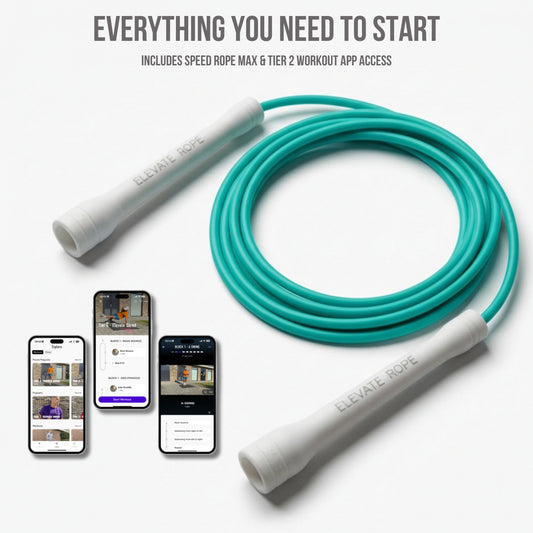
One of jump rope's greatest advantages is simplicity. Here's the complete list of what you need to start your home cardio routine: (+5)
The Rope
Not all jump ropes are equal. For beginners, the right rope makes the difference between frustrating failure and enjoyable progress.
What to look for:
- Adjustable length — Critical for proper sizing (more on this below)
- Some weight — A rope that's too light is actually harder to control. Beaded ropes or light weighted ropes (1/4 lb) provide feedback that helps you feel where the rope is
- Durable handles — Comfortable grip that won't slip when your hands sweat
- Quality bearings — Smooth rotation prevents tangles and frustration
What to avoid:
- Ultra-light speed ropes (designed for advanced double unders, not learning)
- Cheap plastic ropes with no weight (impossible to feel and time)
- Ropes that can't be adjusted to your height
Proper Sizing
This is where most beginners go wrong. An incorrectly sized rope creates constant tripping that has nothing to do with your skill.
How to size your rope:
- Stand on the centre of the rope with one foot
- Pull the handles up along your sides
- The handles should reach between your armpits and your nipple line
For beginners: Err slightly longer. A rope that's a bit long is easier to control than one that's too short.
For your height (general guide):
| Your Height | Rope Length |
| Under 160cm | 2.4m (8') |
| 160-170cm | 2.6m (8'6") |
| 170-180cm | 2.7m (9') |
| 180-190cm | 2.9m (9'6") |
| Over 190cm | 3.0m+ (10'+) |
The Surface
Where you jump matters — both for your joints and your rope's lifespan.
Best surfaces:
- Jump rope mat (purpose-designed)
- Wooden or laminate flooring
- Rubber gym flooring
- Short grass (if rope durability isn't a concern)
Avoid:
- Concrete or asphalt (high impact, destroys ropes quickly)
- Deep carpet (rope drags, throws off timing)
- Uneven surfaces (ankle injury risk)
If you're jumping at home on hard flooring, a dedicated jump rope mat protects both your joints and your floor.
Footwear
Cross-training shoes with cushioning and lateral support work best. Running shoes can work but often have too much heel cushioning for the flat-footed landing of jump rope.
Barefoot jumping is possible on soft surfaces but not recommended for beginners — you want the impact absorption of proper shoes while you're developing technique.
Space Requirements
You need less space than you think for effective cardio training:
- Minimum: 2m × 2m floor space
- Ceiling clearance: Your height plus 30-60cm
- Tip: If ceiling height is an issue, stick to skills that don't require high jumps (basic bounce, boxer step, running step)
Basic Technique: How to Actually Jump Rope
Proper technique makes jump rope sustainable, enjoyable, and effective. Poor technique leads to frustration, fatigue, and potential injury.
Body Position
- Stand tall — shoulders back, chest up
- Eyes forward — don't watch your feet
- Elbows close to body — tucked at your sides, roughly 90-degree bend
- Hands at hip height — slightly forward of your hips
- Knees slightly bent — never locked
The Rotation
This is where most people go wrong. The rope should rotate from your wrists, not your arms or shoulders.
- Small, controlled wrist circles
- Arms stay relatively still
- Shoulders stay relaxed
If your arms are getting tired quickly, you're using too much arm movement.
The Jump
- Small jumps — just 2-5cm off the ground, enough for the rope to pass
- Land on balls of feet — heels can touch lightly, but don't land flat-footed
- Soft knees — absorb the landing, never lock out
- Stay bouncy — think "springy" not "stompy"
The Timing
The rope passes under your feet when you're at the peak of your jump. The rhythm is:
Jump → rope passes → land soft → immediately spring back up
It takes a bit of practice to sync, but your body will find the rhythm naturally within a few sessions.
Common Beginner Mistakes
- Jumping too high — wastes energy, increases impact
- Double bouncing — jumping twice per rope rotation (kills the rhythm)
- Arm windmilling — using shoulders instead of wrists
- Looking down — throws off balance and posture
- Rope too long or short — check your sizing
Your First Workouts: Starting Simple
Don't try to jump for 10 minutes straight on day one. That's a recipe for frustration and shin splints.
Week 1: Building the Foundation
Session structure (15-20 minutes total):
- Warm-up — 2-3 minutes of marching in place, arm circles, light jumping jacks
- Jump rope intervals:20-30 seconds of jumping30-60 seconds of restRepeat 8-10 times
- 20-30 seconds of jumping
- 30-60 seconds of rest
- Repeat 8-10 times
- Cool-down — light stretching (calves, shoulders, forearms)
The goal: Find your rhythm. Tripping is normal and expected. Every session, you'll trip less.
Week 2: Extending Duration
Session structure:
- 30-45 second intervals
- 30-45 second rest
- 10-12 rounds
You're building both skill and conditioning. Don't rush this phase.
Week 3: Introducing Variety
Once the basic bounce feels comfortable, add:
- Boxer step — shifting weight from foot to foot (like a boxer's shuffle)
- Alternating feet — running in place while jumping
Session structure:
- 45-60 second intervals
- 30 second rest
- Mix skills between intervals
- 10-15 rounds
Week 4 and Beyond: Progressive Overload
Options for progression:
- Longer intervals — work toward 2-3 minute unbroken sets
- Shorter rest — 20 seconds, then 15, then 10
- New skills — high knees, side swings, crossovers
- Weighted ropes — increase resistance for strength building
- HIIT structure — maximum effort intervals with timed rest
Sample Workouts by Goal
Fat Burning: The 15-Minute Scorcher
This HIIT-style workout maximises calorie burn and the afterburn effect (EPOC).
Structure:
- 40 seconds maximum effort
- 20 seconds complete rest
- 15 rounds (15 minutes total)
Movements (cycle through):
- Basic bounce (fast)
- High knees
- Boxer step (fast shuffle)
Calorie burn estimate: 200-300 calories
Endurance Building: The 20-Minute Steady State
Longer, sustainable efforts that build cardiovascular base.
Structure:
- 3 minutes of continuous jumping (conversational pace)
- 1 minute active rest (marching in place)
- Repeat 5 times (20 minutes total)
Goal: Complete all intervals without stopping. If you need to stop, shorten intervals and build back up.
Quick Cardio Burst: The 10-Minute Express
For busy days when you need maximum efficiency.
Structure:
- 1 minute jumping
- 30 seconds rest
- 6-7 rounds (10 minutes total)
Intensity: Moderate-high. You should be breathing hard but able to maintain form.
The Office Reset: 5-Minute Movement Snack
Short sessions spread throughout the day can be as effective as one long session.
Structure:
- 45 seconds jumping
- 15 seconds rest
- 5 rounds (5 minutes)
Do this 2-3 times throughout your day for accumulated benefits without needing a full "workout."
Taking It Further: Progression Paths
Once you've established a consistent jump rope practice, several paths forward exist:
Path 1: Skill Development
Learn increasingly complex movements:
- Criss-cross / crossovers
- Side swings
- Double unders (rope passes twice per jump)
- Boxer step variations
- Footwork patterns
This keeps the practice engaging indefinitely. There's always a new challenge.
Path 2: Weighted Ropes
Adding rope weight (1/2 lb, 1 lb, even 2 lb ropes) transforms jump rope into a strength-cardio hybrid:
- Increased upper body engagement
- Higher calorie burn per minute
- Arm, shoulder, and grip development
- Different feel that refreshes the practice
[INTERNAL LINK: Weighted Jump Rope vs. Regular: Which Should You Choose?]
Path 3: Integration
Jump rope doesn't have to be your only exercise. It integrates beautifully with:
- Strength training — use as warm-up or finisher
- Bodyweight circuits — alternate jump rope with push-ups, squats, lunges
- Active recovery — light jumping on rest days
- Sports training — conditioning for any sport requiring footwork
Path 4: Challenges and Programs
Structured programs create accountability and progression:
- 30-day challenges
- Weekly skill-building programs
- Community challenges with accountability

Frequently Asked Questions
Is jumping rope better cardio than running?
For time efficiency, yes. Research shows 10 minutes of jump rope provides cardiovascular benefits equivalent to 30 minutes of jogging. Jump rope also engages more muscle groups (full body vs. primarily legs) and burns comparable or higher calories per minute.
However, "better" depends on your goals. If you enjoy running and want to cover outdoor distance, running serves that purpose. If you want maximum cardio benefit in minimum time, jump rope has a strong advantage.
How long should I jump rope for a good cardio workout?
For beginners, start with 10-15 minute sessions (including rest intervals). As you progress, 15-20 minutes of jump rope 3-4 times per week provides substantial cardiovascular benefit.
For context, 15 minutes of jump rope burns roughly equivalent calories to 30-45 minutes of moderate running.
Can I jump rope in my apartment?
Yes, with considerations:
- Noise: Landing technique matters. Soft, controlled landings are quieter. A jump rope mat also absorbs sound.
- Space: You need roughly 2m × 2m of floor space.
- Ceiling: Check clearance. Basic skills like the boxer step require minimal height.
- Timing: Be mindful of neighbours below — consider jumping during reasonable hours.
Many people successfully jump rope in apartments. The key is proper technique and a good mat.
Is jump rope bad for your knees?
When performed correctly, jump rope is lower impact than running. The key factors:
- Technique: Small jumps, soft landings on balls of feet
- Surface: Avoid concrete; use mats or wood flooring
- Footwear: Cushioned cross-trainers
- Progression: Build duration gradually
If you have existing knee issues, consult a healthcare provider. But for most people, proper jump rope technique is joint-friendly.
What if I haven't jumped rope since I was a kid?
You're not alone — most adults haven't. The good news: the basic skill returns quickly, usually within a few sessions.
Expect to trip frequently in your first week. This is normal and part of the learning process. Focus on rhythm and timing rather than duration. Within 2-3 weeks, most people find a sustainable flow.
How many calories does 10 minutes of jumping rope burn?
Approximately 100-150 calories for most adults, depending on body weight and intensity. At high intensity, this can reach 150-200+ calories.
For comparison, 10 minutes of jogging typically burns 80-120 calories.
Can I lose weight with jump rope?
Jump rope can support weight loss as part of an overall approach that includes nutrition. Its high calorie-burn rate makes it efficient for creating the calorie deficit needed for fat loss.
Many people find the time efficiency and convenience of jump rope helps them maintain consistency — and consistency matters more than any single workout.
The Bottom Line: Why Jump Rope Might Be Your Answer
Let's return to where we started.
You don't hate cardio. You hate cardio that wastes your time, bores you senseless, and beats up your body.
Jump rope is different:
- ✓ Time efficient — 10-15 minutes delivers real results
- ✓ Engaging — skill-based progression keeps it interesting
- ✓ Joint-friendly — lower impact than running when done correctly
- ✓ Cost-effective — less than one month of gym membership
- ✓ Portable — works anywhere, anytime
- ✓ Full-body — cardio and muscle engagement combined
You don't need to become a boxer or a competitive jump roper. You just need a piece of equipment that costs less than a dinner out, a few square metres of space, and 10-15 minutes you were probably going to spend scrolling your phone anyway.
The question isn't whether jump rope works. The science is clear on that.
The question is whether you're ready to try something different.
Ready to Start?
If you're convinced and ready to begin, here's your next step:
Get the right equipment. A properly weighted, adjustable rope designed for beginners makes the learning curve significantly smoother. Cheap ropes create frustration; quality ropes create progress.
[SHOP: Elevate Beginner Rope Collection]
Then follow a structured program. Don't just "try jumping rope." Follow a progression that builds skills and conditioning systematically.
[READ: Jump Rope Workout for Beginners: Your Complete First 30 Days]
And if you want accountability, join thousands of others in our community challenge.
[EXPLORE: Elevate 26 Challenge]

"Remember that 10-minute equivalence? When your cardio workout is measured in minutes rather than hours, the psychological barrier to starting drops dramatically."
Source: Harvard Health Publishing (calorie burn data)
"If you're jumping at home on hard flooring, a dedicated jump rope mat protects both your joints and your floor. Proper surface selection reduces injury risk significantly."
Source: ACE Fitness (American Council on Exercise)
For a complete breakdown of how to get started, see our jump rope workout for beginners: your complete first 30 days.