






If you want to burn more calories than running but dread pounding pavement for 45 minutes, you're not alone. Running has been the default "serious" cardio for decades, and most people assume it's the gold standard. But research tells a different story — several exercises outpace running's calorie output in less time, and a few don't even require leaving your house.
This isn't about bashing running. It's fine if you enjoy it. But if your knees, schedule, or boredom keep pulling you away, there are alternatives that outperform jogging while being easier to stick with.
What You'll Learn
- Five exercises that burn more calories than running, backed by data
- Calories-per-minute comparisons for each exercise
- Why the "best" exercise is the one you'll actually do consistently
- How to start with the most efficient option on this list
The Calorie Burn Baseline
A 70 kg (154 lb) person running at 8 km/h (5 mph) burns roughly 560–600 calories per hour — about 9.5 per minute — according to the Compendium of Physical Activities. That's the number to beat. Every exercise below matches or exceeds it, and most do so in less time with less joint impact.
Calorie burn varies by body weight, effort, and metabolism. The figures below use the same 70 kg baseline for fair comparison.
Exercise 1: Rowing (Indoor Ergometer)
Rowing is one of the most underrated ways to burn more calories than running. A vigorous session burns approximately 600–800 calories per hour, depending on intensity. Research from the Journal of Strength and Conditioning Research confirms that rowing engages roughly 86% of your muscles — it's a genuine full-body exercise that steady-state jogging can't match.
The combination of resistance and cardiovascular demand is what sets it apart. You're pulling against load with your back, legs, and arms simultaneously, creating a metabolic cost that running doesn't match. The drawback? You need a rowing machine and good form. But if you're in a gym environment, rowing is an excellent low-impact option.

Exercise 2: Kettlebell Training
Kettlebell swings and complexes burn more calories than running at roughly double the rate. A study from the American Council on Exercise found that kettlebell training burns approximately 20 calories per minute — that's 400 calories in just 20 minutes of work, compared to roughly 190 for moderate jogging.
The ballistic nature of kettlebell movements is the key. Swings, cleans, and snatches demand explosive power from your posterior chain while taxing your cardiovascular system simultaneously. Your body recruits fast-twitch muscle fibres and maintains aerobic output at the same time, which drives metabolic cost through the roof.
Kettlebells also generate significant EPOC — the "afterburn" effect. Your metabolism stays elevated for hours post-workout because your body is repairing tissue and replenishing energy stores. Running at a steady pace doesn't trigger nearly the same afterburn response. The barrier to entry is one kettlebell and enough space to swing it safely, though learning proper form is important.
Exercise 3: Jump Rope
Here's where things get interesting. Jump rope — the exercise most people dismissed as a childhood game — can burn more calories than running, minute for minute, with serious research to back it up.
A study from Arizona State University found that 10 minutes of jump rope provides roughly equivalent cardiovascular benefit to 30 minutes of jogging. In calorie terms, moderate jump rope burns approximately 700–900 calories per hour (12–15 per minute), comfortably exceeding running's 560–600 range. But the raw numbers aren't even the best part.
It's portable and space-efficient. You need a rope and roughly 2 metres of clearance. No gym, no machine, no commute.
It scales with you. Beginners start with basic bouncing. As coordination improves, you naturally increase speed and add variations — progressively increasing calorie burn without consciously "pushing harder."
The time barrier disappears. A focused 10-minute jump rope HIIT session delivers meaningful results. For busy people, this changes the equation entirely — and it's a key reason jump rope can burn more calories than running in a fraction of the time commitment.
Short answer: Jump rope burns 700–900 calories per hour — enough to burn more calories than running in one-third the time, with equivalent cardiovascular benefits.
Why it matters: The biggest barrier to weight loss isn't finding the "best" exercise. It's finding one you'll do consistently. Jump rope removes the time excuse, the gym excuse, and the boredom excuse all at once.
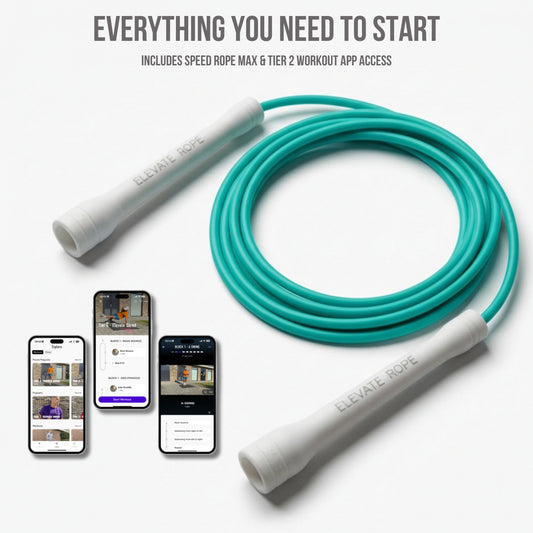
Best next step: If you're new to jump rope, start with a beaded rope — the weight and feedback help beginners find rhythm faster. → Elevate Beaded Ropes
If you're curious about exactly how the calorie math works, we break that down in detail in our complete guide to jump rope calories burned.
Exercise 4: Swimming (Vigorous Laps)
Vigorous swimming burns approximately 700–850 calories per hour — enough to comfortably burn more calories than running while producing zero impact on your joints. For people carrying extra weight or dealing with knee issues, that combination is hard to beat.
The catch is access and skill. "Vigorous laps" means sustained front crawl or butterfly at a pace that keeps your heart rate elevated. Leisurely breaststroke with long rests is closer to 400 calories per hour, which barely matches jogging. You also need a pool, which usually means a gym membership and travel time. For many people, that friction kills the consistency that actually drives weight loss.
If you enjoy swimming and have easy pool access, it's a fantastic option. But for most people looking to outpace running's calorie output on a daily basis, the logistics make it hard to sustain.
Exercise 5: HIIT (High-Intensity Interval Training)
HIIT isn't a single exercise — it's a training protocol that makes almost any exercise burn more calories than running. A well-designed HIIT session burns 25–30% more calories than the same exercise at a steady pace, according to research in the British Journal of Sports Medicine.
Short bursts of maximum effort followed by brief recovery push your heart rate into high zones repeatedly, creating metabolic demand that steady-state exercise can't reach. The afterburn effect is also significantly higher — your body continues burning elevated calories for 12–24 hours post-workout.
In practical terms, a 20-minute HIIT session can burn 300–450 calories. That's comparable to 40+ minutes of moderate jogging. When you combine HIIT with an exercise that already burns more calories than running — like jump rope — the results compound. This is exactly why jump rope HIIT workouts are among the most efficient fat-loss tools available.
Short answer: HIIT burns 25–30% more calories than steady-state exercise, creating an afterburn lasting up to 24 hours. Combined with already-efficient exercises like jump rope, the effect compounds dramatically.
Why it matters: You don't need longer workouts. HIIT applied to high-efficiency exercises — like jump rope — creates a compounding effect that crushes jogging's output in a fraction of the time.
Best next step: Try a speed rope for HIIT — the lighter weight and faster rotation let you push interval intensity higher. → Elevate Speed Ropes

The Comparison: 5 Exercises That Burn More Calories Than Running
| Exercise | Calories/Hour (70 kg) | Equipment Needed | Space Required | Skill Barrier |
| Running (8 km/h) | 560–600 | Shoes | Outdoors / Treadmill | Low |
| Rowing | 600–800 | Rowing machine | Gym | Medium |
| Kettlebell Training | 600–1,200 | Kettlebell | Small area | Medium |
| Jump Rope | 700–900 | Rope only | 2m clearance | Low–Medium |
| Swimming | 700–850 | Pool access | Pool | Medium–High |
| HIIT (general) | 700–1,000+ | Varies | Varies | Medium |
The exercises that burn more calories than running all share one thing: they demand more from your body per unit of time — whether through full-body engagement, ballistic power, or interval intensity.
But notice the practical differences. Rowing needs a machine. Swimming needs a pool. Kettlebells need coaching. Jump rope needs a rope and two square metres. When you factor in accessibility and cost alongside calorie burn, the picture shifts.
Why the "Best" Exercise Is the One You'll Actually Do
The calorie difference between exercises that burn more calories than running matters far less than whether you'll actually do them three to five times per week for months on end.
A "perfect" exercise you skip twice a week burns zero on those days. A "good enough" exercise you do consistently compounds over time as your fitness improves. This is why the alternatives on this list aren't automatically better than running — if you love running, run. The data simply shows that for people who dislike running or can't sustain it, these options outperform jogging while being more practical.
We're particularly focused on jump rope because of the enjoyment factor. Its skill curve keeps your brain engaged, it adapts to any fitness level, it takes almost no time, and it removes every logistical barrier that causes people to quit. Those factors compound into the consistency that actually drives weight loss.
For a direct head-to-head across every metric, our jump rope vs running comparison lays it all out.
Short answer: The most effective exercise for weight loss is the one you'll do consistently — not the one with the highest theoretical calorie burn.
Why it matters: Adherence beats intensity every time. A 10-minute daily habit outperforms a 60-minute workout you skip three times a week.
Best next step: Start with a bundle that gives you progression options as your skills grow. → Elevate Rope Bundles
How to Get Started (If Jump Rope Caught Your Attention)
If exercise number 3 resonated — and you're curious about trying the exercise that can burn more calories than running from your living room — here's how to start.
Choose the right rope for your level. Beginners should start with a beaded rope. The added weight gives tactile feedback on every rotation, making it dramatically easier to find your rhythm. → Elevate Beaded Ropes
Start with 5–10 minutes. Five minutes of jump rope, broken into 30-second intervals with 30-second rest, is a legitimate beginner workout. Our guide to 10-minute workouts explains why short sessions work better for long-term results.
Progress with intention. As basic bouncing becomes comfortable, transition to a speed rope for HIIT. When that feels routine, a weighted rope like the → TITAN 7MM adds upper-body engagement and breaks through plateaus.
For the complete weight loss roadmap, our complete guide to jump rope for weight loss ties everything together.
Frequently Asked Questions
What exercise burns the most calories in 30 minutes?
Vigorous jump rope and HIIT training burn the most in a 30-minute window — approximately 350–450 calories for a 70 kg person. That's 40–60% more than moderate running in the same timeframe. Generally, exercises that burn more calories than running demand full-body engagement and sustained elevated heart rates.
Can I burn more calories than running without a gym?
Yes. Jump rope and bodyweight HIIT both outpace running's calorie output and require zero gym access. Jump rope needs nothing more than a rope and about two metres of clearance — making it one of the most accessible high-calorie-burn exercises available.
Is jump rope hard on your knees?
Less than running. Jump rope involves small hops of 2–5 cm — far less impact per landing than running strides. Jumping on a forgiving surface (rubber mat, wooden floor) reduces impact further. For most people, jump rope is significantly gentler on joints than road running.
How long do I need to jump rope to match a 30-minute run?
Approximately 10–15 minutes of moderate-to-vigorous jump rope matches the calorie burn and cardiovascular benefit of a 30-minute jog. This 3:1 efficiency ratio is why jump rope is so effective for people short on time.
Do these exercises burn more calories than running for everyone?
The relative rankings are consistent across body weights, though absolute numbers change. A heavier person burns more total calories in any exercise, but jump rope, rowing, and HIIT still outpace running by similar proportional margins. Individual effort level is the biggest variable.
What's the best jump rope for beginners who want to lose weight?
A beaded rope. The segmented beads add weight that provides rotational feedback, helping beginners develop timing faster. Once you can jump consistently for 2–3 minutes, transitioning to a speed rope unlocks HIIT training that accelerates calorie burn. Our buyer's guide covers every rope type.
Does the "afterburn effect" really make a difference?
Yes. EPOC from high-intensity exercise adds 50–200 extra calories in the 12–24 hours after your workout. Over months, that adds roughly 0.5 kg (1 lb) of additional fat loss per month. HIIT and kettlebell training produce the strongest afterburn.

Your Next Steps
Running isn't bad. But it's not your only option. All five exercises on this list outperform running on calorie burn while being more time-efficient, more joint-friendly, or more accessible — and jump rope delivers all three advantages at once.
Pick one exercise you could realistically do three to four times per week, and start this week. If jump rope interests you, a rope and 10 minutes is all it takes. → Elevate Bundles give you a progression kit that grows with you, or start with a single → Beaded Rope and build from there.
Sources
- Compendium of Physical Activities — Arizona State University
- Rowing Biomechanics and Muscle Activation Patterns — Journal of Strength and Conditioning Research, 2015
- Kettlebell Training Calorie Expenditure Study — American Council on Exercise, 2010
- Interval Training and Body Adiposity — British Journal of Sports Medicine, 2019
- Comparison of Calorie Expenditure in Jump Rope vs Jogging — Research Quarterly for Exercise and Sport
You May Also Like
- The Complete Guide to Jump Rope for Weight Loss — The pillar page tying this entire series together
- Jump Rope Calories Burned: The Complete Guide — The exact calorie math for every rope type and intensity
- Jump Rope vs Running for Weight Loss — A head-to-head breakdown across every metric
- How to Lose Weight Without Running — 7 proven cardio alternatives for non-runners
- The Science of Exercise You Actually Enjoy — Why fun beats discipline for long-term results
- Jump Rope HIIT Workouts for Fat Loss — 5 routines that actually work