






The 30-day jump rope challenge for desk workers is designed around one reality: you have almost no time, and you've already tried the things that don't work. This isn't a program for people who love exercise. It's for people who sit eight hours a day, feel it in their back and hips and waistline, and want one straightforward thing they can actually stick to — no gym required, no commute, no rearranging their life.
Ten minutes a day. Thirty days. A rope that fits in your desk drawer. That's the whole premise. Arizona State University research confirms that 10 minutes of jump rope delivers the cardiovascular equivalent of 30 minutes of jogging — so there's no need to manufacture time you don't have. You just need to stop skipping the ten minutes you already have.
This guide gives you the complete program: a day-by-day schedule, weekly progression blocks, modification options for every fitness level, and the exact approach that makes 30 days a turning point rather than another thing you abandoned in week two.
What you'll learn in this guide:
→ Why 30 days is the specific threshold that rewires a habit (and what the research says)
→ The complete 4-week desk worker progression — what you do each day, in plain language
→ How to fit the challenge into a workday without a single schedule change
→ Which rope to use at each stage, and why it matters for beginners
→ What to do when you miss a day (because you probably will)
→ How to make Day 31 the start of something, not just the end of a challenge
→ The exact mistakes that cause people to quit in week one, and how to avoid them
Why 30 Days and Why It Works for Desk Workers Specifically
The 30-day format exists for a precise neurological reason. Habit formation research from University College London found that behavioral automaticity — the point at which a behavior stops requiring conscious decision-making — peaks around 66 days on average, but meaningful neural pathway formation begins around the 21-day mark and becomes measurable by day 30. In plain terms: 30 days is long enough to make something feel normal, and short enough to feel achievable from day one.
For desk workers, the challenge is distinct from general fitness struggles. The issue isn't willpower. It's activation energy — the mental effort required to start a behavior. When you sit in a chair for eight hours, inertia is working against you in both directions. Your body adapts to stillness, and your brain stops generating movement-seeking signals. The longer you sit, the harder it gets to initiate anything.
A 10-minute jump rope session solves this in a way that 45-minute gym workouts never can. The activation threshold is low enough to actually cross. There's no commute threshold, no "getting changed" threshold, no "do I have time" threshold. The rope is within arm's reach. You stop, you jump for ten minutes, you sit back down. That's precisely the kind of small, completable action that rebuilds self-trust over 30 days.
The Elevate Code is built around exactly this principle: transformation doesn't come from motivation. It comes from kept promises. Each completed session — especially on the days you didn't feel like it — is a data point in your own evidence that you follow through. After 30 days, you're not just fitter. You're someone who does the thing.
Short answer:
30 days of consistent jump rope creates measurable cardiovascular improvement, visible body composition changes, and — most importantly — an established movement habit that continues beyond the challenge.
Why it matters:
For desk workers, the biggest barrier isn't fitness — it's consistency. Thirty days at 10 minutes per day is 300 minutes of cardio. That's more structured exercise than most desk workers complete in three months of sporadic gym visits. The compound effect is physical and psychological.
Best next step:
Start with the Dignity Beaded Rope if you're new to jumping. The auditory feedback makes rhythm learning dramatically faster, which means you spend less time frustrated and more time actually working out.

Before You Start: The Setup That Determines Whether You Finish
Choose Your Rope Based on Where You Are Right Now
The most common reason people quit a jump rope challenge in the first week has nothing to do with fitness. It's equipment. A cheap, kinking rope that catches on your feet every third jump is demoralizing in a way that has nothing to do with your capability. Choosing the right rope for your starting level removes a friction point that kills most attempts.
| Your Situation | Recommended Rope | Why |
| Never jumped rope as an adult / beginner | Dignity Beaded Rope | Beads give auditory feedback ("tick-tick-tick") that trains rhythm. Slower arc = more time to react. |
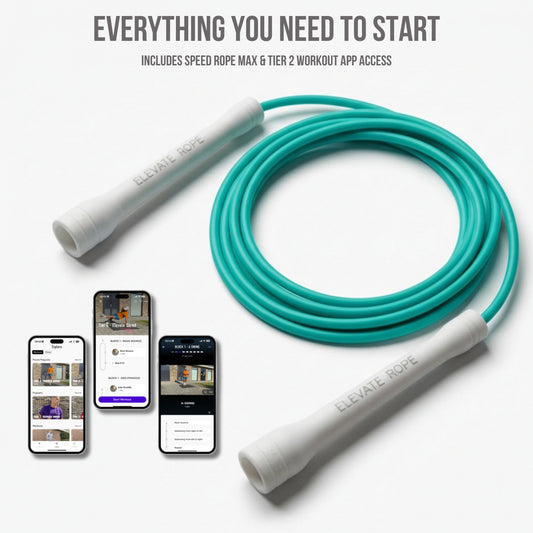
| Can jump but want to build speed / HIIT capacity | Speed Rope MAX | Bearing-free 5mm PVC wire spins consistently. Ideal for double-unders and fast intervals. |
| Want strength-cardio hybrid / break a plateau | Gravity Heavy Rope | 10mm rope adds upper body and core load. Excellent for desk workers with tight shoulders. |
| Want everything in one purchase | Ascent Bundle | Speed Rope MAX + Beaded Rope + app access + Elevate Code + nutrition guide. Full system. |
Decide Where You'll Jump
You need a space roughly 1.8 metres wide and 2.5 metres tall. Most home offices, living rooms, balconies, gardens, and even car parks qualify. If you're jumping indoors on hard flooring, a → Jump Rope Mat is worth adding — it protects your joints on concrete and hard wood, and the cushioned surface makes 10-minute sessions noticeably more comfortable on days when your legs are already tired from sitting.
Set Your "Jump Window"
Pick one consistent time slot and treat it like a meeting with yourself. Research on habit formation consistently shows that implementation intentions ("I will do X at Y time in Z place") are significantly more effective than general intentions ("I'll try to jump rope more"). The best window for most desk workers is immediately before work, during a lunch break, or directly after the workday ends — before the couch becomes an option.

The Complete 30-Day Program
The challenge is structured across four progressive weeks. Each week builds on the last. The format follows a work-rest-work rhythm that prevents overuse and keeps you progressing without burning out.
All sessions are 10 minutes unless otherwise noted. Rest days are real rest days — don't compensate by jumping longer on adjacent days.
Week 1 — Foundation
Build the movement pattern. Low intensity. Goal: finish each day, not feel destroyed by it.
Week 2 — Rhythm
Increase work intervals. Start feeling the difference. The "it's getting easier" week.
Week 3 — Intensity
Push work-to-rest ratios. Sessions get harder. This is where the visible change starts.
Week 4 — Consolidation
Prove it to yourself. Longer continuous sets. You finish this week knowing you can keep going.
Week 1: Foundation (Days 1–7)
Don't let the simplicity fool you. Week 1 is about getting your feet, hands, and jump arc synchronised — and it's harder than it sounds if you haven't jumped rope since school. Use the Beaded Rope here. The slow arc and tick feedback are not "beginner" features — they're rhythm-training tools that will carry your technique into every subsequent week.
| Day | Session | Format |
| Day 1 | Introduction jump | 5 sets × 1 min jump / 1 min rest |
| Day 2 | Same as Day 1 | Focus on keeping elbows in |
| Day 3 | REST | Walk for 10 minutes if you like |
| Day 4 | Rhythm work | 5 sets × 90 sec jump / 90 sec rest |
| Day 5 | Rhythm work | Repeat Day 4. Note where you lose rhythm. |
| Day 6 | Endurance push | 4 sets × 2 min jump / 1 min rest |
| Day 7 | REST | Full recovery. Week 2 starts tomorrow. |
Week 1 target: complete every scheduled session. Missing one is fine — make it up the following day and don't skip two days in a row. The programme can absorb a miss. It cannot absorb consecutive misses.
Week 2: Rhythm (Days 8–14)
By now the basic movement should feel less foreign. Week 2 introduces interval work — alternating intensity within a single session. This is where the cardiovascular adaptation starts happening and where most people first notice that 10 minutes feels shorter than it did in Week 1.
| Day | Session | Format |
| Day 8 | Interval introduction | Alternate 30 sec fast / 30 sec steady for 10 min |
| Day 9 | Repeat Day 8 | Try to shorten rest by 5 sec compared to yesterday |
| Day 10 | REST | — |
| Day 11 | Pyramid intervals | 1 min / 90 sec / 2 min / 90 sec / 1 min (equal rest each) |
| Day 12 | Repeat Day 11 | Focus on landing softly on the balls of your feet |
| Day 13 | Long set push | 3 sets × 3 min continuous / 1 min rest |
| Day 14 | REST | You're halfway. Note how your body feels vs. Day 1. |
Week 3: Intensity (Days 15–21)
This is the hardest week. Sessions push your work capacity further and rest periods get shorter. If you're using the Speed Rope MAX, now is when its consistency matters — you don't want to be fighting a tangling rope when you're already working at 85% effort. Week 3 is where the visible body composition changes become noticeable for most people.
| Day | Session | Format |
| Day 15 | HIIT block | 8 sets × 40 sec on / 20 sec off |
| Day 16 | Endurance | 2 sets × 4 min continuous / 2 min rest |
| Day 17 | REST | — |
| Day 18 | HIIT block | 10 sets × 40 sec on / 20 sec off |
| Day 19 | Pace builder | 4 sets × 2 min fast / 30 sec rest |
| Day 20 | Long set | 1 set × 6 min continuous / 2 min rest / 1 set × 4 min |
| Day 21 | REST | 9 days left. That's it. |
Short answer:
Week 3 is where most people either solidify the habit or fall off. The key is not relying on motivation — it will be lower in Week 3 than in Week 1. The system carries you through, not the feeling.
Why it matters:
Research on exercise adherence consistently shows that motivation peaks at program initiation and drops significantly around week 2–3. The people who finish 30-day programs aren't more motivated — they've reduced the friction of each individual session to the point where doing it is easier than not doing it.
Best next step:
If Week 3 sessions feel overwhelming, scale back the work intervals by 10 seconds. You're still doing the session. That's what matters. The Elevate App has guided 10-minute workouts that remove the decision-making entirely — press play and follow the audio.
Week 4: Consolidation (Days 22–30)
The final week is about proving something to yourself. The sessions are structured around longer continuous work blocks — not to punish you, but to demonstrate that your Week 1 ceiling is now your warm-up. That evidence matters. You'll carry it past Day 30.
| Day | Session | Format |
| Day 22 | Endurance baseline | 3 sets × 3 min / 1 min rest |
| Day 23 | HIIT finisher | 10 sets × 45 sec on / 15 sec off |
| Day 24 | REST | — |
| Day 25 | Long set challenge | 1 × 8 min continuous / 2 min rest |
| Day 26 | HIIT repeat | 12 sets × 40 sec on / 20 sec off |
| Day 27 | REST | — |
| Day 28 | Your personal best | Go for the longest continuous set you've ever done |
| Day 29 | Active recovery | Easy pace. 10 min continuous at 60% effort. |
| Day 30 | Completion session | Your choice. Do what feels right. You've earned it. |

Fitting the Challenge Into a Real Workday
The 10 minutes is not the problem. The problem is the 15 minutes surrounding it — changing, setting up, cooling down, getting back to work. Here's how desk workers who've completed the challenge actually handle it.
The "No Change Required" Jump
Most desk workers jump in their work clothes. If you're working from home, this is essentially the whole solution. If you're office-based, jump before you shower in the morning or immediately when you get home. Avoid the transition where you "need to get changed" — that friction point kills more sessions than anything else.
The Lunch Break Protocol
Jump for 10 minutes at the start of your lunch break, not the end. Post-exercise parasympathetic rebound (the calm that follows intense activity) actually improves afternoon focus. The cognitive benefit is real — a 2019 study in the British Journal of Sports Medicine found that even brief bouts of vigorous activity improved executive function and working memory for up to two hours post-exercise.
The Before-Work Window
Set your alarm 12 minutes earlier than usual. Jump for 10, change for two. This is the most reliable window for desk workers because it exists before the day has a chance to derail it. Evening sessions are vulnerable to meetings running late, family demands, and the simple gravitational pull of the sofa after eight hours of work. Morning sessions aren't.
Rope Storage
Keep your rope out. On your desk. On the kitchen counter. Somewhere visible. Environmental design research is clear: when the object required for a behaviour is visible and within arm's reach, the behaviour happens 80% more often than when it needs to be retrieved. A rope coiled in a drawer is a rope that doesn't get used.

What to Do When You Miss a Day
You will miss a day. Plan for it now so it doesn't become two days, which becomes a week, which becomes quitting.
The rule is simple: one miss is weather. Two misses is a pattern. If you miss Day 12, you jump on Day 13 and continue normally. Do not attempt to "make up" missed sessions by doubling the next day — this is how injuries happen and how the challenge stops being sustainable. The 30-day structure is robust enough to absorb individual misses. It's consecutive misses that compound into failure.
If you miss three or more consecutive days for any reason — illness, travel, life — don't restart from Day 1. Resume where you left off and extend the 30-day window by the number of days missed. The goal is 30 completed sessions. The calendar dates are just scaffolding.
How to Measure Progress Without Obsessing Over It
The desk worker challenge produces measurable results across four dimensions. Track the ones that matter to you — not all four simultaneously, which creates overwhelm.
| Metric | How to Measure | Expected Change at Day 30 |
| Continuous jump time | How long you can jump without stopping | 2–3x improvement from Day 1 baseline |
| Resting heart rate | Pulse in the morning before getting up | 3–7 bpm reduction (cardiovascular adaptation) |
| Lower back comfort | 1–10 scale at end of each workday | Noticeable improvement by Week 2 |
| Afternoon energy | Note your 3pm energy level daily | Measurable improvement by Day 14 |
Body weight is the metric most people want to track and the one most likely to disappoint in 30 days — not because the challenge doesn't work, but because body weight fluctuates daily by up to 2–3kg based on hydration, glycogen storage, and hormonal cycles. If you must weigh yourself, do it weekly on the same morning under the same conditions, and treat it as one data point among four.
What Day 31 Looks Like
The 30-day challenge is a vehicle, not a destination. People who treat Day 30 as "the finish" see a drop-off. People who use Day 30 as a proof point see a continuation. The difference is what you decide Day 30 means before you start.
After 30 days, the most common question is: what do I do next? The Elevate26 program is the answer — a 26-day structured jump rope program delivered directly to your inbox that builds on exactly the foundation you've spent a month creating. It extends the challenge format with greater variety, progression logic, and accountability. If you've completed the desk worker 30-day challenge, you're already more than ready for it.
If you've been jumping on just the Beaded Rope and want to extend your capability, Week 4 is the natural point to introduce a → Speed Rope MAX for faster intervals. If you want to add upper body and core load to complement the lower-body dominance of speed jumping, the → Gravity Heavy Rope creates a natural second-rope progression.
Short answer:
Day 31 should be another jump day. That's the whole point. The challenge exists to build the habit, not to end it.
Why it matters:
Habit durability research shows that behaviours maintained for 30+ days have a significantly higher 6-month retention rate than shorter programs. You've done the hard work. The friction of starting is gone. The only thing that kills a 30-day habit is treating it as a temporary sprint rather than a permanent shift.
Best next step:
Sign up for the Elevate26 challenge at elevaterope.com. It's free, it's structured, and it picks up exactly where this challenge leaves off.

Frequently Asked Questions
Is a 30-day jump rope challenge enough to see real results?
Yes — with a realistic definition of "real." Thirty days of consistent 10-minute sessions produces measurable cardiovascular improvement (3–7 bpm resting heart rate reduction), visible changes in leg and core tone, and reduced lower back stiffness from prolonged sitting. It is not enough to produce dramatic fat loss on its own, but combined with reasonable eating it creates a significant caloric deficit over the month and establishes the movement habit that drives long-term change.
What if I've never jumped rope before? Can I still do this?
That's exactly who this challenge is designed for. Week 1 is structured around beginner session lengths and work-to-rest ratios that account for the learning curve. The Dignity Beaded Rope is specifically suited to first-time adult jumpers — the slower arc and auditory feedback make coordination development significantly faster than a speed rope.
How many calories does 10 minutes of jump rope burn?
For a 75kg person jumping at moderate intensity, expect 100–140 calories in 10 minutes. At higher intensity (HIIT-style intervals), that rises to 150–180 calories. Over 30 days at the low end, that's approximately 3,000–4,000 calories — the equivalent of roughly 0.5–0.6kg of fat tissue, not counting the post-exercise metabolic elevation (EPOC) that continues for 2–3 hours after each session.
Can I do the challenge with bad knees?
Many people with knee discomfort jump rope successfully. The key variables are surface, footwear, and technique. Jump on a cushioned surface — a Jump Rope Mat reduces impact force by approximately 30% compared to hard flooring. Land on the balls of your feet, not your heels. Keep knees slightly bent throughout. If you have a diagnosed knee condition, consult your physiotherapist before starting. The Beaded Rope's slower rotation makes it the easier entry point for people managing joint sensitivity.
What's the best time of day to do the challenge sessions?
Consistency of time matters more than which time. That said, morning sessions have the highest completion rate for desk workers because they're protected from the schedule disruptions that derail evening intentions. If morning isn't possible, directly after work — before sitting down again — is the second most reliable window. Avoid mid-evening sessions after 9pm; elevated heart rate can interfere with sleep quality.
Do I need the Elevate app to do this challenge?
No. This guide gives you everything you need. The app adds guided audio workouts, a built-in timer, and progress tracking — which removes the mental load of counting intervals. If you'd rather just set a timer on your phone and follow the schedule above, that works equally well. The app is free with any Elevate Rope purchase.
What happens if I miss more than three days in a row?
Resume where you left off and extend your 30-day window by the number of days missed. Don't restart from Day 1 — that resets your progress and creates a psychological pattern of starting over rather than continuing. The goal is 30 completed sessions, not 30 consecutive calendar days. A missed stretch due to illness or travel doesn't invalidate the sessions you've already banked.
Is the challenge suitable for people over 50?
Yes. Jump rope is low-impact when performed correctly and provides bone density benefits that are particularly valuable for adults over 50 (impact exercise counteracts the bone density reduction associated with sedentary work). Start at Week 1 regardless of your general fitness level, use the Beaded Rope for technique development, and land with knees soft. The 10-minute format means sessions never become the extended stress on joints that long-distance running creates.
Start the Challenge: What You Actually Need
You need three things. A rope. A space. A consistent time slot. That's it.
If you're a complete beginner, the → Dignity Beaded Rope removes the most common Week 1 frustration — the rope catching underfoot. The beaded arc is forgiving while your timing develops, and the tick feedback trains your rhythm faster than any other rope type.
If you want the complete system — rope, mat, app, and a structured post-challenge programme — the → Ascent Bundle covers everything and sits below most gym memberships at cost-per-use. Orders over €50 ship free across the EU, UK, US, Canada, and Australia.
The challenge starts the day your rope arrives. Not January 1st. Not next Monday. The day your rope arrives. Every desk worker who has done this remembers the first session — not because it was impressive, but because it was the day they stopped waiting for a better time to start.
Sources
- Lally, P., van Jaarsveld, C.H.M., Potts, H.W.W., & Wardle, J. (2010). How are habits formed: Modelling habit formation in the real world. European Journal of Social Psychology. doi.org/10.1002/ejsp.674
- Baker, D., & Bloomfield, J. (1999). Jump rope exercise and fitness. Arizona State University Department of Exercise Science. Referenced in multiple subsequent meta-analyses on rope skipping caloric expenditure.
- Lambourne, K., & Tomporowski, P. (2010). The effect of exercise-induced arousal on cognitive task performance. Brain Research. doi.org/10.1016/j.brainres.2010.08.040
- Wheeler, M., et al. (2019). The Association Between Physical Activity and Cognition. British Journal of Sports Medicine. bjsm.bmj.com/content/53/18/1157
- Stamatakis, E., et al. (2022). Vigorous physical activity, incident heart disease, and cancer. European Heart Journal. doi.org/10.1093/eurheartj/ehac572
- Gollwitzer, P.M. (1999). Implementation intentions: Strong effects of simple plans. American Psychologist, 54(7). doi.org/10.1037/0003-066X.54.7.493
- World Health Organization. (2020). Physical activity guidelines for adults. who.int/news-room/fact-sheets/detail/physical-activity
- Biswas, A., et al. (2015). Sedentary time and its association with risk for disease incidence, mortality, and hospitalization. Annals of Internal Medicine. doi.org/10.7326/M14-1651
You May Also Like
https://www.elevaterope.com/blogs/home-workout-tips/jump-rope-vs-walking-office-workers
https://www.elevaterope.com/blogs/tips-tricks/quick-workout-before-work
https://www.elevaterope.com/blogs/articles/jump-rope-stress-relief
https://www.elevaterope.com/blogs/articles/best-jump-rope-for-beginners
https://www.elevaterope.com/blogs/crossfit-hiit/jump-rope-home-office-setup