





Jump rope for stress relief works through mechanisms that have nothing to do with motivation, willpower, or thinking your way into a better mood — and that is precisely why it works when everything else fails. There is a point in most stressful days when the usual coping tools stop functioning. The deep breath does not land. The walk around the block helps slightly and then the thoughts rush back. The glass of wine helps for an hour and then makes the cortisol worse. What the body is actually demanding in those moments is not relaxation. It is movement — specifically, rhythmic, full-body movement intense enough to burn through the cortisol and adrenaline that the workday has been building since nine o'clock in the morning.
Research published in PMC found that rhythmic exercise such as jump rope measurably reduces anxiety scores and cortisol levels within a single session. What the science confirms is something thousands of people already know from experience: the racing thoughts that dominate a stressful afternoon simply stop when the rope starts moving. The focus required to maintain rhythm — to count rotations, to time each landing, to keep the rope moving without tangling — forces the mind into the present. There is no cognitive space left for the inbox, the deadline, or the conversation that went badly. There is only the rope, the rhythm, and the breath.
This article explains the neuroscience behind why it works, gives you a complete 10-minute stress reset protocol, and helps you choose the right rope for the way stress shows up in your body — because how you experience stress determines which approach will clear it fastest.
What you'll learn in this article:
→ The exact neurochemical reason jump rope clears stress faster than passive relaxation
→ Why the rhythm of a rope works like moving meditation — and why it works when sitting still does not
→ The 10-minute cortisol reset protocol you can do anywhere
→ How different rope types produce different stress outcomes
→ The connection between consistent exercise and long-term anxiety reduction
→ What to do when you are too stressed to even start moving
→ Why desk workers specifically carry a cortisol load that passive rest cannot clear
Why Jump Rope Clears Stress When Breathing Exercises Cannot
Stress is not a psychological event. It is a biological one. When the body registers a stressor — a difficult email, a tense meeting, a looming deadline — it releases cortisol and adrenaline. These hormones serve a specific evolutionary purpose: they prepare the body for physical action. The heart rate rises. Blood flow redirects from the digestive system to the muscles. Glucose is released into the bloodstream. The body is ready to run or fight.
The problem for desk workers is that the stressor never triggers the physical action the hormones were designed to fuel. You sit through the meeting, process the difficult email, and carry the unspent biochemical load into the next hour, and the next. By the end of an eight-hour day, the accumulated cortisol is still circulating. Passive relaxation techniques — breathing exercises, meditation, watching television — do not metabolise it. They interrupt the stress response briefly, but the hormones remain. Sleep quality suffers. The next morning you wake up already carrying yesterday's residue.
What Exercise Does That Nothing Else Does
Physical exercise is the only mechanism that actually burns through accumulated stress hormones. The physiological logic is direct: cortisol and adrenaline were designed to support physical exertion. When you provide that exertion — even for ten minutes — the hormones fulfil their purpose and the system resets. A 2019 review in Frontiers in Neuroscience confirmed that acute aerobic exercise reduces cortisol levels in the bloodstream within a single session, with the effect measurable within minutes of stopping.
Jump rope specifically is effective for this purpose for three reasons that most exercise modalities cannot match simultaneously. First, it is intense enough to trigger the sympathetic-to-parasympathetic shift within a short window — you do not need 45 minutes to burn through the cortisol. Second, the coordination demand forces present-moment attention. You cannot jump rope while ruminating. The cognitive load of maintaining rhythm is small enough to feel effortless but large enough to crowd out intrusive thinking. Third, the rhythmic, bilateral nature of the movement activates the same neural pathways as other bilateral rhythm-based practices like walking and drumming — practices with documented calming effects on the nervous system going back decades of research.
The Flow State Problem — And Why Rope Solves It
One reason people cannot meditate their way out of stress is that sitting still with a racing mind intensifies the experience rather than quieting it. The attempt to observe thoughts without engaging them requires a level of metacognitive control that is essentially impossible when cortisol is elevated. You cannot think your way out of a neurochemical state.
Jump rope creates what researchers call a low-demand attentional state: an activity absorbing enough to require focus, but not so cognitively complex that it generates its own stress. This is the sweet spot for anxiety clearance. The rope asks enough of you to silence the spiral without asking so much that it becomes another source of pressure. As Geraldo, founder of Elevate Rope, describes it: "When I pick up this rope, I just enter some kind of new realm. It's just me and this rope and my music, and you can just let go of everything around you. And that's just the best feeling."
Short answer: Jump rope burns through cortisol and adrenaline physically — the only mechanism that actually clears stress hormones rather than temporarily suppressing them.
Why it matters: Passive relaxation techniques work by interrupting the stress response, not eliminating the underlying biochemistry. Accumulated cortisol from a full workday stays in the bloodstream until physical exertion metabolises it. This is why people who do not exercise after stressful days sleep worse, wake up more anxious, and carry more tension into the next morning.
Best next step: Try the 10-minute cortisol reset protocol below the next time you finish a difficult workday. Use the → Dignity Beaded Rope if your anxiety level makes it hard to focus — the auditory rhythm provides a metronome that anchors attention without effort.

The Rhythm Factor: Why Jump Rope Is Moving Meditation
The relationship between rhythmic movement and mental calm is not new. Cultures worldwide have used rhythmic physical practice — drumming, walking, chanting, dancing — as tools for emotional regulation for thousands of years. Modern neuroscience has given this phenomenon a mechanism: bilateral, rhythmic movement activates the cerebellum and the basal ganglia in patterns associated with reduced amygdala activation, the brain region responsible for anxiety and threat-detection responses.
What makes jump rope distinct within rhythmic exercise is the degree of full-body bilateral engagement. Both arms rotate simultaneously. Both feet land together. The rhythm is self-generated and self-maintained — meaning the feedback loop between action and sensation is immediate and constant. Each rotation of the rope provides proprioceptive feedback. Each landing grounds attention back into the body. Over a 10-minute session, this continuous loop of action, feedback, and rhythm creates a state that practitioners consistently describe in the same language: present, quiet, clear.
Why It Works When Sitting Meditation Does Not
Sitting meditation is a powerful practice for people whose nervous systems can tolerate stillness. For people with elevated cortisol, chronic stress, or anxiety as a baseline, stillness amplifies rather than relieves. The instruction to observe thoughts without engaging them becomes a torment when the thoughts are loud and the cortisol is high. The body is primed for movement, and asking it to stay still creates resistance that the practice then has to work against.
Jump rope sidesteps this entirely. The body is moving, so there is no fight with stillness. The rhythm creates a perceptual narrowing — the attentional spotlight shrinks to the rope, the feet, the breath. One customer review from Elevate Rope's own community captured it precisely: "After a hectic workday, 10 minutes of jumping rope is like a brain reset." Another: "It's almost meditative for me — it clears my mind completely, and the only thing I focus on is the sound of my breathing."
For people who have tried and abandoned traditional meditation, this is a genuinely viable alternative. The meditative quality is a byproduct of the movement, not a goal you have to achieve through discipline. You do not have to be good at quieting your mind. The rope does that for you.

The 10-Minute Cortisol Reset Protocol
The protocol below is designed specifically for stress clearance, not calorie burn or cardiovascular training. The intensity is moderate and intentional — hard enough to trigger cortisol metabolism, controlled enough to avoid generating a new stress response. Do this at the end of a difficult workday, after a tense meeting, or any time the mental load feels like it has nowhere to go.
You need approximately 2×2 metres (6×6 feet) of space and your rope. No music required — though many people find that a single repetitive track at 120–130 BPM naturally synchronises with a comfortable jump cadence and amplifies the meditative effect. The Elevate App includes guided audio sessions structured for exactly this kind of decompression session.
10-Minute Cortisol Reset
0:00–2:00 — Start at easy pace, two-foot jump. Do not try to jump fast. The goal here is to get blood moving and establish rhythm. Breathe through your nose if you can. Let the first two minutes be genuinely easy.
2:00–4:00 — Pick up to a comfortable working pace. Alternate foot (running step). Count rotations in sets of ten. This counting anchors attention without demanding much — exactly the cognitive load you want.
4:00–6:00 — Increase to 80% effort. Two-foot jumps at a pace that feels challenging but sustainable. Breathe through the mouth. This is where the cortisol metabolism happens — the body is now working hard enough to use the stress hormones as fuel.
6:00–7:00 — Drop back to easy alternate-foot pace. Active recovery. Let your heart rate come down slightly but do not stop.
7:00–9:00 — Second working interval. Same 80% effort. Focus entirely on the rhythm. If thoughts arise, return attention to the sound of the rope, the feel of each landing. No negotiation — just return.
9:00–10:00 — Easy two-foot jumps tapering to a stop. Take 60 seconds after the session to stand still, breathe, and notice the contrast. The quiet after a jump rope session is different from the quiet before it.
Most people notice a measurable shift in mental state within the first three to four minutes of this protocol. By minute eight, the physiological stress response has largely cleared. The contrast between how you felt when you picked up the rope and how you feel when you put it down is the most direct demonstration of what the research has been confirming for decades.
What to Do When You Are Too Stressed to Start
There is a particular type of overwhelm where the idea of doing anything — including a 10-minute workout — feels impossible. The body is tense, the mind is resistant, and every suggestion to "just move" feels like an additional demand on a system already past capacity. This is real, and the solution is not to push through it with force.
Start with 60 seconds. Pick up the rope, jump for one minute at the easiest possible pace, and then decide whether to continue. Almost universally, the decision after 60 seconds is to keep going — because the neurochemical shift begins within the first minute, and the body recognises it. The resistance is pre-movement. It dissolves almost immediately once motion starts. The hardest part of the 10-minute reset is the first rotation of the rope.

Choosing the Right Rope for Your Stress Type
Not all stress is the same, and not all ropes produce the same experience. The physical characteristics of a rope — its weight, the sound it makes, its rotational speed — create meaningfully different sessions. For stress relief specifically, matching the rope to how your anxiety actually shows up in your body produces better outcomes than defaulting to whatever rope you happen to own.
| Stress Profile | What It Feels Like | Best Rope | Why |
| Racing thoughts, difficulty focusing | Mind won't slow down; feel scattered and reactive | Dignity Beaded Rope | Auditory tick creates an external metronome — anchors attention without effort |
| Physical tension, tight shoulders and back | Body feels wound up; jaw or neck clenching | Gravity Heavy Rope | Upper-body resistance demands engagement from the muscles holding tension — releases them through use |
| Low energy, flat and drained | Depleted rather than wired; no motivation | Speed Rope MAX | Light, responsive — requires minimal energy to start but activates dopamine quickly |
| General end-of-day decompression | Mentally tired but not acutely stressed | Dignity Beaded Rope | Meditative rhythm, lower intensity ceiling, naturally calming |
| Acute anxiety or overwhelm | Heart racing before you even start; feel unable to focus | Dignity Beaded Rope | Slower pace ceiling, tactile rhythm feedback, gentler entry into movement |
The Dignity Beaded Rope is the most versatile tool for stress relief specifically because the auditory rhythm — the tick-tick-tick of beads on the floor — functions as a sensory anchor. When the mind is loud, having an external rhythm to follow removes the cognitive demand of generating your own. You follow the sound. The sound follows you. Over a few minutes, the two synchronise, and that synchronisation is itself the meditative state.
Short answer: For racing thoughts and anxiety, use the Beaded Rope — the auditory rhythm acts as an external focus anchor. For physical tension and wound-up energy, use the Heavy Rope to engage and release the muscles holding it.
Why it matters: Using a speed rope when you are acutely anxious can feel overwhelming — the fast cadence it encourages matches and amplifies the internal pace you are trying to slow. Matching rope weight and response to your stress state means the tool works with your nervous system rather than against it.
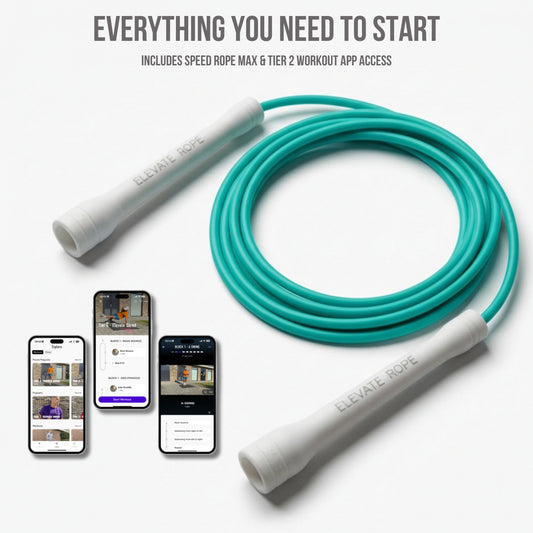
Best next step: → The Ascent Bundle includes both the Speed Rope MAX and the Dignity Beaded Rope, giving you the right tool for both energised morning sessions and evening stress clearance. The free Elevate App adds guided audio decompression sessions.
Beyond the Reset: How Consistent Jump Rope Builds Long-Term Stress Resilience
The 10-minute reset protocol clears the acute stress response. But the more significant benefit of regular jump rope practice is what it does to your baseline — the resting level of cortisol, anxiety, and mental load you carry into each day before anything stressful has even happened.
A 2020 meta-analysis published in Neuroscience and Biobehavioral Reviews found that consistent aerobic exercise over six to eight weeks produced significant reductions in trait anxiety — not just state anxiety in the moment, but the baseline anxiety level that characterises a person's day-to-day experience. Participants who exercised consistently three to five times per week showed measurable reductions in resting cortisol, improved HRV (heart rate variability, a direct marker of stress resilience), and lower self-reported anxiety scores across all timepoints.
Ten minutes of jump rope done consistently five days a week adds up to roughly 50 minutes of moderate-intensity aerobic exercise per week. This is enough to produce the neuroadaptations associated with reduced trait anxiety. The hippocampus — the brain region most suppressed by chronic cortisol — shows measurable growth with consistent aerobic exercise. BDNF production increases. The prefrontal cortex becomes better at modulating the amygdala's threat-detection response. These are structural changes, not mood fluctuations. Consistent movement builds a brain that is physiologically more resilient to stress, independent of what the stressors are.
The Identity Dimension
There is a dimension to this that the neuroscience papers do not fully capture. When you are someone who reliably turns to movement when the day becomes difficult — when reaching for the rope instead of reaching for your phone or a drink becomes your default stress response — something shifts in how you relate to stress itself. You stop fearing hard days. You know you have a tool that works, that you can access anywhere, that costs nothing and takes ten minutes. That knowledge changes the experience of the stressor before you have even moved a muscle.
This is what the Elevate Code calls self-trust: the quiet confidence of someone who keeps the promises they make to themselves. A person who exercises when stressed is not gritting their teeth through a discipline protocol. They have simply built an identity where movement is the answer, and stress becomes the trigger for that answer rather than a reason to avoid it.

Why Desk Workers Carry a Cortisol Load That Rest Alone Cannot Clear
The stress that desk professionals accumulate is different in one important way from the stress of physical labour: it is purely cognitive and emotional, with no physical outlet built into the work itself. A construction worker who has a stressful day has still moved their body. The stress hormones have somewhere to go. A knowledge worker who has a stressful day has sat in a chair while the biochemical stress response ran in the background for eight hours with no discharge mechanism whatsoever.
This creates a compounding problem. Uncleared cortisol from Tuesday evening is still partially present on Wednesday morning. Wednesday's stress adds to it. By Thursday, the baseline is elevated enough that small stressors trigger disproportionate responses. By Friday, the person is describing themselves as "burned out" — which is accurate, but the mechanism is biochemical accumulation rather than a sudden collapse. Research on allostatic load — the cumulative burden of chronic stress — shows that knowledge workers have among the highest average cortisol loads of any occupational group, precisely because the work generates continuous stress without continuous physical resolution.
A consistent jump rope practice at the end of the workday does not just make you feel better. It interrupts this accumulation cycle at the biochemical level. This is the functional argument for why desk workers need regular physical exercise more urgently than people in physically active roles — not for cardiovascular health, though that benefit is real, but for cortisol clearance. The body needs to finish what the stress response started. Ten minutes of rope gives it the permission to do that.
For a full breakdown of how the workday affects your body hour by hour, the cluster pillar page — Jump Rope for Desk Workers: The Complete Guide — covers the sitting cascade in detail and lays out the full week-by-week starter plan for desk professionals beginning a consistent practice.
Short answer: Desk workers accumulate cortisol through cognitive and emotional stress with no physical discharge built into their work. This creates a compounding daily load that passive rest does not clear.
Why it matters: By the end of a typical workweek, a desk professional who does not exercise is carrying up to five days of accumulated, unmetabolised cortisol. This is the biochemical substrate of burnout. Regular jump rope practice at moderate intensity is the most time-efficient mechanism known to interrupt that cycle.
Best next step: Start with the 10-minute reset protocol three times this week — after your three most demanding workdays. Note the difference in sleep quality and morning energy. Most people feel the shift within the first week. → Gravity Heavy Rope for high-tension evenings; → Dignity Beaded Rope for anxious or scattered days.
Frequently Asked Questions
Does jump rope actually reduce stress or just distract from it?
Both — and the distinction matters less than people think. Jump rope reduces cortisol and adrenaline biochemically through physical exertion, which is genuine stress clearance, not distraction. The attentional narrowing created by rhythm-based movement is also a form of directed focus that interrupts ruminative thinking. Both mechanisms are real, and both produce measurable outcomes. The stress relief is not temporary in the way that watching television is temporary — the cortisol is actually lower after the session, not just masked.
How long before I feel the stress-relief effects of jump rope?
Most people report a shift within three to five minutes of a moderate-intensity session. The cortisol reduction begins earlier but becomes perceptually noticeable around the four-minute mark, which is also when attentional narrowing typically locks in and the mind quiets. The full reset — where you feel meaningfully different from how you felt before picking up the rope — usually completes by minute eight to ten. If you are not feeling a shift within 15 minutes, the intensity may be too low to trigger the cortisol metabolism.
Is jump rope better for stress relief than running or cycling?
For the specific purpose of stress clearance, jump rope has practical advantages over both. Running requires leaving your location. Cycling requires equipment or a venue. Jump rope requires 2 square metres and 10 minutes. The coordination demand of jump rope also creates stronger present-moment focus than steady-state running, where the mind can wander freely into the same ruminative loops that generated the stress in the first place. The stress-relief effect of running is well-documented, but the attentional anchoring that makes jump rope meditative is harder to replicate on a treadmill.
What if I have anxiety and am afraid of getting my heart rate up?
Start with the Dignity Beaded Rope at the slowest pace that maintains a continuous rhythm. A gentle 60–70 jump-per-minute cadence raises heart rate minimally while providing all the rhythmic and attentional benefits. The goal is not intensity — it is movement. As your nervous system associates the rope with calm rather than exertion, the intensity can increase naturally over time. Many people with anxiety find that starting with two minutes and building gradually is more effective than committing to a full protocol from the first session.
Can I use jump rope as a replacement for therapy or medication for anxiety?
Exercise is one of the most evidence-backed non-clinical interventions for anxiety and mild-to-moderate depression, and consistent aerobic exercise has been shown to reduce trait anxiety scores significantly. However, jump rope should be understood as a complement to professional support, not a replacement for it. If your anxiety is significantly affecting daily functioning, professional guidance remains important. Jump rope gives you a daily tool for symptom management and nervous system regulation — it does not resolve the underlying causes of clinical anxiety disorders.
Why does jump rope feel calming when other exercise feels like more stress?
The rhythm is the answer. High-intensity interval training without a rhythmic structure — burpees, box jumps, chaotic circuit training — can elevate cortisol rather than metabolise it, particularly when the intensity is too high or the session is too long. Jump rope's inherent rhythm creates a contained, metronomic structure that the nervous system reads as safe rather than threatening. The combination of intensity and rhythm is what produces the stress-clearing effect without adding to the stress load.
How often should I use jump rope for stress relief to see long-term changes?
Three to five sessions per week for six to eight weeks produces the neuroadaptations — reduced resting cortisol, improved HRV, lower trait anxiety — documented in the research. Daily 10-minute sessions are more effective than twice-weekly 30-minute sessions for stress specifically, because the cortisol clearance mechanism works best when applied consistently rather than in infrequent large doses. Consistency of practice is the primary variable. The Elevate 26 Challenge provides a structured 26-day daily programme that builds this consistency with guided sessions through the free Elevate App.
Does the type of music I listen to while jumping affect the stress relief?
Yes, meaningfully. Research on music and exercise consistently shows that tracks with a tempo of 120–140 BPM synchronise with jump rope cadence and produce greater attentional immersion than silence or slower music. Instrumentals and tracks without lyrics that demand active processing further reduce cognitive interference. Tracks you associate with positive states produce larger mood effects than neutral tracks. That said, any music you find genuinely engaging is better than the "right" tempo with tracks you dislike — the goal is immersion, and immersion is personal.
Where to Start
If stress is the reason you are here, the most important thing you can do is start this week — not this month, not when things are less busy. The days when things are less busy are also the days when the cortisol load is lower and the reset feels less necessary. The protocol earns its value on the hard days, and the only way to have it available on hard days is to have built the habit before they arrived.
For most desk workers starting from scratch, the → Dignity Beaded Rope is the right entry point for stress relief specifically. The auditory rhythm is genuinely calming in a way that speed ropes are not. As the habit builds and the rope becomes associated with calm rather than effort, the → Speed Rope MAX opens up higher-intensity sessions for days when the cortisol load is high and needs a stronger discharge. The → Ascent Bundle (€49,95) includes both ropes and access to the free Elevate App, which tracks your sessions and includes guided audio protocols for decompression. That is the complete stress-relief toolkit.
Ten minutes. Anywhere you have space to stand. No commute, no gym, no schedule change required. The rope goes where the stress goes — which, for most desk professionals, means it lives at home and gets used after work. Start there.
Sources
- Salmon, P. (2001). "Effects of physical exercise on anxiety, depression, and sensitivity to stress." Clinical Psychology Review. pubmed.ncbi.nlm.nih.gov/11148895
- Stubbs, B., et al. (2017). "An examination of the anxiolytic effects of exercise for people with anxiety and stress-related disorders." Psychiatry Research. pubmed.ncbi.nlm.nih.gov/28088704
- Zschucke, E., et al. (2013). "Exercise and physical activity in mental disorders: clinical and experimental evidence." Journal of Preventive Medicine and Public Health. ncbi.nlm.nih.gov/pmc/articles/PMC3567313
- Salmon, P. (2001). "Effects of physical exercise on anxiety, depression, and sensitivity to stress." Clinical Psychology Review 21(1). pubmed.ncbi.nlm.nih.gov/11148895
- Gujral, S., et al. (2017). "Exercise effects on depression: possible neural mechanisms." General Hospital Psychiatry. pubmed.ncbi.nlm.nih.gov/28866586
- Harber, V. J., & Sutton, J. R. (1984). "Endorphins and exercise." Sports Medicine. pubmed.ncbi.nlm.nih.gov/6091217
- McEwen, B. S. (2008). "Central effects of stress hormones in health and disease." European Journal of Pharmacology. ncbi.nlm.nih.gov/pmc/articles/PMC2272878
You May Also Like
https://www.elevaterope.com/blogs/articles/best-jump-rope-for-beginners
https://www.elevaterope.com/blogs/crossfit-hiit/jump-rope-home-office-setup
https://www.elevaterope.com/blogs/workouts-tutorials/30-day-desk-worker-jump-rope-challenge