


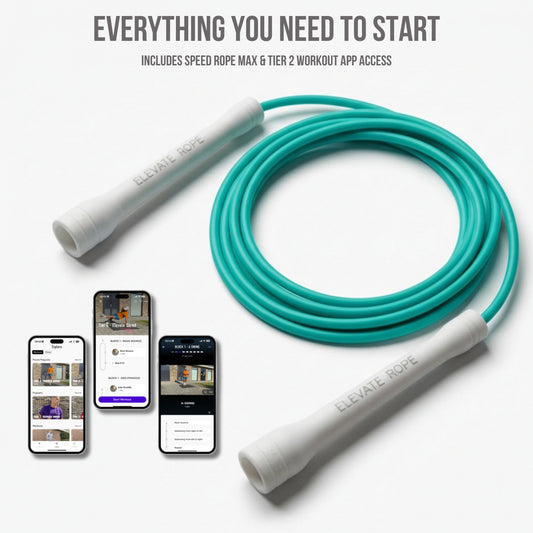




Jump rope progress tracking for kids is the difference between a rope that lives in the toy basket and a rope that becomes part of who your child is. Most parents do the first part well. They buy the rope. They show their child how to swing it. Maybe they even jump along for the first week. Then something quiet happens. The skill stops being new. The early wins stop coming in clusters. And without a way to see the climb, the rope goes silent.
This is not a willpower problem. It is a feedback problem. Children, like adults, need to see progress to keep wanting more of it. The visible climb is the engine. Strip it out and the habit collapses, regardless of how much your child enjoyed the first session.
The good news is that jump rope is one of the easiest activities on earth to track. Every skill is countable. Every milestone is a moment your child can feel in their body. The trick is knowing which numbers matter, when to celebrate them, and how to keep the rhythm going for the long stretch after the novelty fades. That is the entire job of this guide.
What you'll learn
Why progress visibility is the single biggest predictor of whether a child sticks with jump rope
The seven progress markers that actually matter (and the ones that quietly demotivate kids)
A weekly tracking rhythm that takes ninety seconds and works for any age from five upward
How to celebrate wins without accidentally killing your child's intrinsic motivation
The 30-day milestone printable structure you can build yourself in five minutes
What to do when progress stalls (it will, and the response matters more than the stall)
How to use the Elevate App and community to make the habit stick past month three
Why Tracking Matters More Than Talent
The research on habit formation is unambiguous. A 2024 systematic review and meta-analysis in Healthcare looked at the timeline for new health behaviours to become automatic and found median times of fifty-nine to sixty-six days, with individual variation as wide as four to three hundred and thirty-five days. The same review identified self-monitoring as one of the strongest determinants of habit strength alongside frequency, timing, and individual choice. In plain terms, kids who can see their progress build the habit faster, and the habit lasts longer.
Self-determination theory adds the second half of the picture. Children's intrinsic motivation depends on three psychological needs being met: autonomy (a sense of choice), competence (a sense of getting better), and relatedness (a sense of belonging). A 2013 study in the International Journal of Behavioral Nutrition and Physical Activity tested this model directly in 462 primary school children aged seven to eleven and confirmed that competence satisfaction was the strongest motivational driver of sustained physical activity. Tracking does not just measure competence. Tracking creates the experience of competence. Without visible markers, the child's brain has nothing to register the climb against.
This is the parenting paradox of progress. Children who keep jumping are not the most coordinated, the most athletic, or the most disciplined. They are the children whose parents helped them see the climb. The rope is the vehicle. The tracking is the engine.
The Cost of Invisible Progress
When progress is invisible, three things happen, and they happen in roughly this order. First, the early dopamine of novelty fades. Second, the child plateaus on a skill (usually around week three, when basic bounces are competent but the next skill has not yet been introduced). Third, without a marker to show that the plateau is normal and temporary, the child concludes they have hit their limit. The rope quietly goes into the cupboard. Parents blame the child, the child, or the activity. In reality, the system failed before motivation ever ran out.

The Seven Progress Markers That Actually Matter
Not all metrics serve a child. Some, especially the ones adults default to, do real damage. A six-year-old asked to track calories burned learns the wrong lesson about her body before she can spell the word "metabolism". The progress markers below are chosen for two reasons. They scale across ages from roughly five through to fifteen. And they create the kind of visible, embodied feedback that builds competence rather than performance anxiety.
| Marker | What to track | Why it works | Age range |
| Consecutive bounces | Most bounces in a row without a trip | Visible, countable, child does the counting | 5+ |
| Time to first skill | Days from first session to ten consecutive bounces | Validates effort and patience | 5+ |
| Sessions completed | Tick marks on a calendar, nothing more | Trains the showing-up habit, not the result | 5+ |
| Personal best (PB) | Best of the week in any chosen skill | Self-referenced, not peer-referenced | 6+ |
| Tricks unlocked | Single bounce, alternating foot, side swing, criss-cross | Each new skill is a visible level-up | 7+ |
| Endurance time | Longest continuous jumping in seconds | Concrete, easy to measure with a phone | 8+ |
| Family streak | Days in a row the household has jumped at all | Builds the relatedness need, not the performance | All ages |
Notice what is missing from this list. No weight. No calories. No comparison to siblings, classmates, or YouTube children doing tricks in slow motion. The markers above are all internal, all earnable, and all framed against the child's own previous best. This is the rule. Track only what the child can beat themselves at.
Why Self-Referenced Tracking Beats Peer Comparison
Children compared to peers in early skill acquisition show measurably lower persistence and higher dropout rates. The reason is mechanical. A child who has just learned to bounce ten times in a row and is told that their cousin can do thirty has not just received a number. They have received a verdict on their identity. Self-referenced tracking strips out the verdict and leaves only the climb. Last week, eight bounces. This week, twelve. The child does the maths. The child draws the conclusion. The conclusion is always the same: I am getting better.
Short answer: The seven progress markers that work for kids are consecutive bounces, time to first skill, sessions completed, personal best, tricks unlocked, endurance time, and family streak.
Why it matters: Self-referenced markers create the felt sense of competence that self-determination theory identifies as the strongest driver of sustained physical activity in children. Peer-referenced metrics do the opposite.
Best next step: Pick three markers your child can self-track this week. Beaded ropes work especially well for the first four markers because the tick sound makes counting effortless. The → Dignity Beaded Rope is the standard pick for households starting tracking from scratch.

The Ninety-Second Weekly Tracking Rhythm
Tracking only works if it is so light it never becomes a chore. The moment progress logging feels like homework, the activity it is meant to support starts to feel like homework too. The structure below takes ninety seconds at the end of each week and uses nothing more than a fridge, a marker pen, and one conversation.
On Sunday evening, or whichever day functions as your household reset, sit down with your child for one minute. Ask three questions in this exact order. What was your best jump this week? What was your favourite session? What do you want to try next week? Write down the answer to question one on a single chart on the fridge. Do not write down anything else. Question two builds the relatedness loop. Question three builds the autonomy loop. The chart on the fridge builds the competence loop. Three needs, one minute, ninety seconds total if you include the walk to the fridge.
The chart itself can be the simplest thing imaginable. A vertical column for each week and a horizontal row for one or two markers. The child writes the number in. Not the parent. The act of writing is part of the reinforcement. A child who writes "twenty-four" under week four after writing "eight" under week one is not reading a number. They are reading proof that effort changes outcomes. That proof, written in their own hand, on a chart they can see every morning, is more motivating than any sticker, any reward, and any well-meaning compliment.
The Cue, the Routine, the Reward (Built Light)
Adolescent and child physical activity habits form through context-dependent repetition, according to the systematic review on this exact topic. The cue, routine, reward loop is well established. For jump rope, the cue can be as simple as the same time each day (right after school, before dinner) and the same physical space (a corner of the garden, a spot in the living room marked with a mat). The routine is the session itself. The reward, critically, is the tracking moment, not a sticker or a sweet. The child's own number, written on the fridge, is the reward. Building reward into the activity itself rather than bolting it on externally is what separates habits that last from habits that collapse the moment the external reward stops.

How to Celebrate Without Killing the Motivation
This section matters more than parents realise. The research is counter-intuitive. Excessive external praise, especially praise focused on outcome rather than effort, can actively reduce intrinsic motivation. Self-determination theory shows that when a child starts performing for the parent's reaction rather than for the felt experience of getting better, autonomy collapses. The child's motivation moves from internal to external, and external motivation in physical activity correlates weakly or negatively with sustained behaviour, according to a meta-analysis of forty-six studies covering nearly sixteen thousand participants.
The fix is specific. Celebrate process, not outcome. Celebrate effort, not results. Celebrate the child's own observation of their progress, not your observation of it. The phrases below are the operating manual.
| Instead of saying | Try saying |
| "Wow, you're so good at this!" | "You stayed with it. Even when it got hard." |
| "You're amazing! Twenty bounces!" | "You did twelve last week. Notice anything?" |
| "You're going to be the best in your class!" | "What did it feel like when you got the rhythm?" |
| "I'm so proud of you!" | "Are you proud of yourself?" |
| "That's better than last time!" | "You owned that practice." |
The phrases on the right keep the credit, the agency, and the felt experience inside the child. Praise on the left puts the parent's reaction at the centre of the loop. Over time, children praised on the right keep jumping when nobody is watching. Children praised on the left often stop the moment the audience leaves. Both kinds of children love their parents. Only the first kind builds an identity around the activity.
The Bigger Celebrations (Save Them for Real Milestones)
Bigger celebrations work if they are rare, specific, and tied to genuine milestones. The first time a child completes ten consecutive bounces. The first criss-cross. The thirtieth session in a row. The first family workout where the child outlasts a parent. Bigger celebrations should feel like recognition of something real, not a bribe to keep going. A small note on the fridge, a chosen meal that evening, a permission to choose the family activity for the weekend. None of this needs to cost money. The currency is acknowledgement of identity. "You are someone who keeps showing up." That sentence, said honestly at the right moment, is worth more than any toy.

The 30-Day Milestone Printable (Build It In Five Minutes)
You do not need to download anything. You can build the entire tracking system on one piece of A4 paper with a marker pen. The structure below is what works, refined across hundreds of families using → Elevate26 and informal family challenges.
At the top of the page, write your child's name and the start date. Below that, a four-by-eight grid. Each cell represents one day. Inside each cell, leave space for two things: a tick if the session happened (any duration counts, even sixty seconds) and the personal best for that session. At the bottom, leave four lines for the weekly milestone moments. First ten consecutive bounces. First trick learned. Longest session in seconds. Family member who jumped the most days.
That is the entire tracker. Thirty cells, four milestone lines, one page. Print it once. Stick it on the fridge. The child fills in the numbers. The parent says nothing about the numbers except in the ninety-second weekly conversation. Children who fill in their own tracker, in their own hand, with parents who refuse to micromanage the entries, build the habit faster than children given any digital app or paid programme. The technology is paper. The intervention is restraint.
For households that want a structured starting point with daily prompts and an existing community of families doing the same thing in the same month, → Elevate26 is the closest match. It runs in monthly cohorts, includes daily emails, and gives children the sense of belonging to something bigger than their own kitchen, which is the relatedness need self-determination theory identifies as the third pillar of motivation.
Short answer: A working 30-day tracker is one A4 page with thirty session cells, four milestone lines, and the child's own handwriting in every number.
Why it matters: The act of writing one's own progress in one's own hand is one of the strongest competence-building behaviours children can practise. Digital trackers strip this out and replace it with parental surveillance.
Best next step: Build the page tonight. Start tomorrow. If you want a daily structure with community built in, the → Elevate26 Challenge runs in monthly cohorts and slots straight into the tracker.

What to Do When Progress Stalls
Every child plateaus. Usually around week three or four, sometimes earlier. The numbers stop climbing. The novelty has worn off and the next skill has not yet clicked. This is the most fragile window in the entire habit formation timeline. Most children quit here. The ones who do not quit have parents who handle the stall correctly.
The first move is to normalise it before it happens. Tell your child in week one that around week three, the numbers might stop going up for a while, and that is exactly when the brain is doing the real work. Frame the plateau as a feature, not a bug. Children who know a plateau is coming experience it as a checkpoint, not a verdict.
The second move is to change the metric, not the goal. If consecutive bounces have plateaued at fifteen for a week, shift the focus to endurance time. Or to a new trick. Or to family streak. The activity stays the same. The visible climb resumes on a different dimension. This is exactly how the Elevate App's progression structure works. Multiple metrics running in parallel mean the climb is always visible somewhere, even when one number has stalled. For households not using the app, the same logic applies on the paper tracker. Switch which column the child fills in.
The third move is the one most parents miss. During the plateau, increase relatedness. Jump with your child more often. Mention the rope at dinner. Show interest in the chart on the fridge without commenting on the numbers. Self-determination theory's relatedness need carries children through the windows where competence is not visibly climbing. This is the structural argument for the family jump rope habit. Parents who jump alongside their children are not just modelling. They are providing the relatedness fuel that bridges the plateau windows where competence alone cannot.
When to Introduce a Second Rope
The right time to introduce a second rope is when the child has unlocked the alternating foot step and the basic single bounce feels effortless. This usually happens between week four and week eight of consistent practice. The second rope should not replace the first. It should add a new dimension to the tracker. A → Titan 7mm Weighted Speed Rope introduces a new metric (rotations per minute, endurance under resistance) and gives the child a sense that they have graduated to the next level. The original beaded rope stays in rotation for warm-ups and rhythm work. For households where the child is younger or just wants more variety, the → Ascent Bundle sequences multiple ropes so the progression is already mapped out.

How to Use Community to Carry the Habit
The hardest stretch in any family habit is the period after the initial excitement fades and before the behaviour becomes truly automatic. The systematic review on habit formation timing puts this stretch at roughly weeks four through ten for most physical behaviours. This is where community matters most.
Community for children does not need to be elaborate. The Elevate Family community on Instagram and the seasonal challenges run by Elevate Rope give children the sense that their numbers are part of something bigger. Posting a thirty-second video of a child's first criss-cross to the family group chat counts as community. So does showing the chart to grandparents on a video call. The mechanism is the same. The child sees that other people are watching the climb, that the climb matters to people they care about, and that they are part of a wider story than just "my kid practising in the kitchen".
For parents who want their child to enter a structured cohort, → Elevate26 is a thirty-day daily-session programme designed to map onto the exact habit formation window the research identifies. Each daily email is short, prompts a session, and quietly reinforces the showing-up identity. Children who complete the thirty days have, by definition, formed a habit. Children who attempt the thirty days and complete twenty-four have still done more for their self-trust than any single thirty-bounce achievement ever could.
Short answer: Community carries children through weeks four to ten, the structural fragile window where competence has plateaued and novelty has faded.
Why it matters: Self-determination theory identifies relatedness as the third pillar of intrinsic motivation. Children who feel their habit is part of a wider story stick with it three times longer than children practising in isolation.
Best next step: Pick one community touchpoint this week. The family group chat, the grandparents' video call, or a structured cohort like → Elevate26. One is enough. Three is too many.

The Long Game: From Tracker to Identity
The point of all this tracking is not to produce a child with twenty thousand bounces logged. The point is to produce a child who, somewhere between week eight and week twelve, stops needing the tracker. The climb has become internalised. The identity has formed. The child no longer says "I jump rope sometimes". The child says "I am someone who jumps rope". That shift, from behaviour to identity, is the entire goal.
This is the parenting argument that runs underneath the whole Elevate Rope philosophy. Children build self-trust the same way adults do. They make a small promise to themselves. They keep it. The kept promise becomes proof. The proof, accumulated, becomes identity. A child who jumps rope every day for thirty days, even imperfectly, has done more for their self-belief than any external praise or reward could ever generate. The rope is incidental. The identity is the point.
Tracking, celebration, plateau navigation, community. These are not techniques. They are scaffolding for a child to become someone who keeps their own word. That capacity will outlast the jump rope, outlast childhood, and become one of the most valuable things you ever gave them.

Frequently Asked Questions
How do I track jump rope progress for kids without making it stressful?
Use one A4 paper with daily session cells and a weekly personal best. Have the child write the numbers in themselves. Ask three questions on Sunday evening: best jump, favourite session, what to try next week. That is the whole system. Anything more is adult anxiety, not child motivation.
What is a realistic jump rope goal for a six-year-old?
Ten consecutive bounces within four to six weeks of regular practice is a realistic milestone for most six-year-olds. Some children hit it in the first session. Others take twelve weeks. Both outcomes are normal. Focus on session frequency, not bounce count, at this age.
How long does it take for jump rope to become a habit for a child?
The systematic review evidence on health behaviour habit formation puts the median at fifty-nine to sixty-six days. Individual variation runs from four to three hundred and thirty-five days. Plan for three months of conscious habit support and expect the rhythm to become automatic somewhere in that window.
Should I reward my child with money or treats for jump rope progress?
No. External rewards reduce intrinsic motivation over time. Self-determination theory research is consistent on this. The child's own number on the fridge is the reward. If you want a bigger celebration for a real milestone, choose recognition (a chosen meal, a permission to pick the weekend activity) over money or sweets.
What if my child wants to quit after the first week?
Reduce the session length to sixty seconds, not the frequency. A child who jumps for one minute every day for a week feels the showing-up identity forming. A child who skips three days and tries to make it up in one long session feels like a failure. Keep the cue, shrink the routine, never break the streak. The duration can rebuild from there.
Is it okay if my child tracks progress on an app instead of paper?
For very young children, paper wins. The act of writing the number reinforces ownership in a way digital trackers do not. For children aged ten and up, an app can work, provided the parent does not monitor the data behind the child's back. The Elevate App offers structured workouts and progress tracking that respects this principle.
What is the single most common mistake parents make when tracking kids' jump rope progress?
Comparing their child to other children. Sibling, cousin, classmate, YouTube prodigy. The moment a child's progress is measured against someone else's, intrinsic motivation collapses. Track only what the child can beat themselves at. The climb stays felt. The identity keeps forming.
Where to Go Next
If your child is just starting and you have not yet bought the rope, the → Dignity Beaded Rope is the right entry point. The tick of the beads on the floor gives auditory feedback that makes counting effortless and the rhythm easier to feel, which is exactly what the first four progress markers need.
If your child has been jumping for several weeks and the basic bounce feels effortless, the next step is a second rope that adds a new dimension to the tracker. The → Titan 7mm Weighted Speed Rope introduces endurance and resistance as new metrics. For households that prefer a single purchase with the progression already mapped out, the → Ascent Bundle sequences multiple ropes from beginner to intermediate.
If your household wants a structured thirty-day cohort with daily emails and a wider community of families doing the same thing in the same month, → Elevate26 is built for exactly this purpose. It plugs into the paper tracker, it covers the fragile week-four-to-ten window where most habits collapse, and it gives children the relatedness fuel they need to bridge the plateau.
The whole framework for jump rope and children, including age-by-age guidance and the underlying research, lives on the cluster pillar: → Jump Rope for Kids: The Complete Parent's Guide. Start there if you want the wider context. Start with the rope if you want the practice. Both lead to the same place.
Sources
- Singh B, et al. (2024). Time to Form a Habit: A Systematic Review and Meta-Analysis of Health Behaviour Habit Formation and Its Determinants. Healthcare. https://www.ncbi.nlm.nih.gov/pmc/articles/PMC11641623/
- Sebire SJ, et al. (2013). Testing a self-determination theory model of children's physical activity motivation: a cross-sectional study. International Journal of Behavioral Nutrition and Physical Activity, 10:111. https://link.springer.com/article/10.1186/1479-5868-10-111
- Ryan RM, Deci EL (2000). Self-Determination Theory and the Facilitation of Intrinsic Motivation, Social Development, and Well-Being. American Psychologist. https://selfdeterminationtheory.org/SDT/documents/2000_RyanDeci_SDT.pdf
- Owen KB, et al. (2014). Self-determined motivation and physical activity in children and adolescents: A systematic review and meta-analysis. Preventive Medicine. https://www.sciencedirect.com/science/article/abs/pii/S0091743508005094
- Rhodes RE, et al. (2025). Changes in identity and habit formation during 3 months of sport and physical activity participation among parents with young children. Applied Psychology: Health and Well-Being. https://iaap-journals.onlinelibrary.wiley.com/doi/10.1111/aphw.70009
- Lally P, et al. (2010). How are habits formed: Modelling habit formation in the real world. European Journal of Social Psychology, 40(6), 998-1009. https://onlinelibrary.wiley.com/doi/abs/10.1002/ejsp.674
- Just DR, Price J (2015). Using incentives to encourage healthy eating in children. Journal of Human Resources. https://www.cmu.edu/dietrich/sds/docs/loewenstein/HabitChildren.pdf