





Choosing a beaded vs speed rope is the single most important decision a parent makes for there child when buying a first rope, and it is also the one that gets the wrong answer most often. The cheap plastic speed rope at the toy aisle looks identical in the photo to the rope a competitive jumper uses, and the price tag suggests it should be the obvious starting point. Within a week, the rope is in a drawer, and the child has decided they cannot skip.
The rope is the problem, not the child. A speed rope spins so fast and so silently that a beginner has no idea when to jump. A beaded rope makes a clear tick on every rotation, and that single audio cue is the difference between a child who quits in three days and one who learns to skip in fifteen minutes. This guide explains exactly why, what the research on rhythm-based motor learning says, and which rope to buy if you only buy one.
What you will learn in this guide:
Why a beaded jump rope is the only rope a beginner child should start on
The auditory feedback mechanism that teaches rhythm in under twenty minutes
How speed ropes are built for athletes, not learners, and why that matters
The exact age range a beaded rope covers (you only buy one)
Specific specs to look for: cord thickness, bead material, handle weight
A side-by-side comparison table for the two rope types
The buying mistake that costs most parents twice
Why a Beaded Rope Wins for Children Every Time
A beaded jump rope for kids is built around a length of polycord threaded through hollow plastic beads. When the rope rotates, the beads strike the floor on every turn and produce a steady, rhythmic tick. This single feature, the audible beat of the rope hitting the ground, is what makes the beaded rope the correct tool for any beginner, child or adult. The child hears the rotation before they see it, and their feet learn to fire on the sound. Rhythm is the foundational skill of jumping rope, and rhythm is impossible to teach without feedback.
Compare that to a speed rope. A speed rope is a thin steel cable or PVC cord designed to spin as fast as possible with as little resistance as possible. It is silent. It is invisible at speed. A child cannot hear it, cannot see it clearly, and cannot anticipate it. They jump too early, the rope hits their ankles, they jump too late, the rope hits their feet, and after eight or nine failed attempts they conclude they are bad at jumping rope. They are not. They were handed a tool built for someone who already knows how to skip.
The Three-Metre Adjustability Advantage
A second reason the beaded rope wins for families is sizing. The Elevate Rope → Dignity Beaded Rope ships as a three-metre cord that the parent shortens by removing beads. A four-year-old at one metre and an adult parent at 2.6 metres use the same rope, just sized differently. You buy one rope, not three. As the child grows, you add beads back in. Speed ropes, by contrast, are typically sized for a fixed user and need replacing every twelve to eighteen months as the child grows.

What the Auditory Feedback Mechanism Actually Does
This is the part most buying guides skip. The tick of a beaded rope is not a marketing feature. It is a motor-learning mechanism that maps directly to how the human brain acquires new physical skills. Research on rhythmic auditory stimulation, used in physical therapy with stroke patients and children with coordination challenges, shows that pairing movement with an external audible beat measurably improves timing, gait, and motor sequencing. A beaded rope provides exactly this kind of cue, for free, on every rotation.
For a child who has never jumped rope, the cognitive load is enormous. They have to track an object moving around their body, time a jump to clear it, control their landing, and repeat. With a silent rope, all four tasks have to be solved at once by vision alone. With a beaded rope, the timing question is solved by the ears, which frees the brain to focus on jump height and posture. This is why beginners who start on a beaded rope progress faster than beginners who start on a speed rope. It is not subjective. It is how skill acquisition works.
Short answer: A beaded jump rope is the right rope for any child who has never skipped before. The tick of the beads gives them an audible beat to jump to, which is how rhythm is learned.
Why it matters: Most children who quit jump rope within a week do so because they were given a silent speed rope and could not work out the timing. The rope was the problem, not the child. Switching to a beaded rope fixes this in a single session.
Best next step: Start with the → Dignity Beaded Rope at three metres. Shorten it to your child's height in five minutes by removing beads. One rope covers ages four to adult.

When a Speed Rope Becomes the Right Tool
This guide is not anti-speed rope. A speed rope is an excellent tool, just not for beginners. Once a child can consistently complete one hundred unbroken bounces on a beaded rope, they have internalised the rhythm and can transition to a faster, lighter cord. At that point, a speed rope unlocks new skills: double-unders, criss-cross, faster cardio intervals, and competition-style work. For most children this milestone arrives somewhere between six and twelve months of consistent practice, depending on age and how often they jump.
If your child is already past that point, or if they have done a season of skipping at school and want to progress, the → Royal Blue Speed Rope is the natural next step. It uses a 2.5mm coated cable with sealed bearings in the handles, which means consistent spin and minimal drag. The point is that a speed rope rewards skill that already exists, while a beaded rope builds the skill in the first place. Buying them in the right order is the difference between progress and frustration.
What Cheap Toy-Aisle Ropes Get Wrong
The third category, which is what most parents accidentally buy, is the fixed-length plastic rope from a toy aisle or supermarket. These ropes have no bearings, often have hollow plastic handles that warp when wet, and use a cord stiff enough to take chunks out of a wooden floor. They tangle on themselves within a week. They are sold as "kids' jump ropes" but are functionally neither a beaded rope nor a true speed rope. They are the rope equivalent of a plastic recorder sold next to real instruments. If you are choosing between a toy-aisle rope and nothing, choose nothing and order a proper beaded rope instead.

Beaded Jump Rope vs Speed Rope for Kids: Side-by-Side
Here is the comparison most parents need before they buy. The table below covers the seven decisions that actually matter when picking a first rope for a child.
| Factor | Beaded Rope | Speed Rope |
| Best for | Beginners, ages 4–12, anyone who has never skipped | Intermediate to advanced, double-unders, HIIT |
| Audible feedback | Yes, steady tick on every rotation | No, silent in motion |
| Cord material | 3.5mm polycord threaded with hollow plastic beads | 2.0–2.5mm coated steel cable or thin PVC |
| Adjustability | Adjustable by removing beads (one rope, age 4 to adult) | Fixed length or screw-clamp, typically replaced as child grows |
| Learning curve | Most children learn 10 unbroken bounces inside 20 minutes | Frustrating for true beginners; requires existing rhythm |
| Durability on hard floors | Excellent on tarmac, concrete, gym floor | Cable kinks if scraped; PVC frays within months |
| Indoor friendly | Yes, especially paired with a mat for floor protection | Yes, but louder on hard surfaces and harder to control |
What to Look For in a Beaded Rope for a Child
Not all beaded ropes are built the same. Three specifications matter, and most cheap beaded ropes get all three wrong. The first is cord thickness. A proper beaded rope uses 3.5mm polycord, which is heavy enough to maintain rotation under a child's slower swing speed but flexible enough to coil for storage. Thinner cords lose momentum mid-rotation and stall, which trains bad form. Thicker cords are too stiff for small hands to spin.
The second specification is bead quality. The beads need to be hollow injection-moulded plastic with smooth interior bores, so they slide along the cord without catching. Cheap beads have rough interior seams that scrape the cord and fray it within weeks. The third is handle balance. A child's handle should weigh between 60 and 90 grams, light enough that small wrists do not tire but heavy enough to provide the swing momentum that drives the rotation. Handles below 50 grams feel like waving a pencil and produce sloppy, uneven turns.
The Dignity Beaded Rope was designed around all three of these specs, with 3.5mm polycord, smooth-bore beads, and a balanced handle weight that suits both children and adults. It also adjusts in roughly five minutes with no tools. For a household where more than one person will use the rope, this is the difference between one purchase and three.
Short answer: The three specs that matter on a kids' beaded rope are 3.5mm polycord, hollow injection-moulded beads with smooth bores, and a handle weight of 60–90 grams. Get those right and the rope will last for years.
Why it matters: Most cheap beaded ropes fail on at least one of these three points. The cord stalls mid-swing, the beads fray the cord, or the handles are too light to drive a clean rotation. The child blames themselves for what is actually a manufacturing problem.
Best next step: Compare the spec sheet of any rope you are considering against these three numbers before buying. If the listing does not state cord thickness, assume it is too thin.
The One-Rope-or-Bundle Decision for Families
If only one child in the household will be jumping, a single beaded rope is enough. The three-metre cord adjusts down for a four-year-old and back up for a parent who wants to join in. If two or more household members will be jumping daily, the → Ascent Bundle bundles the beaded rope with a speed rope and a heavier rope at a meaningful discount, which means each family member can grab their own without sharing or re-adjusting.
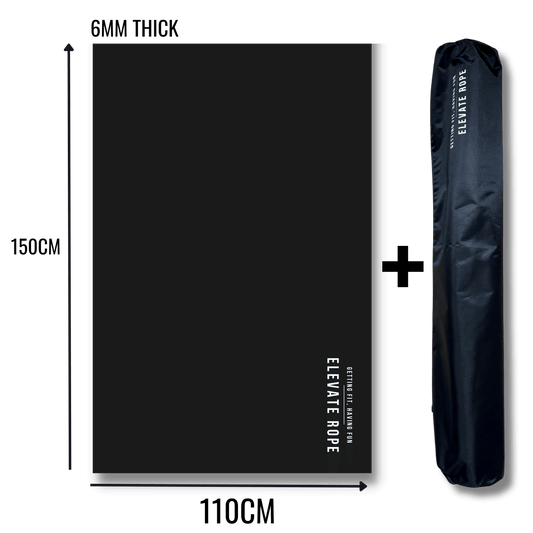
For homes with hardwood or laminate floors, add a → Jump Rope Mat for indoor sessions. It protects the floor from bead impact, cushions the child's joints, and defines the jumping space so younger children stay in one spot rather than drifting across the room. The mat also stops the rope from sliding when stored, which adds years to its life.
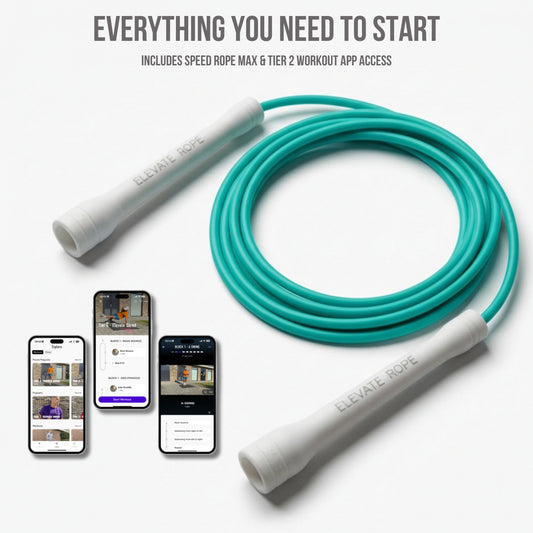
Every Elevate Rope purchase includes free access to the → Elevate App, with over one hundred guided workouts, a beginner pathway specifically built for children, and progress tracking. The competing rope brand most parents compare against charges around €120 per year for an app subscription. With Elevate, the app is included for life, which matters more than the rope price difference once you do the maths over twelve months.

Frequently Asked Questions
What age can a child start using a beaded jump rope?
Most children can start learning from age four, provided the rope is shortened to roughly their armpit height when standing on the centre. By age six or seven, most children can complete ten unbroken bounces inside their first session if the rope makes an audible beat. Earlier than four is fine for play, but proper skipping form usually clicks around four to five.
Is a beaded jump rope safe for indoor use?
Yes, beaded ropes are well suited to indoors, especially on a mat. The beads make contact with the floor on every rotation, so a hard wooden or tile surface will scuff over time without protection. A jump rope mat solves this and also cushions the child's knees, ankles, and hips during repeated impact. Outdoors on tarmac or a garden patio, no mat is needed.
How do I size a beaded rope for my child?
Have the child stand with one foot on the centre of the rope, then pull both handles up alongside their body. The top of the handles should reach the armpits for a beginner, or the shoulders for a more confident jumper who wants a faster turn. To shorten the Dignity Beaded Rope, simply remove beads from one end and re-secure the cord. The whole process takes around five minutes.
Can my child switch from a beaded rope to a speed rope later?
Yes, and the transition is the natural progression once they can complete around one hundred unbroken bounces. At that point, the rhythm is built into their nervous system and a speed rope will feel responsive rather than uncontrollable. Most children make this jump after six to twelve months of consistent practice.
Why is my child's cheap jump rope tangling all the time?
The most common cause is a stiff PVC cord with no bearings in the handles. Without bearings, every rotation puts twist into the cord, which compounds until it knots. Quality beaded ropes use polycord that does not retain twist, and quality speed ropes use sealed bearings to release it. Both designs eliminate tangling within normal use.
Is jump rope safe for children's knees and joints?
Done correctly, yes. Children should land softly on the balls of their feet with a slight knee bend, and the impact is comparable to skipping or running. Most paediatric guidance considers jump rope safe and beneficial for bone density development in children over four. A jump rope mat reduces impact further for daily indoor sessions.
How long should a child's first jump rope session be?
Five to ten minutes is plenty for the first week. The goal is to build rhythm and confidence, not endurance. Once the child can complete twenty or thirty unbroken bounces, sessions can extend to fifteen or twenty minutes with breaks. Short and consistent beats long and rare every time.
Choosing the Right Rope for Your Household
If your child is brand new to skipping and you are buying their first rope, the answer is straightforward. A beaded rope, specifically one with 3.5mm polycord and a smooth-bore bead design, is the only correct choice. The Dignity Beaded Rope was built for exactly this scenario and adjusts down for a child or up for a parent, so one purchase covers the household.
If your child has already mastered the basics and wants to progress to faster work and tricks, a speed rope unlocks the next chapter. The Royal Blue Speed Rope is the standard recommendation for this stage. And if multiple family members plan to jump, the Ascent Bundle is the cleaner long-term decision, because every member gets their own rope without compromise.
Whichever path you choose, the rope is only half the equation. The other half is the first twenty minutes of practice, where the audible tick of a beaded rope makes the difference between a child who quits and a child who keeps the rope by their bed. Choose the right rope first, and the rest takes care of itself.
Sources
- Arizona State University, research on jump rope as a cardiovascular substitute for jogging.
- World Health Organisation, physical activity guidelines for children aged 5–17.
- National Library of Medicine, rhythmic auditory stimulation and motor learning in children.
- Eurostat, physical activity and sedentary behaviour data for children in EU member states.
- American Academy of Pediatrics, guidance on age-appropriate physical activity and bone development.
- PubMed, peer-reviewed research on coordination, rhythm training, and motor skill acquisition.