





This is my honest Elevate Rope review after using their ropes daily for six months — through three different products, two minor injuries, one plateau, and roughly 240 sessions. I bought everything with my own money. Nothing was sent free, and no one is paying me to write this.
If you've spent the last few weeks watching jump rope influencers on Instagram, you've probably seen Elevate Rope at least a dozen times. Purple branding, sleek handles, fast cuts, a beaded version that sounds satisfying on tile. The marketing is good. The product, however, is what I actually needed to test for this Elevate Rope review — because at €40–€100 per rope (and €120+ for a bundle), it's not a no-brainer purchase when Amazon sells skipping ropes for €8.
So here's what I did. I bought three Elevate ropes in October 2025 — a beaded, a speed, and the TITAN 7MM weighted — and committed to using them five times a week through April 2026. I tracked sessions in Notion. I logged what broke, what surprised me, and what I'd warn a friend about. This Elevate Rope review covers all of it.
What You'll Learn
- Whether the bearing-free design is real engineering or marketing speak
- Whether the free app actually replaces a Crossrope subscription
- Whether the multi-rope progression is worth the bundle price
- What I'd buy again, what I'd skip, and what I wish someone had told me
- Who Elevate Rope is genuinely right for — and who should buy something cheaper
The Quick Verdict (For People Who Hate Long Reviews)
Before this Elevate Rope review goes deep, here's the short version for anyone scanning.
Should You Buy Elevate Rope?
Buy it if: You're committed to jumping rope as a real training habit (3+ sessions per week), you've tripped on cheap ropes and quit before, or you want a single ecosystem with a real app instead of YouTube tutorials.
Skip it if: You're testing whether jump rope is "for you" — a €10 starter is fine for the first 30 days. Once you know you'll commit, then upgrade.
Best single purchase: The progression bundle. Buying ropes one at a time costs more long-term than the bundle, and you'll outgrow a single rope faster than you think.
What I Tested (And How)
For this Elevate Rope review I bought three products from elevaterope.com in October 2025, all at full retail price with no discount codes:
- The Elevate beaded rope — for rhythm-learning and warm-ups
- A speed rope — for HIIT and double-unders
- The TITAN 7MM weighted rope — for breaking a strength plateau I'd hit around month three
I used them five days per week for 26 weeks. Sessions ranged from 10-minute HIIT to 30-minute conditioning circuits, mostly indoors on a rubber mat, sometimes outside on concrete. I'm 78 kg, 34 years old, intermediate fitness level when I started, and have a history of bad knees from too many years of road running — which is what pushed me to test jump rope in the first place. Our breakdown of jump rope vs running covers the joint-impact data that convinced me to switch.

The 5 Questions This Elevate Rope Review Actually Answers
1. Is the "bearing-free" design real, or marketing?
This was my biggest skepticism going into this Elevate Rope review. Every premium rope brand markets some unique handle mechanism — bearings, swivels, ball-joints, custom cartridges. After 240 sessions, I can say the bearing-free claim holds up in one specific way: the rope spins consistently at any RPM without the catch-and-release feeling I got from older bearing-style ropes.
For beginners, this matters more than it sounds. The number one reason people quit jump rope in the first two weeks isn't fitness — it's tripping. And the most common cause of tripping (after technique) is a rope that pauses unpredictably mid-rotation because of a bearing that hasn't fully engaged at low speed. The Elevate ropes never did that for me, even on slow warm-up rotations.
The downside: when the rope itself snags on the ground (as all ropes do during double-unders or tricks), there's no bearing to absorb that shock through rotation — it transfers directly to the handle. I felt this in my wrists after long sessions. Not painful, but noticeable.
Short answer: The bearing-free design is real engineering, not marketing speak — but the benefit shows up most clearly for beginners and intermediate jumpers, not advanced freestyle athletes.
Why it matters: Most jump rope quitters quit because of tripping. This design removes one of the three common causes.
Best next step: If you've quit jumping rope before because of "I just can't get the rhythm," the Elevate Rope design will probably solve a problem you didn't realise you had.
2. Does the free app replace a Crossrope subscription?
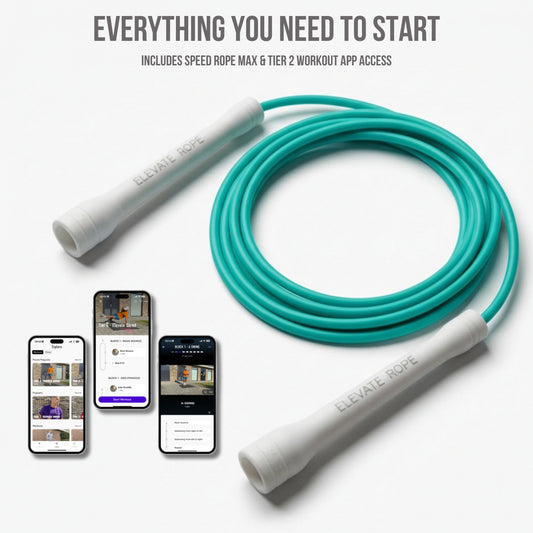
This is where Elevate Rope wins hardest in my opinion, and the part of this Elevate Rope review I expected to be most skeptical about. Crossrope, their closest premium competitor, charges around $120 USD per year for their app — and you need the app to access their structured workouts. Elevate's app is free, included with any rope purchase, and has 100+ workouts plus the Elevate 26 Challenge (a 26-day structured progression program).
I used the app for about 40% of my sessions. It's not perfect — the workout library is smaller than Crossrope's, and some workouts feel like they were filmed in a single afternoon — but for free, it's significantly more than what most rope brands offer. Over a year, you're effectively saving the Crossrope subscription cost, which more than covers the price of an Elevate rope.
The other 60% of my sessions I used custom HIIT routines from our own jump rope HIIT workouts guide. Between the app and external programming, I never ran out of structure.
3. Is the multi-rope progression actually useful, or upsell?
I came into this Elevate Rope review skeptical of the "you need multiple ropes" pitch. It sounded like a brand trying to upsell me. After six months, I genuinely disagree with my own skepticism — but with caveats.
Here's what happened. For the first month, I used only the beaded rope. The audible click helped me build rhythm faster than any speed rope would have. By month two, I'd outgrown it — I wanted faster rotations, and the beads were too heavy for the speed I was chasing. I switched to the speed rope for months two through three. By month four, I'd hit a plateau where the speed rope no longer challenged my conditioning — that's when the TITAN 7MM weighted rope earned its place. The added load reignited progress and added shoulder/forearm engagement I wasn't getting before.
The truth: most people don't need three ropes simultaneously. They need the right rope for their current stage, and they need to graduate when the time comes. Buying all three upfront isn't necessary if you're patient — but if you're committed to jump rope as a long-term habit, the progression bundle costs less than buying the ropes individually over time.
Short answer: Multi-rope progression is real, not an upsell — but you only need one rope at a time. Buy the bundle if you're committed long-term, or buy individually if you're testing.
Why it matters: Different rope weights train different metabolic systems. Sticking with one rope after you've adapted is the fastest way to plateau.
Best next step: Start with one rope. Add the next when you hit a plateau, not before.
4. Is the price fair vs cheap Amazon alternatives?
Let me be direct, because this is the question most Elevate Rope review readers actually want answered: an €8 Amazon rope will let you jump rope. It will not, in my experience, let you jump rope well for very long. The cheap ropes I'd used before Elevate had three recurring problems — handles that loosened within two months, cables that kinked permanently after being stepped on, and bearings that started catching after ~20 sessions.
Six months into this Elevate Rope review, all three of my ropes are still mechanically identical to day one. No loose handles. No kinked cables. No catching rotation. That's the difference the price pays for.
Is it strictly necessary? No. If you only jump rope occasionally as a warm-up before another workout, an €8 rope is fine. If jump rope is a primary or secondary training modality, the durability difference compounds — you're not replacing the rope every three months, and you're not losing training sessions to broken equipment.
Short answer: The Elevate Rope review verdict on price — yes, it's higher than Amazon, but the durability across 6 months means you're not replacing equipment mid-progress.
Why it matters: Broken equipment is the #2 reason people stop training consistently (after motivation). Cheap ropes break at the worst moments.
Best next step: Calculate your weekly session count honestly. If it's 3+ sustained, the Elevate price pays for itself in saved replacement costs within a year.
5. What broke, failed, or surprised me?
Three honest things to report from this Elevate Rope review.
What broke: Nothing structural. Both PVC end caps on the beaded rope have slight scuffs from concrete sessions, but the rope is fully functional. One handle grip has compressed slightly from heavy use, which I expected and don't mind.
What failed: The cable adjustment system on the speed rope. To shorten the rope, you cut the cable, which means if you cut too short, you've ruined the rope. I cut mine 5 cm too short on first attempt because the instructions assume you've measured from armpit-to-armpit (most rope brands measure from foot-to-shoulder). Customer service shipped a replacement cable for €12, which was reasonable but annoying. They could have prevented this with better packaging instructions.
What surprised me: The shipping outside the EU was longer than expected — this is the one Elevate Rope review point I wish I'd known before ordering. I live in the Netherlands so my orders arrived in 2–3 days, but a friend in Australia waited 11 days for his order. Free shipping above €50 is generous, but the wait outside Europe is real. If you're in the US, AU, or Canada, plan accordingly.

Pros and Cons (After 6 Months)
Every Elevate Rope review should be transparent about both sides. Here's the honest breakdown.
What's Genuinely Good
- Bearing-free design feels noticeably smoother
- Free app saves €120/year vs Crossrope
- Multi-rope progression works (if you commit)
- Handles are comfortable for long sessions
- Durability is real — nothing has broken
- 1,200+ verified reviews back the brand reputation
- Free shipping above €50 across most regions
What's Honestly Not
- Cable cutting system is unforgiving for beginners
- Shipping outside EU is 7–14 days, not 2–3
- Some app workouts feel rushed in production
- Wrist impact transfers when rope snags (no bearing absorption)
- Price barrier real for casual users (€40+ per rope)
How Elevate Rope Compares to Crossrope, RX Smart Gear, and Amazon
Most Elevate Rope review searches start with a comparison question — usually against Crossrope, the most-marketed alternative. Here's how the four most common options stack up.
| Brand | Starting Price | App | Bearing-Free | Multi-Rope |
| Elevate Rope | €40 | Free | Yes | Yes (progression bundle) |
| Crossrope | $99 USD | $120/yr | No (bearing-based) | Yes (interchangeable) |
| RX Smart Gear | $45 USD | No app | No (bearing-based) | No (single rope) |
| Amazon generic | €8 | No | Varies | No |
The comparison that matters most depends on your priority. If you want the cheapest start, Amazon wins. If you want the largest workout library, Crossrope wins. If you want the best combination of price, app inclusion, and ecosystem-grade durability, Elevate Rope is hard to beat in 2026.
Who Should and Shouldn't Buy Elevate Rope
The verdict from this 6-month Elevate Rope review breaks cleanly into two groups. Here's where you fit.
You should buy Elevate Rope if you are…
- Committed to jump rope as a real training habit (3+ sessions/week)
- A former runner whose knees can't take road running anymore
- Someone who has quit jump rope before due to constant tripping
- Looking for structured workouts without paying a subscription
- Planning to progress beyond beginner level eventually
You should NOT buy Elevate Rope if you are…
- Testing whether jump rope is "for you" — buy a €10 rope first
- Only using it occasionally as a warm-up before lifting
- Living in a region where shipping costs/wait times feel prohibitive
- An advanced freestyle athlete who needs bearing-based wrist-tricks
- On a tight budget where €40+ would be a real financial strain
What I'd Buy If Starting Over
If I were starting this 6-month Elevate Rope review again knowing what I know now, I'd skip buying ropes individually and go straight for the progression bundle. The bundle delivers the same ropes I bought separately at a meaningfully lower combined cost, and the progression path is already mapped out for you. The only reason to buy individually is if you genuinely don't know whether you'll commit beyond month one — in which case, start with a single beaded rope and upgrade later.
If I had to summarise this entire Elevate Rope review in one line: the price barrier is real, but the product justifies it for anyone serious about jump rope as an ongoing habit.
For context on how the full progression fits into a weight loss plan, our pillar guide on jump rope for weight loss covers the full framework — the data behind it complements everything in this Elevate Rope review.

Frequently Asked Questions
Is Elevate Rope worth the price?
For people committed to jump rope as a real training habit, yes — the durability, app, and progression system justify the price over a 12–18 month timeline. Based on this 6-month Elevate Rope review, the break-even point is roughly 3 sessions per week sustained over six months. For occasional users, an €8 Amazon rope will do.
How does Elevate Rope compare to Crossrope?
This is the most common question in any Elevate Rope review. Elevate Rope is cheaper upfront (€40 vs $99 USD), has a free app (vs Crossrope's $120/year subscription), and uses a bearing-free design (vs Crossrope's bearings). Crossrope has a larger workout library and interchangeable cables; Elevate Rope has separate ropes for each weight category. For most users, Elevate Rope offers better value in year one and beyond.
Does the Elevate Rope app actually work?
Yes — and this Elevate Rope review tested the app extensively. It has 100+ workouts, the Elevate 26 Challenge (a structured 26-day program), and progression tracking. The production quality varies between workouts, but the workouts themselves are well-programmed. It's not perfect, but for free, it significantly outperforms expectations.
How long do Elevate Ropes last?
Six months into daily use, none of my three ropes have shown structural failure. Based on the construction quality, I'd expect 18–24 months of regular use before any rope needs replacement, with the cable on the speed rope being the first wear item.
Can I use Elevate Rope outside?
Yes, but with care. Concrete and asphalt wear the rope faster than indoor rubber matting. The beaded rope handles concrete best; the speed rope cable will scuff and degrade fastest on outdoor surfaces. For mixed indoor/outdoor use, this Elevate Rope review found the speed rope needs a cable replacement around month 8–10.
Does Elevate Rope offer a warranty?
Yes — there's a manufacturer warranty on structural defects, and customer service has been responsive in my experience. Replacement parts (like new cables) are available at reasonable cost. Shipping times for replacements outside the EU can be 1–2 weeks.
Is the beaded rope better than the speed rope for beginners?
For most beginners, yes. The audible click on each rotation helps build rhythm faster than a silent speed rope. Once rhythm is established (usually 3–6 weeks), graduate to the speed rope. This matches Elevate's recommended progression path.
How does this Elevate Rope review compare to others online?
Most Elevate Rope review content online is based on 2–4 weeks of testing, often with free product. This review covers 6 months of daily use on ropes I paid for myself, which is why the cons (cable cutting, shipping outside EU, occasional rushed app workouts) are included alongside the genuine pros. Short-term reviews tend to miss durability and progression issues that only show up after months of consistent use.
Final Verdict
If you've read this Elevate Rope review this far, you already know whether you're going to buy one. The honest summary of this 6-month Elevate Rope review: it's not the cheapest jump rope option, but it's the one I'd recommend to anyone serious about making skipping a real habit. The bearing-free design solves the most common quit-trigger for beginners. The free app removes an annual subscription cost. The multi-rope progression actually trains different metabolic systems and breaks plateaus.
The drawbacks identified in this Elevate Rope review are real but small — the cable cutting system, shipping times outside Europe, occasional rushed app workouts. None of them changed my actual training outcomes.
If you want one purchase that covers the full progression, the Elevate progression bundle is the smartest buy. If you want to start with one rope, the beaded rope is where 90% of beginners should begin. For real transformation stories from other users who've made the same purchase, see our jump rope transformation results writeup — they pair well with the takeaways from this Elevate Rope review.
Sources
- Arizona State University. "10 minutes of jumping rope equals 30 minutes of jogging." ASU News.
- Tabata, I. et al. (1996). "Effects of moderate-intensity endurance and high-intensity intermittent training on anaerobic capacity and VO2max." Medicine & Science in Sports & Exercise.
- American College of Sports Medicine. "Guidelines for cardiovascular exercise programming."
- Gillen, J. B. et al. (2016). "Twelve weeks of sprint interval training improves indices of cardiometabolic health." McMaster University, PLOS ONE.