





Daily weight loss habits — not crash diets or extreme workouts — are what separate the people who keep the weight off from the people who yo-yo for years. According to a 2025 report from the Harvard T.H. Chan School of Public Health, people who eat regular meals regulate their blood sugar more effectively and are less likely to overeat later in the day.
That principle — small, consistent actions compounding over time — sits at the heart of every effective approach to weight management. Meals. Movement. Sleep. Hydration. The people who succeed aren't doing more than you. They're doing the right things more consistently than you. That's the whole secret behind daily weight loss habits.
This guide walks through the daily weight loss habits that matter most, why they work, and how to build them into a routine that survives beyond week three.
Simple Habits Go a Long Way
Most health experts agree on the same short list of daily weight loss habits: plan your meals, stay hydrated, sleep properly, and move your body every day. Not once a week. Not three times a week. Every day.
The World Obesity Federation has reported that people who maintain consistent daily routines are significantly more likely to keep weight off long-term. Fixed daily schedules help develop better eating patterns, a reliable exercise habit, and healthier stress-management methods. The word to underline there is daily.
This is where most weight loss advice falls apart. A plan that requires 45 minutes at the gym, 6 different supplements, and a weighed-to-the-gram meal plan might work for two weeks. It almost never survives a busy Monday, a sick kid, or a rainy week. Daily weight loss habits have to be simple enough to do on your worst day — otherwise they're not habits, they're just aspirations.
Short answer: Daily weight loss habits work because they compound. Small consistent actions produce bigger long-term results than occasional intense effort.
Why it matters: The gap between "people who keep weight off" and "people who regain it" is almost entirely a consistency gap.
Best next step: Pick 2 habits you can genuinely do every day. Stack them on an existing routine (morning coffee, evening wind-down). Protect them.
Staying Physically Active Is Crucial
Of all the daily weight loss habits, consistent movement is the one with the most evidence behind it. A study published in Nature Medicine found that regular moderate-intensity physical activity improves insulin sensitivity and energy balance — two of the biggest drivers of sustainable fat loss. No amount of dialing in nutrition fully replaces the metabolic impact of daily weight loss habits built around movement.
Public health guidelines suggest around 150 minutes of moderate activity per week. Broken down, that's about 20 minutes a day. Walking and cycling are common recommendations, but they require infrastructure — good weather, safe routes, time to actually get out the door. On the days life gets in the way, they're the first thing to go.
This is where jump rope quietly outperforms almost everything else on the list. Research from Arizona State University found that 10 minutes of skipping delivers roughly the same cardiovascular benefit as 30 minutes of jogging. Ten minutes. In your hallway. Before your coffee cools.
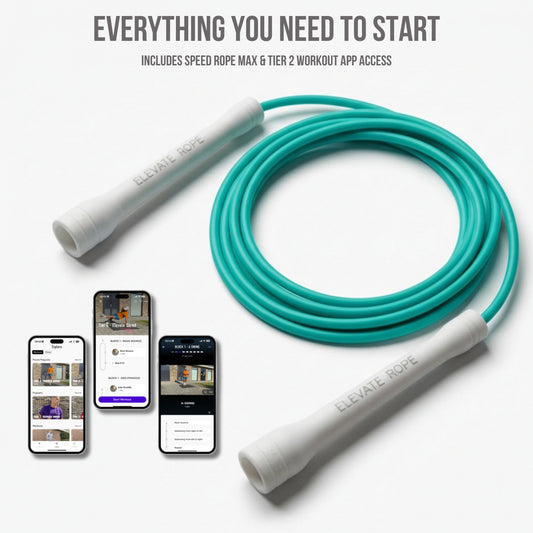
That compression is the whole point. A habit you can do in 10 minutes on 2 square metres of floor is a habit that survives rain, travel, a tight schedule, and the kind of bad day that would kill a gym routine. Our speed ropes are built specifically for this use case — bearing-free, tangle-free, no learning curve fighting your equipment.
For readers completely new to skipping, a beaded rope is a better starting point — the weight gives you a clear auditory and tactile rhythm, which makes consistency far easier in weeks 1 and 2.
The 5 Daily Weight Loss Habits That Matter Most
1. Eat on a consistent schedule
Not a specific diet. Not macros. Just consistent timing. The body responds to predictable intake with predictable appetite signals — which means fewer random hunger spikes and less evening overeating. Of all the daily weight loss habits, this one is the easiest to start tomorrow.
2. Drink water before you drink anything else
Dehydration gets mistaken for hunger roughly 30% of the time. A glass of water first thing in the morning, and another before each meal, quietly cuts calorie intake without any conscious effort. Free. Takes 20 seconds. Massively underrated.
3. Move your body every single day
Not intensely. Not for long. But every day. 10 minutes of jump rope. A 20-minute walk. Something. The goal isn't to crush a workout — it's to make movement non-negotiable. This single habit is the most powerful of all daily weight loss habits because it carries momentum into every other choice.
4. Sleep 7+ hours
Sleep deprivation spikes ghrelin (the hunger hormone) and suppresses leptin (the satiety hormone). You can do everything else right and still plateau because you're sleeping 5 hours a night. Protect sleep like it's part of the workout — because it is.
5. Track the process, not the scale
Daily weigh-ins are psychological sabotage. Instead, track: did I hit my steps? Did I do my 10 minutes? Did I eat on schedule? Did I sleep? These are controllable inputs. The scale is a lagging output.
Seeking Medical Options Like GLP-1 Therapies
For some people, daily weight loss habits alone aren't enough. Genetics, hormones, existing metabolic conditions — all of these can make sustainable weight loss harder than the textbooks suggest. In these cases, medical options are worth a real conversation with a doctor.
GLP-1 medications (the class that includes semaglutide and similar drugs) mimic a natural hormone that regulates appetite, gastric emptying, and blood sugar. A 2025 review published in JAMA Network Open found these medications meaningfully reduce calorie intake by increasing satiety, particularly when combined with diet, exercise, and behavioural support.
The key phrase there is "combined with." GLP-1 therapies aren't a replacement for daily weight loss habits — they're a tool that works best alongside them. Studies consistently show that people who stop the medication without building habits tend to regain most of the lost weight. The medication is leverage. The daily weight loss habits are the foundation. Skip the foundation and the results don't hold.
Short answer: GLP-1 medications can be highly effective for sustained weight loss, but they work best when paired with consistent daily habits — not in place of them.
Why it matters: Stopping the medication without established habits is the #1 predictor of regain. Build the habits first, or alongside — never instead.
Best next step: Speak to your GP about whether GLP-1 therapy is appropriate for your situation. Regardless of the answer, start building daily habits now.

Checking the Correct Health Resources
The internet is full of weight loss advice, and most of it is either outdated, sponsored, or straightforwardly wrong. When you're building long-term daily weight loss habits, the quality of your information sources matters more than you'd think — bad advice about daily weight loss habits can cost you months of genuine progress.
For jump rope specifically, our complete guide to jump rope for weight loss is the most thorough resource we've put together — covering everything from beginner form to calorie burn to progression paths. If you're trying to figure out which rope to start with, the best jump rope for weight loss buyer's guide breaks down the full product range by use case.
Beyond our own content, stick to peer-reviewed research, national health guidelines (NHS, CDC, WHO), and registered dietitians or physicians when making decisions. The more a source promises, the less likely it is to be credible.
Frequently Asked Questions
What are the most important daily weight loss habits?
The five that matter most: consistent meal timing, adequate hydration, 10+ minutes of daily movement, 7+ hours of sleep, and tracking process metrics rather than the scale. None of them are dramatic — which is why they work long-term.
How long does it take for daily habits to produce weight loss results?
Most people see measurable changes within 4–6 weeks of consistent daily habits, with clearer physical changes in the 8–12 week range. The first 3 weeks are usually just habit-building — the actual fat loss follows shortly after the habits stabilise.
Is 10 minutes of jump rope really enough for weight loss?
Yes, when done daily. 10 minutes of skipping burns roughly 120–160 calories depending on body weight and intensity. Over 30 days that's 3,600–4,800 calories — meaningful on its own, and compounding when paired with the other daily weight loss habits in this article.
Should I take GLP-1 medications for weight loss?
That's a conversation for your doctor, not the internet. GLP-1 therapies work well for many people with clinical obesity or metabolic conditions, but they come with side effects, cost, and the requirement to build sustainable habits alongside treatment. Evaluate with a medical professional, not a social media post.
What's the biggest reason daily weight loss habits fail?
Trying to build too many at once. People commonly attempt 6 new habits on day 1, burn out by week 3, and give up. Pick one or two, stack them onto something you already do (like morning coffee), and add more only after they're genuinely automatic.
Is diet or exercise more important for weight loss?
Diet drives the calorie deficit. Exercise drives muscle retention, metabolic health, mental health, and the habit infrastructure that keeps the diet sustainable. You need both, but they play different roles. Think of diet as the accelerator and exercise as the chassis.
Can I lose weight without going to a gym?
Absolutely. Jump rope, bodyweight training, brisk walking, and cycling all deliver strong results without any gym access. For a deeper look, see our guide on cardio at home for weight loss.
Conclusion
Weight loss isn't an overnight phenomenon. It's a gradual process built on sustained daily weight loss habits that compound over months, not days. The people who succeed long-term aren't the ones who tried the hardest for 30 days — they're the ones who kept showing up on day 100, day 200, day 500.
Pick habits small enough to survive your worst day. Stack them onto routines you already have. Use tools that remove friction rather than add it — a jump rope by the door beats a gym membership you have to drive to. And if medical support is right for your situation, pair it with daily weight loss habits rather than substituting it for them.
If you're starting from zero, begin with a beaded rope and 10 minutes a day. If you want the complete progression, the Elevate bundles cover you from beginner through advanced. And whatever tool you pick — use it every single day. That's the whole formula.
Sources
- Harvard T.H. Chan School of Public Health — The Nutrition Source: Meal Timing and Weight Management, 2025
- World Obesity Federation — Policy Dossiers on Behavioural Interventions for Long-term Weight Maintenance
- Nature Medicine — Moderate-intensity Physical Activity and Metabolic Health Outcomes
- JAMA Network Open — Systematic Review of GLP-1 Receptor Agonists for Weight Management, 2025
- Arizona State University — Cardiovascular Efficiency of Rope Skipping vs Jogging (Baker, 1968, cited in ASU fitness research archives)
You May Also Like
- The Complete Guide to Jump Rope for Weight Loss
- 10-Minute Workouts: The Science Behind Why Short Sessions Work Better
- Why You're Not Losing Weight: The Exercise Consistency Problem Nobody Talks About
- Cardio at Home: The Ultimate No-Gym Workout Guide for Weight Loss
- Jump Rope Calories Burned: The Complete Guide
- The Science of Exercise You Actually Enjoy: Why Fun Beats Discipline