






A good jump rope progression for beginners is not about doing more, faster. It is about doing the same thing, for longer, with small changes over time. That is how a 30-day win becomes a lifelong habit.
The first month proves you can start. Month two is where the real work begins. This is the quiet stretch where motivation fades and the habit has to carry itself.
If you have finished a first month, you are exactly who this guide is for. It sits inside our hub on jump rope for menopause. The goal now is simple. Keep going, gently, for the years your bones will thank you.
What You'll Learn
→ Why month two is where most people quietly quit → How gentle progression protects both the habit and your joints → What to change first, and what to leave alone → When a speed rope earns a place in your routine → Ways community and accountability keep you showing up → How to make the identity stick for the long run
Why Month Two Is the Real Test
The first 30 days ride on novelty and motivation. Everything feels fresh, and the streak is exciting to build. Then the newness fades, and real life crowds back in.
This is when most people drift away. The workout was never the problem. The problem is that motivation is unreliable, and it always runs out eventually.
Habits are what replace motivation over time. Research on habit formation found that new routines took a median of 66 days to feel automatic. So month two is not a plateau, it is the bridge to autopilot.
Your job now shifts from starting to sustaining. That is a different skill, and a quieter one. You are no longer chasing a buzz, you are protecting a routine.
The good news is that jump rope suits this stage well. It is short, portable, and always ready. A daily session asks little, which is exactly why it survives busy weeks. A jump rope lives in a drawer and needs no setup at all.
Think of month two as laying track, not sprinting. The aim is not a harder workout. The aim is a habit so normal it needs no willpower at all. Routines that survive are the ones that stop feeling like decisions.
The Rule of Gentle Jump Rope Progression
Progression sounds like adding intensity, but that is the last thing to change. Consistency comes first, always. A habit you keep beats a hard session you quit. A jump rope progression works best when it is boringly consistent.
So change one small thing at a time. Add a set, or a minute, or a new foot pattern. Give each change a week or two before layering on the next.
Your bones reward this patience. They respond to repeated, gentle load over months, not to sudden spikes. A steady jump rope habit is a better bone signal than an occasional hard blast.
Overtraining is the real risk at this stage, not undertraining. Sore joints and fatigue are signs to ease off. There is no prize for rushing, and plenty of downside.
| Phase | Focus | Rope |
| Month 1 | Build the daily habit, master soft landings | Beaded rope |
| Months 2 to 3 | Add small variety and a little more time | Beaded rope, speed optional |
| Month 4 onward | Hold consistency, mix in gentle intensity | Beaded base, speed for cardio |
Read the table as a slow arc, not a schedule. Some women stay in month-one mode for a long time, happily. That is not a failure, it is a habit that fits.
Short answer: Progress by adding consistency first, then tiny changes, never by leaping into hard sessions.
Why it matters: Gentle progression protects your joints and keeps the habit alive. Bone health is built over months of showing up, not weeks of straining.
Best next step: Keep the core move sharp with our gentle 10-jump bone-building routine.

Adding Variety Without Losing the Habit
Boredom quietly ends more routines than injury does. A little variety keeps the sessions interesting. The trick is to add it without breaking what already works.
Start with your feet, not your intensity. Try a gentle side-to-side step, or alternating feet, or a slow march. Small pattern changes keep your brain engaged and your coordination growing. Your jump rope can do far more than a plain two-foot bounce.
Play with timing next. Swap a steady session for short, easy intervals now and then. A few seconds on, a few seconds off, keeps things fresh without a big jump in effort.
You can also vary when and where you jump. A morning session feels different from an evening one. A jump rope travels anywhere, so the garden or a hotel room both work.
Keep your beaded rope as the base through all of this. Its control and feel still suit gentle, bone-friendly work best. Variety should sit on top of that foundation, not replace it.
Short answer: Add variety through footwork, timing, and setting before you ever add real intensity.
Why it matters: Novelty keeps the habit alive without raising your injury risk. A routine you enjoy is a routine you keep.
Best next step: Revisit your rope choice with our guide on the best jump rope for women over 50.
When a Speed Rope Earns Its Place
There comes a point where a second rope makes sense. Not at the start, and never as a shortcut. A speed rope enters once your landings are soft and your rhythm is steady.
Before you add faster work, check in with your body. If you have any bone concern, our jump rope safety guide for menopause is worth a fresh read. New intensity deserves the same caution as day one.
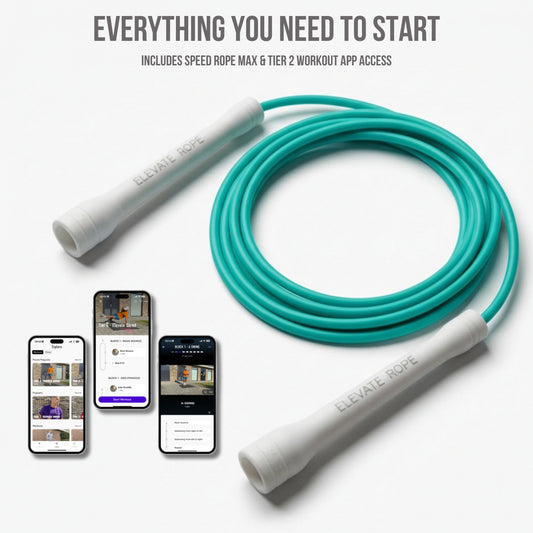
A speed rope is thinner and quicker than a beaded one. It suits short cardio bursts and faster footwork. When you are ready for that, the speed rope range adds a new gear to your week.
Use it as a complement, not a replacement. Keep your beaded rope for your gentle, bone-friendly base sessions. Reach for the speed rope on the days you want a lighter, quicker challenge.
Listen closely as you shift gears. Faster rotation means faster landings, so keep them soft. If your knees or hips complain, drop back to the beaded rope and slow down.
Short answer: Add a speed rope once your rhythm is steady, and keep the beaded rope as your base.
Why it matters: A new rope adds variety and cardio without abandoning your bone-friendly base. Progression should widen your options, not raise your risk.
Best next step: Compare rope types in our beaded versus weighted rope guide.

Lean on Community and Accountability
Consistency is far easier when you are not doing it alone. A little accountability turns a private promise into a shared one. That social pull is quietly powerful on low-energy days.
Find people on the same path. The Elevate community connects jumpers who share wins, questions, and encouragement. Seeing others show up makes it easier to show up yourself.
Simple sharing helps more than you expect. Post your streak, or tell a friend your plan for the week. A promise spoken out loud is harder to quietly abandon. Sharing your jump rope journey turns a solo habit into a shared one.
Accountability also works in reverse. When you encourage someone else, your own habit grows stronger. Helping a friend stay consistent quietly reinforces the promise you made to yourself.
You can also follow along on Instagram at @elevaterope for daily nudges. A steady feed of gentle jump rope content keeps the habit front of mind. Small reminders add up over a month.
None of this needs to be public if that is not your style. A single accountability partner works just as well. The point is connection, in whatever form suits you.
The Identity That Outlasts Any Month
The deepest reason people stay consistent is identity. You are no longer someone trying to exercise. You are a woman who jumps, most days, because that is simply who you are.
That shift changes how missed days feel. A skipped session is a blip, not a failure of character. You are a jumper who missed a day, so you jump again tomorrow.
Keep tying the habit back to your bones and your future. This is not vanity work, it is protection for the decades ahead. Every gentle session is a small deposit in your long-term strength.
Celebrate the quiet milestones too. A hundred days, a season, a full year of showing up. Those numbers matter more than any single hard workout ever could. Over time, your jump rope becomes less a workout and more a small daily ritual.
The rope is just the tool. The real product is the promise you keep to yourself, daily. That is what carries your bones, and your confidence, far beyond 30 days.
Short answer: Long-term consistency comes from identity, seeing yourself as someone who jumps, not someone who is trying to.
Why it matters: Identity survives bad days and busy weeks far better than motivation. It is the quiet engine behind years of bone-protecting habit.
Best next step: Need to restart? Our menopause bone-building challenge gives you a fresh month.
Frequently Asked Questions
How do I stay consistent with jump rope after the first month?
Lean on habit, not motivation, because motivation fades. Anchor the session to a daily cue, keep it short, and lower the bar on hard days. A little community or accountability makes it far easier to keep showing up.
How should a beginner progress with jump rope?
Add consistency first, then change one small thing at a time. Vary your footwork, timing, or session length before you ever add real intensity. Give each change a week or two to settle before the next.
When should I switch from a beaded rope to a speed rope?
Only once your landings are soft and your rhythm is steady, usually after a few months. Even then, keep the beaded rope for your gentle base sessions. Use the speed rope as a faster complement, not a replacement.
Is it bad to just keep doing the same routine every day?
Not at all, if it keeps you consistent and pain-free. A steady daily habit is exactly what supports your bones over time. Add variety only when boredom threatens the habit, not because you must.
How much jump rope should I do in month two?
Roughly what you built to by the end of month one, then grow slowly. A few short sets or up to ten minutes total is plenty. Consistency matters far more than any daily total.
What if I lose my streak completely?
You simply start again, without treating it as a failure. Missing a week does not erase the habit you built. Pick up the rope today, and the routine resumes faster than you expect.
Can jump rope stay useful for bone health long term?
Yes, because bones respond to repeated gentle impact over years. A sustained jump rope habit keeps giving that signal well beyond menopause. The key is consistency, kept up gently for the long run.
Your Next Step, Based on Where You Are
If your habit is steady and you like it as it is, keep going. Your beaded rope remains the ideal bone-friendly base. There is no need to change a thing that already works.
If you are ready for variety, add it gently and in one small step. A speed rope brings faster footwork and short cardio bursts for the days you want them. Keep the beaded rope for your gentle sessions, and alternate as you like.
Whatever your pace, do not do it alone. Join the Elevate community and let shared momentum carry you through the flat weeks. The goal is a kept promise, repeated, that protects the body you live in. Keep the promise. Elevate the rest.
Sources
- Lally P, et al. How are habits formed: Modelling habit formation in the real world, European Journal of Social Psychology, 2010: https://onlinelibrary.wiley.com/doi/10.1002/ejsp.674
- Tucker LA, et al. Effect of two jumping programs on hip bone mineral density in premenopausal women, American Journal of Health Promotion, 2015: https://pubmed.ncbi.nlm.nih.gov/24460005/
- Montgomery G, et al. Feasibility of a jumping intervention for postmenopausal women, randomized controlled study: https://pmc.ncbi.nlm.nih.gov/articles/PMC10664055/
- Brooke-Wavell K, et al. Strong, Steady and Straight: UK consensus statement on physical activity and exercise for osteoporosis, British Journal of Sports Medicine, 2022: https://pmc.ncbi.nlm.nih.gov/articles/PMC9304091/
- Royal Osteoporosis Society, Exercise for bone health: https://theros.org.uk/information-and-support/bone-health/exercise-for-bones/
- International Osteoporosis Foundation, Exercise for individuals with osteoporosis: https://www.osteoporosis.foundation/health-professionals/prevention/exercise/exercise-individuals-with-osteoporosis
- Hospital for Special Surgery, Why jumping rope is the ideal post-menopausal workout for your bones: https://news.hss.edu/why-jumping-rope-is-the-ideal-post-menopausal-workout-for-your-bones-according-to-an-exercise-scientist/
You May Also Like
→ Your First 30 Days: The Menopause Bone-Building Challenge
→ The 10-Jump Method: A Gentle Bone-Building Routine
→ The Best Jump Rope for Women Over 50
→ Beaded vs Weighted Rope for Bone Health After Menopause
→ Is Jump Rope Safe During Menopause? Who Should and Should Not
→ How to Start Jump Rope After 50 Without Hurting Your Joints