





Your jump rope home office setup doesn't need to be elaborate. It needs to be ready. That single difference — equipment that's already out, already configured, already waiting — is what separates people who actually move from people who intend to. Research from the University of Bath found that proximity to exercise equipment is a stronger predictor of daily activity than motivation. The rope three metres from your desk beats the gym membership fifteen minutes away, every single time.
Most remote workers already know they should move more. They've read the research on sitting, felt the 3 p.m. energy crash, noticed the tension creeping into their shoulders by Thursday afternoon. What they're missing isn't information — it's a frictionless setup. This guide covers exactly what goes into a complete home office jump rope kit, how to configure your space in under 30 minutes, and how to make the daily 10-minute reset a locked-in part of your workday rather than another intention that never happens.
The full kit costs less than a single month at most city gyms. It stores in a corner. And once it's set up, the only decision left is how many minutes to jump.
What you'll learn in this guide:
→ The exact equipment that belongs in a home office jump rope kit
→ Minimum space requirements and how to check your ceiling in 60 seconds
→ Which rope to start with based on your experience level
→ How to configure your space so the workout happens automatically
→ The complete 10-minute daily reset routine for desk workers
→ A cost comparison: gym membership vs. the full Elevate kit over 12 months
→ The free app that replaces €150/year in competitor subscriptions
What Actually Belongs in a Home Office Jump Rope Kit
The home office jump rope setup has three components: the mat, the rope, and the training system. Most people skip the first and ignore the third — and then wonder why the habit doesn't stick. Each element solves a specific friction point.
The Mat: The Most Underrated Purchase in the Kit
Surface protection comes first for two reasons. First, jumping on hardwood floors or tiles without a mat transmits more impact through your joints with each landing. A proper exercise mat absorbs that force — research published in the journal Gait & Posture found that appropriate surface compliance significantly reduces ground reaction forces during repetitive impact activities, protecting knees and ankles over time. Second, concrete, laminate, and tile will wear through a rope cable within weeks. Customers who jump on rough surfaces without a mat report fraying and breakage, issues that never appear when a mat is in place.
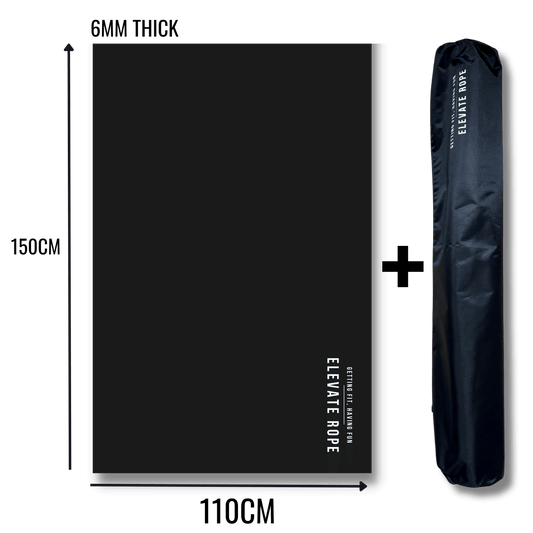
For a home office setup, the → Elevate Jump Rope Mat is purpose-built for this exact situation. It's thick enough to absorb impact, grippy enough to stay put on smooth floors, and has defined edges so you can position yourself perfectly every time. The mat also serves a second function: it marks your training zone. When you step onto it, your brain shifts context. That physical boundary creates a micro-ritual that makes the transition from work mode to movement mode automatic over time.
The noise argument matters too. Apartment workers and anyone with downstairs neighbours worry about the impact sound of each landing. Proper form (landing softly on the balls of your feet, 2–3 cm off the ground) does most of the work, but the mat eliminates the rest. Your downstairs neighbours won't hear a thing.
The Rope: Matching Equipment to Experience Level
The wrong rope doesn't just underperform — it actively prevents the habit from forming. A wire-cable speed rope in the hands of someone who hasn't jumped since primary school creates a frustrating trip-and-stop cycle that ends with the rope in a drawer. The right rope makes the first session feel achievable, which is the only thing that matters at this stage.
For most home office workers starting or restarting a jump rope practice, the → Elevate Dignity Beaded Rope is the correct starting point. The 3-metre adjustable cord is segmented with 2.5 cm PVC beads that provide two advantages that matter during learning: the beads catch air mid-rotation so you can feel exactly where the rope is without looking down, and the sound of beads hitting the mat gives you the timing cue for your next jump. That auditory feedback removes the guesswork that trips up beginners and replaces it with an intuitive rhythm that develops within two to three sessions.
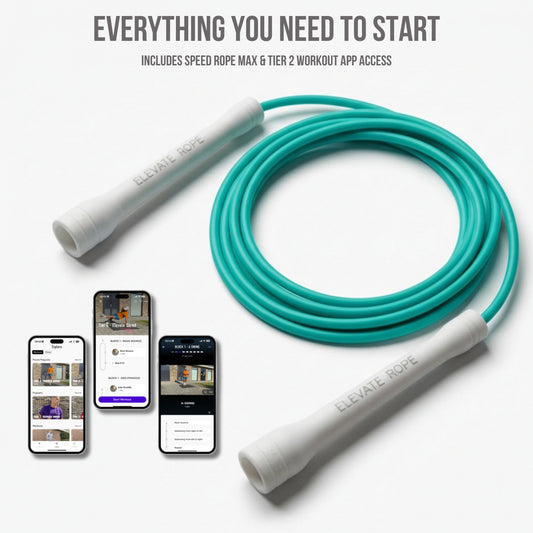
If you've jumped before and want to use the rope for HIIT-style sessions, the → Speed Rope MAX is the upgrade. Its bearing-free design is a deliberate engineering choice — bearings create artificial spin that moves faster than your body, disrupting your natural rhythm. Without bearings, the rope moves with you. The 5 mm PVC cable with nylon core never tangles, never kinks, and cuts to your exact height in under two minutes using household scissors.
The Training System: What Prevents the Rope from Becoming Furniture
Equipment doesn't build habits. Structure does. Every Elevate Rope purchase includes free lifetime access to the Elevate App — 100+ guided workouts, an audio-coached timer, a progress tracker, and a 26-day structured challenge designed specifically for people building the jump rope habit from scratch. This is worth pausing on. The main competitor in this space, Crossrope, charges €150 per year for their training app. The Elevate App is free, permanently, with every rope.
The Elevate26 challenge within the app is the most useful entry point for home office workers. It's structured as a daily commitment — short enough to fit into a lunch break or between meetings, progressive enough that you're never bored, and built around the identity-first principle: you're not someone who "tries to exercise," you're someone who jumps every day. That distinction sounds small. It isn't.
Short answer: A complete home office jump rope kit needs three things — a mat to protect your joints and floors, the right rope for your experience level, and a training system that gives you something to follow each day.
Why it matters: Each element removes a specific friction point. The mat means you don't have to clear space or worry about impact. The right rope means your first sessions feel achievable instead of frustrating. The training system means you never stand in front of your rope wondering what to do.
Best next step: The Ascent Bundle covers the rope and the app in one purchase. Add the Jump Rope Mat and your setup is complete.

Space Check: How Much Room Do You Actually Need
The most common reason people don't set up a home office workout space is the belief that they don't have enough room. For jump rope, that belief is almost always wrong.
The Minimum Space Formula
You need a rectangle of floor space approximately 3 metres front-to-back and 2 metres side-to-side. That's it. In real terms: the space in front of most office desks, a cleared corner of a spare room, the area between a sofa and a coffee table, or a modest patch of garden. The only dimension that regularly causes problems is ceiling height. A reliable rule is that you need at least 90 cm of clearance above your outstretched hands at the top of your jump. For most adults, that means a ceiling of around 3 metres or higher is ideal, and 2.7 metres works fine for standard jump height. For lower ceilings, a shorter rope adjusted to reduce the arc is the practical solution — or the ropeless option for ultra-restricted spaces.
The quickest space check: stand in the spot you're considering, hold one handle above your head, and swing the rope through one slow rotation. If it clears without touching anything, the space works. If it clips something, adjust the rope length before your first session rather than on your first session.
Setting Up for Frictionless Daily Access
Where you store the rope matters more than where you jump. The research on habit formation consistently shows that the fewer steps between intention and action, the higher the completion rate. A rope stored in a drawer requires a decision to retrieve it. A rope coiled on the mat, visible from your desk, requires almost no decision at all. The visual cue does the triggering.
The practical setup: position the mat in a corner of your home office or adjacent room. Leave the rope coiled on the mat. When the mat is visible from your workstation, your brain logs it as an environmental prompt — the same mechanism that makes a glass of water on your desk result in more hydration than water available in the kitchen. Small environmental design produces outsized behavioural results.

The 12-Month Cost Comparison: Gym vs. Home Office Jump Rope Setup
Price is always part of the decision, and the numbers here are worth examining honestly.
Cost Comparison: Gym Membership vs. Full Elevate Kit
| Item | Gym Membership | Full Elevate Kit |
| Upfront cost | €40–€80 joining fee | €0 joining fee |
| Monthly cost | €30–€60/month | €0/month |
| Year 1 total | €400–€800 | €65–€80 (kit, once) |
| Year 2 total | €360–€720 | €0 (equipment owned) |
| Training app | Usually separate (€0–€15/month) | Free, included forever |
| Commute time | 15–30 min each way | 0 min |
| Equipment availability | Depends on opening hours | Always available |
| Weather dependency | No (indoor) | No (indoor mat setup) |
Over 12 months, the average gym member in the Netherlands spends between €400 and €800 including joining fees. The full Elevate home office kit — mat, rope, and free app — comes in under €80. Over two years, the gap compounds: the gym member spends another €360–€720, while the Elevate kit owner spends nothing. The equipment is already there, already paid for, already waiting.
This is worth framing correctly. The objection to home fitness is often phrased as "I need to leave the house to exercise, otherwise I won't do it." That objection is about motivation, not logistics. And the answer to a motivation problem isn't a more expensive gym membership — it's a lower-friction environment. Motivation fluctuates. Environment doesn't.
Short answer: The full home office jump rope kit costs under €80 once. An average gym membership costs €400–€800 per year, every year.
Why it matters: Over two years, most gym members spend more than ten times the cost of the Elevate kit — and still have to commute, wait for equipment, and work around opening hours. The rope is available at 6 a.m., at midnight, and in the two-minute window between back-to-back meetings.
Best next step: Start with the Ascent Bundle at €49,95 (includes the Speed Rope MAX, Beaded Rope, app, and nutrition guide), then add the Jump Rope Mat to complete your setup for under €80 total.

The 10-Minute Daily Reset: A Complete Desk Worker Routine
Ten minutes of jump rope at moderate intensity burns approximately the same calories as a 30-minute jog, according to a study by researchers at Arizona State University published in the Research Quarterly for Exercise and Sport. That comparison is frequently cited and frequently disbelieved, because 10 minutes feels too short to matter. The data says otherwise. The cardiovascular load of sustained jumping — even at beginner pace — keeps heart rate elevated in the 130–150 bpm range, which is the aerobic training zone most associated with fat metabolism and cardiovascular improvement.
For desk workers specifically, the goal isn't maximum calorie burn in a single session. It's breaking the sedentary pattern. Research from the University of Maastricht demonstrated that interrupting sitting every 30 minutes with light physical activity produced better metabolic outcomes than a single hour-long exercise session per day. The mechanism is insulin sensitivity: muscles that contract periodically throughout the day process glucose more efficiently than muscles that sit still for eight hours and then exercise once. Jump rope is the most efficient tool for this kind of pattern interruption because the equipment is always available, the setup takes under 30 seconds, and the intensity is adjustable from gentle warm-up pace to full-speed HIIT.
The Routine (10 Minutes, No Equipment Changes)
This structure works for complete beginners using the Beaded Rope and for experienced jumpers using the Speed Rope MAX. Adjust the rest intervals based on your current fitness level — more rest early on, less as the weeks progress.
Minutes 1–2: Basic bounce at your own pace. This is warm-up. Focus on landing softly on the balls of your feet, keeping your elbows close to your sides, and letting the rope do the work. Don't rush the rotation.
Minutes 2–5: Alternate between 30 seconds of continuous jumping and 15 seconds of rest. Three rounds. This builds the aerobic base and trains your body to recover quickly between efforts.
Minutes 5–8: Increase your pace or try a variation — alternating feet (running in place), or simple side-to-side movements. Stay within control. The goal is consistency within each interval, not maximum speed.
Minutes 8–10: Return to basic bounce pace. Let your heart rate drop. Finish with 30 seconds of slow, deliberate jumps before stopping. This cool-down is brief but important — abruptly stopping high-intensity cardio can cause blood pooling in the legs, producing the dizzy feeling some people associate with jump rope.
Over time, the Elevate App progression replaces this manual structure with guided audio sessions that do the counting, cueing, and motivation for you.

The Ascent Bundle: One Purchase, Complete Setup
The → Ascent Bundle was designed specifically for the person setting up a home fitness routine from scratch. At €49,95 (reduced from €69,95), it includes the Speed Rope MAX, the Dignity Beaded Rope, free lifetime access to the Elevate App, the Elevate Code identity framework, a nutrition guide, and a progress tracker. That's the rope for learning and the rope for progressing, plus the complete support structure, in a single purchase.
The logic of including two ropes is important. Most home office workers don't know which rope they need until they've used both. The Beaded Rope is where almost everyone should start: it's forgiving, rhythmic, and teaches form in a way that wire cables simply don't. After two to three weeks, when the basic bounce is consistent, the Speed Rope MAX becomes the right tool for HIIT sessions and calorie-burn workouts. Having both means you never hit a progress ceiling and never have to make a second purchase to keep improving.
For those who want to push further — adding weighted rope training for plateau-breaking strength-cardio sessions — the → Ascent Max Bundle at €69,95 adds the Gravity Heavy Rope to the set. The Heavy Rope builds shoulder stability and core engagement in a way that lighter ropes can't match, and it's particularly useful for desk workers dealing with upper-body tension from long hours at a keyboard.
The Free App vs. Paid Competitor Subscriptions
This is worth examining directly. Crossrope — the most prominent competitor in the jump rope fitness space — charges €150 per year for access to their training app. The Elevate App is free, permanently, for every Elevate Rope customer. Both apps offer guided workouts, timers, and progression tracking. The Elevate App adds the Elevate26 Challenge, which is the most structured entry-point for beginners. The price difference over five years is €750 — enough to buy ten jump ropes, fund three months of personal training, or simply stay in your pocket.
Over 50.000 customers across Europe have built their home fitness setups around the Elevate ecosystem. The consistency data behind those customers reflects something that purchase numbers alone don't show: a rope that comes with a free app, a structured challenge, and a clear progression path gets used. One that sits in a bag without guidance often doesn't.
Short answer: The Ascent Bundle gives you everything needed to start and progress — two ropes for different stages, plus the free app that replaces €150/year in competitor subscription costs.
Why it matters: Most people who buy a single rope hit a progress ceiling within a month and either stop or make a second purchase. The Ascent Bundle removes that ceiling by giving you the learning rope and the training rope from day one.
Best next step: Get the Ascent Bundle and pair it with the Jump Rope Mat for a complete, permanent home office setup under €80.
Building the Habit: Why the First 10 Days Are All That Matter
Every habit research framework — from BJ Fogg's Tiny Habits model to James Clear's work on identity-based behaviour — points to the same finding: the first repetitions are disproportionately important. Not because of the physical results they produce, but because of the identity they build. Every time you step onto the mat and jump, you cast a vote for the version of yourself who exercises daily. Miss a day and the streak resets; complete it and the identity strengthens.
The jump rope home office setup is specifically designed for this. The mat is visible. The rope is on the mat. The app is on your phone. The cue-routine-reward loop is already assembled. What remains is the first session — and then the next one.
Desk workers who add the jump rope reset to their lunch break report the same effect that's well-documented in the cognitive performance literature: afternoon focus improves, the post-lunch energy dip shortens or disappears entirely, and the feeling of having done something physical carries a disproportionate confidence effect through the rest of the day. One study published in the British Journal of Sports Medicine found that even a single session of moderate aerobic exercise improved attention and processing speed for up to three hours afterward. For anyone who has ever felt mentally stuck at 2 p.m., that finding is worth sitting with.
The smallest kept promise is still a kept promise. Ten minutes is enough.

Frequently Asked Questions
What is the best jump rope setup for a home office?
The most effective home office jump rope setup has three components: a purpose-built exercise mat to protect your joints and floors, the right rope for your experience level (beaded rope for beginners, speed rope for more experienced jumpers), and a free training app that gives you structure beyond "jump for a while." The Ascent Bundle paired with the Jump Rope Mat covers all three for under €80.
How much space do I need to jump rope at home?
You need approximately 3 metres front-to-back, 2 metres side-to-side, and ceiling clearance of at least 90 cm above your outstretched hands. For most adults, that means a ceiling around 2.7–3 metres or higher. The quickest way to check: hold one rope handle above your head and swing it through one slow rotation. If it clears, the space works.
Is 10 minutes of jump rope enough for a daily workout?
For desk workers using jump rope as a daily movement reset, 10 minutes is highly effective. Research from Arizona State University found that 10 minutes of jump rope produces comparable cardiovascular benefits to 30 minutes of jogging. The goal isn't a single exhausting session — it's consistent daily movement that interrupts sedentary patterns and keeps your metabolism engaged throughout the workday.
Which Elevate Rope should I start with as a beginner?
The Dignity Beaded Rope is the right starting point for most beginners. The beaded design gives you auditory and tactile feedback on rope position, which dramatically shortens the learning curve. Once your rhythm is consistent — usually after two to three weeks — the Speed Rope MAX becomes the right tool for higher-intensity sessions. The Ascent Bundle includes both.
Do I need a mat to jump rope indoors?
Yes, and for two reasons. First, a mat absorbs impact and reduces joint stress — important when jumping on hard floors like tile, laminate, or hardwood. Second, jumping without a mat on abrasive surfaces wears through the rope cable within weeks. The Elevate Jump Rope Mat solves both problems and reduces noise for apartment jumpers.
How does the Elevate App compare to paid fitness apps?
The Elevate App includes 100+ guided workouts, audio coaching, a progress tracker, the Elevate26 Challenge, and ongoing programming — all permanently free with every rope purchase. Crossrope, the main competitor, charges €150 per year for equivalent app features. Over five years, that's a €750 difference. The Elevate App is included for every customer, forever, with no subscription required.
Can I jump rope in an apartment with low ceilings?
Yes. The key adjustment is shortening the rope slightly to reduce the arc height — this lowers the apex of each rotation without changing the jump technique. For ceilings below 2.5 metres, a ropeless jump rope (the rope is replaced with weighted handles and short cords) eliminates ceiling concerns entirely. The mat still applies: it reduces landing noise for downstairs neighbours regardless of the rope type.
What is the Elevate26 Challenge?
Elevate26 is a free 26-day structured jump rope program included in the Elevate App with every rope purchase. Each day has a specific session — short enough to fit into a lunch break, progressive enough that the difficulty increases week by week. It's designed for people building the jump rope habit from scratch and is the most structured entry point for home office workers new to the practice.
Your Setup, Your Reset: Where to Start
The home office jump rope setup works because it removes the two obstacles that kill fitness habits before they start: distance and decision. The rope is there. The mat is there. The app has today's session loaded. The only thing between you and 10 minutes of movement is stepping onto the mat.
If you're starting from zero — no jump rope experience, no home workout routine, just a desk job and the intention to change that — the Ascent Bundle and the Jump Rope Mat is the complete kit. The Bundle gives you the Beaded Rope to learn on, the Speed Rope MAX to progress to, and the Elevate App to structure every session. The Mat gives your setup a permanent home. Together they cost less than two months at a budget gym and last years.
If you already jump and want to add weighted training to break through a plateau, the Ascent Max Bundle adds the Gravity Heavy Rope for full-spectrum training from one rack. And if you want a guided challenge to get the habit locked in before you start experimenting, launch the Elevate26 Challenge in the app on the same day your kit arrives. Twenty-six consecutive days of kept promises changes how you see yourself. That's what the setup is really for.
Sources
- Baker, J.A. — Jump rope training and cardiovascular efficiency comparison to jogging, Research Quarterly for Exercise and Sport, Arizona State University: tandfonline.com
- Gait & Posture — Joint protection and ground reaction force reduction with appropriate surface compliance: ncbi.nlm.nih.gov/pmc/articles/PMC9760008
- University of Maastricht — Interrupting prolonged sitting with light activity and metabolic outcomes: pubmed.ncbi.nlm.nih.gov/23274764
- British Journal of Sports Medicine — Acute aerobic exercise and cognitive performance: bjsm.bmj.com/content/53/1/18
- Fogg, BJ — Tiny Habits: The Small Changes that Change Everything (habit loop formation research): tinyhabits.com
- Clear, J. — Atomic Habits: identity-based habit formation and environmental design: jamesclear.com/atomic-habits
You May Also Like
https://www.elevaterope.com/blogs/workouts-tutorials/30-day-desk-worker-jump-rope-challenge
https://www.elevaterope.com/blogs/home-workout-tips/jump-rope-vs-walking-office-workers
https://www.elevaterope.com/blogs/tips-tricks/quick-workout-before-work
https://www.elevaterope.com/blogs/articles/jump-rope-stress-relief
https://www.elevaterope.com/blogs/articles/best-jump-rope-for-beginners