





Fun exercise isn't a luxury — it's the single most reliable predictor of whether you'll still be working out six months from now. And that matters far more than any calorie-per-minute calculation ever could.
We've all been sold the same story: results require suffering, fat loss demands discipline, and the harder a workout feels, the more effective it must be. But recent research from the University of Chicago found that immediate rewards — like enjoyment — predicted whether people stuck with their exercise goals, while delayed rewards like "future health" did not. How much you enjoy your workout is a stronger predictor of success than how important you believe it is.
What You'll Learn
- Why 50% of people abandon exercise programmes within six months — and how enjoyment fixes that
- The neuroscience behind why fun workouts produce better fat-loss results
- How intrinsic motivation outperforms discipline in every long-term study
- Why jump rope is uniquely positioned as a fun exercise that delivers serious results
- Practical ways to make any workout more enjoyable — starting today
The Discipline Myth: Why Willpower Is a Terrible Weight Loss Strategy
Approximately 50% of people who start a structured exercise programme drop out within six months. Not 50% of lazy people — half of everyone who starts. This statistic has remained stubbornly consistent across decades of research.
The conventional response is to blame the individual. They lacked discipline. But researchers studying exercise adherence have increasingly pointed to a different culprit: the exercise itself wasn't enjoyable enough to sustain.
A 2020 paper in Frontiers in Psychology argued that novelty and enjoyment may be among the key determinants of physical activity adherence — more important than willpower or programme design. The authors noted that approximately 60% of the global population doesn't meet recommended activity levels, and many people associate exercise more with discomfort than with anything positive. We've spent decades telling people to exercise harder and more seriously — and 60% of the world still isn't moving enough.
Willpower is a depletable resource. You use it to get out of bed, resist snacking at work, handle stressful meetings, and manage family life — and then you're supposed to have enough left over for a workout you don't enjoy? Exercise bypasses that problem entirely. You don't need discipline to do something you genuinely look forward to.
Short answer: Discipline fails because willpower is finite. Exercise succeeds because it removes the need for willpower altogether.
Why it matters: The 50% dropout rate isn't a discipline problem — it's an enjoyment problem. When exercise feels like punishment, quitting is the rational response.
Best next step: Audit your current routine honestly. If you dread it, that's data telling you to find something better.
What the Research Actually Says About Fun Exercise and Fat Loss
In 2017, researchers Kaitlin Woolley and Ayelet Fishbach at the University of Chicago published a landmark study examining what predicts whether people stick with their goals. Across multiple experiments, they found a consistent pattern: immediate rewards (like enjoyment) predicted persistence, while delayed rewards (like future health benefits) did not.
This wasn't subtle. People who found their fun exercise routines genuinely enjoyable worked out more consistently and for longer. Their follow-up research in 2025 confirmed this pattern held across cultures and across an entire year of goal pursuit.

The Enjoyment-Adherence Connection
A separate experimental study by Jekauc (2015) directly tested whether promoting positive emotions during exercise could improve adherence. Trainers in the experimental group were instructed to make sessions more fun. The result? Participants in the enjoyment-focused group maintained significantly higher attendance than those following standard exercise prescriptions.
Here's the mechanism: fun exercise creates a positive feedback loop. You enjoy the session → you feel good afterward → you associate exercise with pleasure → you come back tomorrow → you build a habit → you lose weight. Discipline-based exercise creates the opposite: force yourself through → feel relieved it's over → skip tomorrow → feel guilty → quit.
Your Brain on Fun: The Neuroscience of Enjoyable Movement
When you engage in fun exercise , your brain reinforces the behaviour automatically. Dopamine floods the striatum and prefrontal cortex. Serotonin levels rise, reducing anxiety. Norepinephrine sharpens focus.
A 2021 study in Brain Sciences examined the neurochemical effects of rhythmic rope jumping specifically. Researchers found that rope jumping significantly increased metabolites of norepinephrine and serotonin compared to a control condition. Participants also showed reduced anxiety and improved cognitive performance. The rhythmic, coordinated nature of the movement engaged the brain differently than repetitive steady-state exercise.
Flow State: Where Fun Exercise Becomes Addictive
Psychologist Mihaly Csikszentmihalyi spent decades studying flow — that state of complete absorption where time disappears and effort feels effortless. Flow occurs when the challenge of an activity closely matches your skill level.
Jump rope is almost uniquely suited to produce flow states. The constant rhythm creates a meditative cadence. The progressive skill development — from basic bounces to crossovers, double unders, and freestyle tricks — ensures the challenge scales with your ability. This is fundamentally different from running on a treadmill. Fun exercise engages your brain, not just your body — and that engagement keeps you coming back.
→ A beaded jump rope is the ideal starting point — the audible rhythm and visual feedback help beginners find their flow faster than any other rope type.
Short answer: Fun exercise triggers dopamine and serotonin release while creating the conditions for flow state — making the habit self-reinforcing.
Why it matters: You don't need motivation to repeat something your brain has labelled as rewarding. The neurochemistry does the heavy lifting.
Best next step: Choose exercise that requires coordination and offers progressive skill development. Your brain will reward you for it.
Why Jump Rope Is the Ultimate Fun Exercise (Backed by Data)
Not all fun exercise is equally effective. What makes jump rope special is that it sits at the intersection of high calorie burn and high engagement.
Arizona State University research found that 10 minutes of jumping rope delivers cardiovascular benefits comparable to 30 minutes of jogging. When you combine that efficiency with the inherent enjoyment of rhythm, music, tricks, and progression, you get something rare: a workout that qualifies as both fun exercise and serious training.
The Skill Component Changes Everything
Most cardio is repetitive by design. Jump rope flips this model. The skill element transforms it into something closer to a sport or a dance. Learning a new trick provides the same dopamine hit as levelling up in a video game.
This skill progression — from basic bounces to sideswings, crossovers, double unders, and freestyle combinations — creates "novelty within structure." The 2020 Frontiers in Psychology paper specifically identified this type of varied activity as critical for long-term adherence.
→ Elevate Rope bundles include multiple rope types so you can advance from beginner beaded ropes to speed ropes as your skills develop.
Community and Music: The Multiplier Effect
Jump rope pairs naturally with music. When your rope rhythm syncs with a beat, rhythmic entrainment locks your movement to the tempo, making effort feel like dancing. The community aspect — from Instagram freestyle videos to the Elevate 26 Challenge — creates social connection that isolated gym cardio can't replicate. Group fitness participants have a 56% higher retention rate than solo exercisers.
7 Ways to Make Any Workout More Enjoyable
These principles apply whether jump rope is your thing or not. Making workouts enjoyable isn't frivolous — it's the most evidence-based weight loss strategy that exists.
1. Add music with a purpose. Choose tracks at 120–150 BPM and sync your movement. Research shows music reduces perceived effort by up to 12%.
2. Learn something new every session. Novelty triggers dopamine. A new trick, a different variation, a fresh workout structure — keep your brain engaged.
3. Track skills, not just calories. "What can I do now that I couldn't last week" makes fun exercise personally meaningful in a way calorie counts never do.
4. Keep it short. The research on 10-minute workouts consistently shows shorter sessions produce better adherence. Consistency compounds into results.
5. Exercise outdoors when possible. Natural environments increase enjoyment. A park, a driveway, a rooftop — jump rope goes wherever you go.
6. Build social connection. Work out with a friend, share progress online, or join a challenge.
7. Remove friction. A speed rope fits in a bag, requires zero setup, and delivers a complete fun exercise workout anywhere.
Fun Exercise vs. "Optimal" Exercise: Why Enjoyment Always Wins Long-Term
Fitness influencers love debating which exercise burns the most calories per minute. These rankings are technically accurate — and completely useless for real-world weight loss.
A workout that burns 500 calories once a week delivers 500 calories. Fun exercise that burns 200 calories but that you do five times a week delivers 1,000 calories. The "inferior" workout produced double the results because you actually did it consistently. The complete guide to jump rope for weight loss breaks down why consistency is the single most important variable in any fat loss programme.
Woolley and Fishbach's year-long study confirmed this: intrinsic motivation — how much people enjoyed the activity — predicted adherence both short-term and long-term. Extrinsic motivation — how important they believed the goal to be — did not predict success at any time point. Believing something is important does not predict whether you'll do it. Enjoying it does.
Short answer: The "best" exercise is the one you'll do consistently. Fun exercise beats "optimal" exercise because adherence is the only variable that matters long-term.
Why it matters: A moderate workout done 5 times a week outperforms an intense workout done once.
Best next step: Stop optimising for calories-per-minute. Read about why you're not losing weight despite exercising to understand how consistency trumps intensity.
From Fun to Transformation: How Enjoyment Creates Lasting Change
When you find fun exercise that genuinely resonates, something shifts in your identity. You stop being "someone who exercises because they should" and become "someone who jumps rope because they love it." That identity shift is the difference between temporary compliance and permanent transformation.
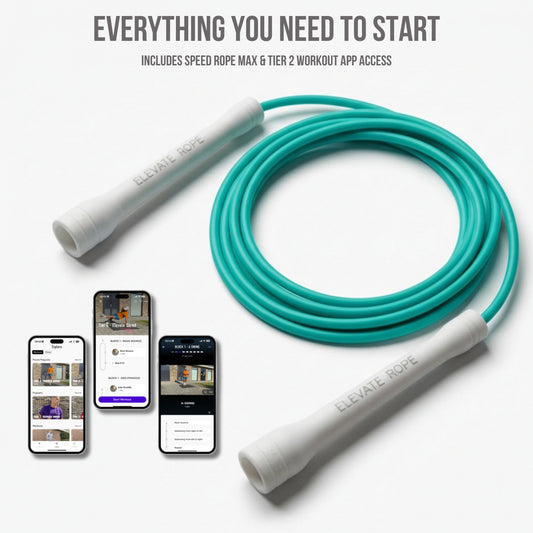
This is the foundation of Elevate Rope's approach: structure over motivation, enjoyment over discipline. The Elevate Rope system is built around progressive skill development — beaded ropes for beginners, speed ropes for conditioning, weighted TITAN 7MM ropes for plateau-breaking — because progression creates engagement, and engagement creates consistency. With a free app offering 100+ guided workouts and 1,200+ verified reviews, the evidence is clear: when fun exercise is the foundation, people stick with it.

Frequently Asked Questions
Can fun exercise really help me lose weight, or do I need intense workouts?
Fun exercise absolutely drives weight loss — not despite being enjoyable, but because of it. Adherence is the primary predictor of fat loss outcomes. A moderate workout you do five days a week produces dramatically better results than an intense session you dread and do once.
What makes jump rope a particularly fun exercise compared to other cardio?
Jump rope combines rhythm, music, skill progression, and community in a way most cardio can't. Learning tricks activates your brain's reward system, the rhythmic nature induces flow states, and the short session length means you finish energised. Plus, 10 minutes of jumping delivers results comparable to 30 minutes of jogging.
How long does it take for fun exercise habits to form?
Research suggests habit formation averages around 66 days. But enjoyable activities form habits faster because the positive emotional response reinforces the behaviour loop. Many jump rope beginners report looking forward to sessions within two weeks.
I've always hated cardio. Is there fun exercise that actually works?
If you've always hated cardio, you haven't tried the right type. Treadmills and ellipticals are designed for endurance, not engagement. Jump rope, dance, and martial arts involve skill and coordination that keep your brain engaged. Most "cardio haters" are actually "boredom haters."
Does fun exercise burn fewer calories than serious training?
Not necessarily. Jump rope burns between 10 and 16 calories per minute — comparable to fast-paced running. HIIT-style jump rope sessions can be extremely demanding while still feeling engaging. The idea that fun exercise is somehow less effective is a myth.
What if I'm a complete beginner with no fitness background?
Beginners often benefit most because the learning curve creates constant novelty. Most people can maintain a basic bounce within their first session. The cardio at home guide offers beginner-friendly approaches to start today.
Is there scientific evidence that enjoyment predicts exercise success?
Extensive evidence. Woolley and Fishbach (2017, 2025) demonstrated that enjoyment predicted persistence while perceived importance did not. Jekauc (2015) showed enjoyment-focused interventions increased adherence. Multiple meta-analyses confirm enjoyment as one of the strongest predictors of long-term physical activity.
How do I make my current routine more fun?
Add music, learn a new skill, switch your environment, or shorten your sessions. Even small changes — timing yourself, setting trick goals, or using the Elevate app — can transform a stale routine. Check out the exercises that burn more than running for high-engagement alternatives.
Your Next Step: Choose Fun, Choose Consistency, Choose Results
Every piece of evidence points in the same direction: the most effective exercise programme is the one you enjoy enough to follow through on. If you've been caught in the cycle of starting intense programmes and burning out, you don't have a discipline problem. You have an enjoyment problem.
Jump rope offers a rare combination: fun exercise that's genuinely effective, endlessly progressive, and requires nothing more than a rope and a few square metres of space. Whether you're starting with a beaded rope for beginners or ready to push your limits with HIIT jump rope workouts, the path forward is the same: find the fun, and the results will follow.
Sources
You May Also Like
- The Complete Guide to Jump Rope for Weight Loss
- 10-Minute Workouts: The Science Behind Why Short Sessions Work Better
- 5 Exercises That Burn More Calories Than Running
- Why You're Not Losing Weight: The Exercise Consistency Problem
- Why Your Gym Membership Is Making You Fatter
- Jump Rope vs Running for Weight Loss: Which Burns More Fat?