





Short workouts sound too good to be true — until you look at the research. For decades, we've been told that effective exercise means long, sweaty sessions in a crowded gym. Thirty minutes minimum. Sixty is better. But that 30-minute rule might be sabotaging your results — not because the exercise is bad, but because of what happens around it.
This article challenges everything you think you know about workout duration and shows you why doing less, more often, might be the shift that finally makes fat loss stick.
What you'll learn:
- The "compensation effect" — why longer workouts trigger more eating
- What research says about exercise duration and fat loss
- Why 10-minute short workouts can outperform 30-minute sessions
- How to structure effective short workouts that actually deliver results
The Compensation Effect: Your Body's Sneaky Sabotage
In 2016, a study in Current Biology introduced the "constrained energy model." Researcher Herman Pontzer studied over 300 adults and found that people who exercised the most didn't burn proportionally more total calories than moderate exercisers. The body compensated — reducing fidgeting, lowering non-exercise activity — until the caloric advantage of longer workouts largely disappeared.
The psychological compensation is arguably worse. A study in Marketing Letters found that people who completed longer exercise sessions ate significantly more afterwards. A 45-minute gym session became a mental permission slip for a 600-calorie post-workout smoothie. This is the hidden calorie trap: you spend 40 minutes on equipment you don't enjoy, leave feeling depleted, and eat back every calorie you burned. People who switch to short workouts often discover they sidestep this cycle entirely because the sessions don't leave them feeling depleted enough to "reward" themselves.
Short answer: Longer workouts trigger both metabolic and psychological compensation, which can erase the caloric deficit you worked to create.
Why it matters: Duration is less important than what happens in the 23 hours after your workout — and shorter sessions interfere less with the rest of your day.
Best next step: Track your total daily intake on training vs. rest days. The difference might surprise you.

What the Research Says About Short Workouts and Fat Loss
A 2019 meta-analysis in the British Journal of Sports Medicine found that HIIT was 28.5% more effective at reducing body fat compared to moderate-intensity continuous training — despite sessions being substantially shorter. Participants doing intense 10-to-20-minute sessions lost more fat than those jogging for 40 minutes.
The reason is excess post-exercise oxygen consumption (EPOC). After a high-intensity session, your body keeps burning calories at an elevated rate for hours. A 10-minute high-intensity workout can elevate your metabolic rate for 12 to 24 hours. A steady-state 30-minute jog? The metabolic boost ends within an hour. This is precisely why short workouts paired with high intensity outperform longer moderate sessions for body fat reduction.
Why Consistency Matters More Than Duration
Here's where short workouts really shine: adherence. The greatest predictor of exercise success isn't programme design — it's whether you actually do it. Perceived time commitment is the number one barrier to exercise. When a workout needs 45 minutes, people skip it on busy days. When it takes 10 minutes, they follow through.
Consider the maths. Three short workouts per week across 50 weeks equals 150 sessions a year. Three planned 45-minute sessions where you show up twice? Around 100 sessions at best. Shorter wins because it actually happens — and consistency is what drives real fat loss over time.
Why the "30-Minute Minimum" Myth Persists
The 30-minute standard traces back to early guidelines from the American College of Sports Medicine in the 1990s. These recommendations targeted cardiovascular health — not fat loss. Somewhere along the way, "30 minutes for heart health" became "30 minutes for weight loss," even though the physiology is completely different.
There's a financial incentive too. Gyms sell memberships based on you spending meaningful time in their facility. A trainer who recommends short workouts at home is a trainer out of a job. The entire industry is built on the premise that more is better and that you need their space and equipment. The truth is more liberating. When your actual goal is weight loss through exercise, intensity and consistency matter infinitely more than duration.
Short answer: The 30-minute minimum was designed for cardiovascular health, not fat loss. It persists because of institutional momentum and gym economics.
Why it matters: Believing you need 30+ minutes creates an all-or-nothing mindset that kills consistency — the real enemy of weight loss.
Best next step: Reframe your minimum viable workout. Ten focused minutes is enough to move the needle.
How to Structure Effective Short Workouts
The best short workouts share three principles: high intensity, full-body movements, and minimal rest.
Jump Rope: The Ultimate Tool for Short Workouts
Research from Arizona State University found that 10 minutes of jumping rope equals the cardiovascular output of 30 minutes of jogging. That 3:1 efficiency ratio makes jump rope ideal for anyone who wants results without spending half their day exercising.
Jump rope is particularly powerful because it combines cardio with a coordination challenge that keeps your brain engaged. Unlike a treadmill — where boredom hits at minute three — a rope demands attention, which means higher intensity and fewer wasted minutes. If you're new to jumping, a beaded rope provides the best feedback for learning timing. The weighted beads create a consistent arc that helps beginners find their rhythm without constant tripping.
A Simple 10-Minute Framework
Minutes 1–2: Light warm-up at 50% effort. Easy jumping or marching.
Minutes 3–8: Alternating intervals. 30 seconds high-intensity (fast jumps, high knees), 15 seconds active recovery. Eight rounds in 6 minutes.
Minutes 9–10: Cool-down at decreasing intensity.
This framework works with a jump rope, bodyweight exercises, or a combination. Short workouts built on this interval structure deliver maximum calorie burn per minute. For more exercises that burn more calories than running, there are plenty of options that fit this format perfectly.
Making Short Workouts Part of Your Daily Routine
The real magic of shorter sessions is psychological. When exercise requires less willpower and less scheduling, you remove nearly every barrier that causes people to quit.
"Just do 10 minutes" is remarkably effective on low-motivation days. Research on habit formation shows starting is the hardest part. Once you're 2 minutes in, resistance dissolves. But even if you genuinely only do 10 minutes, you've maintained the habit and triggered the EPOC effect. Ten minutes done always beats sixty minutes skipped — and short workouts make "done" the default.
Another approach gaining traction is "exercise snacking" — multiple brief bouts across the day. A 2022 study in Nature Medicine found that even 1-to-2-minute bursts of vigorous activity reduced cancer and cardiovascular risk significantly. Practically, this means a 10-minute jump rope HIIT session in the morning and a 5-minute bodyweight routine at lunch — 15 quality minutes with zero schedule disruption.
The Equipment Advantage
Short workouts work best with zero friction between thinking "I should exercise" and actually starting. A jump rope fits in a drawer, works in any room with a standard ceiling, and gets your heart rate up within 60 seconds. By the time a gym-goer finishes their commute and starts their warm-up, you could be finished with your entire session and in the shower.
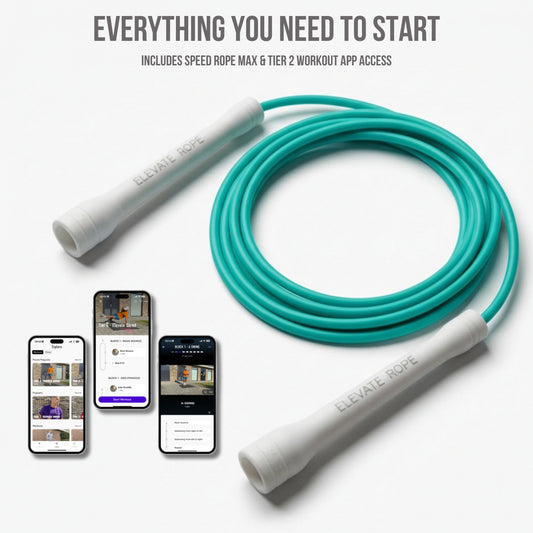
→ The Elevate Rope bundles include multiple rope types so you can vary intensity — lighter ropes for speed, heavier options like the TITAN 7MM weighted rope for sessions where you want to push harder in less time.
Short answer: Remove every barrier between you and a 10-minute session. Keep equipment accessible, eliminate commute time, and treat short workouts as complete workouts — not compromises.
Why it matters: The best programme is one you follow for months. Short, home-based sessions have dramatically higher adherence than gym routines.
Best next step: Commit to one 10-minute session tomorrow morning before checking your phone.
The Proof: When Longer Isn't Better
A 2012 study from the University of Copenhagen followed overweight men in three groups: sedentary, moderate exercise (30 min/day), and high exercise (60 min/day). After 13 weeks, the 30-minute group lost 3.6 kg (7.9 lbs) — the 60-minute group lost only 2.7 kg (6 lbs). Moderate exercisers outperformed heavy exercisers by 33%, doing half the work.
Researchers attributed the difference to compensatory eating and reduced non-exercise activity. With short workouts at high intensity, this pattern scales down even further — 10 focused minutes don't trigger the same "I earned it" overeating that 60-minute sessions produce. The workout fits into your life rather than replacing parts of it.
Your Weekly Plan for Short Workouts
Ready to put this into practice? Here's a simple weekly structure for effective short cardio workouts at home:
Monday: 10-minute jump rope intervals (30 seconds on, 15 seconds off)
Wednesday: 10-minute bodyweight circuit (push-ups, squats, planks — 40 seconds work, 20 seconds rest)
Friday: 10-minute jump rope freestyle (mix speeds, try tricks, keep moving)
That's 30 minutes per week total. It sounds low. But maintain this schedule for six months — far more realistic than maintaining a 5-day gym programme — and you'll accumulate over 75 high-quality sessions. That consistency compounds into real, visible results that short workouts deliver precisely because you actually stick with them.
Frequently Asked Questions
Can you really lose weight with short workouts?
Yes. Research shows that high-intensity sessions of 10 to 20 minutes produce equal or superior fat-loss results compared to longer moderate sessions. Short workouts succeed because they're sustainable — you actually do them for months, which is what drives real change.
How many calories do you burn in a 10-minute workout?
A 10-minute high-intensity session typically burns 100 to 200 calories during the workout. The real advantage is EPOC — your elevated metabolic rate for 12 to 24 hours after. A 10-minute jump rope session can match a 30-minute jog's total burn.
Is 10 minutes of exercise a day enough to lose weight?
For most people, 10 minutes of daily high-intensity exercise combined with reasonable eating creates a meaningful calorie deficit over time. The critical factor isn't any single session — it's consistency over months.
What's the best type of exercise for short workouts?
Jump rope HIIT is exceptionally efficient — it combines cardiovascular training, coordination, and full-body engagement. Try 30 seconds jumping, 15 seconds rest, repeated for 10 minutes.
Why do I gain weight when I exercise more?
Often caused by the compensation effect. Longer sessions increase appetite and reduce non-exercise activity throughout the day. People who exercise for 60 minutes often eat back more than they burned. Short workouts minimise this compensatory cycle because they don't leave you depleted.
Are short workouts better than long ones for weight loss?
For most people, yes — not because each session is physiologically superior, but because they're dramatically more sustainable. Research shows shorter sessions produce less compensatory eating and lower dropout rates. If time is a barrier, short workouts aren't a compromise — they're a strategy.
Less Can Be More: Your Next Steps
Short workouts aren't a hack — they're a recognition of how human physiology and psychology actually work. Your body compensates for long sessions. Your brain uses lengthy workouts as permission to overeat. Your schedule uses the time commitment as an excuse to skip. Reduce the duration, increase the intensity, and you sidestep all three problems simultaneously.
If you're new to short workouts with a jump rope, → Elevate Rope's beaded ropes are designed for beginners learning rhythm and timing. If you want to push intensity, → the speed rope collection is built for HIIT that makes every second count.
Ten minutes. Three times a week. Start tomorrow.
Sources
You May Also Like
- The Complete Guide to Jump Rope for Weight Loss
- 10-Minute Workouts: The Science Behind Why Short Sessions Work Better
- 5 Exercises That Burn More Calories Than Running
- Why Your Gym Membership Is Making You Fatter
- The Science of Exercise You Actually Enjoy
- Cardio at Home: The Ultimate No-Gym Workout Guide