





Jump rope HIIT workouts have become the most efficient fat-loss tool in modern training — and the research is finally catching up to what athletes have known for decades. Twenty minutes with a rope can do what an hour on the treadmill cannot, and the reason has less to do with effort than with the way your body responds to short, repeated bursts of intensity.
But here's the catch most articles skip: not every jump rope HIIT routine is built for fat loss. Some are designed for cardiovascular endurance. Some target anaerobic power. Some are simply too advanced for the body to recover from session to session — which means they stop working after week two. Pick the wrong one, and you'll burn out before you see results.
This guide breaks down five jump rope HIIT workouts that target fat loss specifically, each one built for a different goal: starting out, breaking a plateau, training when time is tight, conditioning at an advanced level, and maximising the afterburn effect known as EPOC. Every routine is grounded in research, paired with the right rope, and structured so you can run it as a complete fat-loss plan.
What You'll Learn
- Why jump rope HIIT workouts burn more fat than steady-state cardio in less time
- The science behind EPOC — the "afterburn" that keeps your metabolism elevated for hours
- 5 complete jump rope HIIT routines, each built for a specific fat-loss goal
- How to match the right rope to each routine
- A weekly schedule for combining the routines without burning out
Why Jump Rope HIIT Workouts Outperform Steady-State Cardio
The case for jump rope HIIT workouts isn't about working harder — it's about working differently. Steady-state cardio burns calories during the session, but your metabolism returns to baseline shortly after you stop. HIIT does something steady-state cardio cannot: it triggers excess post-exercise oxygen consumption, or EPOC, which keeps your body burning calories for hours after the workout ends.
A study published in the Journal of Applied Physiology found that HIIT protocols produced significantly greater fat oxidation over a 24-hour period than continuous moderate-intensity exercise, even when total session calories were similar. The fat-burning didn't happen during the workout — it happened in the 14 hours afterwards.
Jump rope amplifies this effect because it recruits the calves, quads, glutes, shoulders, and core in every rotation. More muscle engagement means more oxygen debt, which means a longer and deeper EPOC response. Arizona State University researchers found that 10 minutes of jumping rope produces the cardiovascular benefit of 30 minutes of jogging — a 3:1 efficiency ratio that explains why elite boxers, MMA fighters, and Olympic athletes have used it for over a century.
The other advantage is mechanical. Running pounds the joints with each stride at three to five times bodyweight. A rope, performed correctly with soft landings on the balls of the feet, distributes that force across both legs evenly. Our jump rope vs running breakdown covers the joint-impact data in detail.
Short answer: Jump rope HIIT workouts burn more fat than steady-state cardio because they trigger EPOC — an afterburn effect that keeps your metabolism elevated for up to 14 hours post-workout.
Why it matters: You're not just burning calories during the session. You're spending the rest of the day in a heightened fat-oxidation state, which compounds over weeks.
Best next step: Choose one of the five routines below based on your current fitness level and goal.

The 5 Jump Rope HIIT Workouts
Each routine below targets a specific fat-loss outcome. The work-to-rest ratios aren't generic templates — they're calibrated for the metabolic system the workout is designed to train.
Routine 1 — The Beginner Fat Burner (15 minutes)
Built for: First 4–6 weeks of jump rope HIIT training. Anyone returning to exercise or new to skipping.
Why it works: A 1:2 work-to-rest ratio (30 seconds on, 60 seconds off) gives the cardiovascular system enough recovery to maintain intensity across all rounds. Push the ratio too aggressively in the first month and you'll quit before adaptation happens.
- Warm-up: 2 minutes light bouncing without the rope
- Work: 30 seconds basic bounce at moderate pace
- Rest: 60 seconds walking or marching in place
- Rounds: 8
- Cool-down: 1 minute walking + calf stretch
- Total time: 15 minutes
Best rope: A weighted beaded rope. The audible click each rotation makes timing easier to learn, and the slight weight builds rhythm faster. Start with the Elevate beaded rope.
Routine 2 — The Tabata Plateau Breaker (20 minutes)
Built for: Intermediate jumpers stuck on the same body composition for 3+ weeks.
Why it works: The original Tabata study by Dr. Izumi Tabata, published in Medicine & Science in Sports & Exercise, used 20 seconds of all-out work with only 10 seconds of rest across 8 rounds. It produced greater improvements in both anaerobic and aerobic capacity than steady-state cardio at 70% effort. The compressed work-to-rest ratio (2:1) is what jolts a plateaued body back into adaptation.
- Warm-up: 3 minutes easy bouncing
- Block 1: 20 seconds maximum-effort skipping, 10 seconds rest × 8 rounds (4 min)
- Rest: 2 minutes walking
- Block 2: 20 seconds high knees with rope, 10 seconds rest × 8 rounds (4 min)
- Rest: 2 minutes walking
- Block 3: 20 seconds double-unders (or fastest pace possible), 10 seconds rest × 8 rounds (4 min)
- Cool-down: 1 minute
- Total time: 20 minutes
Best rope: For plateau breaking, the resistance of a weighted rope multiplies the metabolic cost without making you jump faster. The TITAN 7MM weighted speed rope is purpose-built for this — heavy enough to fatigue the upper body, light enough to maintain Tabata intervals.
Routine 3 — The 10-Minute Time Crunch (10 minutes)
Built for: Busy days. Lunch breaks. Mornings when the alarm wins.
Why it works: Research from McMaster University showed that three 20-second sprints inside a 10-minute session produced the same VO2 max improvements as 45 minutes of moderate cycling — three times a week, over 12 weeks. The total work was just one minute per session, but the metabolic stimulus was equal. Our 10-minute workout breakdown dives deeper into the science.
- Warm-up: 2 minutes easy bouncing
- Sprint 1: 20 seconds all-out skipping
- Rest: 2 minutes walking
- Sprint 2: 20 seconds all-out skipping
- Rest: 2 minutes walking
- Sprint 3: 20 seconds all-out skipping
- Cool-down: 1 minute
- Total time: 10 minutes
Best rope: Maximum speed matters here. A bearing-free speed rope produces a clean, consistent rotation that won't snag at top RPM.
Routine 4 — The Advanced Conditioning Circuit (25 minutes)
Built for: Established jumpers with 8+ weeks of consistent training. Athletes building sport-specific conditioning.
Why it works: Mixing skipping with bodyweight resistance work in the same circuit forces the heart rate to stay elevated while shifting the muscular load. This trains both aerobic capacity and muscular endurance simultaneously — a combination that drives faster body composition change than either modality alone.
- Warm-up: 3 minutes easy bouncing + dynamic stretches
-
Circuit (repeat 4 times):45 seconds fast skipping15 seconds rest20 push-ups30 seconds rest45 seconds high knees with rope15 seconds rest20 air squats45 seconds rest before next round
- 45 seconds fast skipping
- 15 seconds rest
- 20 push-ups
- 30 seconds rest
- 45 seconds high knees with rope
- 15 seconds rest
- 20 air squats
- 45 seconds rest before next round
- Cool-down: 2 minutes walking + full-body stretch
- Total time: 25 minutes
Best rope: A heavy rope adds strength stimulus to every rotation. The shoulder, lat, and forearm engagement transforms each work interval into a hybrid cardio-strength session. See the heavy ropes collection.

Routine 5 — The EPOC Maximiser (18 minutes)
Built for: Anyone optimising for total daily fat burn, not just session calories.
Why it works: EPOC scales with intensity, not duration. A study in the European Journal of Applied Physiology showed that short bursts at 85–90% of maximum heart rate generated nearly twice the EPOC response of longer efforts at 60–70%. This routine front-loads intensity using descending intervals — your hardest work happens when you're freshest, which is when EPOC accumulates most.
- Warm-up: 3 minutes
- Round 1: 60 seconds maximum-effort skipping → 30 seconds rest
- Round 2: 45 seconds maximum-effort skipping → 30 seconds rest
- Round 3: 30 seconds maximum-effort skipping → 30 seconds rest
- Round 4: 20 seconds maximum-effort skipping → 30 seconds rest
- Round 5: 15 seconds maximum-effort skipping → 30 seconds rest
- Repeat the pyramid in reverse: 15s, 20s, 30s, 45s, 60s
- Cool-down: 2 minutes
- Total time: 18 minutes
Best rope: A versatile speed rope or weighted speed rope works. If you're not sure where to start across multiple routines, the Elevate bundles give you the progression in one purchase.
How to Stack These Workouts Into a Weekly Plan
Running all five routines in the same week is overtraining. Your central nervous system needs recovery from maximum-intensity work, and skipping that recovery is the fastest way to plateau or get injured. The point of jump rope HIIT workouts isn't to do more — it's to do enough at the right intensity to keep adapting.
Here's a sustainable weekly structure for fat loss:
| Day | Routine | Notes |
| Monday | Routine 2 — Tabata Plateau Breaker | Start the week with maximum stimulus |
| Tuesday | Active recovery (walk) | 20–30 min easy movement |
| Wednesday | Routine 4 — Advanced Circuit | Mixed cardio-strength |
| Thursday | Rest | Full recovery |
| Friday | Routine 5 — EPOC Maximiser | Pre-weekend afterburn |
| Saturday | Routine 3 — 10-Minute Time Crunch | Short, intense, easy to fit in |
| Sunday | Rest | Full recovery |
Beginners should start with three sessions per week using Routine 1 only for the first four weeks. Adaptation isn't linear, and the early weeks of jump rope HIIT build the foundation that makes the harder routines possible later.
Short answer: Three to four jump rope HIIT workouts per week is the sweet spot for fat loss without overtraining.
Why it matters: EPOC and adaptation both require recovery. More sessions ≠ more results — they often produce fewer results because the body never fully recovers.
Best next step: Block the four sessions into your calendar this week. Treat them like meetings.
The Most Common Jump Rope HIIT Mistakes (And How to Fix Them)
Most people who fail with jump rope HIIT don't fail because the workouts are wrong. They fail because of small execution errors that compound. Three matter most.
Mistake 1 — Jumping too high
Every centimetre above two or three centimetres is wasted energy and added joint impact. The rope only needs to clear the soles of your shoes. High jumping is the single biggest energy leak in beginners and the fastest path to shin splints.
Mistake 2 — Skipping the warm-up
Cold calves and Achilles tendons don't handle Tabata intervals well. Two to three minutes of light bouncing isn't optional — it's the difference between a sustainable training programme and a six-week injury.
Mistake 3 — Going maximum effort on every work interval
HIIT means high-intensity intervals, not maximum-intensity intervals. The work bouts should be sustainable across all rounds at roughly 80–90% of your perceived effort. If round one feels like round eight, you started too hard and your last round will collapse.

Frequently Asked Questions
How long should jump rope HIIT workouts be for fat loss?
Most effective sessions sit between 10 and 25 minutes total, including warm-up and cool-down. Anything longer typically reduces intensity, which is the variable that drives the EPOC response. Shorter is better than longer if intensity is preserved.
Can you do jump rope HIIT workouts every day?
No. The metabolic and neuromuscular demand of true HIIT requires 48 hours of recovery between sessions. Three to four sessions per week is optimal. Daily skipping at low to moderate intensity is fine — but it isn't HIIT.
What's the best jump rope for HIIT workouts?
For pure speed-based jump rope HIIT, a bearing-free speed rope. For plateau-breaking or adding metabolic load, a weighted speed rope like the TITAN 7MM. For strength-cardio hybrid circuits, a heavy rope. Beginners should start with a beaded rope to learn rhythm and timing first.
How many calories do jump rope HIIT workouts burn?
A 70 kg adult burns roughly 13–15 calories per minute during high-intensity skipping, plus an additional 6–15% of total session calories through EPOC over the following 14 hours. A 20-minute session can therefore yield 280–340 calories burned, with another 20–50 calories burned post-workout. See our full jump rope calories burned guide for body-weight breakdowns.
Do you need to combine HIIT with diet for fat loss?
Yes. No training programme outruns a calorie surplus. Jump rope HIIT creates a calorie deficit potential, but the deficit only happens if total daily intake is below total daily expenditure. The advantage of jump rope HIIT is that it widens the deficit ceiling without requiring hours of training.
Are jump rope HIIT workouts safe for beginners?
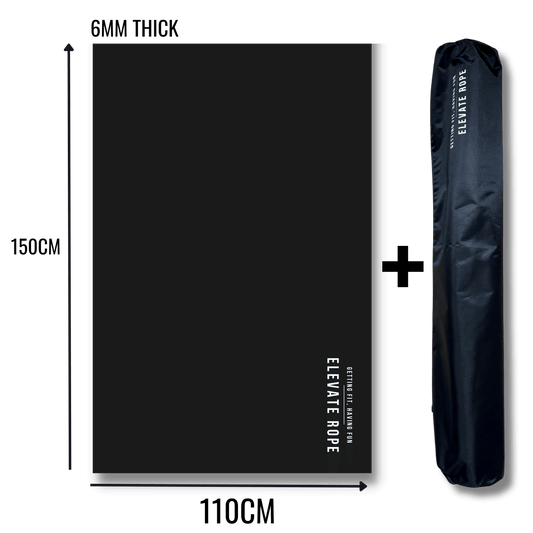
Yes, when programmed appropriately. Start with Routine 1 (the Beginner Fat Burner) and progress only after four consistent weeks. Land softly on the balls of the feet, keep jumps low, and use a surface with mild give — wooden flooring, rubber mat, or a quality jump rope mat. Concrete is the worst surface for repeated sessions.
Can jump rope HIIT replace strength training?
No. HIIT builds conditioning and burns fat efficiently, but it doesn't drive the muscle protein synthesis needed for hypertrophy or strength gains. For complete body composition change, pair HIIT with two to three strength sessions per week.
Your Next Step
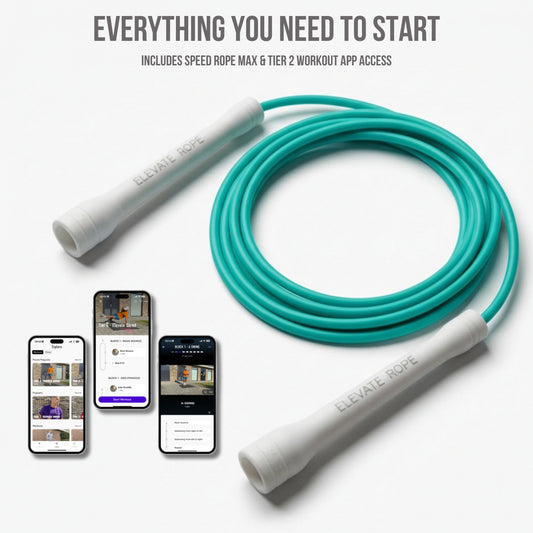
The hardest part of any jump rope HIIT plan isn't the workouts themselves — it's choosing the right rope to make the work feel achievable. If you've never skipped consistently before, start with a beaded rope and Routine 1. If you've been jumping for a few months and want to break a plateau, the TITAN 7MM weighted rope is the most-recommended next step. If you want one purchase that covers the full jump rope HIIT progression, our progression bundles include the ropes you'll grow into.
For the full strategic framework behind fat loss with jump rope — calories, programming, nutrition, and the psychology of consistency — work through our pillar guide on jump rope for weight loss.
Sources
- Treuth, M. S. et al. (2006). "Effect of high-intensity exercise on fat oxidation." Journal of Applied Physiology.
- Tabata, I. et al. (1996). "Effects of moderate-intensity endurance and high-intensity intermittent training on anaerobic capacity and VO2max." Medicine & Science in Sports & Exercise.
- Gillen, J. B. et al. (2016). "Twelve weeks of sprint interval training improves indices of cardiometabolic health similar to traditional endurance training." McMaster University, PLOS ONE.
- LaForgia, J. et al. (2006). "Effects of exercise intensity and duration on the excess post-exercise oxygen consumption." European Journal of Applied Physiology.
- Arizona State University. "10 minutes of jumping rope equals 30 minutes of jogging." ASU News.