





Fixing bad posture (office posture) from a desk job is harder than most fitness content makes it sound — and the standard advice is a big reason why. "Sit up straight." "Roll your shoulders back." "Buy a standing desk." None of it lasts longer than twenty minutes because none of it actually addresses what prolonged sitting does to your musculoskeletal system at the structural level. Your spine does not forget eight hours a day for five years. It adapts to them.
The stiffness when you stand up. The ache between your shoulder blades that appears like clockwork around 3pm. The forward head position that makes you look exhausted even when you're not. These are not posture habits — they are structural adaptations. Your hip flexors have shortened. Your thoracic spine has lost its natural curve. Your glutes have partially switched off. You are not slouching because you lack willpower. You are slouching because your body has physically restructured itself around the demands of a chair. This pattern is commonly known as office posture, and it affects millions of people who spend most of their day sitting.
Most people try to fix office posture by forcing themselves into a straighter position. The problem is that office posture is rarely a simple awareness issue. Office posture develops over months and years of repetitive positioning, and the body gradually adapts to those demands. That is why office posture often returns the moment you stop consciously thinking about it.
The good news: the same adaptability that got you here gets you out. Muscle tissue, connective tissue, and movement patterns respond to new inputs. The question is which inputs actually work — and how often you need to apply them to see results that last. The most effective solutions for office posture focus on restoring movement, strength, and alignment rather than relying on temporary posture cues.
If you have struggled with office posture for years, don't be discouraged. Office posture is not permanent. The body is constantly adapting, and the same process that created office posture can help reverse it when you consistently provide better movement patterns and physical challenges.
What you'll learn in this article:
→ What sitting 8+ hours a day physically does to your spine, hips, and shoulders
→ Why stretching alone doesn't fix office posture (and what does)
→ The three structural problems behind office posture — and the fix for each
→ A 7-fix protocol you can start without any equipment
→ Why jump rope is one of the most underrated tools for improving office posture and helping desk workers move better
→ How to know when your office posture is actually improving
→ The one daily habit that makes every other office posture fix stick
Whether your goal is less pain, better movement, improved confidence, or simply standing taller, understanding office posture is the first step toward lasting change.

What "Office Posture" Actually Is (It's Not Just Bad Habits)
The clinical term is adaptive postural dysfunction. When your body stays in a single position for the majority of its waking hours, it does not keep all the muscles involved in a neutral ready state. It downregulates the ones it doesn't need. Over weeks and months, certain muscles become chronically shortened and overactive, while their opposing muscles lengthen and become underactive. This is not a character flaw. It's biology.
What most people call office posture is actually a collection of structural adaptations that develop in response to prolonged sitting. Office posture is not something you choose. Office posture is something your body gradually adopts when a desk becomes your primary environment for years at a time.
The 4 Structural Changes That Happen to Desk Workers
Physiotherapists identify four predictable changes in desk workers, often called Upper and Lower Crossed Syndromes. Together, these changes create the classic office posture pattern seen in millions of people worldwide.
The first is anterior pelvic tilt. When you sit, your hip flexors — the psoas and iliacus — are in a shortened position for hours at a time. Over months, they stay that way. This contributes significantly to office posture by tilting the pelvis forward, exaggerating the lumbar curve, and increasing compressive load on the lower back. A 2012 study published in the Journal of the American Academy of Orthopaedic Surgeons found that psoas tightness is present in over 65% of people with chronic lower back pain.
The second is gluteal amnesia. Your glutes are the largest and most powerful muscles in your body. When you sit for prolonged periods, neural drive to the glutes is reduced — your nervous system effectively stops recruiting them efficiently. This is another major driver of office posture. Weak, inhibited glutes force your lower back, hamstrings, and hip flexors to compensate, which cascades into back pain, knee strain, and poor movement mechanics throughout daily life.
The third is thoracic kyphosis. The thoracic spine — the middle portion running roughly from your shoulder blades to your mid-back — is designed to have a gentle natural curve. Extended forward flexion (your typical screen posture) pushes this curve beyond its natural range and holds it there. Over time, the posterior thoracic muscles lengthen and weaken, the anterior chest muscles shorten, and what was once a working position becomes a resting state. This rounded upper-back position is one of the most recognisable signs of office posture.
The fourth is forward head posture. For every 2.5 centimetres your head moves forward from its neutral position over your spine, the effective load on your cervical vertebrae increases by roughly 4–5 kg. At a typical office posture, your head — which weighs around 5 kg — can place the equivalent of 20–25 kg of load on your neck and upper spine. This explains the trapezius tension and headaches that so many desk workers treat as just "stress."
Why Stretching Alone Doesn't Fix Any of This
Stretching is not useless — static stretching of shortened muscles is part of a proper protocol. But stretching without strengthening is like loosening a tent rope without staking the other side down. You need to lengthen the tight structures AND strengthen the lengthened ones simultaneously.
Many people attempt to fix office posture with stretching routines alone. The problem is that office posture develops because some muscles become too tight while others become too weak. Effective office posture correction requires addressing both problems at the same time.
Hip flexor stretches without glute activation rarely create lasting changes in office posture. Chest stretches without upper-back strengthening produce the same result. The correction requires both ends of the chain working together.
Short answer: Office posture is a structural adaptation, not a habit. Prolonged sitting shortens hip flexors, inhibits glutes, rounds the thoracic spine, and pushes your head forward — all of which require both stretching and strengthening to reverse.
Why it matters: Understanding the structural cause of office posture means you stop treating it as a willpower problem. The fixes become targeted and logical rather than vague reminders to "sit up straight."
Best next step: Read through the 7 fixes below in order. The first three address the structural root causes of office posture. The last four build the active correction on top of that foundation and help create lasting improvements in office posture.

The 7 Fixes — In the Order That Actually Works
These aren't isolated exercises. They're a layered protocol — each one addresses a specific piece of the puzzle, and they work best when applied together. You don't need a gym. You need about 20 minutes and a floor.
Fix 1: Release the hip flexors before you do anything else
Start here because tight hip flexors are the anchor point for the whole chain. The most effective release for desk workers is the 90/90 hip flexor stretch: one knee on the floor, other foot forward at 90 degrees, posterior pelvic tilt (tuck your tailbone slightly to flatten the lower back), then lean forward gently until you feel a pull in the front of the back hip. Hold for 90 seconds per side. This is longer than most people do it — research on viscoelastic tissue elongation suggests that minimum of 60–90 seconds is needed to create meaningful change in shortened connective tissue.
Do not skip this or rush it. Everything built on top of it depends on your pelvis being able to return to a neutral position.
Fix 2: Reactivate the glutes
Once the hip flexors have released, the glutes need to be reminded they exist. The most direct re-activation exercise is the glute bridge. Lie on your back, feet flat on the floor, drive your heels into the ground and push your hips toward the ceiling. At the top, squeeze hard for 2 seconds. Lower slowly. Do 3 sets of 15. The key is intent — a glute bridge done passively using the hamstrings and lower back is not glute activation. Squeeze at the top on every single rep.
Progress to single-leg glute bridges once the bilateral version feels too easy. Single-leg work also addresses the asymmetries that prolonged sitting tends to create between left and right sides.
Fix 3: Open the thoracic spine
Thoracic mobility work is the most neglected piece of desk worker rehab and one of the highest-leverage interventions. The thoracic extension over a foam roller is the standard tool: place the roller perpendicular to your spine at mid-back level, support your head with your hands, and allow your upper back to extend gently over it. Move up one vertebral level at a time. 60 seconds total. Many people report immediate relief from that constant mid-back tightness on the first session.
After the mobility work, pair it with band pull-aparts or face pulls if you have access to resistance bands. The goal is not just range of motion but strengthening the mid and lower trapezius and rhomboids — the muscles that hold your shoulder blades in their proper position.
Fix 4: Strengthen the deep neck flexors
Forward head posture does not respond to "just pull your head back." The muscles that hold your head in neutral position — the deep cervical flexors, including the longus colli and longus capitis — are often severely underactivated in people who spend their days at a screen. The chin tuck is the standard re-activation drill: gently retract your chin horizontally (not downward — it's a glide, not a nod), hold for 5 seconds, release. Do 10 repetitions. This is subtle and awkward at first. That's a sign it's working on muscles you haven't been using.
Fix 5: Add impact movement daily
This is the fix that separates lasting correction from temporary relief. Static stretching and activation drills improve your posture while you're doing them. Impact movement changes it structurally over time.
Jump rope is particularly effective for desk workers because the mechanics of good jump rope form directly oppose the most common postural failures. When you jump rope correctly, your shoulders are back and down, your spine is in a natural upright position, your glutes are engaged on every landing, and your core is braced. You are reinforcing the exact postural pattern you're trying to rebuild — under light cardiovascular load, with hundreds of repetitions per session.
A 2015 study in PLOS ONE found that jump rope training over six weeks produced significant improvements in muscular coordination and postural stability in sedentary adults. The impact loading also stimulates bone density — relevant for desk workers whose sedentary hours reduce the skeletal loading that keeps bones dense.
For anyone starting from zero, the → Dignity Beaded Rope is the most forgiving entry point. The weight and auditory feedback of the beaded design gives you a natural rhythm to lock into, which removes the cognitive load from the movement and lets you focus on form. Ten minutes daily — ideally split into a short morning session and a short evening session — is enough to start creating structural change over 4–6 weeks.
Fix 6: Change your relationship with your chair
This is not "get a standing desk." Standing desks, when used incorrectly, simply trade one static posture for another. The actual fix is movement variability throughout the day. Your body does not need a perfect posture — it needs to cycle through many postures, none of which are held for longer than 30–45 minutes at a stretch.
A practical protocol: set a timer for every 30 minutes. When it goes off, stand up, do 5 glute bridges or 2 minutes of light movement, then return to work. This is not about getting cardio. It's about interrupting the adaptive shortening process before it compounds. Research published in Medicine & Science in Sports & Exercise found that breaking up sitting time with short movement bouts every 30 minutes significantly improved glucose regulation and reduced markers of metabolic dysfunction — even without any formal exercise program.
Fix 7: Address sleep posture
You spend 7–9 hours in bed every night. If your sleep position is reinforcing the same patterns as your desk position, your daytime rehab work is fighting an uphill battle. Stomach sleeping is the most problematic for desk workers — it forces your cervical spine into rotation and often encourages anterior pelvic tilt. Side sleeping with a pillow between the knees and your head supported in a neutral position is generally the most spine-friendly option. Back sleeping works well if your pillow height keeps your head in neutral and you place a pillow under your knees to reduce lumbar stress.

How Long Does It Actually Take to Fix Office Posture?
Honest answer: it depends on how long the pattern has been embedded. Research on connective tissue adaptation suggests that meaningful structural change requires consistent stimulus over a minimum of 8–12 weeks. That's not discouraging — it's just reality management. You will feel different within the first two weeks if you apply the protocol consistently. You will look different — standing taller, shoulders back without effort — closer to 8–12 weeks.
What slows progress most is inconsistency. Doing the full routine three times a week produces more results than half the routine seven times a week, but both beat the alternative. Build the minimum viable version into your daily routine first. Fix 1 (hip flexor stretch) + Fix 2 (glute bridges) + Fix 5 (10 minutes of jump rope) is 15 minutes. That's your floor.
| Timeframe | What to Expect | Key Markers |
| Week 1–2 | Reduced afternoon stiffness, better range of motion when standing | Hip flexors feel less "locked up" after sitting |
| Week 3–4 | Glutes activate more naturally, mid-back discomfort reduces | You start noticing when you're slouching — awareness precedes correction |
| Week 5–8 | Upright posture starts to feel more natural than effortful | Forward head position visibly reduced; headaches decrease |
| Week 9–12 | Structural changes consolidating; movement patterns retraining | Others notice the change; posture maintained without conscious effort |
Short answer: Noticeable improvement in how your body feels occurs within 2–4 weeks of consistent work. Visible structural correction takes 8–12 weeks of daily practice.
Why it matters: Setting realistic expectations prevents the common pattern of abandoning the protocol right before it starts producing visible results.
Best next step: Commit to the 15-minute minimum daily version (hip flexor stretch + glute bridges + 10-minute jump rope) for 30 consecutive days before assessing progress. The Elevate26 challenge at elevaterope.com gives you a structured 26-day framework to build this kind of consistency.

Why Jump Rope Works When Other Fixes Plateau
Most desk workers who address posture do the rehab work for a few weeks, feel better, and stop. Then the posture creeps back over the following months because the underlying pattern — a sedentary lifestyle — has not changed. Static rehab exercises fix the damage but don't change the lifestyle generating the damage.
Jump rope addresses both simultaneously. It is one of the only common exercises that combines full-body cardiovascular load with the postural demands of an upright, neutral-spine position. Running, for comparison, often reinforces forward head posture and does nothing to counteract hip flexor tightness. Cycling compresses the thoracic spine. Rowing, done with poor form, reinforces thoracic kyphosis.
Jump rope done correctly — soft landings on the balls of the feet, shoulders relaxed and back, gaze forward, slight core engagement throughout — is an active rehearsal of the posture you're trying to build. And because you're doing 100+ repetitions per minute, you're getting more postural pattern reinforcement in 10 minutes of jump rope than in most 45-minute strength training sessions.
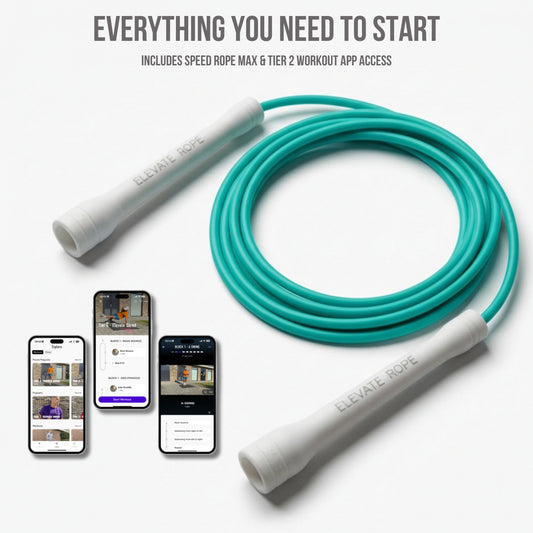
For desk workers who have been mostly sedentary, the approach matters. Start with the → Dignity Beaded Rope and aim for 5–10 minutes of continuous or broken jumping in the first week. The beaded design's weight and auditory cue make it significantly easier to find your rhythm than lightweight speed ropes, which is why it's the right starting tool for anyone whose last serious exercise was years ago. Once you've built 20+ minutes of weekly jump rope volume and your posture feels more stable, the → Speed Rope MAX opens up higher-intensity HIIT options that accelerate the cardiovascular and metabolic benefits.
For a full guide to how jump rope fits into the desk worker fitness approach, see our pillar: Jump Rope for Desk Workers: The Complete Guide to Staying Fit with a Sedentary Job.

Postural Fixes vs. Postural Causes: What the Fitness Industry Gets Wrong
There is a large and profitable industry built around posture correction gadgets, ergonomic accessories, and back braces. Most of them work by providing external support rather than building internal capacity. A posture corrector brace holds your shoulders back while you're wearing it. The moment you take it off, the musculature that should be doing that job has not gotten any stronger. You haven't corrected anything — you've outsourced the problem.
The same logic applies to ergonomic chair upgrades and standing desks as standalone solutions. A better chair is less damaging than a worse chair, but it's still a chair. The fix for a sedentary lifestyle is not a higher-quality seat — it's movement.
| Approach | Addresses Root Cause? | Sustainable? | Cost |
| Posture brace | No — external support only | No (dependency) | €30–€80 |
| Ergonomic chair upgrade | No — reduces damage, doesn't reverse it | Partially | €200–€1,500 |
| Standing desk | No — trades one static posture for another | Partially | €300–€1,200 |
| Stretching routine only | Partial — addresses tightness, not weakness | If consistent | Free |
| Full protocol (stretch + activate + impact movement) | Yes | Yes | €0 + optional rope (€25–€35) |
The most cost-effective posture intervention available to a desk worker is 15 minutes of targeted floor work followed by 10 minutes of jump rope. Not a standing desk. Not a brace. Not expensive physiotherapy sessions you attend once a month. Daily movement is the mechanism — everything else is supplementary.
Short answer: Most posture products provide external support without building the internal strength needed for lasting correction. The fix requires active movement that strengthens the muscles responsible for holding your posture — not equipment that does it for you.
Why it matters: Understanding this saves money and prevents the frustration of investing in tools that produce temporary relief without structural change.
Best next step: If you want to add an equipment piece that actually builds active postural strength rather than substituting for it, start with the → Dignity Beaded Rope and the free Elevate app (100+ guided workouts, no subscription required — unlike competitors charging €150/year).

The Daily Minimum: A Protocol That Fits Into Any Work Schedule
The biggest obstacle for desk workers is not motivation — it is time and logistics. A protocol that requires 45 minutes and a gym has a very low completion rate among people who are already time-compressed. Here is a version that requires a floor, 15 minutes, and optionally a jump rope.
Morning (8 minutes)
90/90 hip flexor stretch, 90 seconds each side (3 minutes). Glute bridges 3 × 10 (2 minutes). Thoracic extension over foam roller or firm pillow (2 minutes). Chin tucks, 2 × 10 (1 minute).
Midday or after work (10 minutes)
Jump rope. Begin with 3 rounds of 90 seconds on, 30 seconds rest. Build to continuous 10 minutes over 2–3 weeks. Maintain upright posture, relaxed shoulders, soft landings throughout. This session is doing more postural work than most people realise — because every jump is a rep of the posture you're trying to own.
Evening (optional, 5 minutes)
Cat-cow mobilisation, 10 reps. Child's pose, 60 seconds. Supine twist, 30 seconds each side. This is nervous system downregulation as much as mobility work — important for anyone who carries physical tension through a desk-based workday.
Total daily time investment: 18–23 minutes. That is less time than the average European spends scrolling their phone before getting out of bed in the morning.
Frequently Asked Questions
How long does it take to fix posture from years of desk work?
Noticeable functional improvement — less stiffness, better range of motion, reduced afternoon back pain — typically occurs within 2–4 weeks of consistent daily practice. Visible structural changes take longer: most people see meaningful correction at 8–12 weeks. The key variable is consistency. Three sessions a week produces visible results. Daily practice accelerates them significantly.
Can jump rope actually help fix posture?
Yes, and it's one of the more underrated tools for it. Correct jump rope form requires an upright spine, retracted shoulders, engaged core, and active glutes on every landing — the exact postural pattern desk workers need to reinforce. At 80–100 jumps per minute, a 10-minute session gives you hundreds of postural repetitions under light cardiovascular load, which is more effective for pattern reinforcement than most traditional rehab exercises. See our desk worker guide for the full picture.
What causes the mid-back pain that desk workers always get?
The most common cause is weakness and lengthening of the mid and lower trapezius muscles, combined with tightness of the anterior chest and shoulder muscles. This pulls your shoulder blades into a protracted position, placing chronic strain on the muscles and connective tissue between them. Thoracic extension work combined with upper back strengthening exercises directly addresses this. Jump rope accelerates the correction by reactivating the posterior chain in every session.
Is it too late to fix posture if I've been sitting for 10+ years?
No. Musculoskeletal tissue retains adaptive capacity well into adulthood and beyond. Research on sedentary adults who begin structured movement programs consistently shows significant improvements in posture, mobility, and pain levels — regardless of how long the pattern has been in place. The timeline may be longer for more established patterns, but the direction of change is the same. Start the protocol and let biology do the rest.
Why does my back hurt more at the end of the workday than the start?
Spinal discs lose fluid and height throughout the day under compressive load — this is normal physiology. But in desk workers, this compressive load is also asymmetric due to forward flexion and lateral shifts. By afternoon, the posterior spinal muscles that have been working to hold you upright are fatigued, the discs are compressed, and the hip flexors are shortened. The result is the classic 3pm lower back ache. A short movement break at lunch and again at 3pm (even 5 minutes of movement) can significantly reduce this pattern.
Should I see a physiotherapist before starting this protocol?
If you have a diagnosed spinal condition, known disc herniation, or significant acute pain, consult a physiotherapist first. For the vast majority of desk workers with general postural stiffness, aching, and tightness — with no acute injury or diagnosed pathology — this protocol is safe to begin without clinical clearance. Start conservatively on the jump rope (shorter sessions, lower intensity), listen to your body, and progress gradually.
What is the best jump rope for someone with bad posture just starting out?
The → Dignity Beaded Rope is the most practical starting choice. The weight of the beaded design naturally encourages the upright, shoulders-back form that corrects postural patterns. Lightweight speed ropes require more precision and tend to penalise beginners with tangles that interrupt the session — which is the last thing you want when building a new daily habit. The beaded rope is forgiving, rhythmic, and adjustable to any height up to 3 metres.
Does the free Elevate app have workouts for desk workers and posture?
Yes. The Elevate app includes beginner-friendly structured sessions specifically designed for people returning to exercise after periods of inactivity — including the kind of sedentary lifestyle desk work creates. It's available for free at elevaterope.com, with 100+ guided workouts and a built-in timer. No subscription required — unlike most competitor platforms that charge €150/year for equivalent content.
Where to Start If Your Posture Feels Beyond Fixing
It is not beyond fixing. But the way you feel right now — stiff, aching, upright only when you're consciously trying — makes sense given what your body has been adapting to for years. The protocol above addresses each piece of the structural problem in a logical order. Start with the hip flexors. Add glute activation. Add thoracic mobility. Build in daily impact movement.
If you have never jumped rope before or it's been years, start with the → Dignity Beaded Rope. Five minutes on day one is enough. Build from there. The structure of the Elevate26 challenge at elevaterope.com gives you a 26-day progression that layers exactly this kind of gradual increase in volume and intensity — designed specifically for people starting from a low fitness baseline.
If you want to understand the full picture of what jump rope does for desk workers beyond posture — cardiovascular health, metabolic function, energy levels, mental clarity — the complete desk worker guide covers it in depth. That's the pillar page for this entire content cluster, and it's the most comprehensive resource we've built for this specific situation.
Your spine adapted to years of sitting. It can adapt to years of moving. The process just has to start somewhere.
Sources
- Hides JA, et al. "Multifidus and psoas muscle changes in chronic low back pain." Journal of the American Academy of Orthopaedic Surgeons. 2012. pubmed.ncbi.nlm.nih.gov/22553101
- Biswas A, et al. "Sedentary time and its association with risk for disease incidence, mortality, and hospitalization in adults." Annals of Internal Medicine. 2015. pubmed.ncbi.nlm.nih.gov/25599350
- Trecroci A, et al. "Jump rope training: improved coordination and balance in preadolescents." PLOS ONE. 2015. pubmed.ncbi.nlm.nih.gov/26291445
- Chastin SFM, et al. "Effects of breaking up prolonged sitting with brief bouts of light walking or simple resistance activities on metabolic risk factors." Medicine & Science in Sports & Exercise. 2015. pubmed.ncbi.nlm.nih.gov/25398980
- Janda V. "Muscle weakness and inhibition in back pain syndromes." Physical Therapy of the Low Back. Churchill Livingstone, 1994. sciencedirect.com/science/article/pii/S1355604X03000455
- Rempel D, et al. "The effect of cervical spine posture on muscle activation during upper extremity loading tasks." Gait & Posture. 2007. pubmed.ncbi.nlm.nih.gov/16996745
- Garber CE, et al. "American College of Sports Medicine position stand. Quantity and quality of exercise for developing and maintaining cardiorespiratory, musculoskeletal, and neuromotor fitness." Medicine & Science in Sports & Exercise. 2011. pubmed.ncbi.nlm.nih.gov/21694556