






Jump rope on concrete and your cable wears out faster than on any other surface. Every rotation drags the coating across grit, so it thins where it touches down. Concrete is not off limits, but it is hard on your joints over time and hard on the rope every single session.
Almost nobody connects the two. A cable starts kinking after a few months, and the rope gets blamed. The rope is usually fine. The floor did it.
What happens on every rotation
The cable touches the ground once per turn. That is the part people forget, because it happens too fast to see.
At around 130 revolutions a minute, ten minutes is roughly 1,300 ground contacts. Concrete is not smooth. It has aggregate in it, and the surface is closer to fine sandpaper than to glass.
So each contact takes a small amount of coating off, always in roughly the same place. Your rope length and your hand position do not change much within a session.
After a few weeks you get a dull, flat patch on one section of the cable. That patch is thinner than the rest of the rope. Thinner wall means less resistance to bending, so that is where the first kink appears, and once a cable kinks in one spot it kinks there forever.
How to spot it before it fails

Run the cable through your fingers, slowly, from handle to handle.
You are feeling for a section that is flatter on one side than the other, or a place where the diameter has visibly dropped. Hold it up to a window and you will often see the shine change where the coating has gone matte.
Do this once a month if you train on hard ground. It takes ten seconds and it is the difference between replacing a cable on your terms and having it fail mid-set.
Three ways to jump rope on concrete without killing the cable
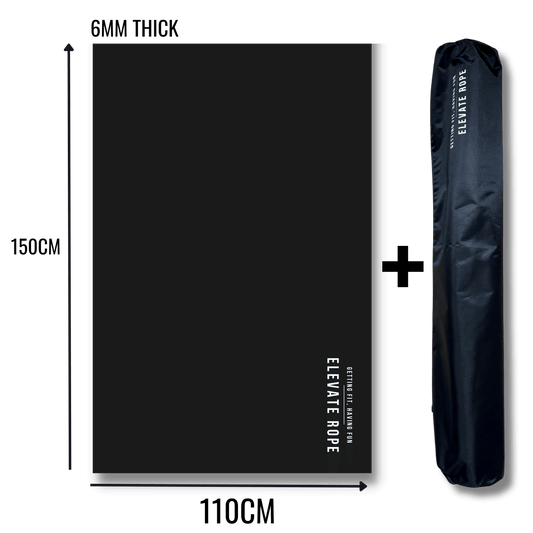
Put something between the rope and the grit. A mat is the obvious one, and it does most of the work because it removes the abrasive surface entirely. Width is what matters, not thickness: the arc is wider than you are, and a cable landing off the edge of the mat is still landing on concrete.
Shorten the rope. A rope that is too long spends more of each rotation dragging along the ground. Stand on the middle of the cable and pull the handles up along your chest. For most people the handle tops should sit somewhere between the armpit and the shoulder. Anything longer and you are paying for it in wear on every turn.
Pick a rope that suits the ground. A thin speed cable has the least material between the grit and the core. A beaded rope puts 2.5cm PVC beads in the contact position instead of the cord, so the beads take the hit. They wear flat eventually, but they are doing the job they are there for.
Your body, briefly
Concrete returns nearly all of the landing energy straight back up your leg. Short sessions are fine for most people. Twenty minutes a day, five days a week, on bare concrete, is a lot of repeated load.
Landing on the ball of the foot with a small bend at the knee takes some of it out. Keeping the hop low takes more out, because a lower hop is a softer landing.
That is as far as this article goes on the subject. We have a separate piece on jumping and knees, and it is more useful than anything I could squeeze in here.
What we built, and what we will not claim
Our speed cables are 5mm PVC over a nylon core. No metal anywhere in the rope.
The PVC is the wear layer and the nylon core holds the shape. That combination is why a worn Elevate cable thins first and kinks later. A bare steel cable does not warn you, it just goes. Plain PVC without a core deforms much sooner.
The lack of metal has a second effect that matters more on concrete than anywhere else. Misses are common on hard ground because the surface is unforgiving and people tense up. A PVC cable across the calf stings and then stops. There is nothing in it that cuts.
What we will not tell you is that any of this makes a cable last forever on concrete. It does not. The handles carry a lifetime warranty and the cable does not, and that split is deliberate: on hard ground the cable is a consumable. Anyone selling you a rope that is immune to concrete is selling you something else.
If concrete is all you have
Plenty of people jump rope on concrete and always have. Boxing gyms, driveways, courts, car parks.
Use a mat if you can. If you cannot, shorten the rope properly, keep the hop low, check the cable monthly, and keep a spare. That is the whole strategy, and it costs less than most people expect.
Geraldo Alken is the founder and CEO of Elevate Rope. He designs jump ropes and works daily with jumpers from beginner to professional.