





What Does Jump Rope Do to Your Body? Cardio, Muscles and Fitness Benefits
What does jump rope do to your body? It challenges your cardiovascular system while training rhythm, coordination, and repeated jumping mechanics. Your calves and legs handle much of the jumping. Your wrists, forearms, shoulders, and trunk help control every rotation.
That makes rope skipping different from steady cardio. You are also practicing a skill. Better timing can make each round smoother and reduce wasted movement.
The important part is separating realistic benefits from fitness hype. Jump rope can improve conditioning when used consistently. Results still depend on training, recovery, experience, nutrition, and your wider lifestyle.
What Happens to Your Body When You Jump Rope?

Rope skipping combines repeated take-offs with continuous rope control.
Your heart and lungs support the effort. Your lower body absorbs each landing. Your upper body keeps the rope moving.
The exact demand changes with pace, skill, interval length, and rest.
An easy basic bounce feels very different from a hard interval session.
Your Heart Rate and Breathing Increase
Working muscles need more oxygen as activity becomes harder.
Your breathing usually becomes faster. Your heart rate also rises with the workload.
A 2025 randomized trial followed healthy young adults for eight weeks. Both interval and continuous rope-skipping groups improved cardiorespiratory fitness.
The researchers found no significant body-composition changes during the same study.
That is an important distinction.
This training can improve conditioning without automatically producing dramatic visual changes.
Your Legs Handle Repeated Take-Offs and Landings
Your calves work during almost every basic jump.
Your ankles help manage repeated ground contact. Your quadriceps, hamstrings, and glutes also contribute to jumping and landing.
Efficient technique does not require huge jumps.
Small jumps usually create enough clearance while reducing unnecessary movement.
Beginners should increase training volume gradually. Repeated jumping can feel demanding when your body is new to the movement.
Your Upper Body Controls the Rope
Rope skipping is not only a lower-body activity.
Your wrists and forearms help create the rotation. Your shoulders support the movement without needing large circles.
Your trunk helps keep your posture stable.
Efficient technique usually feels controlled rather than forced.
Is Jump Rope Good Cardio?
Yes. Jump rope can create a meaningful cardiovascular workload.
A 2022 systematic review analyzed 21 studies involving 1,021 participants. Researchers found improvements across several fitness outcomes.
Cardiorespiratory endurance was one of the measures that improved.
Most included studies involved younger participants. The findings should not predict identical results for every adult.
The evidence still supports rope skipping as a legitimate conditioning tool.
Cardio Intensity Depends on How You Jump
There is no single intensity for this activity.
Relaxed basic bounce can support easier cardio. Faster footwork and shorter rest periods can raise the demand quickly.
Your skill level matters too.
A beginner may stop because of trips before reaching cardiovascular fatigue.
An experienced jumper can usually maintain rhythm for longer.
Intervals Work Well for Beginners
You do not need continuous jumping to make a session useful.
Intervals can protect technique while you learn.
Try 30 seconds of easy jumping followed by 30 to 60 seconds of rest.
Repeat several controlled rounds.
Longer rounds can come later.
Your first goal is repeatable movement, not surviving the longest possible session.
Does Jump Rope Work Your Muscles?
Rope skipping mainly trains conditioning, coordination, and repeated movement.
It also involves several muscle groups.
Calves and Ankles
Your calves help push you away from the floor and control each landing.
Your ankles manage repeated ground contact.
This is one reason beginners should avoid excessive first-week volume.
Quadriceps, Hamstrings, and Glutes
These muscles contribute to jumping, landing, and body position.
Their involvement changes with footwork and intensity.
Rope skipping can challenge the lower body, but it does not replace dedicated strength training.
Core and Trunk
Your trunk helps keep your body stable during each rotation.
Good control reduces unnecessary leaning and twisting.
Think of your core as a stabilizer, not the main source of movement.
Wrists, Forearms, and Shoulders
Efficient rotation comes mainly from controlled wrist movement.
Your forearms and shoulders support that action.
Large arm circles usually make the rope harder to control.
Beginners often benefit from clearer rope feedback. A beaded jump rope can make the rotation easier to feel.
Can Jump Rope Change Your Body?
Regular rope training can improve fitness.
It cannot promise a specific body shape, weight, or body-fat result.
That difference matters.
Cardiorespiratory Fitness Can Improve
The strongest evidence supports improvements in conditioning.
The 2025 trial found better cardiorespiratory fitness after eight weeks of structured rope skipping.
The 2022 review also found improvements in cardiorespiratory endurance across multiple studies.
Fitness changes usually require repeated training.
One difficult workout does not create the same effect as a consistent program.
Body Composition Is More Complicated
Rope skipping uses energy and can support an active lifestyle.
Body-fat and weight changes depend on more than one exercise.
Nutrition, total activity, sleep, recovery, and individual factors all matter.
The 2025 study found no significant body-composition differences after the intervention.
That does not make the training ineffective.
Better cardiovascular fitness is still a meaningful result.
Coordination Becomes Part of the Workout
Skipping asks your hands and feet to follow the same timing pattern.
That makes coordination central to the activity.
Basic bounce can later become boxer step, alternate-foot steps, crosses, and faster rotations.
Your cardio tool can grow with your skill.
Does Jump Rope Improve Fitness Beyond Cardio?
Rope skipping can contribute to several areas of physical fitness.
The 2022 review reported improvements across multiple measures, including cardiorespiratory endurance and jumping performance.
The size of the effect varied between outcomes and studies.
That is why broad claims should stay realistic.
Rope skipping is useful because it combines conditioning with a movement skill.
It is not a replacement for every form of exercise.
Strength training, walking, running, mobility work, and other sports can still play useful roles.
Which Jump Rope Is Best for Cardio?
The best rope depends on your current skill and training goal.
Beginners usually need control first.
Experienced jumpers can add speed or resistance later.
Beaded Rope for Learning Control
A beaded rope gives more tactile feedback through the hands and arms.
That can help beginners understand the rope path.
The segmented design also makes floor contact easier to hear.
This helps connect the turn with the jump.
Choose a beaded rope when consistent rhythm is still your main goal.
Speed Rope for Faster Cardio
A speed rope suits jumpers who already control basic bounce.
It supports quicker rotations and faster footwork.
That makes it useful for progressing toward faster cardio rounds.
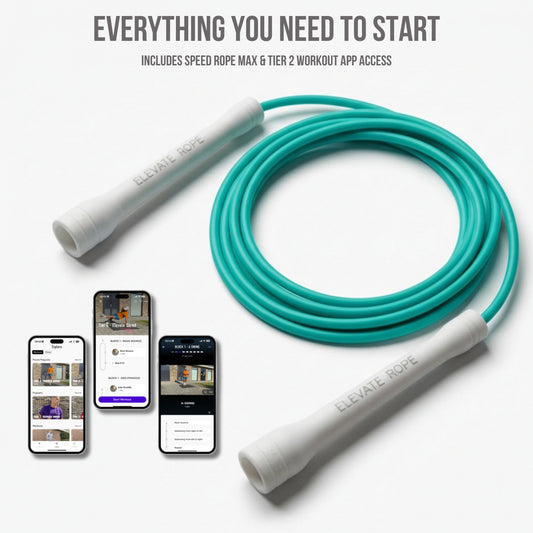
Elevate's Speed Rope MAX uses a PVC cable with a nylon core. Its bearing-free design keeps the setup simple.
You can explore the Speed Rope MAX when basic rhythm already feels controlled.
Heavy Rope for Resistance-Based Intervals
A heavy rope changes the feel of the session.
The extra resistance asks more from your shoulders, forearms, and trunk.
That makes heavy rope training better suited to controlled intervals.
It is not usually the first choice for long continuous cardio.
Use a lighter rope when sustained jumping is your main goal.
Explore Elevate Heavy Ropes when you want resistance-focused rounds.
How to Start Jump Rope Cardio Without Doing Too Much
Start with short rounds and leave room for recovery.
Your first goal is repeatable technique.
Use a Simple Beginner Interval
Warm up before your first round.
Then try 30 seconds of easy jumping.
Rest for 30 to 60 seconds.
Repeat several controlled rounds.
Stop when your technique starts breaking down.
Add time gradually as your rhythm becomes more reliable.
Progress Skill Before Intensity
Start with basic bounce.
Build a repeatable rhythm.
Then extend your rounds or add simple footwork.
Speed can come later.
Advanced tricks can come later too.
A skipping session becomes more useful when progression stays manageable.
Avoid the Too-Much-Too-Soon Mistake
Beginners often jump too high or swing from the shoulders.
Others start with long sessions immediately.
Both approaches can add fatigue before good technique has settled.
Increase duration, intensity, or frequency gradually.
Do not increase everything at the same time.
The World Health Organization recommends regular aerobic activity across the week for adults.
Your rope sessions can form part of that total. They do not need to be your only exercise.
How Often Should You Jump Rope?
There is no perfect frequency for everyone.
Your experience, recovery, surface, footwear, and other training all matter.
Beginners can start with a few short sessions each week.
Leave recovery between harder sessions.
Increase frequency when your calves, feet, and technique tolerate the current workload well.
Experienced jumpers can train more often.
Recovery still matters when intensity rises.
Quality repetitions are more useful than forcing daily sessions.
Common Signs You Should Reduce the Workload

Normal training fatigue is different from persistent pain.
Reduce your workload when technique keeps getting worse during every session.
Also pay attention when soreness keeps building instead of settling.
Trips can increase when fatigue changes your posture and hand position.
Take recovery seriously when jumping starts feeling less controlled.
If pain is persistent, severe, or unusual, stop and seek appropriate professional guidance.
What Jump Rope Does Not Do
Jump rope does not guarantee weight loss.
It does not target belly fat.
It does not replace strength training.
It does not need to replace running, cycling, or walking.
It also does not need to be extreme to be useful.
The best use of the rope is as a repeatable training tool.
You can change pace, intervals, footwork, and rope type as your skill improves.
Frequently Asked Questions
Is Jump Rope Good Cardio?
Yes. Jump rope can create moderate-to-vigorous cardiovascular exercise depending on your pace and skill. Research has found improvements in cardiorespiratory fitness after structured rope-skipping programs. Beginners can use short intervals while learning. More experienced jumpers can increase round length, speed, or complexity.
What Happens if You Jump Rope Regularly?
Regular jump rope practice can improve your rope skill and cardiovascular fitness. Your timing and coordination may also become more efficient. Results depend on training frequency, intensity, recovery, and experience. Consistent practice matters more than one very hard session.
What Muscles Does Jump Rope Work?
Jump rope involves your calves, ankles, quadriceps, hamstrings, and glutes during repeated jumps. Your wrists and forearms control the rope. Your shoulders support the rotation, while your trunk helps stabilize your body. It remains mainly conditioning and skill work rather than dedicated strength training.
Can Jump Rope Reduce Body Fat?
Jump rope increases physical activity and energy use, so it can support a broader weight-management plan. Fat loss still depends on overall energy balance and other individual factors. One exercise cannot guarantee a specific body-fat result or decide where your body loses fat first.
Is 10 Minutes of Jump Rope Enough?
Ten minutes can be a useful session, especially when it contains focused intervals. It is not automatically equivalent to a fixed running duration. Your pace, fitness, technique, and rest periods change the workload. Beginners can also benefit from shorter sessions.
Should Beginners Use a Speed Rope?
They can, but many beginners benefit from more tactile feedback first. A beaded rope makes the rope path easier to feel. Move toward a speed rope when basic rhythm feels controlled. The best choice is the rope that helps you practice consistent, relaxed technique.
Make Cardio a Skill You Can Build
Jump rope can challenge your heart and lungs while teaching timing, rhythm, and footwork.
That combination makes it different from many simple cardio tools.
You do not need exaggerated calorie claims.
You do not need a thirty-minute session on day one.
Start with a rope you can control.
Use short sessions you can repeat.
As your skill improves, change the pace, footwork, interval length, or rope type.
If you are still choosing your setup, use the complete jump rope buying guide.
About the Author
Geraldo Alken is the founder and CEO of Elevate Rope. He designs jump ropes and works with jumpers from beginners to advanced athletes.