





If you want the best jump rope for bone density after menopause, the honest answer surprises most women. It is not the heaviest rope on the shelf. The rope that protects your bones is the one you actually use, with good form, for years.
This guide sits inside our wider resource on jump rope for menopause. It compares beaded and weighted jump ropes fairly. Both can support your bones, so the real choice is about your body, your confidence, and your stage.
A quick note before we begin. This article is educational and is not medical advice. If you have a bone or joint condition, read the safety section and speak to a professional first.
What You'll Learn
→ What actually builds bone when you jump, and why rope weight is not the driver → How a beaded rope gives feedback without loading your shoulders → Why most coaches say master a light rope before adding weight → Where a weighted rope fits, and when it is worth adding → A clear side-by-side comparison for women new to impact at 50 → How to choose and start with the jump rope that suits you now
First, the Question Behind the Question
Most "beaded vs weighted" articles argue about the ropes. The better question is different. Which rope gets a woman new to impact at 55 jumping consistently, with clean technique?
That framing matters because consistency builds bone, not a single hard session. A rope that intimidates you sits in a drawer. A rope you trust gets used. For this avatar, approachability is not a nice extra. It is the whole game.
One thing comes before either rope. Confirm that impact exercise suits your body. If you have osteoporosis, a past fracture, or pelvic-floor symptoms, get clearance first. Our guide on whether jump rope is safe during menopause explains exactly who should check before starting.
Short answer: The best rope for your bones is the one you use consistently with good form, not the heaviest one.
Why it matters: Bone responds to repeated, regular loading over months. A rope that feels manageable wins on consistency, which is what actually protects your skeleton.
Best next step: Confirm impact suits you with our jump rope safety guide for menopause, then read on to compare.
What Actually Builds Bone

Here is the part the marketing skips. Bone responds to impact, not to the weight of your rope. When you land a jump, force travels up through your legs into your hips and spine. That ground impact is the signal that tells bone to stay strong.
The research points the same way. The Royal Osteoporosis Society notes that bones stay strong when you give them work to do. One skip counts as one useful impact. Controlled trials have shown that short, low-volume jumping can support hip and femoral-neck bone density. One study found measurable femoral-neck gains from just ten jumps performed three times a week.
Notice what is doing the work in those studies. It is the jump and the landing, not a loaded cable. A heavier rope mainly adds resistance to your arms and shoulders. It does not dramatically change the bone-loading impact that travels through your legs.
Menopause is why this matters now. As oestrogen falls, bone can be lost faster in the years around your final period. A regular jump rope habit gives your skeleton the loading it needs to push back. That impact is the same whether the rope is beaded or weighted.
This reframes the whole comparison. For bone specifically, both a beaded and a weighted rope deliver similar leg-and-hip impact. The differences live elsewhere, in feedback, learning curve, and upper-body load.
The cardio side is efficient either way. Research has shown jump rope can deliver cardiovascular gains in a fraction of the time of jogging. You do not need a heavy rope to get the heart benefit.
So weight is not the bone factor people assume it is. Our guide to the best exercises for bone density after menopause puts jumping in a wider context.
Short answer: Bone is built by the impact of landing, so rope weight is not the deciding factor for your skeleton.
Why it matters: This frees you to pick the rope that fits your ability, since both deliver the bone-loading impact you need.
Best next step: Turn the science into a habit with our 10-jump bone-building routine.
Beaded Rope: The Controllable Entry

A beaded jump rope is built around control. The beads catch air on each turn, which slows the rotation to a readable speed. That slower, steadier arc is far easier to time than a thin, whippy cable.
You also feel the rope through your hands and arms as it travels. That tactile feedback tells you where the rope is, so your timing improves session by session. For a beginner who feels uncoordinated, this is the difference between progress and quitting.
The practical details help too. A beaded rope is 3 meters adjustable, so you can size it to your height in about a minute. Correct length keeps your arm movement small and your form tidy.
Crucially, a beaded rope gives all that feedback without adding load to your shoulders and wrists. You get the controllability benefit that weighted ropes are praised for, minus the upper-body strain. For someone new to impact at 50, that trade is exactly right. That is why many beginners stay with a beaded rope through their whole first season.
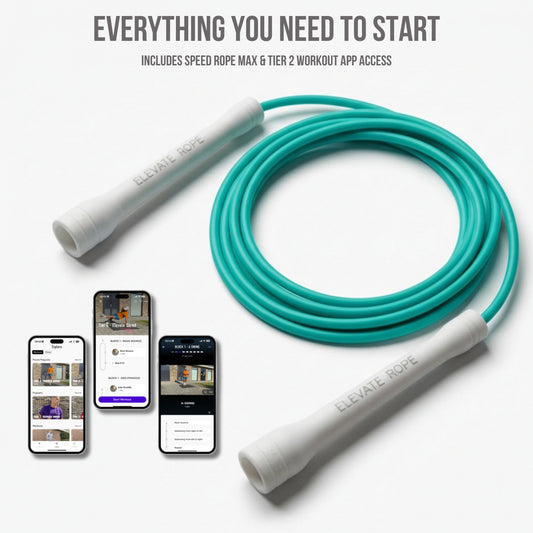
For a gentle, controllable start, → the beaded rope is the natural first choice. You can also browse the full → range of beaded ropes to pick a length and colour you like.
Weighted Rope: Strong, but a Later Step
Weighted ropes are not the villain here. They build real upper-body strength, since your arms, shoulders, and back work against the extra resistance every turn. They also give clear feedback, because the added weight slows the rope and makes its position easy to feel.
It loads bone too, in the same way any jumping does. So a weighted rope is a genuinely good tool. The question is whether it is the right tool for you right now.
For a woman new to impact at 50, the answer is usually not yet. Most coaches recommend mastering a light rope before adding weight. You want rhythm, soft landings, and confident timing in place first.
There is a load consideration as well. A rope that is too heavy can strain the shoulders and elbows over time. If your upper body is not yet conditioned, the risk is soreness and a stalled habit, not stronger bones.
So treat a weighted rope as a later step, not a starting point. Once your technique is solid and you want a fresh challenge, it earns its place. Until then, the extra load adds friction without adding bone benefit.
Side by Side: Which Fits You
The table below sums up the comparison for a woman starting out after menopause. Read it with your own confidence and stage in mind.
| Factor | Beaded rope | Weighted rope |
| Bone-loading impact | Strong, from the jump | Strong, from the jump |
| Feedback for timing | High, beads slow the turn | High, weight slows the turn |
| Shoulder and wrist load | Low | Higher |
| Learning curve | Gentle, beginner-friendly | Steeper, better once skilled |
| Best for | New to impact at 50 | A later progression |
The pattern is clear. On the thing that matters most for bone, the impact, the two ropes are close. On the things that decide whether a beginner sticks with it, the beaded rope wins.
Short answer: For bone benefit the ropes are similar, but the beaded rope is easier to learn and gentler on the shoulders.
Why it matters: The rope that fits your current ability is the one you will keep using. For a menopause beginner, that is almost always the beaded rope.
Best next step: See our gentle, joint-safe walkthrough on how to start jump rope after 50.
How to Choose and Start
Keep the decision simple. If you are new to impact, start with a beaded rope and build clean technique. Add a weighted rope later only if you want a strength challenge once your form is solid. A beaded jump rope is the safer bet for most beginners here.
There is no rush to add weight. Give yourself a few months of steady beaded jumping first. When your landings are soft and your timing is automatic, a weighted rope becomes a reward, not a risk.
Begin small whatever jump rope you choose. Ten easy jumps, then rest, is a sensible first block. Our 10-jump bone-building routine turns that into a simple, repeatable pattern you can follow.
Mind your pelvic floor as you start, especially through menopause. Daily pelvic-floor contractions support continence as you add impact. A pelvic health physiotherapist can help if you notice any leaking.
Remember the real goal here. Each short jump rope session is a small promise kept to your own body. That identity, built one session at a time, is what protects your bones for decades.
Frequently Asked Questions
Does a weighted rope build more bone than a beaded rope?
Not meaningfully. Bone responds to the impact of landing, which is similar for both ropes. A weighted rope adds upper-body resistance, but the leg-and-hip loading that strengthens bone comes from the jump.
Is a beaded rope good for bone density after menopause?
Yes. It delivers the same bone-loading impact as heavier ropes, while staying easy to control. For a woman new to impact, that combination makes consistent training far more likely.
Are weighted jump ropes safe for beginners over 50?
They can be, but most coaches suggest mastering a light rope first. Added weight loads the shoulders and wrists, which an unconditioned upper body may not be ready for. Build technique and confidence before you add resistance.
Which jump rope is easiest to learn on?
A beaded jump rope is one of the easiest. The beads slow the turn to a readable speed and give feedback through your hands. That helps a nervous beginner build rhythm without tripping.
Do I need a heavy rope to see results for my bones?
No. The bone benefit comes from impact, not rope weight. A beaded rope provides that impact while being far kinder to learn on.
Can I switch from beaded to weighted later?
Absolutely. Many people start beaded, build solid technique, then add a weighted rope for variety or upper-body work. That order respects your joints and your learning curve.
Is jump rope safe if I have osteoporosis?
Not without guidance. Established osteoporosis can make high-impact jumping unsafe. Read our safety guide for jump rope during menopause and speak to your doctor first.
Your Next Step, Based on Where You Are
If you are cleared and new to impact, start with a beaded rope and keep it simple. Short sets, soft landings, and a readable turn will carry your first month. The controllable feel is exactly what builds confidence early.
If you have a bone or joint concern, begin with the safety guide and a professional's advice. Read whether jump rope is safe during menopause, take the flags to your doctor, then choose your rope.
When you are ready, our buyer's guide to the best jump rope for women over 50 helps you choose. The aim is not the fanciest rope. It is a kept promise, repeated, that protects the body you live in.
Sources
- Royal Osteoporosis Society, Exercise for bone health: https://theros.org.uk/information-and-support/bone-health/exercise-for-bones/
- Brooke-Wavell K, et al. Strong, Steady and Straight: UK consensus statement on physical activity and exercise for osteoporosis, British Journal of Sports Medicine, 2022: https://pmc.ncbi.nlm.nih.gov/articles/PMC9304091/
- Kato T, et al. Effect of low-repetition jump training on bone mineral density in young women, Journal of Applied Physiology: https://journals.physiology.org/doi/full/10.1152/japplphysiol.00666.2005
- Montgomery G, et al. Feasibility of a jumping intervention for postmenopausal women, randomized controlled study: https://pmc.ncbi.nlm.nih.gov/articles/PMC10664055/
- Hospital for Special Surgery, Why jumping rope is the ideal post-menopausal workout for your bones: https://news.hss.edu/why-jumping-rope-is-the-ideal-post-menopausal-workout-for-your-bones-according-to-an-exercise-scientist/
- International Osteoporosis Foundation, Exercise for individuals with osteoporosis: https://www.osteoporosis.foundation/health-professionals/prevention/exercise/exercise-individuals-with-osteoporosis
You May Also Like
→ Is Jump Rope Safe During Menopause? Who Should and Should Not
→ The Best Jump Rope for Women Over 50
→ The 10-Jump Method: A Gentle Bone-Building Routine
→ How to Start Jump Rope After 50 Without Hurting Your Joints