






The best exercise tips for parents have nothing to do with motivation and everything to do with logistics.. It is a logistics problem — and most fitness advice is designed for people who do not have small humans disrupting every plan they make. You have probably tried the 6am alarm (a toddler woke up first), the nap-time workout (they skipped the nap), the after-bedtime session (you fell asleep on the sofa at 8:30pm). These are not failures of willpower. They are the predictable results of trying to fit gym culture into a life that gym culture was never designed for.
This guide is not going to suggest you wake up an hour earlier or find a babysitter three times a week. It is going to show you how to build a workout habit around your actual life — in fragments, in the margins, in the ten minutes that already exist inside your day once you know where to look. And it is going to explain why one piece of equipment, costing less than a round of coffees, is the only tool that makes this genuinely possible.
What you'll learn in this guide:
→ Why "I don't have time" is accurate — and how to fix the real problem underneath it
→ The 10-minute window that already exists in most parents' days (even the chaotic ones)
→ Why gym-based exercise is structurally incompatible with parenting life
→ What the research says about short, high-intensity sessions vs. long workouts
→ How to build a workout that works whether the kids are watching, joining, or screaming
→ The one piece of equipment every parent should own (and why it costs less than one gym class)
→ How to make fitness something your children see you do — and eventually want to do with you
The Real Reason Parents Stop Exercising
Before children, exercise was inconvenient. After children, it becomes structurally impossible — at least in the form most people picture it. A gym session requires a commute, a window of 60 to 90 minutes, changing clothes, showering, and getting back. That is roughly 2.5 hours carved from a schedule that already has no slack in it. This is not a time management problem. It is a mismatch between a fitness model designed for single adults with disposable time and a life organised entirely around another person's unpredictable needs.
Work-from-home mothers often face this exact struggle across their entire day. However, taking advantage of remote flexibility and logging daily tasks with a simple time recording app allows them to protect clear work boundaries and pinpoint those small, open windows for themselves.
The research supports this. A 2019 study published in Preventive Medicine found that parenthood is one of the strongest predictors of physical activity decline — particularly for mothers of children under five, and for fathers in dual-income households. It is not that parents do not value exercise. It is that the format exercise takes in mainstream fitness culture is genuinely incompatible with what parenting actually looks like on a Tuesday afternoon.
The solution is not to fix your schedule. It is to fix the format of the workout itself.
Gym Culture Was Never Built for You
Gyms are built on the assumption that you can arrive at a predictable time, complete a session without interruption, and leave when you are finished. Every element of a gym membership — the commute, the peak hours, the class schedule, the shower queue — assumes a kind of control over your time that parenting removes almost entirely. This is not a criticism of gyms. It is simply a description of why they stop working for most people the moment they have children at home.
What parents actually need is equipment that is always ready, a workout that can be paused and resumed, a session that delivers real results in under fifteen minutes, and an activity that can happen in the kitchen, the garden, or the living room depending on where the children are. That is a very specific brief. There is only one piece of fitness equipment that ticks every box.

What 10 Minutes of the Right Exercise Actually Does
The number that stops most parents is ten minutes. It sounds too short to matter — too far from the "30 minutes of moderate exercise, five times a week" recommendation most people grew up hearing. But that recommendation is for moderate-intensity, steady-state movement. The moment you raise the intensity, the math changes significantly.
Arizona State University compared ten minutes of jump rope with thirty minutes of jogging at equivalent heart rate levels. The cardiovascular return was equivalent. Researchers noted that the jump rope group achieved the same aerobic conditioning in one-third of the time. This is not a niche finding — it reflects a well-established principle in exercise physiology: intensity is a multiplier. A harder ten minutes outperforms an easier thirty.
Separately, the Tabata protocol — eight rounds of twenty seconds of maximum effort with ten seconds of rest, totalling exactly four minutes — has been shown to improve both aerobic and anaerobic capacity more than sixty minutes of moderate-intensity steady-state exercise. Short sessions do not just "count." At sufficient intensity, they outperform longer ones.
Short answer: Ten minutes of high-intensity jump rope provides the same cardiovascular benefit as thirty minutes of jogging, according to research from Arizona State University.
Why it matters: Most parents assume a ten-minute workout is not worth doing. The evidence suggests the opposite — when intensity is high, shorter sessions are not a compromise. They are the format.
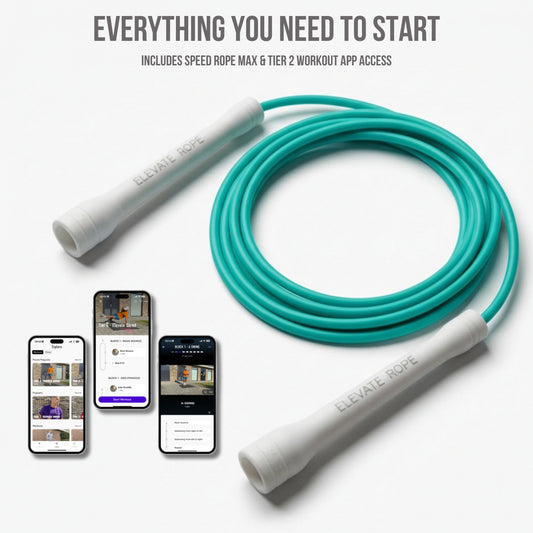
Best next step: Start with three sets of sixty seconds of jumping with thirty seconds of rest. That is four and a half minutes. Build from there. → Speed Rope MAX is designed for exactly this kind of interval training.

Finding the 10 Minutes That Already Exist in Your Day
The claim that there is no time is almost always inaccurate — what is actually true is that the available time is scattered, unpredictable, and does not look like "exercise time." Here are the windows that already exist in most parents' days once you know what to look for.
The Transition Gap
The fifteen minutes between one child-related task ending and the next one beginning — after school drop-off, after breakfast has been cleared, after bath time. These windows feel too short to do anything with, which is exactly why they get absorbed by scrolling or standing in the kitchen. Ten minutes of jumping rope fits this window perfectly because there is no commute, no setup, and no requirement to change into gym clothes.
The "They're Occupied" Window
Children watching television, playing independently, or engaged in a craft project. This is not a stable window — it will end unpredictably — which is why it never works for gym-based routines. It works perfectly for jump rope because the workout can be paused and resumed, the equipment is in the same room, and a child who interrupts does not ruin the session.
Before They Wake Up or After They Sleep
This is the classic advice, and it works for some parents — particularly those with children who sleep predictably. The advantage of jump rope over other morning workouts is that it requires zero setup and is genuinely done in ten minutes, meaning you do not need to sacrifice sleep for a meaningful session. For evening exercise, the same applies: ten minutes at 9pm is sustainable in a way that a forty-five-minute home workout is not.
When They Join You
This is the option most fitness advice ignores entirely. Children love jump rope. An eight-year-old who picks up a beaded rope in the garden is not a distraction from your workout — they are a workout partner. → The Dignity Beaded Rope is adjustable from child height to adult height, which makes it the first piece of fitness equipment in most households that genuinely works for everyone.

Why Jump Rope Is the Only Equipment That Fits a Parent's Life
There is no shortage of home fitness equipment marketed at parents. Resistance bands, kettlebells, folding bikes, yoga mats, pull-up bars that hang in doorframes. Most of these work in principle and fail in practice — not because the exercise is ineffective, but because the equipment requires space, setup, or a level of focus that disappears the moment a three-year-old enters the room.
Jump rope is structurally different for several reasons that matter specifically to parents.
| Format | Setup time | Minimum session | Pausable? | Works with kids present? | Monthly cost |
| Gym membership | 30–60 min (travel) | 60–90 min | No | No | €40–80/mo |
| Home gym equipment | 5–10 min | 30–45 min | Partly | Safety risk | €200–2,000 (purchase) |
| Fitness app (Crossrope) | Minimal | 20–30 min | Yes | Partly | €150/yr subscription |
| Jump rope + free app | 0 min | 10 min | Yes | Yes | One-time purchase |
The free Elevate app includes 100+ structured workouts with guided audio coaching, a built-in workout timer, and the Elevate26 challenge — a 26-day structured program designed specifically for people building consistency from scratch. There is no subscription fee, compared to Crossrope's €150 per year for similar functionality. For a parent trying to build a habit without adding another monthly outgoing, this matters.
The Bearing-Free Difference
Most parents who try jump rope as children remember two things: the satisfying rhythm of a beaded rope, and the frustration of a speed rope that tangled, caught underfoot, or required precise technique before you could get past two consecutive jumps. The Elevate Rope bearing-free design means the rope spins consistently regardless of your technique level. There are no ball bearings to seize, no handle mechanics to manage, no trip-and-quit failure point. You pick it up, you jump. That matters when you have seven minutes and cannot afford to spend three of them untangling a handle.
Short answer: Jump rope is the only mainstream fitness activity with zero setup, zero commute, a ten-minute minimum effective session, and the ability to include children naturally rather than exclude them.
Why it matters: Every other home fitness format either requires dedicated time (resistance training, yoga, cycling) or dedicated space (kettlebells, pull-up bars). Jump rope requires a two-metre ceiling and a rope that fits in a pocket.
Best next step: → The Ascent Bundle includes both the Speed Rope MAX and the Dignity Beaded Rope — a Speed Rope for the parent's own HIIT sessions, and a Beaded Rope for when the kids join in.

Building a Workout That Survives Real Life
The mistake most parents make when returning to exercise is designing a plan that requires everything to go right. Perfect plans collapse under the first disruption. What survives is a system built on imperfect conditions.
The 3-2-1 Rule for Busy Parents
Three sessions per week minimum. Two of those can be under fifteen minutes. One should be slightly longer — twenty to twenty-five minutes when a bigger window appears. This framework works because it does not require consistency of duration, only consistency of frequency. Showing up for ten minutes on a chaotic day counts. It counts more than skipping because conditions were not ideal, because skipping is how habits die.
The Identity Shift Underneath the Habit
There is a deeper reason to exercise when you have children beyond the physical benefits. Children do not learn fitness values from what you tell them. They learn from what they see. A parent who jumps rope in the garden on a Tuesday evening — not for an hour, not in special gear, just for ten minutes before dinner — is showing their child what consistency looks like. Not as performance. As identity. This is the core of the Elevate Code philosophy: kept small promises rebuild self-trust, and that self-trust is visible to the people watching you.
The goal is not to get your children interested in fitness. It is to be the kind of person who moves their body without making it a production — and let them absorb that over time.
Short answer: A three-session week with sessions as short as ten minutes builds more sustainable fitness than a five-session plan that collapses in week two when real life intervenes.
Why it matters: Consistency beats intensity for habit formation. A parent who jumps rope three times a week for six months will be significantly fitter than one who attempts daily workouts and quits after three weeks.
Best next step: Start the Elevate26 challenge via the free Elevate app. Twenty-six days, structured daily sessions, designed for beginners building from zero. → Download the free Elevate app here.

The Honest Starting Point
If you have not exercised regularly since before children, do not start with a speed rope and a HIIT interval. Start with the Dignity Beaded Rope and the most basic possible session: three minutes of jumping at whatever pace feels comfortable, three times a week. The beaded rope is forgiving — it gives auditory feedback on rhythm, it does not tangle, and it can be adjusted to your exact height in thirty seconds. It is also the rope your children will want to pick up when they see you using it, which transforms a solo workout into something entirely different.
Once three minutes feels easy — usually within two weeks — extend to five. Then to ten. Add a speed rope when you want to introduce intervals. Add the Gravity Heavy Rope when you want to build upper body strength and slow the cardio to something your joints appreciate more. The progression exists. You do not need to access all of it on day one.
Parents who choose the → Ascent Bundle get both the Speed Rope MAX and the Dignity Beaded Rope in a single purchase. This covers the full range: the beaded rope for building the habit, including any sessions with children, and the speed rope for the higher-intensity sessions as fitness improves. It is also the most practical purchase for a household — one rope for parent workouts, one rope that the kids can use without risking expensive equipment.
The jump rope for kids and families complete guide covers everything from choosing the right first rope to age-appropriate progressions, family workout games, and teaching children who have never jumped before. → Read the complete guide: Jump Rope for Kids — The Parent's Complete Guide.

Frequently Asked Questions
How do I find time to exercise when I have young children at home?
The most effective approach is identifying existing gaps in your day — the fifteen minutes after school drop-off, the window when children are occupied, or the ten minutes before they wake up — rather than trying to create entirely new time. Jump rope is the format that fits these fragmented windows best because sessions as short as ten minutes are genuinely effective at high intensity, there is no commute, and the equipment requires zero setup.
Is 10 minutes of exercise really enough for a parent who barely moves all day?
At sufficient intensity, yes. Research from Arizona State University shows ten minutes of jump rope delivers equivalent cardiovascular benefit to thirty minutes of jogging. The key is intensity — a casual walk for ten minutes will not produce the same result as ten minutes of jump rope intervals. For parents with very low current fitness levels, even three to five minutes of moderate jumping is a meaningful starting point.
What is the best exercise for busy parents with no equipment?
Jump rope consistently ranks as the most efficient exercise per minute for cardiovascular fitness, coordination, and calorie expenditure. A single rope costs less than a gym class, fits in a coat pocket, can be used indoors or outdoors, and requires no equipment beyond a two-metre ceiling height. For parents specifically, the ability to pause mid-session and resume makes it far more practical than any workout that requires sustained concentration.
Can I exercise while my kids are with me?
Yes — and jump rope is uniquely suited to this. Children find beaded ropes engaging and want to join in, which turns a solo session into shared activity. The → Dignity Beaded Rope adjusts from child height to adult height, so one rope works for both. If children are too young to jump, they can still sit nearby safely while a parent uses a speed rope, unlike kettlebells or resistance bands which present genuine hazards in a shared space.
How do I start exercising again after having kids when I've been inactive for years?
Start smaller than you think you need to. Three minutes of jumping, three times a week, for the first two weeks. This is not about intensity — it is about re-establishing the identity of someone who exercises. Once three-minute sessions feel automatic, extend to five, then ten. Consistency of habit matters more than volume at this stage. The Elevate26 challenge in the free Elevate app is designed specifically for this return-to-fitness scenario, with daily structured sessions that progress gradually over 26 days.
What jump rope should a parent buy to work out at home?
For parents starting from a low fitness base or wanting a rope their children can also use, the → Dignity Beaded Rope is the recommended starting point. For parents at an intermediate level looking for a high-intensity tool, the → Speed Rope MAX is the better fit. For the most flexible option that covers both, the → Ascent Bundle includes both ropes and is designed for exactly this mixed-use household scenario.
Will my children learn healthy habits if I exercise in front of them?
Research consistently shows that parental modelling is the most powerful predictor of children's long-term activity levels — more powerful than structured sports programmes, school PE, or active encouragement. Children who regularly see a parent exercise are significantly more likely to be active as adults. A parent who jumps rope at home, even briefly, is doing more for their child's long-term health than any formal intervention.
How do I stop making excuses and actually exercise as a parent?
Remove every barrier between you and the first jump. Keep the rope out and visible — not in a drawer, not in a sports bag. Set the session target at three minutes, not thirty. Use the Elevate app so the workout is already planned. The goal for the first month is not fitness. It is showing up. Once the habit exists, improving it is straightforward.
Where to Start Based on Your Situation
If you are completely new to exercise or returning after several years, the Dignity Beaded Rope is your starting point. It is forgiving to learn, adjustable to your height, and doubles as your children's first rope. Pair it with the free Elevate app and start the Elevate26 challenge — twenty-six days of structured sessions that build progressively, designed for people building from nothing.
If you already have some fitness base and want a tool for intense ten-minute sessions during the gaps in your day, the Speed Rope MAX is the right choice. Bearing-free, consistent spin, built for HIIT intervals that deliver in the time you actually have.
If you want one purchase that covers everything — your own intense sessions and the sessions where your children join in — the → Ascent Bundle includes both ropes and is the best value for households. Over 50.000 people have used Elevate Rope to rebuild the habit. Most of them started exactly where you are.
Sources
- Gallo, L. A., et al. (2019). Declining physical activity after parenthood. Preventive Medicine. sciencedirect.com
- Arizona State University jump rope and jogging equivalency study. ncbi.nlm.nih.gov/pmc/articles/PMC1250253/
- Tabata, I., et al. (1996). Effects of moderate-intensity endurance and high-intensity intermittent training on anaerobic capacity and VO₂max. Medicine & Science in Sports & Exercise, 28(10). pubmed.ncbi.nlm.nih.gov/8897392/
- Loprinzi, P. D., & Trost, S. G. (2010). Parental influences on physical activity behavior in preschool children. Preventive Medicine, 50(3). pubmed.ncbi.nlm.nih.gov/19962393/
- Stamatakis, E., et al. (2019). Vigorous physical activity and all-cause mortality. JAMA Internal Medicine. pubmed.ncbi.nlm.nih.gov/30958526/
- Bailey, R. (2019). Physical education and sport in schools: A review of benefits and outcomes. Journal of School Health. pubmed.ncbi.nlm.nih.gov/15560059/