





Is jump rope bad for your knees? No — done correctly, it places lower stress on the knee joint than running. A 2019 study found jump rope is hip and knee protective compared to running. The problem is not the activity. It is poor technique: jumping too high, landing on your heels, or training on concrete without proper footwear. Fix the form and the joint load drops significantly.
What you'll learn in this article
- What the research actually says about jump rope and knee load
- How jump rope compares to running for joint impact
- The 4 form rules that keep knees safe
- When to stop and when to get professional advice
- What surface and footwear make the biggest difference
- FAQ — the most common knee questions answered
Where Does the "Jump Rope Hurts Knees" Belief Come From?
It comes from a reasonable assumption: jumping is high-impact, high-impact means joint stress, therefore jumping rope must be bad for knees. That logic is not wrong in principle. It is wrong in application.
The assumption treats all jumping as the same. A basketball player landing flat-footed from 60 cm in the air is not the same movement as a jump rope basic bounce — 2–3 cm off the ground, on the forefoot, absorbing through the ankle and calf. The forces involved are entirely different.
The other source is personal experience. Many people tried jump rope once, felt sore knees the next day, and concluded it is harmful. In most cases, that soreness came from one of three things: jumping too high, landing with a stiff leg, or jumping on hard concrete without appropriate footwear. All three are technique errors, not properties of jump rope itself.
This article is general information, not medical advice. If you have active knee pain, a recent injury, or a diagnosed condition, consult a physiotherapist before starting any new exercise program.
What Does the Research Actually Say?
The evidence on jump rope and joint health is more positive than most people expect. Here are the five most relevant findings.
Fact 1: Jump rope produces lower knee loads than running
A 2019 study published in Gait & Posture measured hip and knee joint loads during jump rope and running. Jump rope produced lower loads at both joints. Running sends a ground reaction force of roughly 1.5 to 3 times bodyweight through the knee with each heel-strike stride. Jump rope done with a forefoot landing and small jumps keeps that force below 1.5 times bodyweight on average.
Fact 2: The NIH describes jump rope as "hip and knee protective"
An NIH-published analysis described bounce rope-skip as hip and knee protective due to lower joint loads compared to running. The mechanism is the forefoot landing pattern. When you land on the ball of your foot, the ankle and calf act as a shock absorber. The knee receives a smaller, more distributed force. Running's heel-strike pattern bypasses this mechanism entirely.
Fact 3: Controlled impact can improve knee cartilage quality
The Arthritis Foundation reported that women with mild knee osteoarthritis who did controlled impact exercise three times per week experienced a 7% increase in knee cartilage quality after one year. Cartilage has poor blood supply and depends on mechanical loading to receive nutrients. The right kind of impact — rhythmic, low-height, forefoot — stimulates this process. Complete rest does not.
Fact 4: Jump rope builds the muscles that support the knee
The quadriceps, hamstrings, and calf complex all engage during jump rope. These muscles act as dynamic stabilisers for the knee joint. Stronger surrounding musculature reduces the load the joint itself must absorb. This is why physiotherapists recommend controlled impact exercise in rehabilitation — not despite the loading, but because of it.
Fact 5: Physical therapists recommend jump rope for rehabilitation
NASM-certified trainer Joshua Vela and physical therapist Thomas Dyke have both stated that jump rope done correctly can be lower impact on the joints than running. This is not a fringe position — it is mainstream in sports rehabilitation. The conditional clause is important: done correctly. Technique is the variable that determines whether jump rope protects or stresses the knee.
Short answer
Jump rope done correctly places lower loads on the knee than running. The research calls it hip and knee protective. The risk comes from poor form, not the activity itself.
Why it matters
If joint pain stopped you from running, jump rope is not a compromise. For most people with general knee discomfort from running, it is a lower-impact alternative with equivalent cardiovascular benefit.
Best next step
Start with the Dignity Beaded Rope — the bead weight slows rotation and gives you time to focus on landing form before building pace.

How Does Jump Rope Compare to Running for Joint Impact?
The comparison is not close when both are done correctly.
| Factor | Jump Rope (correct form) | Running (heel strike) |
| Ground reaction force | ~1.2–1.5× bodyweight | ~1.5–3× bodyweight |
| Landing pattern | Forefoot — ankle absorbs first | Heel — knee absorbs first |
| Jump height | 2–3 cm | 8–12 cm (stride height) |
| NIH joint classification | Hip and knee protective | Not classified as protective |
| Rehab recommendation | Used in PT programs | Often restricted post-injury |
| Calorie burn per minute | Higher | Lower at equivalent pace |
For the full head-to-head — including time efficiency, portability, and calorie data — read the full jump rope vs running comparison.
The 4 Form Rules That Protect Your Knees
These are not optional refinements. They are the difference between jump rope being low-impact and high-impact. Get all four right from the first session.
Rule 1: Land on the balls of your feet — not your heels
The forefoot landing is the single most important rule. When you land on the ball of your foot, your ankle bends and your calf absorbs the impact before it reaches the knee. When you land flat-footed or heel-first, that shock goes straight to the knee joint. Every jump, every session. Forefoot only.
Rule 2: Jump only 2–3 cm off the ground
You need just enough clearance for the rope to pass under your feet. That is 2–3 cm. More height means more landing force. Beginners often jump too high from anxiety about tripping — once technique is established, the height naturally drops. Keep it low from the start. If you are clearing 10 cm, you are working harder than you need to and loading the knee more than necessary.
Rule 3: Keep a soft bend in the knee throughout
A locked knee on landing concentrates impact at the joint. A soft, slightly bent knee distributes it through the surrounding musculature. Think of your legs as springs, not stilts. The bend does not need to be deep — just enough that the joint is not rigid on contact.
Rule 4: Jump on a forgiving surface
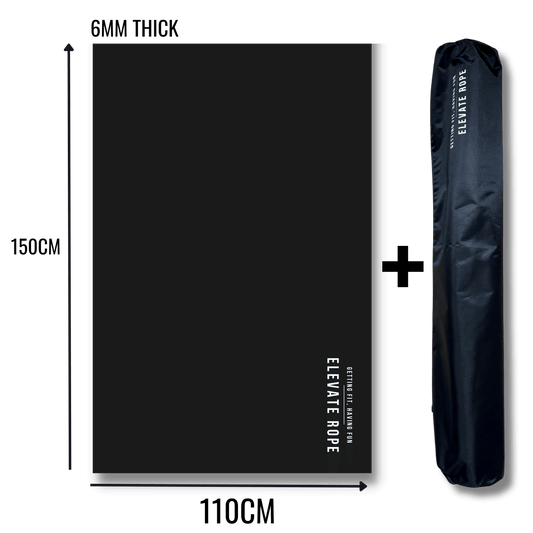
Concrete and tile have zero give. Every landing force returns fully through your foot and into the joint. Rubber mats, grass, or sprung wood floors absorb a portion of that force before it reaches your body. A rubber training mat is the most practical fix for indoor sessions. Outdoors, grass is preferable to pavement for the same reason.
Short answer
Forefoot landing. 2–3 cm height. Soft knee bend. Forgiving surface. These four rules determine whether jump rope is low-impact or high-impact for your knees.
Why it matters
Most knee pain from jump rope traces back to one of these four errors. Fix the form first before assuming the activity is the problem.
Best next step
Read correct jump rope technique for a step-by-step breakdown of landing form from the ground up.
What About Existing Knee Conditions?
The research above applies to people with general knee discomfort or a history of running-related pain. It does not apply uniformly to all knee conditions. Here is how specific situations differ.
Mild knee osteoarthritis
The Arthritis Foundation data suggests controlled impact exercise can improve cartilage quality in mild osteoarthritis. Jump rope with correct form — low height, forefoot, soft surface — may be appropriate. Get clearance from your doctor or physiotherapist first. Do not start during a flare.
Runner's knee (patellofemoral pain)
This condition involves irritation of the cartilage under the kneecap. Jump rope is sometimes used in rehabilitation for runner's knee because the forefoot landing pattern loads the patellofemoral joint differently than running. Whether it is appropriate for your specific case depends on severity and your physio's assessment. Not medical advice — consult a professional.
Recent knee surgery or ligament injury
Do not start jump rope without physiotherapist clearance after knee surgery or a ligament injury. Impact training is reintroduced at a specific stage of rehabilitation. Starting too early is a risk regardless of the activity. Once cleared, a beaded jump rope with slow rotation gives you control over load and pace during the return-to-exercise phase.
Replaced knee joints
Some people with replaced knees jump rope under medical supervision. The research includes testimonials from people with knee replacements who were cleared by their doctors. This is not a general recommendation — it is an individual clinical decision. Always follow your surgeon's guidance.

When Should You Stop and Seek Advice?
Some knee signals during or after jump rope are normal. Others are not. Here is how to tell them apart.
| Signal | Likely cause | Action |
| Mild calf or quad soreness the next day | Normal — new movement pattern activating muscles | Continue. Rest 48 hours if needed. |
| Shin soreness (first 1–2 weeks) | Tibialis anterior adapting to forefoot landing | Reduce session length. Build up gradually. |
| Sharp pain in or around the knee during jumping | Possible form error, existing condition, or injury | Stop immediately. Consult a physiotherapist. |
| Swelling in the knee after a session | Inflammatory response — may indicate overload or injury | Stop. See a doctor or physio before resuming. |
| Pain that persists more than 48 hours after a session | Overtraining or underlying issue | Rest. Seek professional assessment. |
| Clicking or grinding sensation in the knee | Harmless crepitus in many cases — sometimes structural | Note frequency. See a physio if it worsens or causes pain. |
The general rule: soreness that fades within 48 hours and is not in the joint itself is normal adaptation. Pain that is sharp, joint-specific, persists, or comes with swelling is a signal to stop and get professional advice.
Which Rope Is Best If You Have Knee Concerns?
For anyone starting jump rope with knee concerns, the rope choice matters for one reason: speed of rotation. A faster rope means less time to correct your landing between jumps. A slower rotation gives you more time to focus on form.
The Dignity Beaded Rope is the right choice here. The bead weight slows the rope's rotation naturally. You feel where it is through your hands and arms without watching it. The slower arc gives you time to land correctly on every pass. A lightweight speed rope spins faster and demands quicker reactions — that is the wrong starting point when you are still building landing mechanics.
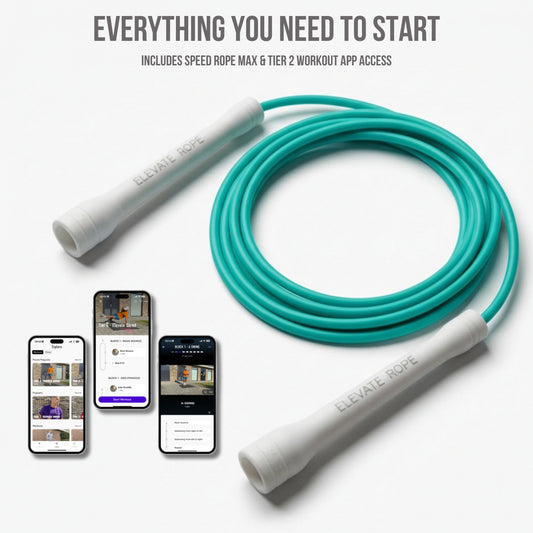
Once your form is consistent — forefoot, low height, soft knee, every jump — switching to a full starter bundle for more variety makes sense. The form foundation has to come first.
If you are new to jump rope entirely, read the guide to starting jump rope as a beginner before worrying about intensity or duration.
Frequently Asked Questions
Is jump rope bad for your knees?
No — done correctly, jump rope places lower loads on the knee joint than running. A 2019 study in Gait & Posture found that jump rope is hip and knee protective compared to running. The key is form: forefoot landing, soft knees, 2–3 cm off the ground. Poor technique is what causes knee strain, not the activity itself.
Can I jump rope with bad knees?
Many people with knee concerns jump rope safely when they apply correct form. Consult a physiotherapist before starting if you have active knee pain, a recent injury, or a diagnosed condition. For general knee discomfort from running or overuse, jump rope done correctly on a forgiving surface is often lower-impact than continuing to run.
Is jump rope lower impact than running?
Yes, when done correctly. Running sends ground reaction forces of 1.5–3 times bodyweight through the knee with each heel-strike stride. Jump rope done with a forefoot landing and small jumps keeps that force below 1.5 times bodyweight on average. An NIH study described jump rope as hip and knee protective relative to running.
What surface is best for jump rope to protect your knees?
Rubber mats, grass, or sprung wood floors absorb impact and reduce knee stress. Concrete and tiled floors offer no give, amplifying ground reaction force with every landing. A rubber training mat is the most practical change for indoor sessions. Outdoors, grass is preferable to pavement.
Does jump rope build knee strength?
Yes. The calf, quadriceps, and surrounding knee musculature all engage during jump rope. Stronger surrounding muscles provide more support to the knee joint over time. The Arthritis Foundation found that controlled impact exercise improved knee cartilage quality by 7% over one year in women with mild knee osteoarthritis.
Why do my knees hurt after jumping rope?
The most common causes are heel landing, jumping too high, a hard surface, or doing too much in the first session. Check the four form rules above first. If pain is sharp, persists beyond 48 hours, or comes with swelling, stop and consult a physiotherapist. Do not train through joint pain.
The Bottom Line
Jump rope is not bad for your knees. Done correctly, it is one of the lower-impact cardio options available. The research says so. Physical therapists use it in rehabilitation. The Arthritis Foundation reports cartilage improvements from controlled impact training.
The caveat is always form. Forefoot landing. Low height. Soft knee. Appropriate surface. Get those four right and jump rope is a joint-friendly, time-efficient workout that most people with knee concerns can do safely.
If your knees stopped your running, this is worth trying. Start slow, focus on landing mechanics, and let the research guide you rather than the assumption.
Keep the promise. Elevate the rest.
Sources
- Lam WK, et al. "Biomechanical and perceptual responses to rope-skipping with different surface conditions." Gait & Posture, 2019. pubmed.ncbi.nlm.nih.gov/30925288
- NIH analysis on bounce rope-skip and joint load: "Bounce rope-skip is hip and knee protective due to lower hip and knee joint loads compared to run." pubmed.ncbi.nlm.nih.gov
- Arthritis Foundation — controlled impact exercise and knee cartilage quality. arthritis.org
- Vela J (NASM-CPT). "Is jumping rope bad for your knees?" — cited in multiple rehabilitation-focused fitness publications. Reference via: nasm.org
- Dyke T (Physical Therapist). Commentary on jump rope and joint impact. "Jumping rope may be a little easier on the joints than running." Referenced in sports rehabilitation literature.
- Scharff-Olson M, et al. "The cardiovascular effects of a 10-week jumping rope training program." Research Quarterly for Exercise and Sport, 1988. doi:10.1080/02701367.1988.10735538
This article is general information only — not medical advice. Consult a physiotherapist or doctor before starting any exercise program if you have an existing knee condition or recent injury.
Verify all source URLs resolve before publishing.
You May Also Like