






The clearest signal that jump rope confidence kids gain is real, not a parent's projection, comes from the bedroom door. The same child who stomped off saying "I can't do it" three weeks earlier is now jumping on the patio shouting "watch this" before you've even sat down. That moment is not a coincidence. It is the predictable outcome of a specific psychological mechanism that researchers have spent four decades documenting, and jump rope happens to activate it more efficiently than almost any other childhood activity.
This is not about jump rope being magical. It is about how confidence actually gets built in a child, what conditions allow it, and which activities create those conditions naturally. Most extracurriculars fail at the first step. They demand a level of skill the child does not yet have, set them up against more experienced peers, and offer no clear path to visible improvement. Jump rope inverts every one of those failure modes. The result is the kind of confidence that does not just stay on the patio. It transfers.
What you'll learn in this article:
Why perceived competence is the actual driver of confidence in children, not praise
The 12-week study showing measurable gains in academic self-efficacy from jump rope
The skill ladder that gives kids a visible win every 7 to 10 days
Why most kids' activities fail to build genuine confidence (and what jump rope does differently)
The role of auditory feedback in helping a child feel capable from the first session
How to structure 4 weeks of progression that produces a visible breakthrough
The mistake parents make that quietly undermines the confidence-building effect
What Confidence Actually Is (And Why Most Activities Fail to Build It)
The word confidence gets used loosely. In the research literature, the more useful concept is perceived competence, sometimes called self-efficacy. It is a child's belief that they can successfully perform a specific task. Susan Harter's competence motivation theory, which has shaped four decades of child development research, describes how this works: when a child attempts something and succeeds, perceived competence rises. Higher perceived competence drives motivation. Higher motivation drives engagement. Engagement produces more skill. The cycle compounds.
The reverse is also true and explains why so many children quit activities. When a child attempts something and fails repeatedly, perceived competence drops. Lower perceived competence drives avoidance. Avoidance prevents skill development. The child concludes they are simply not good at the activity, and the conclusion becomes self-reinforcing. Researchers call this the "spiral of disengagement," and it is the silent killer of confidence in childhood.
Why Group Sports Often Make This Worse
Most children's activities are structured in ways that accelerate the disengagement spiral rather than the engagement one. Football, basketball, and team sports place a child against more experienced peers from day one. The child who joins late, or who has below-average motor coordination, spends the first three months consistently failing in front of others. By the time they have the basic skills, they have already concluded they are bad at it. A 2018 study of 1,031 Canadian children aged 8 to 12 found that more than half could not accurately perceive their own motor competence, and as they aged, more children underestimated their abilities than overestimated them. The pattern is one of children quietly concluding they are less capable than they actually are.
Jump rope is structurally different. The child competes against the rope, not against other children. Improvement is measured against yesterday's self, not against a peer's performance. There is no scoreboard, no team selection, no coach picking who plays. The child gets to fail privately and succeed publicly, which is the inverse of how team sports work for beginners.

What the Research Actually Shows About Jump Rope and Self-Efficacy
The most rigorous study on jump rope and confidence was published in the Journal of Pediatric Endocrinology and Metabolism in 2020. Kim and colleagues took 48 prehypertensive obese adolescent girls, the demographic with arguably the lowest baseline confidence in physical activity, and randomly assigned half to a 12-week jump rope program. The intervention group did 50-minute sessions five times weekly. The control group did nothing structured.
The headline finding was not the body composition change, though that was significant. It was the measurable improvement in academic self-efficacy. The girls who jumped rope reported greater belief in their ability to handle academic challenges after 12 weeks, despite the intervention having nothing to do with school. This is the transfer effect that confidence research predicts. When a child demonstrates to themselves that they can master a difficult physical skill, that demonstration generalises. The brain updates its model of what the child is capable of, and the update is not domain-specific.
The Peer Relationship Finding
A separate study published in the International Journal of Environmental Research and Public Health examined a jump rope-based afterschool program for adolescents and found measurable improvements in self-confidence and peer relationships. The peer relationship piece matters because it points to something parents notice anecdotally: a child who can jump rope becomes a child other children want to play with. The skill is visible, mildly impressive, and easy to share. Compare this to a child who reads above grade level, which is also impressive but socially invisible at age 8.
The Structured Instruction Effect
A 2025 study by Woodard and Chen, published in the Journal of Teaching in Physical Education, looked at 109 third and fourth graders learning jump rope through three different methods: teacher-led, video-led, and a control group. All children who received structured instruction improved on the 30-second jump test and the criss-cross test. The two instruction groups also showed gains in agility, balance, inhibitory control, and perceived enjoyment. The control group did not. Structure matters. A rope handed to a child without progression collapses the confidence-building mechanism. Structured progression is what actually works.
Short answer: Jump rope builds confidence in children through visible skill mastery on a clear progression ladder. A 2020 study showed 12 weeks of jump rope produced measurable gains in self-efficacy that transferred to academic confidence.
Why it matters: Confidence is built through perceived competence, not praise. Jump rope offers daily evidence of improvement in a way most activities cannot. The skill is private to learn but public to demonstrate, which is the ideal structure for confidence transfer.
Best next step: Start with a beaded rope, which is easier to learn and gives faster early wins than any other type. → Elevate Dignity Beaded Rope

The Skill Ladder: Why Jump Rope Is Engineered for Visible Wins
The single most important feature of any confidence-building activity is the visibility of progress. A child needs to see, hear, or feel that they are getting better. Vague encouragement from a parent does not register as evidence. The child's own demonstration to themselves is what counts. This is where jump rope's structure outperforms almost every alternative.
The skill progression in jump rope is unusually granular. Each skill is clearly defined, requires real practice, and produces an unmistakable signal of mastery. A child either lands the criss-cross or they do not. There is no judging, no subjectivity, no parental cheerleading required. This clarity is what makes the progression so effective at building belief.
The First-Year Progression Map
| Stage | Skill | Typical Time to Master | What the Child Learns About Themselves |
| 1 | 10 consecutive basic bounces | 3 to 7 sessions | "I can do this. It actually works." |
| 2 | 30 seconds without tripping | 2 to 3 weeks | "I can sustain effort and get better." |
| 3 | Alternate-foot step (jogging style) | 3 to 4 weeks | "I can learn new versions of the same skill." |
| 4 | 1 minute continuous jumping | 4 to 6 weeks | "I have built real endurance." |
| 5 | Side-to-side hop or high knees | 6 to 10 weeks | "I can choose how to challenge myself." |
| 6 | First trick (criss-cross or single-side swing) | 3 to 6 months | "I can do something that looks impressive." |
| 7 | Double under (rope passes twice per jump) | 6 to 12 months | "I am genuinely good at this." |
What makes this ladder powerful is the spacing. There is a meaningful win every one to two weeks for the first four months, which keeps the dopamine loop active and the engagement spiral pointing the right direction. Compare this to a sport where it might take a child three months to get on the field at all.

Why the First Week Is the Whole Battle
The confidence-building mechanism only activates if the child gets through the first week without concluding they cannot do it. This is where most parents accidentally undermine the entire effort. They buy a cheap supermarket rope or a sleek wire-cable speed rope, hand it to the child, and watch them trip on every second rotation for ten minutes before quitting in tears. The child does not conclude "this rope is wrong for me." They conclude "I am not a jump rope person."
The rope itself does most of the work in the first week, which is why this is the most important purchase decision in the whole confidence sequence. A beaded rope produces a distinct tick-tick-tick sound on each rotation. The brain processes this sound as an external metronome, which compensates for the underdeveloped internal timing system in young children. The → Elevate Dignity Beaded Rope uses a 3.5mm polycord, which is 17% thicker than the industry standard, slowing rotation to a learnable pace. The 2.5cm beads catch air during rotation, providing tactile feedback alongside the audio.
The combined effect is that a child using a beaded rope typically gets to 10 consecutive bounces within the first three sessions. A child using a silent or wire rope often does not get there at all. The difference is not motivation or talent. It is multi-sensory feedback. And those first 10 consecutive bounces are the difference between the engagement spiral starting and the disengagement spiral starting.
The Quiet Mistake Parents Make
Praise is a confidence killer when it is unearned, and most parents over-praise during the first week. The child does five jumps in a row, and the parent says "amazing, you're a natural." The child knows this is not true. They tripped four times before getting those five. The dishonesty of the praise teaches them not to trust parental feedback, which removes a useful future tool. Better feedback sounds like specific observation: "you went from two in a row to five in a row this week, that is real progress." The child believes this because it matches their own experience.

A 4-Week Confidence Progression Plan
The following plan is designed to produce one clear, visible breakthrough at the end of each week. The breakthroughs are deliberately small at the start and build in complexity. Each session is 8 to 10 minutes, short enough to fit before homework or after school without resistance.
Week 1: Survival
The goal is 10 consecutive basic bounces. Three sessions of 6 to 8 minutes, with rope work in 20 to 30 second rounds. Most children will trip frequently in sessions 1 and 2, then experience the click in session 3 or 4. The breakthrough moment is the first time they hit 10 in a row. Mark this on a calendar. The visible record matters more than parents typically realise.
Week 2: Endurance
The goal is 30 seconds of continuous jumping. Three sessions, working up from 15 seconds to 30 seconds across the week. By the end of week 2, the child has visible evidence that they are not just lucky. They can sustain it. This is when the activity stops being a gamble and starts being a skill.
Week 3: Variation
The goal is the alternate-foot step, which mimics a jogging motion. This is the first real skill expansion. Most children find it surprisingly easy once they have the basic bounce locked in. The breakthrough is realising that other variations exist and they can learn them. This is where the activity starts to feel like something they want to keep doing.
Week 4: Choice
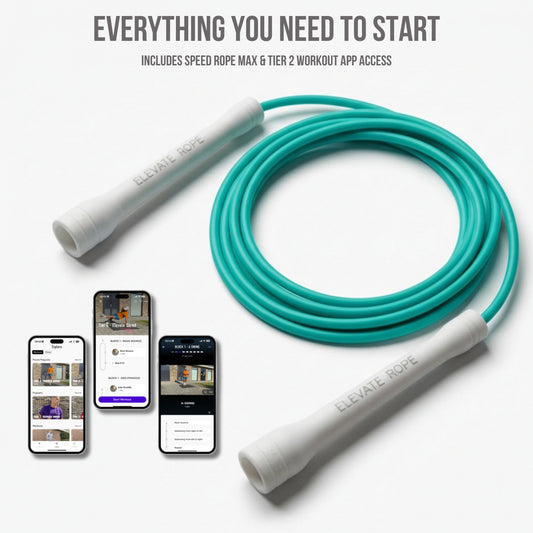
The goal is for the child to invent their own session. Pick three skills they have learned, decide the order, run it themselves. The → free Elevate App includes a library of 100+ tutorials and short workouts, which gives the child a buffet of options to explore independently. This is the moment confidence becomes ownership. They are not following parental instructions any more. They are running their own practice.
Short answer: A 4-week progression with weekly breakthroughs builds confidence faster than open-ended practice. The structure produces visible wins every 7 days, which the child internalises as evidence of their capability.
Why it matters: Confidence does not come from the total amount of practice. It comes from the visible spacing of wins. A predictable cadence of small breakthroughs is what reshapes a child's self-perception.
Best next step: Pair the 4-week plan with a beaded rope and the Elevate App's guided sessions. The audio cues remove the executive function load and let the child focus on skill acquisition.

What Transfers Outside of Jump Rope
Parents often ask whether the confidence built through jump rope actually shows up elsewhere. The research suggests it does, with one important caveat. The Kim 2020 study found that academic self-efficacy improved after 12 weeks of jumping, which is direct evidence of cross-domain transfer. But the transfer is not automatic. It happens through a specific cognitive route: the child internalises a generalisable belief such as "I am the kind of person who can learn hard things." That belief, once established, carries into homework, social situations, and future activities.
The transfer breaks down when parents frame the activity narrowly. A child who is told "good job, you got better at jump rope" learns one thing. A child who is told "remember six weeks ago when you couldn't do this and now you can, that's how learning works" learns something much larger. The framing builds the bridge between the specific skill and the general belief about themselves. It is the cheapest, highest-leverage thing a parent can do during the practice window.

Frequently Asked Questions
At what age does jump rope start building confidence in children?
Most children can begin jumping around age 5 or 6, and the confidence-building effect kicks in as soon as they hit their first visible win, usually within the first three sessions. Younger children benefit from rope-on-the-floor games before introducing the full skipping motion. The full transfer effect documented in the research applies most clearly from ages 7 upward.
How long before I see my child's confidence change?
The first visible win typically arrives within the first week, usually session 3 or 4. The deeper personality-level shifts described in the 12-week studies take 8 to 12 weeks of consistent practice. Parents often notice a difference in homework willingness or peer interactions around week 4 or 5.
What if my child gives up after the first frustrating session?
This is the single most common failure point. The fix is almost always the rope, not the child's character. Switch to a beaded rope if you are using a silent one, lower the rope's pace by adjusting it longer than recommended, and break sessions into 20-second rounds with rest. A child who trips constantly in session 1 with the right rope is a rare exception.
Can a shy or anxious child build confidence through jump rope?
Strongly yes. Jump rope is one of the few skill-building activities a child can practice in complete privacy until they choose to demonstrate it. This makes it especially well suited to anxious, shy, or perfectionist children who freeze in front of an audience. They get to fail privately and reveal the skill only when they are ready.
How do I know if my child is improving without comparing them to other kids?
Track three numbers and write them on a calendar: most consecutive jumps in a single attempt, longest sustained time without tripping, and number of skills they can perform. Compare each week to the previous week. The → Elevate App tracks these automatically, which removes the load of remembering and creates a visual progress record the child can see.
Should I jump rope alongside my child?
Yes. Children with parents who participate in the activity build confidence faster and more durably than children who practice alone. The reason is modelling. A parent who occasionally trips and laughs about it teaches the child that mistakes are part of the process, not a sign of inadequacy. The → Dignity Beaded Rope is adjustable from child to adult height, so one rope works for both.
Does jump rope confidence translate to school performance?
The research suggests it can. The 2020 Kim study measured academic self-efficacy specifically and found significant improvement after 12 weeks of jumping. The mechanism is generalised self-belief: a child who proves to themselves they can master a hard physical skill carries that belief into school challenges. The transfer is stronger when parents frame progress in general terms ("you learned how to learn this") rather than narrow ones.
Where to Start
If your child is new to jump rope, the right starting point is the → Elevate Dignity Beaded Rope and the 4-week progression plan above. The beaded design makes the first week dramatically easier, which is the only week that really matters for whether confidence-building takes hold or collapses. The rope is adjustable for the whole household, so siblings and parents can use the same one.
If you want a complete setup with built-in progression, the → Ascent Bundle includes both a beaded rope (for the early confidence-building stage) and a speed rope (for the next stage when the child wants more challenge). Most families need both within six months, so the bundle is the most cost-effective entry point. Add a jump rope mat if you have hard floors, since indoor sessions become much more sustainable with one.
Whichever rope you choose, install the free Elevate App before the first session. The structured progression and 100+ tutorials remove the parental burden of figuring out what skill to teach next, and the tracking turns invisible progress into a visible record. Twelve weeks of consistent short sessions is the timeframe the research is built on. That is the real commitment, and the breakthrough every parent waits for usually arrives much sooner.
Sources
- Kim, J., et al. (2020). The effects of a 12-week jump rope exercise program on body composition, insulin sensitivity, and academic self-efficacy in obese adolescent girls. Journal of Pediatric Endocrinology and Metabolism.
- Chen, S., et al. (2020). Physical Fitness Promotion among Adolescents: Effects of a Jump Rope-Based Physical Activity Afterschool Program. International Journal of Environmental Research and Public Health.
- Woodard, R., & Chen, S. (2025). Jump Rope Benefits for Kids' Fitness, Agility, and Cognitive Function. Journal of Teaching in Physical Education (summary).
- Wei, X., et al. (2024). Effects of fancy rope-skipping on motor coordination and selective attention in children aged 7–9 years. Frontiers in Psychology.
- Bremer, E., et al. (2018). Children's Self-Perceived and Actual Motor Competence in Relation to Their Peers. International Journal of Environmental Research and Public Health.
- Stodden, D., et al. (2025). Linking Motor Competence to Children's Self-Perceptions: The Mediating Role of Physical Fitness. International Journal of Environmental Research and Public Health.
- Harter, S. Competence Motivation Theory and the Pictorial Scale of Perceived Competence and Social Acceptance for Young Children. American Psychological Association.