





Doing cardio at home is one of the most underrated ways to lose weight — and one of the most convenient. You don't need a gym membership, a treadmill, or even a pair of running shoes. All you need is a few square metres of floor space and 15–20 minutes to get a workout that rivals anything a commercial gym can offer.
The problem is that most "home cardio" advice is either too vague ("just do some jumping jacks!") or too intimidating (45-minute HIIT circuits that leave you crawling). This guide sits in the middle: eight proven cardio at home workouts ranked by calorie burn, impact level, and difficulty — so you can pick the right one for where you are right now and progress from there.
What You'll Learn
- 8 effective cardio at home exercises ranked by calorie burn
- How to structure a no-equipment home workout for fat loss
- Which exercises are best for beginners vs experienced athletes
- How to progress from easy sessions to high-intensity fat burning
- The one piece of equipment that transforms home cardio results
Why Cardio at Home Works Just as Well as the Gym
The idea that you need a gym for effective cardio is one of the biggest myths in fitness. The Physical Activity Guidelines for Americans recommend 150 minutes of moderate-intensity or 75 minutes of vigorous-intensity aerobic activity per week for meaningful health and weight loss benefits. Nothing in that recommendation mentions a gym.
Research published in the British Journal of Sports Medicine (2019) found that home-based exercise programmes produced equivalent improvements in cardiovascular fitness and body composition compared to supervised gym-based programmes. The key factor wasn't location — it was consistency. And that's exactly where cardio at home has an advantage: when the workout is 10 steps from your bedroom, you're far more likely to actually do it.
A separate study in the Journal of Obesity confirmed that short, high-intensity sessions (10–20 minutes) performed at home produced greater fat loss over 12 weeks than longer steady-state sessions performed in a gym setting. The convenience factor removed the biggest barrier to exercise — getting started.
Short answer: Home-based cardio produces the same cardiovascular and fat loss results as gym-based cardio, with the added advantage of convenience and consistency.
Why it matters: Removing travel time and scheduling friction means you're far more likely to stick with a cardio at home routine long enough to see real results.
Best next step: Commit to 15 minutes of home cardio, 4–5 days per week. That's all it takes to meet the minimum effective dose for fat loss.

8 Best Cardio at Home Exercises Ranked by Calorie Burn
Not all home cardio is created equal. Some exercises burn 200 calories in 20 minutes; others barely hit 100. Here are the eight most effective cardio at home options, ranked by average calorie burn for a 75 kg (165 lb) person over 20 minutes.
1. Jump Rope — 290 calories / 20 min
Jump rope is the undisputed king of cardio at home. With a MET value of 11.0 at moderate pace, it burns more calories per minute than any other bodyweight exercise — and you need less than 2 square metres. It also builds coordination, footwork, and cardiovascular endurance simultaneously. For the full science, read our complete guide to jump rope calories burned.
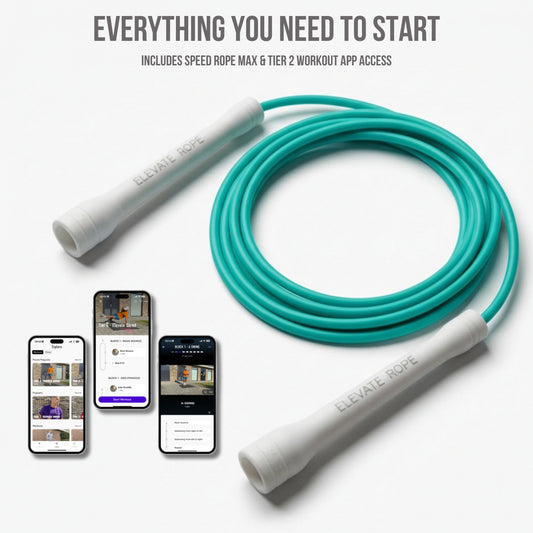
→ Elevate speed ropes are designed for home training — lightweight, fast, and built to handle daily sessions on any surface.
2. Burpees — 250 calories / 20 min
Burpees combine a squat, push-up, and explosive jump into one brutal movement. A 2015 study in the Journal of Strength and Conditioning Research found they produce similar cardiovascular demands to sprinting. The downside: they're high-impact and hard to sustain, making them better for intervals than steady-state sessions.
3. High Knees — 220 calories / 20 min
High knees are a standing cardio exercise that mimics sprinting without the forward movement. Drive your knees to hip height at a fast pace and you'll hit a heart rate zone comparable to running at 9 km/h. They're excellent for cardio at home because they require zero equipment and zero space — you can do them in front of your desk during a work break.
4. Mountain Climbers — 210 calories / 20 min
Mountain climbers target your core, shoulders, and hip flexors while keeping your heart rate elevated. Research in the Journal of Exercise Rehabilitation found they activate more muscle groups simultaneously than most isolation exercises — making them highly time-efficient for any cardio at home routine.
5. Jumping Jacks — 180 calories / 20 min
Jumping jacks are the simplest entry point to home cardio. They require no coordination, no learning curve, and no equipment. While the calorie burn is lower than jump rope or burpees, they're sustainable for longer periods — making them ideal for steady-state sessions or active recovery days within your cardio at home programme.
6. Shadow Boxing — 170 calories / 20 min
Shadow boxing combines upper-body punches with footwork for a surprisingly effective cardiovascular workout. It engages shoulders, core, and legs while keeping your heart rate in the fat-burning zone — and it's low-impact, making it smart if joint stress is a concern.
7. Dancing — 150 calories / 20 min
Dancing is the most underrated form of cardio at home. A PLOS ONE study found dance-based programmes produced equivalent fat loss to structured aerobic programmes — with significantly higher adherence rates. Enjoyment drives consistency, which drives results.
8. Stair Climbing — 180 calories / 20 min
If you have a staircase in your home, you have a free cardio machine. Walking stairs elevates your heart rate quickly and engages your glutes, quads, and calves more aggressively than flat-ground cardio. Alternate between walking and running the stairs for an interval-style cardio at home session that requires zero equipment.
How to Structure a Cardio at Home Workout for Fat Loss
Knowing the exercises is only half the equation. How you structure them determines whether you see results or plateau. The most effective approach for fat loss is interval-based training — alternating between high-effort and low-effort periods within a single session.
A beginner-friendly structure looks like this: 30 seconds of work followed by 30 seconds of rest, repeated for 10–15 minutes. Pick 3–4 exercises from the list above and cycle through them. For example: jump rope for 30 seconds, rest 30 seconds, high knees for 30 seconds, rest 30 seconds, mountain climbers for 30 seconds, rest 30 seconds. Repeat for 4 rounds. That's a complete cardio at home workout in under 15 minutes.
As your fitness improves, shift to 40 seconds of work with 20 seconds of rest, then eventually 45/15. Research in the Journal of Obesity found that this progressive interval approach burns 25–30% more calories than steady-state exercise at the same duration — partly because of EPOC (excess post-exercise oxygen consumption), where your body continues burning elevated calories for hours after the session ends.
For maximum variety and calorie burn, combine a → weighted Elevate rope with bodyweight movements. Start with 5 minutes of weighted rope to build upper-body fatigue, then cycle through bodyweight intervals. This hybrid approach keeps your heart rate high and prevents the adaptation that slows results over time.
Short answer: Structure your cardio at home sessions as intervals — 30 seconds work, 30 seconds rest — cycling through 3–4 exercises for 10–15 minutes total.
Why it matters: Interval training burns 25–30% more calories than steady-state exercise and triggers the afterburn effect for continued fat loss hours after your session.
Best next step: Try the beginner circuit above (jump rope, high knees, mountain climbers) for 4 rounds tomorrow morning. Time it — you'll be done in under 13 minutes.

Jump Rope: The Best Single Tool for Cardio at Home
If you could only pick one piece of equipment for home cardio, a jump rope would be the obvious choice. It burns more calories per minute than every bodyweight exercise on this list, it costs less than a single month of gym membership, and it fits in a drawer when you're done.
Beyond calorie burn, jump rope builds coordination that transfers to every sport. It strengthens calves, ankles, and feet — foundation muscles most home workouts neglect. And it scales infinitely: beginners start at 60 skips per minute, advanced athletes push past 140 with double-unders and criss-crosses.
For anyone serious about cardio at home, the investment in a quality rope pays for itself within weeks. → Elevate Rope bundles include both a speed rope for fast intervals and options for weighted training — giving you two completely different cardio at home workouts from a single purchase. Read our full breakdown in the complete guide to jump rope for weight loss.
Beginner vs Advanced: Choosing the Right Home Cardio Level
One of the biggest mistakes with cardio at home is starting too hard. If your first session leaves you unable to walk the next day, you won't do a second one. Sustainability beats intensity every time in the first four weeks.
Beginner (weeks 1–4): Start with jumping jacks, marching in place, and basic jump rope bounce. Use a 30/30 work-rest ratio for 10 minutes total, 3 days per week. Focus on showing up consistently rather than pushing intensity. A 10-minute session burns 90–140 calories depending on the exercises — and that adds up to over 1,500 calories per month from minimal effort.
Intermediate (weeks 5–12): Progress to high knees, mountain climbers, and faster jump rope intervals. Shift to 40/20 work-rest for 15 minutes, 4 days per week. Start incorporating → beaded ropes for rhythm feedback or a weighted rope for resistance. Your weekly calorie burn from cardio at home should now exceed 800–1,000 calories.
Advanced (12+ weeks): Full HIIT circuits combining burpees, jump rope double-unders, and shadow boxing. Use 45/15 work-rest for 20 minutes, 5 days per week. At this level, your cardio at home sessions are burning 250–350 calories each — equivalent to or exceeding most gym-based cardio classes.
For a deeper look at how short sessions deliver outsized results, read our guide on why 10-minute workouts work better than you think.
Short answer: Start with 10-minute sessions at a 30/30 work-rest ratio and progress to 20-minute HIIT sessions over 12 weeks. Match your cardio at home intensity to your current fitness level.
Why it matters: Progressive overload prevents burnout and injury while steadily increasing your weekly calorie burn from home cardio.
Best next step: Identify your current level (beginner, intermediate, or advanced) and follow the corresponding programme for the next 4 weeks before progressing.

Frequently Asked Questions
Can you lose weight with cardio at home?
Absolutely. Research shows that home-based exercise produces equivalent fat loss results to gym-based programmes. A 75 kg person doing 15 minutes of jump rope at home, 5 days per week, burns over 1,000 calories weekly — enough to lose 0.5 kg per week when combined with a modest calorie deficit. The key is consistency, not location.
What is the best cardio at home for beginners?
Jumping jacks, marching in place, and basic jump rope bounce are the three best starting points. They're low-impact, require no coordination, and can be done at any pace. Start with 10-minute sessions using 30 seconds of work and 30 seconds of rest, 3 days per week.
How long should a home cardio workout be?
For weight loss, 15–20 minutes of interval-based cardio at home is the sweet spot. Research consistently shows that short, intense sessions produce better fat loss results than longer, moderate sessions. If you're a beginner, start at 10 minutes and build up over 4–6 weeks.
Is jump rope the best cardio at home?
Yes. Jump rope burns more calories per minute than any other bodyweight or home-based cardio exercise — roughly 14 calories per minute at moderate pace for a 75 kg person. It also builds coordination, strengthens lower legs, and requires less than 2 square metres of space. It's the single most efficient tool for home cardio.
Can I do cardio at home every day?
You can, but it's better to alternate between 4–5 cardio days and 2–3 rest or active recovery days per week. Daily intense sessions without rest can lead to overtraining and burnout. On rest days, light walking or gentle stretching is enough to stay active without taxing your cardiovascular system.
Do I need equipment for cardio at home?
No — bodyweight exercises like burpees, high knees, and mountain climbers require zero equipment. However, adding a jump rope dramatically increases your calorie burn per minute and adds variety that keeps sessions engaging long-term. A quality rope costs less than a single month of most gym memberships.
What burns more calories: running or cardio at home?
It depends on the exercise. Jump rope at moderate pace (11.0 METs) burns more calories than running at 8 km/h (8.3 METs). Burpees are comparable to sprinting. Jumping jacks burn slightly less than a slow jog. The advantage of home cardio is that you can combine multiple exercises for higher overall burn without needing to leave the house.
Start Your Cardio at Home Routine Today
You don't need a gym to get in shape. These eight exercises cover every level — from gentle jumping jacks to all-out jump rope HIIT. The only thing between you and results is starting.
→ Browse Elevate Rope bundles and add the most efficient home cardio tool to your setup. Whether you want a speed rope for fast intervals or a weighted rope for extra resistance, there's a bundle built for your goals.
For more ways to lose weight without a gym, check out our guide on how to lose weight without running.
Sources
- Ashton RE, Tew GA, et al. — Effects of Short-Term, Medium-Term and Long-Term Resistance Exercise Training on Cardiometabolic Health Outcomes in Adults (British Journal of Sports Medicine, 2019)
- Wewege M, van den Berg R, et al. — The Effects of High-Intensity Interval Training vs Moderate-Intensity Continuous Training on Body Composition (Journal of Obesity, 2017)
- Ainsworth BE, Haskell WL, et al. — 2011 Compendium of Physical Activities: A Second Update of Codes and MET Values (Medicine & Science in Sports & Exercise, 2011)
- Ramos JS, Dalleck LC, et al. — The Impact of High-Intensity Interval Training Versus Moderate-Intensity Continuous Training on Vascular Function (Journal of the American Heart Association, 2015)
- U.S. Department of Health and Human Services — Physical Activity Guidelines for Americans, 2nd Edition (2018)
- Domene PA, Moir HJ, et al. — The Health-Related Benefits of Dance-Based Exercise Programmes (PLOS ONE, 2016)