






You're comparing swimming vs jump rope because your joints need protection but you still want effective cardio. Both activities get recommended for people with joint issues, but they work in completely different ways. One eliminates impact entirely. The other, despite involving jumping, creates surprisingly low joint stress when performed correctly.
The decision matters because choosing wrong either limits your results or aggravates your joints. Swimming offers zero impact but requires pool access and significant time commitment. Jump rope offers intense efficiency but involves some impact regardless of technique. Neither is universally better. The right choice depends on your specific joint issues, available resources, and fitness goals.
This article compares swimming vs jump rope across every factor that matters for joint health: impact forces, accessibility, effectiveness, learning curve, and suitability for different conditions. By the end, you'll know which option fits your situation better, or whether combining both makes the most sense.
What you'll learn:
- How swimming and jump rope compare for joint protection
- The accessibility and practicality differences between them
- Which delivers better cardiovascular results
- How to choose based on your specific joint condition
- When combining both activities makes sense
The Fundamental Difference
The comparison starts with a fundamental mechanical difference.
Swimming: Zero impact
Water supports your body weight entirely. There's no landing, no ground reaction force, no impact stress whatsoever. Your joints move through their range of motion against water resistance. But they never absorb the shock of body weight landing on a surface.
This makes swimming the gentlest possible form of cardiovascular exercise for joints. Nothing else comes close for pure joint protection.
Jump rope: Low impact (with proper technique)
Despite both feet leaving the ground, research shows that proper jump rope technique creates lower peak joint forces than running. Landing on the balls of your feet with bent knees engages muscles as shock absorbers. Minimal jump height (1-2cm) limits acceleration forces.
However, "low impact" isn't "zero impact." Some force still transmits through joints with every landing. Over hundreds or thousands of repetitions, this adds up.
The practical gap:
In the swimming vs jump rope comparison, swimming provides absolute joint protection while jump rope provides relative joint protection. Swimming works for virtually any joint condition. Jump rope works for mild to moderate joint issues but may not suit severe problems.
Answer Block: Is Swimming or Jump Rope Better for Bad Joints?
Short answer: Swimming provides superior joint protection because it eliminates impact entirely. However, jump rope with proper technique creates surprisingly low joint stress and offers advantages in accessibility and time efficiency. For severe joint problems, swimming is clearly better. For mild to moderate issues, either can work depending on your situation.
Key insight: The swimming vs jump rope decision isn't just about joint protection. Accessibility, time, enjoyment, and fitness goals all matter. The "best" choice is the one you'll actually do consistently.
Decision framework: If you have reliable pool access and your joints are significantly compromised, choose swimming. If pool access is limited or your joints tolerate some impact, jump rope offers excellent efficiency with reasonable joint protection.
Joint Protection: Detailed Comparison
Let's examine exactly how swimming vs jump rope compare for joint stress.
Swimming mechanics:
Water provides buoyancy that supports approximately 90% of your body weight. When you're in chest-deep water, your joints experience only about 10% of the gravitational load they handle on land.
During swimming strokes, your joints move through their range of motion against water resistance. This builds strength and maintains mobility without compression or impact. The resistance is constant and controllable based on how hard you push.
No swimming stroke involves impact. Even aggressive flip turns and push-offs from the wall create minimal joint stress compared to land-based activities.
Jump rope mechanics:
Proper jump rope technique involves landing on the balls of your feet with bent knees. This engages the calves and quadriceps as shock absorbers, dissipating force that would otherwise transmit through joints.
Research published in Gait & Posture found that rope skipping produced lower peak joint forces than running at comparable intensity. The study described skipping as "hip and knee protective" compared to running.
However, some impact remains unavoidable. Each landing creates ground reaction force. With proper technique, this force is modest. With poor technique, it's significant.
The verdict on joint protection:
In the swimming vs jump rope comparison for pure joint protection, swimming wins decisively. Zero impact beats low impact for anyone with significant joint concerns.
But "wins on joint protection" doesn't mean "wins overall." Other factors matter too.
Accessibility: Where Jump Rope Dominates
The swimming vs jump rope comparison shifts dramatically when you consider accessibility.
Swimming accessibility:
Requires a pool. For most people, this means either gym membership with pool access, public pool admission fees, or living somewhere with a private pool.
Pool hours limit when you can train. Early morning, lunch break, or late evening may be your only options depending on facility schedules.
Travel disrupts swimming routines. Finding pools while traveling ranges from inconvenient to impossible depending on destination.
Weather affects outdoor pools. Indoor pools solve this but aren't universally available.
Time commitment is significant. Getting to the pool, changing, showering afterward, and returning home adds 30-60 minutes to every swimming session. A 30-minute swim often becomes a 90-minute commitment.
Jump rope accessibility:
Requires a rope and small space. That's it. No membership, no travel, no facility hours.
Works anywhere with ceiling clearance. Home, hotel room, office, outdoor space, anywhere.
Takes minimal setup time. Grab the rope, jump. No commute, no changing rooms, no scheduling around facility hours.
Weather-flexible. Indoor jumping works regardless of conditions outside.
Travel-friendly. A rope weighs almost nothing and fits in any bag.
The accessibility gap:
In the swimming vs jump rope comparison for accessibility, jump rope wins overwhelmingly. The barrier to entry is essentially zero. You can start a jump rope session within 30 seconds of deciding to exercise.
This accessibility advantage translates to consistency. The easiest exercise to access is the exercise you're most likely to actually do.

Cardiovascular Effectiveness: Surprisingly Close
Many people assume swimming provides better cardiovascular training. The swimming vs jump rope comparison here is closer than expected.
Swimming cardiovascular benefits:
Excellent cardiovascular training when performed at appropriate intensity. Full-body engagement requires significant oxygen delivery. Heart rate can reach high levels during intense swimming intervals.
Research shows swimming improves cardiovascular fitness effectively. Regular swimmers develop strong hearts and efficient oxygen utilisation.
Jump rope cardiovascular benefits:
Extremely efficient cardiovascular training. Research from Arizona State University found that 10 minutes of jump rope provides cardiovascular benefits equivalent to 30 minutes of jogging.
Heart rate elevates rapidly during jump rope. The combination of continuous jumping and arm movement creates full-body demand.
The time efficiency is remarkable. You can complete an effective cardiovascular session in 15-20 minutes that would require 45-60 minutes of swimming to match.
Calorie burn comparison:
Swimming: 400-700 calories per hour depending on stroke and intensity.
Jump rope: 700-1000 calories per hour depending on speed and technique.
Jump rope burns more calories per minute for most people, though swimming's lower perceived exertion may allow longer sessions.
The cardiovascular verdict:
The swimming vs jump rope comparison for cardiovascular effectiveness is essentially a tie, with jump rope winning on time efficiency and swimming winning on sustainability for longer sessions.
Learning Curve: Different Challenges
Both activities require skill development, though in different ways.
Swimming learning curve:
Requires learning proper stroke technique. Poor swimming form is inefficient and can cause shoulder problems.
Breathing coordination is challenging for beginners. Learning to breathe rhythmically while swimming takes practice.
Multiple strokes provide variety but each requires learning. Freestyle, backstroke, breaststroke, and butterfly have different technique requirements.
Most adults can learn basic functional swimming in several weeks of consistent practice. Efficient, sustainable swimming technique takes longer.
Jump rope learning curve:
Requires coordination to time jumps with rope rotation. Most beginners trip frequently during initial sessions.
Basic bounce can be learned in 1-3 sessions for most people. Consistency develops over 2-4 weeks.
Advanced skills (crosses, double-unders, footwork variations) provide years of progression potential.
Proper technique for joint protection requires attention but isn't difficult to learn.
The learning comparison:
In the swimming vs jump rope comparison for learning curve, jump rope is faster to become functional. You can get a decent workout within your first few sessions despite frequent trips. Swimming requires more baseline competence before cardiovascular training becomes effective.
However, swimming's technique complexity provides more skill development potential for those who enjoy mastery pursuits.
Condition-Specific Recommendations
The swimming vs jump rope choice depends significantly on your specific joint situation.
Severe arthritis:
Swimming is the clear choice. Zero impact accommodates even significantly compromised joints. Water exercise during flares can maintain mobility when land-based activity is impossible.
Jump rope is not recommended for severe arthritis. Even optimised technique creates impact stress that severely damaged joints may not tolerate.
Mild to moderate arthritis:
Both can work. Swimming provides maximum protection. Jump rope may be sustainable with proper technique and cushioned surface if joints tolerate some impact.
Try both if possible. Individual response varies. Some people with moderate arthritis tolerate jump rope well; others don't.
Knee problems specifically:
Swimming works well for most knee conditions. Avoid breaststroke kick if it aggravates symptoms, stick to freestyle and backstroke.
Jump rope can work for mild knee issues with excellent technique. Landing mechanics matter enormously. Stop if knee pain develops or worsens.
Hip problems:
Swimming generally accommodates hip issues well. Water's buoyancy reduces loading.
Jump rope may work for mild hip problems but the repetitive nature can aggravate some conditions. Monitor response carefully.
Back pain:
Swimming (especially backstroke) often helps back pain by strengthening supporting muscles without compression.
Jump rope can be neutral to positive for back pain if posture is maintained. Avoid excessive forward lean.
Post-surgical recovery:
Swimming is often recommended earlier in recovery due to zero impact. Water provides a protected environment for rebuilding fitness.
Jump rope should wait until joints are fully healed and cleared for impact activity. Introduce gradually.

Time Efficiency: Jump Rope's Major Advantage
When comparing swimming vs jump rope for busy schedules, the difference is substantial.
Swimming time requirements:
Travel to pool: 10-30 minutes depending on location Changing before: 5-10 minutes Actual swimming: 30-60 minutes Showering/changing after: 10-15 minutes Travel home: 10-30 minutes
Total time commitment: 65-145 minutes for 30-60 minutes of exercise.
Jump rope time requirements:
Setup: 30 seconds to 2 minutes Actual jumping: 10-30 minutes Cool down/stretch: 5 minutes
Total time commitment: 15-35 minutes for 10-30 minutes of exercise.
The efficiency gap:
The swimming vs jump rope comparison for time efficiency isn't close. Jump rope provides equivalent cardiovascular benefit in a fraction of the total time investment.
For busy people, this efficiency advantage is decisive. A 15-minute jump rope session that you actually complete beats a 90-minute pool commitment that you skip because you don't have time.
Cost Comparison
The swimming vs jump rope financial comparison favours jump rope dramatically.
Swimming costs:
Gym membership with pool: €30-100/month (€360-1200/year) Public pool admission: €5-15/session (€250-750/year at 50 sessions) Swimwear, goggles, accessories: €50-150 Ongoing: Monthly fees continue indefinitely
Jump rope costs:
Quality rope: €20-40 one-time Jump rope mat: €30-60 one-time Total: €50-100 one-time, no ongoing costs
The cost verdict:
In the swimming vs jump rope comparison for cost, jump rope wins by an enormous margin. A one-time investment under €100 provides complete equipment for years of training, versus hundreds or thousands per year for pool access.
Combining Both: The Optimal Approach
For many people, the swimming vs jump rope decision doesn't need to be exclusive.
Why combining works:
Swimming provides absolute joint protection for days when joints need rest from any impact.
Jump rope provides time-efficient training for days when a quick session is all you have.
Variety prevents boredom and overuse. Different movement patterns stress different structures.
Sample combined weekly schedule:
Monday: Jump rope 20 minutes (time-efficient start to week) Tuesday: Swimming 40 minutes (joint-protective, full-body) Wednesday: Rest or walking Thursday: Jump rope 15 minutes (quick session) Friday: Swimming 45 minutes (longer session with pool access) Saturday: Jump rope or swimming based on energy and time Sunday: Rest
Who benefits most from combining:
People with moderate joint issues who tolerate some impact but benefit from zero-impact recovery sessions.
Those with variable schedules who can swim some days but need quick options on others.
Anyone who enjoys variety and finds single-activity routines boring.
Frequently Asked Questions
Can jump rope replace swimming for joint protection?
Not entirely. Jump rope can be joint-friendly but still involves some impact. For severe joint problems, swimming's zero-impact nature is irreplaceable. For mild joint issues, jump rope may provide sufficient protection.
Which burns more fat: swimming or jump rope?
Jump rope typically burns more calories per minute, but fat loss depends on total calorie deficit rather than activity choice. Both support fat loss effectively when combined with appropriate nutrition.
Is swimming or jump rope better for beginners?
Jump rope is faster to become functional. You can get a workout despite beginner mistakes. Swimming requires more baseline competence before it becomes cardiovascular training rather than just staying afloat.
Can I swim if I don't know how?
Basic swimming is learnable at any age. However, you'll need lessons or practice time before swimming becomes effective cardio. Water walking and water aerobics provide alternatives while you're learning to swim.
Which is better for weight loss with bad knees?
Both work for weight loss. Swimming provides more joint protection but requires pool access. Jump rope with proper technique and cushioned surface may work depending on knee severity. Choose based on your specific knee condition and practical constraints.
How do I know which is right for me?
If you have reliable pool access and significant joint issues, swimming is safer. If pool access is limited or your joints tolerate some impact, jump rope offers better time efficiency. Try both if possible and monitor how your joints respond.
The Bottom Line: Different Tools for Different Situations
The swimming vs jump rope comparison doesn't have a universal winner. Each excels in different circumstances.
Choose swimming if:
Your joints are significantly compromised and need maximum protection. You have reliable, convenient pool access. Enjoy water-based exercise. You have time for the full pool commitment including travel and changing. Cost isn't a primary concern.
Choose jump rope if:
Your joints tolerate some impact with proper technique. Pool access is limited or inconvenient. Time efficiency is important. You want minimal equipment and maximum flexibility. You prefer quick, intense sessions over longer commitments.
Choose both if:
You have moderate joint issues that benefit from variety. Your schedule varies and you need both quick and longer session options. You want the best of both approaches. You can access a pool sometimes but not always.
The swimming vs jump rope question ultimately comes down to matching the activity to your specific situation. Joint condition, pool access, time availability, and personal preference all matter.
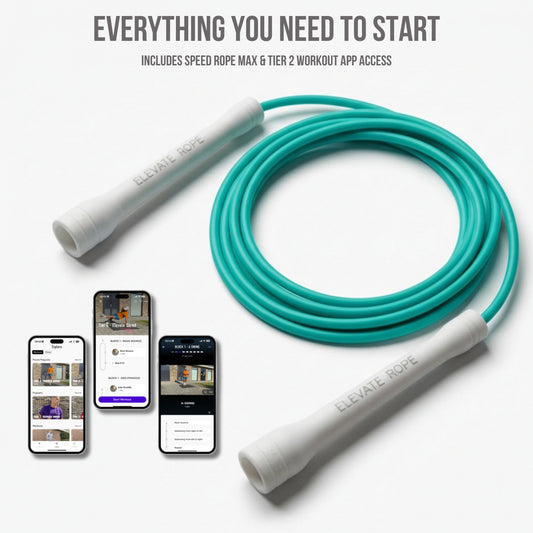
For a complete guide to joint-friendly cardio, read our low-impact cardio guide for bad knees, hips, and joints. If jump rope fits your situation, the Elevate Dignity Beaded Rope provides the feedback for developing joint-protective technique, and our Jump Rope Mat adds cushioning that further reduces impact.
Your joints need protection. Whether that comes from water or from technique, what matters is finding an approach you'll sustain.
Sources
Jump rope joint loading comparison references biomechanical research published in Gait & Posture demonstrating lower peak forces during skipping compared to running. Cardiovascular equivalence of jump rope and jogging references research by John A. Baker at Arizona State University. Swimming and joint health recommendations align with guidelines from the Arthritis Foundation.