






🎾 Tennis Jump Rope Training: Build Agility, Speed & Endurance
Modern tennis demands athletic precision. Matches are faster, rallies are longer, and players must move with explosive speed while maintaining balance and control.
That’s why more professional and recreational players are turning to the tennis jump rope — one of the simplest and most effective tools to elevate performance on the court.
In this guide, you’ll learn how jump rope training enhances agility, endurance, and reaction time — plus how to build rope workouts designed specifically for tennis players.
💥 Why Tennis Players Should Jump Rope
Tennis is a sport of quick reactions, fast starts, and constant directional shifts. The jump rope develops all three.
When you train with a rope, you’re not just improving cardiovascular fitness — you’re sharpening coordination, rhythm, and neuromuscular control.
Every jump forces your body to react instantly, training your muscles to respond faster when chasing a ball.
A short 10-minute session can raise your heart rate as effectively as a 30-minute run, while also reinforcing balance, ankle stability, and timing.
For players who already spend hours on court, it’s an efficient cross-training method that improves performance without overloading joints. tennis training.

⚡ Key Benefits of Jump Rope Training for Tennis
1. Agility & Footwork
Agility defines how efficiently you reach every shot. Jumping rope strengthens stabilizing muscles in your feet, ankles, and calves — exactly what you need for lightning-quick side movement.
Use 30-second fast intervals with 15-second rests to simulate rally intensity.
2. Endurance & Stamina
Rope workouts engage both upper and lower body, improving stamina and maintaining power deep into tie-breaks. Weighted ropes can add resistance for endurance without sacrificing mobility.
3. Coordination & Timing
Tennis requires split-second coordination between hands, eyes, and feet. The rhythmic feedback of a tennis jump rope improves that synchronization, making your swings and footwork more fluid.
4. Balance & Injury Prevention
Regular skipping strengthens tendons and connective tissue, protecting against ankle sprains and knee strain — two of the most common injuries among tennis players.
5. Mental Focus
Rope rhythm builds focus. It keeps your mind present — the same steady concentration needed for long rallies and pressure points.
🧩 Best Jump Rope Drills for Tennis Players
These tennis-specific rope drills build agility, speed, and reactive power. Perform them 2–3 times per week as warm-ups or stand-alone sessions.
1. Lateral Shuffle Jumps
Purpose: Improve side-to-side baseline coverage.
How: Jump twice in place, then move two feet right, two feet left.
Time: 3 × 45 sec.
2. Single-Leg Alternating Jumps
Purpose: Strengthen balance and even power distribution.
How: Switch feet every rotation.
Time: 4 × 30 sec.
3. High-Knee Speed Steps
Purpose: Boost acceleration for net sprints.
How: Run in place over the rope, lifting knees to hip height.
Time: 3 × 60 sec.
4. Double Unders
Purpose: Train explosiveness and fast-twitch response.
How: Spin the rope twice under each jump.
Time: 3 × 20 reps.
5. Side-Swing Crossovers
Purpose: Build upper-body coordination for forehands and backhands.
How: Swing rope to one side, cross in front, repeat.
Time: 3 × 45 sec.
Combine these into a 10–15-minute tennis rope circuit for agility, endurance, and on-court confidence.
🕒 How to Integrate Rope Work Into Your Schedule
Before Practice — Warm-Up (5–7 min)
Use the rope to raise your heart rate and activate coordination before hitting.
- 1 min single bounce
- 30 sec high knees
- 30 sec side swings
- 1 min alternating foot jumps
- 2 min lateral shuffle
Follow with mobility stretches.
After Practice — Conditioning Finisher (8–10 min)
- 5 rounds: 45 sec speed steps / 15 sec rest
- 3 rounds of double unders for power bursts
Low-impact, high-intensity conditioning that won’t overload your joints.
Off-Court Days — Strength & Recovery (15–20 min)
Pair rope circuits with resistance or mobility work:
- Rope intervals for cardio
- Core & glute exercises for stability
- Stretching for recovery
🧠 Choosing the Right Rope for Tennis
The rope you choose shapes your results.
Speed Rope — Ideal for quick feet and short bursts. Lightweight and precise, perfect for court-movement drills.
Beaded Rope — Great for rhythm and timing practice. Offers tactile feedback for consistency and control.
Weighted Rope — Adds resistance for upper-body and cardiovascular endurance. Best for off-court conditioning sessions.
👉 Pro Tip: Mix speed and beaded ropes — speed for reaction drills, beaded for rhythm training.
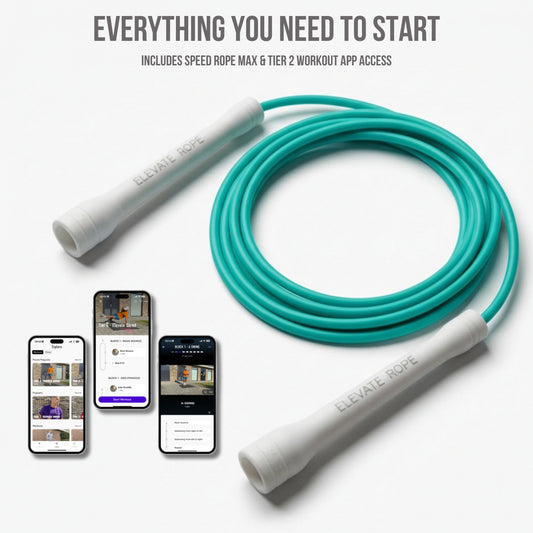
For the perfect setup, explore the Elevate Tennis Performance Rope Bundle — engineered for agility, control, and precision in tennis-specific workouts.
📅 4-Week Jump Rope Plan for Tennis Players
Week 1: Master rhythm and posture with single jumps and lateral moves.
Week 2: Increase intensity using double unders and quick-foot circuits.
Week 3: Combine rope drills with sprints or resistance training.
Week 4: Simulate match conditions with short, explosive bursts.
Track improvement by counting rotations, endurance time, or footwork speed during rallies.
🚫 Common Mistakes to Avoid
- Jumping too high — stay light on your toes.
- Spinning from the shoulders instead of wrists.
- Ignoring rhythm — sync rope tempo with breathing.
- Overtraining — rest days keep you sharp.
💪 The Mental Edge
Rope work isn’t just physical — it builds mental resilience.
Missing a jump teaches patience and composure, the same mindset needed to recover from errors on court.
Consistency with the tennis rope trains both body and focus — so you stay calm, fast, and confident under pressure.

🎯 Train Like an Athlete, Move Like a Pro
Adding jump rope sessions doesn’t replace your court time — it amplifies it.
A few minutes a day can redefine your movement, reaction, and endurance.
Start today with Elevate’s Tennis Performance Rope Bundle and experience smoother, faster, more powerful play.
Your footwork will speak for itself — one jump at a time.