





The treadmill has dominated home cardio for decades. It's the default purchase, the obvious choice, the equipment that seems synonymous with getting fit at home.
It's also expensive, space-consuming, and frequently abandoned. Walk through any neighbourhood on bin day and you'll spot treadmills awaiting collection—expensive purchases that became expensive clothes racks before becoming expensive rubbish.
If you're looking to do cardio without a treadmill, you're not settling for less. You're often choosing something better. The alternatives are cheaper, more compact, more engaging, and in many cases more effective at delivering actual cardiovascular results.
This article covers everything you need to build serious cardio fitness at home with no treadmill required—from equipment-free options to minimal gear that stores in a drawer.
What you'll learn:
- Why treadmills fail so many home exercisers
- The most effective cardio without a treadmill options ranked by results
- Equipment-free routines that deliver real cardiovascular benefits
- Minimal equipment that outperforms treadmills for less money and space
- How to structure home cardio for consistency and results
Why Treadmills Fail (And Why You Don't Need One)
Before exploring how to do cardio, it's worth understanding why treadmills have such high abandonment rates.
The treadmill was literally invented as punishment. In 1818, British engineer William Cubitt designed the "tread-wheel" for prison inmates—hours of walking in place, going nowhere, as a form of hard labour. The modern treadmill is a refinished version of a torture device, and your brain knows it.
This isn't just historical trivia. It explains the psychological experience of treadmill running: monotony, temporal distortion (time feeling slower than it actually passes), and the sensation of effort without progress. You work hard and end up exactly where you started.
The practical problems compound the psychological ones. Treadmills cost €500-€3,000 for quality models. They consume 1-2 square metres of permanent floor space. They require assembly, maintenance, and eventually repair. The "folding" versions still need clearance and rarely get folded.
Cardio without a treadmill eliminates all of these barriers. No large purchase decision, dedicated space requirement, mechanical maintenance. Just movement, available whenever you want it.

Answer Block: Can You Get Effective Cardio Without a Treadmill?
Short answer: Yes. Research shows that several non-treadmill cardio methods match or exceed treadmill training for cardiovascular improvement, calorie burn, and health benefits. Jump rope, bodyweight circuits, and other modalities deliver equivalent or superior results with less cost, space, and boredom.
Why it matters: The treadmill's dominance in home fitness is marketing, not science. Understanding that effective cardio is not only possible but often preferable opens better options for sustainable home fitness.
Key insight: The best cardio equipment is the kind you actually use consistently. For most people, that's not a treadmill.
The Best Cardio Without a Treadmill: Ranked by Effectiveness
1. Jump Rope
Jump rope sits at the top of the cardio hierarchy for good reason. Research from Arizona State University found that ten minutes of jumping delivers cardiovascular benefits equivalent to thirty minutes of jogging. You get treadmill-level results in one-third the time.
The space requirement is minimal: roughly two metres of ceiling clearance and a two-by-three metre floor area. Most living rooms qualify. The equipment cost is €15-€40 for a quality rope that lasts years. Storage means hanging it on a hook or tossing it in a drawer.
Beyond efficiency, jump rope solves the boredom problem that kills treadmill motivation. The coordination demand forces active attention—you can't zone out and watch the minutes tick by because losing focus means tripping. This engagement makes time pass faster rather than slower.
The learning curve adds what treadmills lack: skill progression. You start with basic bounces, advance to alternating feet, then boxer steps, crosses, and eventually double-unders. There's always something new to work toward, which maintains long-term interest.
For anyone seeking cardio, jump rope deserves first consideration.
2. Bodyweight HIIT Circuits
High-intensity interval training using only bodyweight requires zero equipment and zero space beyond a yoga mat footprint. Exercises like burpees, mountain climbers, high knees, squat jumps, and jumping jacks create cardiovascular demand that matches or exceeds steady-state treadmill jogging.
A typical HIIT structure: 30 seconds of work, 30 seconds of rest, rotating through 4-5 exercises for 15-20 minutes total. This format produces what exercise scientists call "EPOC" (excess post-exercise oxygen consumption)—elevated calorie burn that continues for hours after the workout ends.
The downside: high-impact movements create noise that apartment dwellers may need to consider. Burpees at 6am won't make you popular with downstairs neighbours. This is cardio without a treadmill that works best in houses or ground-floor apartments.
3. Shadowboxing
Combat cardio delivers intense cardiovascular training while building coordination, core strength, and stress relief. Three-minute rounds of focused combination work—jabs, crosses, hooks, uppercuts mixed with footwork and head movement—create sustained heart rate elevation without equipment or impact.
Shadowboxing is among the most neighbour-friendly forms of cardio without a treadmill. There's no jumping, no floor impact, just continuous movement that keeps your heart rate in training zones.
The skill element prevents boredom. You're not just moving—you're practicing combinations, working angles, and engaging mentally in ways that treadmill walking never requires. Fifteen minutes of shadowboxing feels like five, while fifteen minutes on a treadmill feels like an hour.
Free YouTube tutorials provide structure for beginners. No gloves, bags, or gym membership required.
4. Dance Workouts
Dance-based cardio transforms exercise into entertainment. Platforms like YouTube offer thousands of free dance workouts ranging from hip-hop to Latin to K-pop choreography, typically 15-45 minutes in length.
The appeal is psychological: you're learning routines and following music rather than grinding through repetitions. This reframes cardio from punishment to play, which dramatically improves adherence rates.
Dance provides legitimate cardio without a treadmill—moderate-intensity sessions burn 300-500 calories per hour while building coordination and rhythm. The variability prevents the repetitive strain injuries that plague treadmill users.
Space requirements are modest: enough room to step side to side and move arms freely. Equipment requirement: none beyond a screen to follow along.
5. Stair Climbing
If you have stairs in your home, you have cardio equipment that costs nothing and stores itself. Walking or running stairs elevates heart rate quickly while building leg strength and power.
Ten minutes of stair climbing burns approximately 100-150 calories—comparable to jogging at moderate pace but with greater leg muscle engagement. The vertical component makes cardio without a treadmill feel harder at slower speeds, which improves time efficiency.
No stairs at home? Stair-stepping on a single step, sturdy box, or even a thick book creates similar benefits at smaller scale. The motion pattern matters more than the height.

Equipment-Free Cardio Without a Treadmill: Three Complete Routines
Routine 1: The Silent Apartment Workout (15 minutes)
Designed for cardio without a treadmill when you can't make noise:
Warm-up (2 minutes): March in place, arm circles, gentle squats
Main circuit (repeat 3 times):
- Squat to calf raise: 45 seconds
- Standing oblique crunches: 45 seconds
- Reverse lunges (alternating): 45 seconds
- Standing mountain climbers (slow, controlled): 45 seconds
- Rest: 30 seconds
Cool-down (1 minute): Standing forward fold, quad stretch
This routine keeps one foot on the ground at all times, eliminating impact noise while maintaining cardiovascular elevation.
Routine 2: Maximum Burn (20 minutes)
For those who can make noise and want intensity:
Warm-up (3 minutes): Jumping jacks, high knees, arm swings
Main circuit (repeat 4 times):
- Burpees: 30 seconds
- Mountain climbers: 30 seconds
- Squat jumps: 30 seconds
- High knees: 30 seconds
- Rest: 60 seconds
Cool-down (2 minutes): Walking in place, stretching
This delivers cardio without a treadmill at maximum intensity—expect to burn 200-250 calories in twenty minutes.
Routine 3: The Ten-Minute Efficiency Protocol
When time is extremely limited:
No warm-up—start at moderate pace and build
Circuit (no rest between exercises):
- Jumping jacks: 60 seconds
- Bodyweight squats: 60 seconds
- High knees: 60 seconds
- Push-ups: 60 seconds
- Burpees: 60 seconds
- Mountain climbers: 60 seconds
- Squat jumps: 60 seconds
- Plank jacks: 60 seconds
- Jumping jacks: 60 seconds
- March in place (cool-down): 60 seconds
Ten exercises, one minute each, continuous movement. Cardio without a treadmill in its most time-efficient form.
Adding Minimal Equipment: Maximum Results
While bodyweight cardio without a treadmill works well, minimal equipment investments can dramatically improve results.
Jump rope (€15-€40)
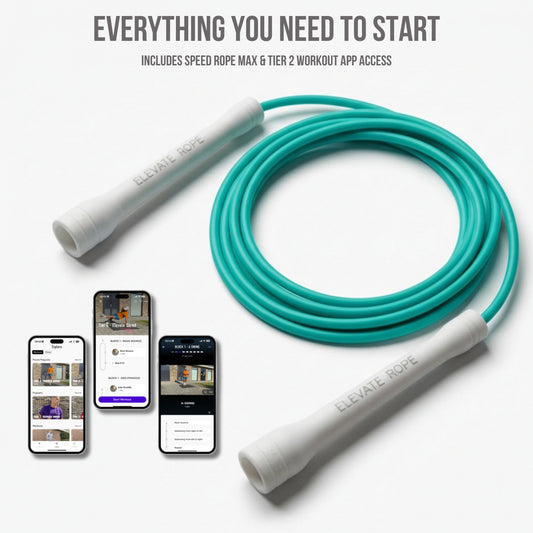
Already discussed as the top option. A quality rope lasts years, stores anywhere, and delivers the best cardio-per-minute available. The Elevate Dignity Beaded Rope provides rhythmic feedback that accelerates learning, while the Speed Rope MAX suits those ready for high-intensity interval work.
Resistance bands (€15-€30)
Bands don't provide cardio directly, but they enable circuit training that keeps heart rate elevated while building strength. A set of 3-5 bands with different resistances supports hundreds of exercises in zero floor space.
Kettlebell (€40-€80)
A single kettlebell transforms cardio without a treadmill options. Swings, snatches, and clean-and-press combinations create cardiovascular demand while building posterior chain strength. Twenty minutes of kettlebell work matches or exceeds twenty minutes of jogging for both cardio benefit and calorie burn.
Yoga mat (€15-€30)
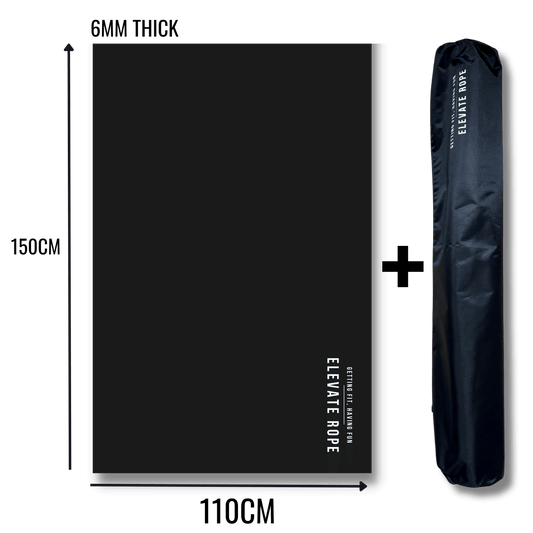
Not cardio equipment directly, but a mat defines workout space, provides cushioning for floor exercises, and reduces noise transmission to downstairs neighbours. A worthwhile investment for any home cardio routine.
Total investment for all four items: €85-€180—less than the cheapest quality treadmill, infinitely more versatile, and requiring virtually no storage space.

Structuring Your Cardio Without a Treadmill Routine
Having options matters less than using them consistently. Here's how to structure cardio without a treadmill for sustainable results.
Frequency: Aim for 3-5 cardio sessions per week. This can be dedicated cardio workouts or cardio elements added to strength training. More isn't always better—recovery matters.
Duration: Start with what you can actually do. Ten minutes you complete beats thirty minutes you skip. Build duration gradually as fitness improves and the habit solidifies.
Intensity: Include variety. Some sessions should be moderate and sustainable (dance workouts, steady-pace jumping). Others should be high-intensity intervals (HIIT circuits, sprint-pace rope jumping). The combination produces better adaptations than either extreme alone.
Progression: Track something. Rounds completed, total jump rope rotations, or simply checkmarks on a calendar. Measurement creates accountability and reveals improvement over time.
Variety: Rotate between options to prevent boredom and overuse injuries. Jump rope Monday, shadowboxing Wednesday, HIIT circuit Friday. The diversity of cardio without a treadmill options is a feature, not a limitation.
Frequently Asked Questions
Is cardio without a treadmill as effective as treadmill training?
Yes—often more effective. Research shows that jump rope, HIIT circuits, and other non-treadmill modalities produce equivalent or superior cardiovascular improvements compared to treadmill jogging. The treadmill's main advantage is simplicity, not effectiveness. Many alternatives deliver better results in less time.
What burns the most calories without a treadmill?
Jump rope and high-intensity interval training (HIIT) top the calorie-burn rankings. Jump rope at vigorous pace burns approximately 12-15 calories per minute, while HIIT circuits burn 10-14 calories per minute depending on exercises selected. Both match or exceed treadmill running for calorie expenditure.
How can I do cardio at home quietly?
Focus on low-impact movements: marching in place, standing mountain climbers, shadowboxing, squat variations without jumping, and controlled step-ups. Jump rope with proper technique (small hops, soft landings) on a thick mat is surprisingly quiet. Avoid burpees, jumping jacks, and squat jumps if noise is a concern.
Do I need any equipment for effective home cardio?
No, but minimal equipment improves results significantly. A jump rope (€15-€40) provides the best cardio-per-euro investment available. Beyond that, a yoga mat and resistance bands round out a complete home cardio setup for under €100 total.
How long should a cardio session be without a treadmill?
Start with whatever duration you can sustain consistently—even ten minutes produces measurable benefits. Most people find 15-30 minutes optimal for home cardio sessions. The key is matching duration to intensity: shorter sessions can be more intense, while longer sessions should moderate effort.
Can I build endurance without a treadmill?
Absolutely. Endurance develops through progressive cardiovascular stress, which any sustained cardio activity provides. Jump rope, cycling, swimming, and even extended dance workouts build endurance effectively. The mode matters less than the consistency and progressive challenge.
The Bottom Line: You Never Needed a Treadmill
The treadmill isn't bad equipment—it's just unnecessary for most people and optimal for almost nobody. It consumes space, money, and motivation while delivering results you can achieve faster with cheaper, more compact alternatives.
Cardio without a treadmill isn't a compromise. It's a liberation from the false assumption that effective home fitness requires large, expensive equipment.
A jump rope, some floor space, and fifteen minutes of focused effort. That's all home cardio actually requires. Everything else is optional.
If you're ready to make the switch, our complete guide to jump rope for home cardio covers everything from choosing your first rope to building progressive routines. The Elevate Dignity Beaded Rope is ideal for beginners—the rhythmic bead sound provides timing feedback that accelerates learning. For those ready for intensity, the Elevate Speed Rope MAX handles the fastest interval training you can throw at it.
Sources
The treadmill's origin as prison punishment references historical documentation of William Cubitt's 1818 "tread-wheel" designed for British prisons. Cardiovascular equivalence between jump rope and jogging references research by John A. Baker at Arizona State University, published in The Research Quarterly. Calorie expenditure estimates reference metabolic equivalent (MET) values from the Compendium of Physical Activities. HIIT and EPOC research draws from studies on excess post-exercise oxygen consumption published in the Journal of Sports Sciences and related peer-reviewed publications.