






I canceled my gym membership, switched to working out at home, and got in the best shape of my adult life. It took less time, cost less money, and for the first time in years I actually stuck with it. Here is exactly what I did, why it worked, and how you can do the same thing.
But first, the part nobody talks about.
I paid for that gym membership for eleven months after I stopped going. Eleven months. Every single month, the charge hit my bank account like a little notification from the universe reminding me that I was, once again, not following through on something I said I would do.
I stopped opening the gym app, I stopped reading their promotional emails and I even changed my route to work so I would not drive past the building. Not because I hated the gym. Because every time I saw it, I felt something worse than frustration. I felt like a fraud.
And here is the thing I did not understand at the time: it was never about the money. Yes, I was wasting 40 EUR a month on a service I did not use. But the real cost was what that unused membership was doing to my self-image. Every month it renewed was another small piece of evidence that I could not keep a promise to myself. I was not paying for fitness. I was paying for "just in case." Holding onto the idea of who I might become someday, while quietly proving every month that I was not that person yet.
If any of that sounds familiar, you are not alone. Research shows that 67% of gym memberships go unused. That is not a fringe statistic. That is the majority. The gym model does not fail a few people. It fails most people. And understanding why changed everything for me.

Why the Gym Was Never Going to Work for Me
For years, I assumed I was the problem. I was not disciplined enough and I was not motivated enough I just needed to just try harder, wake up earlier, want it more. Every January I would recommit, and every March the membership would go back to collecting dust.
It took me a long time to realize I was not the problem. The model was.
Start with the time math. A "one-hour workout" at the gym was never one hour. It was 15 minutes to drive there, 10 minutes to change and find available equipment, 45 minutes of actual exercise, 10 minutes to shower and change back, and 15 minutes to drive home. That is an hour and a half for 45 minutes of working out. As a working adult with responsibilities, that math stopped making sense a long time ago. I just did not admit it.
Then there was the intimidation. I never felt like I belonged in that building also i did not know how to use half the machines. I was always aware of other people around me and wondering if they were watching, judging, noticing how lost I looked. Research suggests that roughly 28% of women avoid gyms specifically due to social anxiety, and the numbers for men are not far behind. We just do not talk about it as openly. This is not a willpower problem. It is a design problem. The gym environment actively works against people who are not already confident in it.
And then the consistency cliff. Studies show that gym attendance drops roughly 50% after February for people who signed up in January. Half of all New Year resolvers are gone within eight weeks. Not because they stopped wanting results. Because the friction of getting to the gym, navigating the environment, and carving out 90 minutes from an already packed day became unsustainable once the initial motivation faded.
The financial picture made it worse, not better. The average gym membership in Europe runs 30 to 50 EUR per month. Across the Atlantic, Americans waste nearly $2 billion annually on memberships they do not use. And here is the statistic that hit me hardest: research tracking thousands of gym members found that the average person continues paying for 2.3 full months after their last visit before finally canceling. That is $187 spent on nothing except avoiding the feeling of admitting defeat.
I want to be clear about something. The gym is a great tool for some people. If you love going, if it fits your schedule, if the environment motivates you, keep going. This is not an anti-gym article. This is an article for the millions of people, the 67%, for whom the gym model introduces more friction than it removes. The question I finally asked myself was not "how do I force the gym to work?" It was "what would actually work for my life?"
That question changed everything.

The Real Cost of Paying for a Gym You Do Not Use
Let me do the math I avoided for almost a year. Eleven months at 40 EUR per month. That is 440 EUR I spent on a building I did not enter. For that money I could have bought an entire home workout setup three times over. I could have taken my family on a weekend trip. I could have invested in a year of better groceries. Instead, I invested in guilt.
But the financial cost was not the part that stuck with me. The emotional cost was worse.
Every month that membership renewed, it sent a quiet message to a part of my brain I could not argue with: you said you would, and you did not. Again. It was not dramatic, It was not a crisis and It was a slow drip of broken promises that eroded something I did not even have a name for at the time. I would later learn to call it self-trust. The belief that when you say you are going to do something, you actually do it.
Most people do not cancel because canceling feels like the final admission that it is over. That the version of yourself who goes to the gym four days a week is not coming. Research backs this up. A study tracking 7,752 gym members over three years found that the average person pays for 2.3 months after their last visit before canceling. That is $187 spent purely on avoiding the emotional weight of quitting. The shame of canceling literally costs more than the membership.
I remember the day I finally did it, I expected to feel defeated and I expected the shame to get worse. Instead, something I did not anticipate happened. I felt lighter. Like I had been carrying a weight I did not realize was there until I set it down. Canceling was not giving up. It was giving myself permission to stop pretending and start looking for something that actually fit my life.
That relief was the beginning of everything that came next.

What I Did Instead of the Gym (And Why It Actually Worked)
I did not have a plan. I just knew what I needed. Something I could do at home and something that took 15 minutes or less. Something that required no commute, no locker room, no monthly fee, and no setup more complicated than walking into my living room. And it had to be real cardio. Not gentle stretching. Not a five-minute cool-down video. Something that actually made me sweat and breathe hard.
So I tried everything.
Bodyweight circuits came first. Push-ups, squats, burpees, planks. They worked. For about two weeks. Then the boredom set in. Doing the same movements in the same order in the same room with no external feedback and no sense of progression made every session feel identical. I was not getting worse. I just was not getting anywhere interesting.
YouTube workout videos were next. The variety was better, but the quality was wildly inconsistent. Some were clearly designed by people who understood fitness. Others were content-first, exercise-second. I spent more time searching for the right video than actually working out. And I never built a routine because every day was a different instructor with a different style.
Resistance bands surprised me. Great for strength work, especially upper body. But they did not get my heart rate up enough to replace cardio. They became a supplement, not a solution.
Dance workouts were genuinely fun. I will not pretend otherwise. But I could not measure progress. There was no skill curve, no clear improvement from session to session. After the novelty faded, I had no reason to keep choosing it over sitting on the couch.
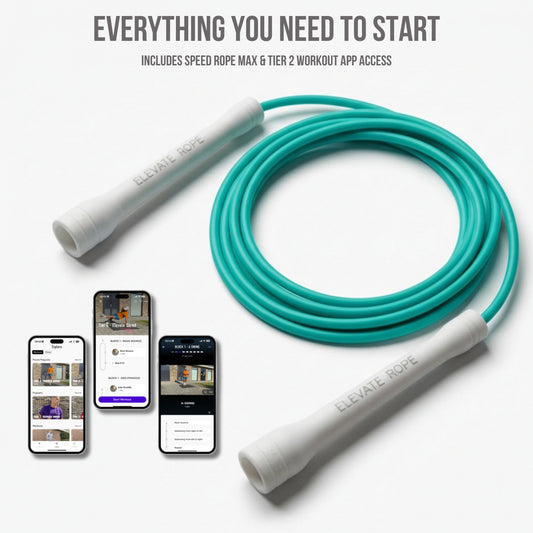
Then I picked up a jump rope. And something clicked.
It was not love at first session. I tripped constantly. My timing was terrible. I could barely string together 20 consecutive jumps without catching my foot. But here is what I noticed immediately: I was completely absorbed. My brain could not wander to emails or deadlines or the dishes in the sink because the moment I lost focus, I tripped. It demanded presence in a way that nothing else I tried had.
Within a week I could hold a rhythm for 60 seconds, Within two weeks I was doing three-minute rounds. Within a month I was doing 15-minute sessions that left me more wrecked than any gym visit I could remember.
The numbers backed up what my body was telling me. Research from Arizona State University found that 10 minutes of vigorous jump rope activity provides cardiovascular benefits equivalent to 30 minutes of jogging. That is not a marketing angle. That is peer-reviewed exercise science. I was getting a better cardio workout in a fraction of the time, in my living room, with a piece of equipment that cost less than one month of my old gym membership and fit in a kitchen drawer.
But the real reason it worked was not the efficiency. It was the friction test. The gym required 90 to 120 minutes of total time investment. Jump rope required walking to my living room, picking up a rope, and pressing play on a 10-minute timer. That difference is everything. Because on the days when motivation was low, when work had drained me, when I absolutely did not feel like exercising, the jump rope still won. Not because I wanted to do it. Because the barrier was so low that skipping it would have taken more mental effort than just doing it.
I want to be honest here. Jump rope is not the only answer. For some people the best option is bodyweight work, or resistance bands, or dance, or a combination. The best workout is the one you will actually do. But for someone who needs time efficiency, minimal space, zero setup, and something that stays interesting because it is a skill you are always improving at, it is hard to beat.

Gym Membership vs. Home Workouts: An Honest Comparison
I spent a lot of time going back and forth before I canceled. Would I regret it? Would my results suffer? Was I just being lazy? So I started tracking the differences honestly. Not what I hoped would happen. What actually happened. Here is how the two approaches compared across every factor that mattered to me:
| Factor | Gym Membership | Home Workouts |
| Monthly Cost | 30-50 EUR/month | 0 EUR (bodyweight) to 5 EUR/month amortized (equipment) |
| Time Per Session (incl. commute) | 90-120 minutes total | 10-20 minutes total |
| Equipment Variety | Extensive (machines, free weights, pools) | Limited but sufficient for most goals |
| Social / Community | Built-in (classes, gym buddies) | Self-directed (online communities optional) |
| Privacy | Low (shared space, mirrors, other people) | Complete (your space, your rules) |
| Consistency Rate | 2x per month (my reality, not my plan) | 4-5x per week (because friction disappeared) |
| Flexibility of Schedule | Limited by opening hours and commute | Anytime, anywhere, no scheduling required |
| Barrier to Start | High (commute, outfit, equipment knowledge) | Near zero (stand up, start moving) |
I want to be fair. The gym wins on equipment variety and social environment. If you thrive in a group setting and you love having access to heavy barbells and cable machines, a home setup cannot fully replicate that. Those are real advantages for the right person.
But look at the other six rows. For someone whose biggest problem was never intensity but consistency, the home workout model won in almost every category that actually determines whether you stick with something long enough to see results. The best equipment in the world does not matter if you are not in the building. And I was never in the building.

What Happened After 90 Days Without a Gym
I did not set out to run a 90-day experiment. I just wanted to see if working out at home would stick longer than two weeks. It did. Here is what changed.
The consistency shift was the most dramatic. I went from visiting the gym roughly twice a month (on a good month) to working out at home four to five times per week. That is not a small improvement. That is the difference between a fitness identity built on intention and one built on action. Nothing about my willpower changed. Nothing about my motivation changed. The only thing that changed was friction. And removing friction turned out to be the only variable that mattered.
Physically, the results followed the consistency. My resting heart rate dropped. My endurance improved noticeably within the first month. I lost a few kilograms without changing my diet, which I had never managed to do during my sporadic gym visits. I started seeing definition in my shoulders and legs that had not been there in years. None of this was dramatic. None of it was overnight. But it was steady, and it was real, and it came from showing up five days a week instead of twice a month.
Financially, the math reversed completely. I saved somewhere between 360 and 480 EUR in the first year. My total equipment investment was less than 50 EUR. No recurring fees, No contracts and No cancellation hassle looming over me if I ever wanted to stop. For the first time, my fitness expenses matched my fitness activity. I was paying for what I used, and I was using everything I paid for.
But the results that surprised me most were not physical or financial. They were emotional.
The guilt was gone. That low-grade background noise of knowing I was wasting money on something I was not using, of feeling like a fraud every time the topic of fitness came up, of quietly proving to myself month after month that I could not follow through. All of it was gone. In its place was something I had not felt in a long time. I felt like someone who does what they say they are going to do.
That shift sounds small on paper. It was not small in practice. When you show up for yourself five days a week instead of two days a month, something changes in how you carry yourself. You start to trust your own word. Not just about exercise. About everything. You say you will make that phone call, and you make it. You say you will finish that project, and you finish it. The kept promises compound. They start as 10 minutes of jump rope in the living room and they end up restructuring how you see yourself as a person.
I did not get in better shape because I found a better workout. I got in better shape because I found a system with so little friction that I could not talk myself out of it. And then the showing up did what showing up always does. It built something I could not buy with a gym membership: proof that I follow through.

How to Cancel Your Gym and Set Up a Home Workout Routine
If you are reading this and recognizing yourself in any of it, here is exactly what I would do if I were starting over. No fluff. No 30-day ramp-up plan. Five steps.
Step 1: Cancel the membership today.
Not Monday. Not after one more try. Today. The longer you wait, the deeper the sunk cost trap pulls you in. Every additional month you pay is another month of evidence that you cannot make a decision and act on it. Most gyms allow cancellation online or by phone. If yours requires you to go in person (and yes, some do this on purpose), schedule it for this week. Put it in your calendar right now. The act of canceling is the first kept promise in your new system.
Step 2: Choose one home workout method and commit to it for 14 days.
Not three methods. Not five. One. The goal is not to build the perfect program. The goal is to prove to yourself that you can show up consistently to a single activity for two weeks straight. Pick based on your biggest priority. If you need time efficiency, try jump rope, If you want strength, try resistance bands. If you need fun above all else, try dance workouts and If you want zero cost, try bodyweight circuits. Do not overthink this. You can always switch after the 14 days. But you cannot switch during. The commitment is the point.
Step 3: Anchor it to an existing habit.
Do not rely on motivation to remember. Attach your workout to something you already do every day. Before your morning coffee. During your lunch break. Right after putting the kids to bed. Habit stacking works because it removes the decision of when to work out. The trigger is automatic. You finish one thing, you start the next. No willpower required.
Step 4: Start with 10 minutes.
Not 30. Not 60. Ten. This is the part where most people resist because it feels too easy. Good. Easy is the point. The goal for the first two weeks is not to get a great workout. It is to build an unbreakable streak. You are training the habit, not the body. The fitness will come. But only if the habit comes first. Ten minutes is short enough that you can do it on your worst day, after your longest shift, when every fiber of your being wants to sit on the couch. That is exactly why it works.
Step 5: Track your streak, not your reps.
For the first month, the only metric that matters is: did I do it today? Not how many calories you burned its Not how many reps you completed and Not whether you beat yesterday. Just: did I show up? Get a wall calendar. Put it somewhere you will see it every morning. Mark an X on every day you complete your 10 minutes. Your only job is to not break the chain. That visual streak will motivate you more than any fitness app, any transformation photo, any motivational quote ever could. Because it is not someone else's progress. It is yours. Written in your handwriting. On your wall.
That is it. Five steps. No equipment list, No meal plan and No training split. Those things have their place, but they are not what failed you before. What failed you was friction and complexity. This is the opposite. This is the lowest possible barrier between you and becoming someone who moves every day.

Frequently Asked Questions About Canceling Your Gym Membership
Will I lose my progress if I cancel my gym membership?
If you have an unused membership, you are not currently making progress to lose. That is not a judgment. It is just the math. Switching from a gym you visit twice a month to a home routine you do four to five times per week will produce better results, not worse. Consistency beats environment every time.
Can home workouts actually replace the gym for building muscle?
For general fitness, cardiovascular health, and moderate strength building, absolutely. Bodyweight exercises, resistance bands, and weighted jump ropes can provide serious stimulus for most people. Where home setups have genuine limitations is heavy barbell work for powerlifting or bodybuilding. But for roughly 90% of people whose goal is to look better, feel stronger, and improve their health, a home setup provides more than enough.
How much does a basic home workout setup cost?
It can cost nothing if you stick to bodyweight exercises. A jump rope and a set of resistance bands together run 30 to 60 EUR, which is less than one month of most gym memberships. Even a more complete setup with a mat, a few bands, and a couple of rope options rarely exceeds 100 EUR. Compare that to 360 to 600 EUR per year for a gym membership you may or may not use.
What if I get bored working out at home?
Boredom is one of the top reasons people stop going to the gym too. The issue is not the location. It is the activity. The advantage of home workouts is that you can switch formats any time you want. YouTube alone has millions of free workout videos across every style imaginable. And certain activities, like jump rope, have a built-in skill curve that keeps things interesting. You are not just repeating the same motion. You are getting measurably better at a coordination-based skill, which means every week feels slightly different from the last.
Is canceling my gym membership the same as giving up?
No. Canceling something that is not working is not quitting. It is making a better decision with better information. Continuing to pay for something you do not use while feeling guilty about it every month is not perseverance. It is inertia dressed up as commitment. Giving up would be stopping exercise entirely. Switching to a model that actually fits your life is the opposite of giving up. It is finally being honest about what works.
What is the best home cardio for someone who hates running?
Jump rope, dance workouts, and HIIT bodyweight circuits all deliver strong cardiovascular benefits without running. Jump rope is particularly efficient. Research shows that 10 minutes of jump rope provides cardiovascular benefits equivalent to 30 minutes of jogging. If running has always felt like punishment to you, there are options that feel nothing like it and deliver equal or better results in less time.
Do I need a lot of space to work out at home?
No. Most effective home workouts require a space roughly the size of a yoga mat. Jump rope needs a bit of ceiling clearance (about 25 to 30 centimeters above your head) and roughly two meters of floor space in each direction. Bodyweight circuits, resistance band work, and most stretching routines can be done in even smaller spaces. If you can stand in your living room with your arms extended, you have enough room.

The Best Gym Is the One You Actually Use
The best gym in the world is worthless if you do not walk through the door. And the most perfectly designed workout program means nothing if it lives in a PDF you never open. I spent years believing I needed to find the right gym and the right plan and the right motivation to finally become consistent. U are wrong about all of it.
I did not become a fitness person by finding the perfect facility. I became a fitness person by removing every obstacle between me and 10 minutes of movement. The gym was not helping me get there. It was the obstacle. And removing it was not the end of my fitness journey. It was the actual beginning.
If you are sitting on an unused membership right now, feeling that familiar mix of guilt and "maybe next week," I want you to know something. You are not lazy, You are not undisciplined and You are just using a system that was not built for your life. And there is no shame in admitting that. The shame is in paying for it for another six months while pretending things will change on their own.
Cancel the membership. Keep the results.
Sources and Further Reading
The statistics and research referenced throughout this article come from peer-reviewed studies and established industry sources. If you want to explore the data behind the gym membership problem and home workout science in more detail, here are the primary sources:
Gym Membership Usage and Dropout Rates Statistic Brain Research Institute. 67% of gym memberships go unused, with 50% of new members quitting within six months. View the research at Statistic Brain
The Financial Cost of Unused Memberships DellaVigna, S. & Malmendier, U. (2006). Paying Not to Go to the Gym. American Economic Review, 96(3), 694-719. Study tracking 7,752 gym members over three years, finding the average person pays $187 after their last visit before canceling. Read the full study at the American Economic Association
Americans Wasting $1.3-2 Billion Annually on Unused Memberships Multiple industry analyses including data from the International Health, Racquet & Sportsclub Association (IHRSA) and consumer finance research. View IHRSA industry data
Gym Intimidation and Social Anxiety Salvatore, J. & Marecek, J. (2010). Research on gym anxiety and exercise avoidance, showing approximately 28% of women avoid gyms due to social anxiety, with significant numbers of men reporting similar experiences. Read about gymtimidation research at ACSM
Jump Rope Cardiovascular Equivalence Arizona State University research on oxygen consumption during jump rope exercise, finding 10 minutes of vigorous jump rope activity provides cardiovascular benefits equivalent to 30 minutes of jogging. View the research at the American College of Sports Medicine
Cerebral Blood Flow and Sedentary Behavior Carter, S.E., Draijer, R., Holder, S.M., Brown, L., Thijssen, D.H.J., & Hopkins, N.D. (2018). Regular walking breaks prevent the decline in cerebral blood flow associated with prolonged sitting. Journal of Applied Physiology, 125(3), 790-798. Read the full study at the American Physiological Society
Morning Exercise and Sustained Brain Benefits Wheeler, M.J., Dunstan, D.W., et al. (2019). Morning exercise mitigates the impact of prolonged sitting on cerebral blood flow in older adults. Journal of Applied Physiology. Read the full study at the American Physiological Society
European Gym Membership Costs Europe Active and Deloitte. European Health & Fitness Market Report, tracking average membership costs across European markets at 30-50 EUR per month. View reports at Europe Active