





How long does a jump rope last? No month count would be honest. Your floor and your hours decide it, not the calendar. What we can give you is the signal. When the cable stops holding its shape in the air, it's done. On an Elevate rope that means a new rope rather than a new cable.
That last part surprises people, so it gets its own section below. First, what makes a jump rope last, and the signals that it's close to the end.
How long does a jump rope last in practice
Two people can buy the same jump rope on the same day. One trains barefoot on a mat indoors, four times a week. The other does double unders on a car park three times a week. Their ropes won't finish anywhere near each other. No honest number covers both.
So we don't publish one. Anyone who does is either guessing, or describing one specific case and rounding it into a rule. What holds across every case is the sequence. The cable thins at one point, then stops behaving, then eventually fails. Jump rope lifespan is a process, not a date.
What makes a jump rope last: the 4 factors
Four things set jump rope lifespan, in this order.
- Surface. By a distance the biggest factor. Every turn scrapes the cable against the floor. Concrete is the worst common case, and it's the one heavy users tell us about.
- Hours. Not sessions. Twenty minutes of double unders puts far more turns through the cable than an hour of basic bounce. Count hours of turning, not weeks, when you ask how long does a jump rope last.
- Storage. A cable stored folded develops a weak point whether or not you ever train on it. PVC slowly takes the shape it's held in.
- Length. A rope cut too long drags more cable across the floor on every turn. Cut it to fit and you remove that.
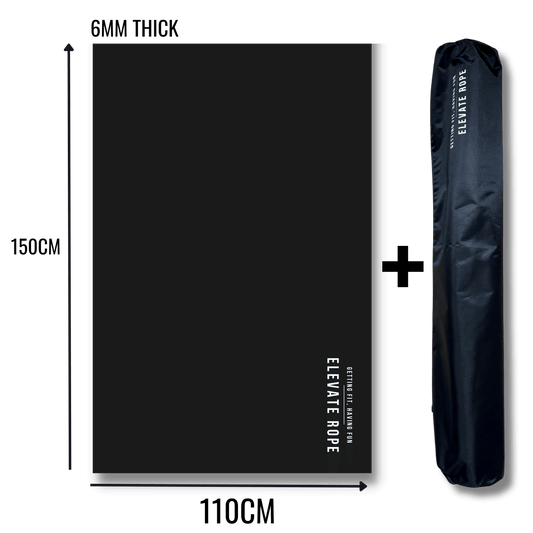
Only the first of those costs money to fix, and not much. An Elevate jump rope mat sits between the cable and the floor. It's the single change that does most to make a jump rope last. If concrete is your only option, we went through the specifics in jump rope mat for concrete.
What a worn cable feels like before it looks worn
You'll feel wear in the air before you see it, though people rarely name it correctly. The rope starts arriving a fraction late. Its arc goes soft. You trip more often on the trick you had last month. Most jumpers blame themselves. Check the cable first.
Find the strike point. Lay the rope out and look for the section that's gone slightly flat. It may be shiny, or narrower than the rest. On most people it sits a hand's width from one side of the centre.
Then run it through your fingers. Your fingers will find a thinning strike point before your eyes do.
The end state is a cable that's visibly frayed. Or one with a kink that won't come out however often you straighten it. At that point it's finished. Why it got there is covered in why jump rope cables kink, fray and snap.

Why there is no replacement cable to buy
On a lot of jump ropes the cable is a serviced part. There's a metal fitting, a crimp or a screw terminal. You buy a matching replacement cable and fit it.
Ours isn't built that way, on purpose. There's no metal in the cable. Sizing is a snaplock inside the handle plus a pair of household scissors. You cut it to your height and you're finished. That's the whole benefit.
The cost of it is that a replacement cable isn't really a product we can sell you. What you'd be buying is a length of cable you then cut, which is most of a rope. So when the cable is done, the rope is done. We'd rather say that plainly than sell a part that doesn't fit how the rope is made.
On ours, how long does a jump rope last has one answer. As long as its cable. Every rope carries a 90-day guarantee from purchase. That covers something being wrong rather than worn.
Handles are the part with a lifetime warranty
Handles are the exception, and deliberately so. They carry a lifetime warranty, no questions asked. A handle is a part in a way a cut-to-fit cable isn't. A new handle makes a jump rope last only while the cable is still good.
If yours have taken one ground smash too many, the replacement short handles are the standard 13cm set. There are also 20cm long handles, which are a different rope rather than a repair. The extra reach is for crosses and freestyle, the moves you see in competitive jump rope. They're not what we'd put in a first-time jumper's hands. The swap itself is straightforward, and we walked through it in replacing your jump rope handles.
Beads wear on their own schedule
Our beaded ropes age differently. Their 2.5cm PVC beads meet the floor instead of the cord. The 3.5mm polycord underneath is mostly protected. That's why a beaded rope often outlives a speed rope on the same floor.
What goes instead is the beads. Usually only two or three of them, flattened on the side that lands. Replace those and the rope is back. Beads are the one place where a small repair makes a jump rope last longer. The method is in jumping rope beads replacement. Cord thickness under the beads is worth understanding on its own, in 3.5mm polycord vs 3mm.
4 habits that make a jump rope last longer
Four habits make a jump rope last longer. Here they are, in order of how much they change:
- Train on a jump rope mat, or on wood, rather than on concrete.
- Cut the rope to your actual length instead of leaving the slack.
- Coil it loosely between sessions. Full method in how to store a jump rope.
- Get grit off the cable before it grinds in. See how to clean a jump rope.
None of that is exotic. Together it's the difference between a rope you replace twice a year and one you stop thinking about. Habits, not luck, are what make a jump rope last. The wider picture is in the jump rope care guide.
Cutting to length is habit two. Geraldo walks through sizing and cutting a rope in this video.
Frequently Asked Questions
How long does a jump rope last?
There is no honest month count. Your floor and your hours decide it, not the calendar. A rope used on a mat indoors will outlive one used for double unders on a car park. The reliable signal is the cable. When it stops holding its shape in the air, it's done.
What makes a jump rope last longer?
Four habits make a jump rope last longer. Train on a jump rope mat or on wood instead of concrete. Cut the rope to your actual length. Coil it loosely between sessions. Clean grit off the cable before it grinds in. The surface change matters most by a distance.
How do I know my jump rope cable is worn out?
Check the strike point, usually a hand's width from one side of the centre. Look for a flat, shiny or narrower section. In the air, the rope arrives a fraction late and the arc goes soft. A visible fray or a kink that won't straighten means it's finished.
Can I buy a replacement cable for an Elevate rope?
No, and that is deliberate. There's no metal in the cable, so you size it with scissors at home. A spare would be a length of cable you cut yourself, which is most of a rope. When the cable is done, the rope is done. The handles carry a lifetime warranty.
Does a beaded jump rope last longer than a speed rope?
Often, yes, on the same floor. The 2.5cm PVC beads meet the floor instead of the cord, so the 3.5mm polycord stays mostly protected. The beads wear instead, usually two or three on the side that lands. Replacing those is how you make a beaded jump rope last.
Geraldo Alken is the founder and CEO of Elevate Rope. He designs jump ropes and works daily with jumpers from beginner to professional.
You May Also Like
- Jumping Rope on Concrete: What It Does to Your Cable
- Proper Jump Rope Length: How Long Should Your Jump Rope Be? And How to Size It
- Top 3 Methods on How to Straighten a PVC Jump Rope Cord for Longevity
- What Are Beaded Jump Ropes, and Why Do I Need One?
- PVC, Cable, or Beaded? How to Pick the Right Jump Rope Material