





Looking for the best cardio for busy people? When your calendar is wall-to-wall meetings, cardio is usually the first thing to go. Skipping movement isn't the answer. Choosing cardio that fits your day is.
That's where the classic showdown comes in: jump rope vs running. Both work. Runners love the rhythm, the fresh air and the headspace. Jumpers love the efficiency, the skill and how little it asks for. The real question is which one fits a packed week.
Below we compare them across 7 rounds. Where there's a number, it comes from a published source. Where there isn't one, we say so.
- Time and calorie burn
- Joint impact
- Accessibility
- Cost of gear
- Full-body work
- Travel
- The verdict
1. Time and calories: which works faster?
Minute for minute, the two are closer than most blogs claim. Harvard Health Publishing lists 30-minute figures for a 155 lb (70 kg) person:
- Fast rope jumping: 421 calories.
- Slow rope jumping: 281 calories.
- Running at 6 mph: 360 calories.
- Running at 7.5 mph: 450 calories.
So fast rope beats a 10-minute mile, and a fast run edges out fast rope. A 15-minute rope session won't match a 30-minute jog on calories. What the rope wins on is the time around the workout. No route, no commute, no changing for the weather. We ran the full numbers in jump rope vs running: calories compared.
Want more out of each minute? Add intervals, as in jump rope HIIT. Short and hard is the natural format of cardio for busy people.
2. Joint impact: which is kinder on your body?
Running repeats the same landing over and over, often on hard ground. Runners commonly deal with shin pain, sore knees or plantar fasciitis. We covered the usual suspects in running overuse injuries.
Jump rope isn't low impact, whatever you've read. It's a form of low-intensity plyometrics. That means small, quick hops on the balls of your feet. The hops are short, both feet land together, and you choose the surface.
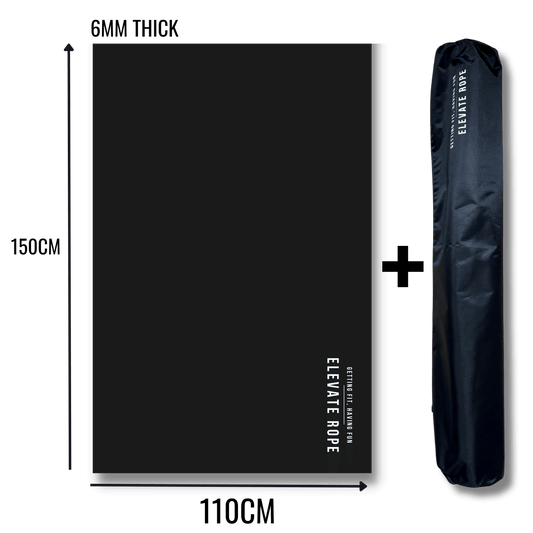
Surface matters for both. The NHS lists running or jumping on hard surfaces as a cause of shin splints. An Elevate jump rope mat gives you a consistent landing and protects the cable.
Start slow and learn the form. Too much too soon hurts on either. With sensible progression, rope is more forgiving than its reputation. That matters, because cardio for busy people only works if you can repeat it week after week.
3. Accessibility: cardio for busy people has to fit real life
Picture this. You have 20 minutes between calls. It's raining. The gym is across town. A run probably isn't happening. A rope session is.
All you need is a rope, 2x2 metres of floor and a surface to land on. A living room, garage, hotel room or patio all work. Weather stops mattering. There's no warm-up mile before the real work starts.
That's the core of cardio for busy people: fewer steps between deciding to train and actually training.

4. Cost of gear: shoes vs rope
Running looks free, but it isn't. Running shoes wear out with mileage and need replacing. Add weather layers, lights for dark evenings and a phone armband, and it adds up.
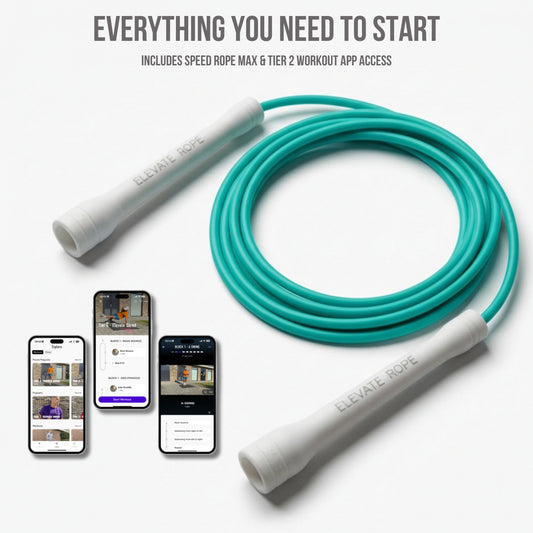
An Elevate rope costs €29.95 to €39.95. The handles carry a lifetime warranty, and every rope has a 90-day guarantee. A jump rope mat is optional, and worth it on hard floors. There's no mileage-based upgrade cycle and no weather gear. Low, one-off gear cost is part of what makes a rope good cardio for busy people. If you're new, our beaded ropes are the easiest place to start.
5. Full-body work: runner or jumper?
Running is mainly lower body. Quads, hamstrings, calves and glutes do the work, with some core stabilisation.
Jump rope spreads the load. Shoulders and forearms control the rope. Your core holds your posture. Calves and glutes drive every jump. And your brain handles timing, coordination and rhythm on every turn.
The skills add variety. Crossovers bring in the upper body. Double unders test your core and timing. Side swings load the shoulders. More on this in jump rope, the underrated cardio king.
It's cardio with a skill layer. That skill keeps sessions interesting, and interesting sessions are the ones you repeat. Variety like that is underrated in cardio for busy people.
6. Travel: cardio for busy people that moves with you
To run, you need decent weather, a safe route and time to warm up and cool down. You also need to pack your running shoes.
Now picture a city you don't know, rain outside, and 35 minutes before a meeting. The run is off.
A rope fits in your carry-on. It needs 2x2 metres and 10 to 20 minutes. Indoors, the weather doesn't matter. Pack it coiled, as in how to store a jump rope, and it arrives ready. For anyone who travels, this is where cardio for busy people gets decided.

7. The verdict: the best cardio for busy people
- Calories per minute: close, and set by your pace on both.
- Joint load: different, and the surface matters for both.
- Portability: jump rope.
- Gear cost: jump rope.
- Full-body work and skill: jump rope.
- Long, steady endurance: running.
- Travel and weather: jump rope.
If you want cardio that fits around your day, builds coordination and travels with you, the rope wins. If you love long runs, keep them. Many people do both. But if you're choosing one cardio for busy people, choose the rope.
Start today with Elevate14
Not sure where to begin? Elevate14 is our free 14-day jump rope challenge. The follow-along videos are on Geraldo's YouTube channel. No gym and no experience needed.
Here is the full Elevate14 playlist. Press play on day one.
Frequently Asked Questions
What is the best cardio for busy people?
For most busy people, jump rope. It needs 2x2 metres of floor, no route and no weather check. Minute for minute it burns about the same as running at a similar effort. The real saving is the time around the workout. That makes it the easiest cardio for busy people to repeat.
Is jump rope better than running for busy people?
Usually, yes, on convenience. Calories per minute are close. Harvard Health lists 421 calories for fast rope over 30 minutes at 155 lb. A 10-minute mile burns 360. Rope wins on travel, weather and gear cost. Running wins for long, steady endurance.
Is jump rope easier on the joints than running?
It's different, not impact-free. Jump rope is low-intensity plyometrics: small hops on the balls of your feet, with both feet landing together. You also control the surface. Hard surfaces raise shin splint risk for runners and jumpers alike, so a mat helps.
How much space do I need to jump rope at home?
About 2x2 metres of floor, plus enough ceiling height for the rope to pass overhead. A living room, garage, hotel room or patio all work. On hard floors, a mat protects your rope and gives a consistent landing. That small footprint is why it suits cardio for busy people.
Is 15 minutes of jump rope enough cardio for busy people?
It's a solid session, especially with intervals. At 155 lb, 15 minutes of fast jumping burns roughly 210 calories on Harvard Health's figures. That's less than a 30-minute run. But a 15-minute session you actually do beats a longer one you keep skipping.
Geraldo Alken is the founder and CEO of Elevate Rope. He designs jump ropes and works daily with jumpers from beginner to professional.
You May Also Like
- Cost Breakdown: Jump Rope Gear vs Gym Membership
- Best Full-Body Jump Rope Workouts to Replace the Gym
- Jump Rope vs Gym: What's the Best Workout for Busy People?
- Top 5 Cardio Jump Rope Home Workouts
- Can You Lose Belly Fat Jump Roping Every Day?