






You hate cardio because your brain is wired to reject repetitive, purposeless movement — not because you lack discipline. Research in exercise psychology shows that boredom is the single most cited reason people quit cardiovascular exercise, and traditional options like treadmills and steady-state running are specifically designed in ways that trigger disengagement and time distortion.
What you'll learn in this article:
- The neuroscience behind why cardio feels like torture for some people
- Why the treadmill — literally invented as prison punishment — triggers dread
- The difference between mindless and skill-based cardio
- How PE class trauma and identity beliefs keep you stuck
- What exercise science says actually works for people who hate cardio
- A cardio approach that people describe as the first one they don't hate
Your Brain Isn't Broken — It's Bored
The reason you hate cardio has less to do with willpower and more to do with neuroscience. Your brain requires cognitive engagement to sustain voluntary effort. When an activity provides no skill challenge, no feedback, and no novelty, your brain enters a state that psychologists describe as "temporal distortion through disengagement." Time slows down. Discomfort amplifies. Every second feels like punishment.
This is exactly what happens on a treadmill. Your body moves, but your brain has nothing to grab onto. There's no timing to learn, no rhythm to chase, no progression to track. The result is a psychological experience that feels dramatically worse than the physical effort warrants. Studies suggest that treadmill running feels harder than outdoor running at the same intensity, largely because of this cognitive vacuum.
If you've ever watched the clock during a treadmill session and thought "that was only three minutes?" — your brain wasn't failing you. It was accurately reporting that it was starving for stimulation.
Why Boredom Kills Consistency
Exercise adherence research consistently identifies boredom as the primary driver of dropout. People don't quit because workouts are hard. They quit because workouts are boring. A review of exercise psychology literature found that perceived enjoyment is the strongest predictor of long-term exercise adherence — stronger than perceived health benefits, social pressure, or even visible results.
This creates a painful cycle for people who hate cardio : you know it's important, you force yourself through it, the experience is miserable, you associate cardio with suffering, and the dread compounds until you stop entirely. The guilt follows. Then the resolution to try again. Then the same miserable experience. Repeat indefinitely.
Answer Block: Why Do People Hate Cardio ?
Short answer: Most people hate cardio because traditional forms like treadmills and steady-state running fail to engage the brain, triggering boredom, time distortion, and negative psychological associations that compound with each session.
Why it matters: Boredom is the number one reason people quit exercise entirely. Forcing yourself through activities your brain rejects doesn't build discipline — it builds dread. Understanding this frees you to seek forms of cardio that work with your neurology instead of against it.
Best next step: Stop blaming yourself and start evaluating whether your cardio method provides enough cognitive engagement to hold your attention.

The Treadmill Was Literally Invented as Prison Punishment
This isn't a metaphor. The treadmill was invented in 1818 by Sir William Cubitt as a punishment device in British prisons. Inmates would spend hours walking on massive wooden tread wheels — running in place, going nowhere, staring at the same wall. The device was explicitly designed to be monotonous and soul-crushing. It was so brutal that it was eventually banned as inhumane.
And somehow, this became the default tool for cardiovascular fitness.
The modern treadmill is obviously different in mechanics, but the psychological experience is strikingly similar: repetitive motion, no destination, no engagement, watching time crawl. When people describe the treadmill as a "dreadmill" or a "glorified hamster wheel," they're articulating a genuine neurological experience. Research shows 42% of runners actively dislike treadmill running, with boredom cited as the primary reason.
If you hate cardio and your primary exposure has been treadmills, ellipticals, and stationary bikes, you haven't actually experienced the full spectrum of cardiovascular exercise. You've experienced the most psychologically punishing forms of it.
The "Just Push Through It" Myth
The conventional advice for people who hate cardio is some variation of "just push through." Add a playlist. Watch Netflix on the treadmill. Find a running buddy. Try a new podcast.
None of these address the root cause. You're still doing repetitive, purposeless movement — you're just adding a distraction layer on top of the misery. The experience underneath remains the same. Your brain is still disengaged from the activity itself, and every coping mechanism eventually loses its novelty.
The people who say they "learned to love running" are often describing a genuine neurological difference in how their brains process rhythmic motion — not a moral achievement you're failing to replicate. For a large percentage of the population, the runner's high never materializes. The promised meditative state never arrives. The internal monologue during a treadmill session remains some version of: "I hate this. I hate this. I hate this."
If that sounds familiar, you're not alone. And you're not broken.

Five Hidden Reasons You Hate Cardio (That Nobody Talks About)
1. PE Class Trauma Left a Mark
For many people, the hatred of cardio traces back to childhood. Specifically, to mile run day in PE class. Being the slowest kid, gasping for air while classmates watched from the finish line with their orange slices, created an association between cardiovascular effort and public humiliation. This isn't trivial — those experiences wire your nervous system to interpret cardio as a threat.
Exercise psychology research documents this as "exercise-induced anxiety" rooted in early negative experiences. You're not just hating cardio as an adult — your body is remembering the shame of being watched, struggling, and falling behind.
2. You've Internalized a False Identity
After enough failed attempts, many people adopt "I'm just not a cardio person" as a core identity belief. This feels protective — if cardio isn't "your thing," the failure to stick with it becomes a preference rather than a problem. But it's based on a false premise: that "cardio" means running, cycling, or machine-based endurance work.
In reality, cardiovascular exercise is any activity that elevates your heart rate. Dancing, swimming, martial arts, and jumping rope are all cardio. The identity of "not a cardio person" often just means "not a treadmill person" — which is entirely reasonable.
3. Your Cardio Lacks a Skill Component
This is the most underappreciated factor. Activities with a skill-learning component activate your brain's reward pathways in ways that pure endurance work does not. When you're learning a new movement pattern — timing a jump, mastering a boxing combination, coordinating a dance step — your brain releases dopamine in response to incremental progress.
Treadmills, ellipticals, and stationary bikes offer zero skill progression. You're doing the same motion at minute one and minute thirty. There's nothing to learn, nothing to master, and therefore nothing for your brain to reward. This is why people with ADHD or high novelty needs particularly hate cardio — their brains require even more stimulation than average to sustain attention on a task.
4. You're Comparing Yourself to Runners
Social comparison compounds the problem. When everyone around you seems to love running, your inability to enjoy it feels like a character flaw. Social media amplifies this — marathon finisher posts, sunrise jog photos, and "best run ever!" captions create the impression that everyone except you has found cardio bliss.
The reality is that a substantial portion of people who run regularly don't enjoy it. They tolerate it. They endure it. They've simply normalized the suffering in a way that you haven't — and that's not necessarily something to aspire to.
5. Traditional Cardio Doesn't Respect Your Time
If you already strength train, adding 30–45 minutes of treadmill work feels like a tax on your real workout. The efficiency problem is genuine: conventional cardio recommendations suggest 150 minutes per week of moderate activity. That's over two hours of doing something you despise — no wonder so many people hate cardio enough to skip it entirely.
This is where exercise science offers good news. Research from Arizona State University found that 10 minutes of jump rope provides cardiovascular benefits comparable to 30 minutes of jogging. Not all cardio demands the same time investment — but the options that respect your time tend to be the ones requiring skill and intensity rather than duration.
Answer Block: Hidden Reasons Behind Cardio Hatred
Short answer: Childhood PE trauma, false identity beliefs, lack of skill engagement, social comparison, and poor time efficiency are the five most common hidden drivers behind chronic cardio avoidance.
Why it matters: Most people blame themselves for hating cardio, but the root causes are environmental and psychological — not character flaws. Addressing the actual barriers rather than doubling down on willpower is the path to sustainable cardiovascular fitness.
Best next step: Identify which of these five factors resonates most with your experience, then seek cardio methods that specifically address that barrier.
What Actually Works for People Who Hate Cardio
If traditional cardio triggers dread, the solution isn't more willpower. It's finding movement that works with your brain instead of against it. If you hate cardio, you don't need to force yourself harder — you need a different approach entirely. Exercise science identifies several characteristics that make cardiovascular activities sustainable for people who hate cardio.
Skill-Based Movement Over Mindless Repetition
Activities requiring coordination, timing, and technique keep your brain engaged because there's always something to improve. This is why martial arts practitioners, dancers, and jump rope enthusiasts rarely complain about cardio boredom — the skill component transforms the experience from endurance into play.
Jump rope is a particularly strong example. What neuroscientists call "active attention" — the forced focus required to coordinate timing, rhythm, and foot placement — leaves no cognitive space for clock-watching. You can't zone out because missing a beat means tripping. This is the opposite of the treadmill experience, where zoning out is the entire problem.
If you've been looking for cardio alternatives that don't feel like traditional cardio, skill-based options should be at the top of your list.
Short Duration, High Engagement
Time efficiency directly correlates with adherence for people who hate cardio . When an activity delivers results in 10–15 minutes instead of 30–45, the psychological barrier shrinks dramatically. Research supports this: high-intensity, skill-based cardio provides comparable cardiovascular adaptation in a fraction of the time required by steady-state exercise.
This doesn't mean every workout needs to be short. It means that when you're building a cardio habit from zero, starting with something achievable — 10 minutes you can actually complete without dread — builds consistency faster than ambitious plans you abandon.
Privacy and Low Judgment Environments
For people carrying PE trauma or gym anxiety, the ability to practice at home matters enormously. Research indicates that 28% of women experience significant gym anxiety, and the fear of looking uncoordinated while learning a new activity prevents many people from starting.
Home-friendly cardio removes this barrier entirely. You can fail, trip, and look ridiculous in your living room without anyone watching. By the time anyone sees you exercise, you've already built competence and confidence. For a complete overview of effective home cardio options that require almost no equipment, we've put together a dedicated guide.
Built-In Progress and Variety
Activities with visible skill progression keep you coming back because your brain receives regular dopamine rewards for improvement. This is the same mechanism that makes video games addictive — clear feedback, incremental challenge, and a sense of mastery.
Jump rope leverages this naturally. Basic bounce leads to boxer step. Boxer step leads to crossovers. Crossovers lead to double-unders. Each skill unlocked creates a new challenge, and the variation across footwork patterns, speed intervals, and weighted progressions means the experience never stagnates. People who describe getting "addicted" to jump rope are describing this neurological progression loop.
Answer Block: Cardio That Works for Cardio Haters
Short answer: Skill-based, time-efficient, home-friendly cardio with built-in progression is the most effective approach for people who hate traditional cardiovascular exercise.
Why it matters: The characteristics that make traditional cardio miserable — repetition, duration, boredom, public exposure — are design features, not universal requirements. Cardiovascular fitness can be built through activities that provide cognitive engagement, rapid feedback, and genuine enjoyment.
Best next step: Choose one skill-based cardio activity and commit to 10 minutes daily for two weeks before evaluating whether it works for you.
Why Jump Rope Specifically Works for People Who Hate Cardio
Among skill-based cardio options, jump rope addresses the specific neurological and psychological triggers behind cardio hate more directly than almost any alternative.
It Forces Active Attention
The coordination required to jump rope — timing the rotation, matching your jump to the rope's arc, placing your feet correctly — creates what neuroscientists call a "flow state entry point." Your brain can't wander because the task demands presence. This is the direct opposite of the treadmill's cognitive vacuum.
People who have never experienced flow during exercise often find it for the first time with jump rope. The rhythm becomes almost meditative — not because you're zoning out, but because you're so locked in that the mental chatter stops.
Time Compression Instead of Time Distortion
While treadmills make 10 minutes feel like 30, jump rope makes 10 minutes feel like 3. The cognitive engagement compresses your perception of time rather than stretching it. This single shift transforms cardio from something you endure to something that's over before you're ready to stop.
Auditory Feedback Creates Natural Rhythm
Beaded jump ropes add another sensory dimension. The sound of beads hitting the ground creates a rhythmic metronome that helps your brain anticipate each rotation. This auditory feedback system teaches timing subconsciously — your brain learns when to jump before your eyes can process the rope's position. For beginners especially, this makes learning dramatically faster and more intuitive.
The Elevate Dignity Beaded Rope uses this auditory timing system with a 3.5mm polycord — 17% thicker than the industry standard — to deliver clear tactile and sound feedback that accelerates the learning curve for people who've never jumped rope before.
10 Minutes Equals 30 Minutes of Jogging
The time efficiency is supported by research. Arizona State University data suggests 10 minutes of jump rope provides cardiovascular benefits comparable to 30 minutes of jogging. For someone who already resents spending time on cardio, getting equivalent results in a third of the time changes the equation entirely.
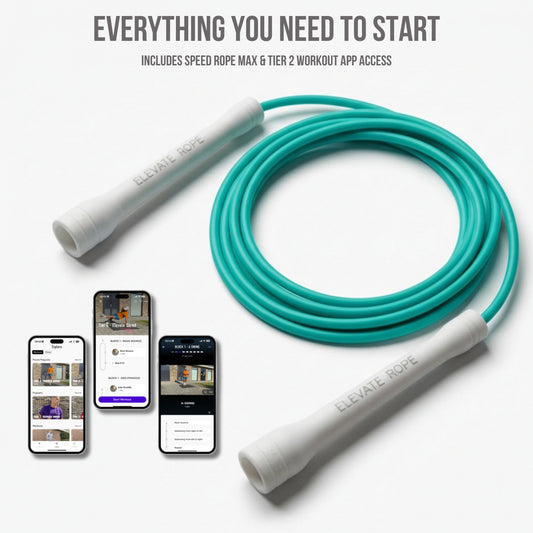
Combined with the fact that every rope comes with free access to the Elevate App — featuring 100+ guided workouts with no subscription fees — the barrier to starting and sticking with it is as low as it gets. For context on how jump rope stacks up against running across multiple dimensions, our detailed comparison breaks down calories, joint impact, time efficiency, and more.
How to Start When You've Always Hated Cardio
If you've identified with everything in this article, here's a practical starting framework designed specifically for people who hate cardio.
Week 1–2: The Two-Minute Test
Don't commit to a workout program. Commit to two minutes. Pick up a rope, jump for two minutes, and observe how you feel. Not how many calories you burned or how high your heart rate got — how you felt during those two minutes. Did time drag? Or did it pass surprisingly fast? Most people report the latter.
Week 3–4: Build to Ten Minutes
If the two-minute test produced a different experience from your usual cardio dread, gradually extend to 10 minutes. Use interval formats: 30 seconds of jumping, 30 seconds of rest. The rest intervals give you micro-recoveries that prevent the grinding endurance suffering that makes people hate cardio in the first place.
Week 5+: Explore the Skill Tree
Once basic jumping feels comfortable, start exploring footwork variations. Boxer step, high knees, side swings, criss-crosses. Each new skill introduces novelty that keeps your brain engaged — which is the entire mechanism that makes this sustainable.
For a complete, structured approach to your first 30 days, our complete guide to jump rope for home cardio walks through everything from sizing your rope to building a progression plan that works specifically for people starting from zero.

Frequently Asked Questions (Quick Answers)
Is it normal to hate cardio ?
Completely normal. Boredom with repetitive cardiovascular exercise is the most commonly reported reason for exercise dropout across all demographics. If you hate treadmills, stationary bikes, or running, you share that experience with a significant portion of the population. The problem isn't you — it's the mismatch between your brain's need for engagement and the activity's failure to provide it.
Can I get fit without doing traditional cardio?
Yes. Cardiovascular fitness improves through any activity that elevates your heart rate sufficiently. Jump rope, martial arts, dancing, swimming, rowing, and circuit training all develop cardiovascular capacity without requiring treadmill time. The key is finding an activity you'll actually do consistently, not the theoretically optimal one you'll avoid.
Is hating cardio genetic?
Partly. Research suggests that some people have a genuine neurological predisposition toward finding repetitive endurance exercise less rewarding. Variations in dopamine receptor sensitivity may influence how much enjoyment you derive from activities like running. However, this doesn't mean you're destined to hate all cardiovascular exercise — just that you may need more stimulating forms of it.
How can I make myself like cardio?
Stop trying to like the cardio methods that don't work for you. Instead, explore activities that provide skill learning, rhythm, or social interaction. Jump rope, boxing, dance-based workouts, and sport-specific training all deliver cardiovascular benefits through engagement rather than endurance. The goal isn't forcing enjoyment — it's finding the form that naturally produces it.
Why does 10 minutes on the treadmill feel like an hour?
Temporal distortion through disengagement. When your body moves but your brain has no challenge to focus on, your perception of time stretches dramatically. This is a documented neurological phenomenon, not a personal failing. Activities requiring coordination and timing compress time perception instead of stretching it.
Is jump rope hard to learn?
The basic bounce takes most people one to two weeks to feel comfortable with. Beaded ropes specifically accelerate the learning curve because the auditory feedback — the sound of beads hitting the ground — helps your brain anticipate timing. Starting with short intervals (30 seconds on, 30 seconds rest) makes the learning process manageable regardless of fitness level.
Can jump rope replace running entirely?
For cardiovascular fitness, yes. Research from Arizona State University suggests 10 minutes of jump rope provides comparable cardiovascular benefits to 30 minutes of jogging. Jump rope also develops coordination, agility, and bone density that running doesn't address. The only scenario where running is superior is if you're specifically training for a running event.
What if I trip constantly and feel uncoordinated?
Everyone trips at first. Jump rope is a skill with a learning curve, and the initial coordination challenge is part of what makes it effective — your brain engages because it has to. Using a beaded rope provides more feedback than a speed rope, making timing easier to learn. Practicing at home removes the judgment factor entirely.
How often should I do cardio if I hate it?
Start with whatever frequency you'll actually maintain. Even 10 minutes three times per week provides meaningful cardiovascular benefit. Consistency at low volume beats ambitious plans you abandon. Once you find a form you don't dread, increasing frequency happens naturally.
Will I always hate cardio ?
Not if you find the right form. Many people who spent years hating cardio discovered they only hated specific types of it. The shift from "I hate cardio " to "I hate treadmills" is the breakthrough that unlocks everything. Once you find movement that engages your brain, the dread disappears — and sometimes genuine enjoyment takes its place.
Stop Blaming Yourself. Start Finding What Works.
If you've spent years believing you're broken because you hate cardio , this article should offer some relief. The problem was never your discipline, your character, or your fitness level. The problem was a mismatch between your brain's needs and the activities you've been forcing yourself through.
Cardiovascular fitness is non-negotiable for long-term health. But the method is entirely up to you. And for thousands of people who thought they'd never find cardio they could tolerate — let alone enjoy — the answer turned out to be a piece of equipment that costs less than a single month of gym membership and fits in a backpack.
Ready to find out if you're one of them? Explore the complete guide to jump rope for home cardio and discover the running alternative that thousands of former cardio haters now swear by.
Sources
The exercise psychology and neuroscience principles in this article draw from established research in the following areas:
Exercise adherence and dropout research examining boredom as the primary predictor of cessation. (Source: American College of Sports Medicine position statements on exercise adherence)
Temporal distortion and perceived exertion studies comparing treadmill versus outdoor and skill-based exercise modalities.
Treadmill historical origins documented in prison reform literature dating to Sir William Cubitt's 1818 design for Brixton Prison.
Cardiovascular equivalence research from Arizona State University comparing jump rope and jogging for heart rate adaptation.
Flow state psychology research examining cognitive engagement requirements for sustained voluntary physical effort. (Source: Csikszentmihalyi, M. — Flow: The Psychology of Optimal Experience)
Gym anxiety prevalence data from Sport England's Active Lives Survey examining barriers to exercise participation.