






For office workers weighing up jump rope vs. walking, the short answer is that both beat sitting—but they solve very different problems. Walking is the easier daily habit; jump rope delivers three to four times more cardiovascular benefit per minute and is the only option that actively reverses the structural damage that desk work causes to your posture, metabolism, and joints. If you only have 10 minutes before or after work, jump rope wins on every measurable metric. If you want a low-effort movement habit you can layer on top of your existing routine, walking earns its place too. Most office workers end up needing both—and understanding exactly why makes it easier to decide where to start.
The comparison feels obvious on the surface. Walking is something humans have done for millions of years. Jump rope is a piece of equipment that most people associate with boxers or childhood playgrounds. But the physiology tells a different story. Office work—specifically the accumulated effect of sitting for seven to nine hours a day—creates a specific type of damage: shortened hip flexors, weakened glutes, compressed spinal discs, reduced bone density, and a metabolic rate that barely ticks above resting. Walking helps, but at a MET (Metabolic Equivalent of Task) of roughly 3.5, it simply does not generate the intensity needed to reverse these adaptations. Jump rope, at a MET of 11.8 even at a moderate pace, does.
This article breaks down the science behind both options—calories burned, time requirements, joint impact, muscle engagement, and the specific conditions each one addresses. By the end, you will know exactly which to prioritise for your situation and how to make both work inside a desk worker's schedule.
What you'll learn in this article:
The real calorie burn difference between jump rope and walking per minute and per sessionWhy walking alone cannot fully reverse the structural damage of prolonged sittingThe specific desk-worker conditions that jump rope addresses and walking cannotHow to fit both activities into a realistic workday scheduleWhich rope to start with if you have never exercised beforeA practical 10-minute jump rope protocol designed for desk workers
The Calorie Math: What 10 Minutes Actually Burns
This is where the comparison starts, because calorie burn is what most office workers care about when they are evaluating cardio options. The numbers are more dramatic than most people expect.
A 70 kg person walking briskly at 5.5 km/h burns approximately 40 to 50 calories in 10 minutes. The same person jumping rope at a moderate pace—nothing fancy, just consistent single-bounce jumps—burns 120 to 130 calories in those same 10 minutes. That is roughly a 3:1 ratio in favour of jump rope, and it holds across different body weights. For a 80 kg person, those numbers shift upward proportionally, but the ratio remains consistent.
Research from Arizona State University, published in the Research Quarterly for Exercise and Sport, found that 10 minutes of daily jump rope training improved cardiovascular fitness as effectively as 30 minutes of jogging per day over a six-week period. That equivalence has been replicated across multiple studies and is one of the most frequently cited statistics in jump rope research—for good reason. It reframes the time conversation entirely. When an office worker says "I don't have 30 minutes," jump rope makes that objection irrelevant.
How the Numbers Stack Up Side by Side
| Activity | Duration | Approx. Calories (70 kg person) | MET Score | Equipment Needed |
| Brisk walking | 10 min | 40–50 kcal | 3.5–4.3 | None |
| Jump rope (moderate) | 10 min | 120–130 kcal | 11.8 | Jump rope + ~2m² space |
| Walking (30 min total) | 30 min | 120–150 kcal | 3.5–4.3 | None |
| Jump rope (10 min HIIT) | 10 min | 140–160 kcal | 12.3+ | Jump rope + ~2m² space |
| Under-desk treadmill walk | 30 min | 95–100 kcal | ~2.5 | Treadmill (€400–1,200) |
| Yoga / desk stretches | 10 min | 25–35 kcal | 2.3–3.0 | None |
Walking still matters—particularly as what researchers call NEAT (Non-Exercise Activity Thermogenesis), the low-intensity background movement that makes up a significant portion of your daily energy expenditure. Studies show NEAT can vary by up to 2,000 calories per day between highly active and highly sedentary individuals, which is why keeping your step count up throughout the day genuinely contributes to weight management. But NEAT-style walking is not structured exercise—it is background movement. For actual cardiovascular adaptation and reversal of sitting damage, you need structured intensity, and that is where jump rope earns its place.
Short answer: Jump rope burns approximately 3 times more calories per minute than brisk walking—making a 10-minute rope session equivalent in calorie terms to a 30-minute walk.
Why it matters: For office workers with 10 to 15 minutes of free time before or after work, the calorie gap between these two activities is the difference between meaningful cardiovascular benefit and maintenance-level movement. Time is the constraint; intensity is the solution.
Best next step: Start with the Speed Rope MAX if you have any prior fitness base, or the Dignity Beaded Rope if you are starting from scratch—the auditory feedback makes rhythm far easier to find.

The Problem Walking Cannot Fully Solve
Walking is genuinely good for you. This is not a piece designed to dismiss it. A 2024 study published in the Journal of the American Medical Association found that people who predominantly sit at work carry a 16% higher risk of all-cause mortality and a 34% higher risk of cardiovascular disease mortality compared to those who do not sit most of the day. Walking and light movement break up the cortisol-and-insulin cascade that prolonged sitting triggers, and the research is consistent on this point.
But there is a category of damage that walking at a mild-to-moderate intensity does not reverse. A brisk walk at 5.5 km/h barely gets your heart rate above 100–110 BPM for most adults. It does not generate the EPOC (Excess Post-Exercise Oxygen Consumption) effect that keeps your metabolism elevated for one to two hours after a session. It does not produce the impact forces that stimulate bone remodelling. And critically, it does not fire the posterior chain muscles—glutes, hamstrings, spinal erectors—in the coordinated, rapid way needed to counteract the chronic weakening caused by sitting.
The Specific Damage Desk Workers Accumulate
Prolonged sitting creates a predictable set of adaptations, most of which are invisible until they become painful. Hip flexors shorten and tighten because they remain in a compressed position for hours. The glutes develop what researchers casually call "gluteal amnesia"—they stop firing correctly because the nervous system learns that sitting requires them to switch off. The anterior core weakens, the thoracic spine stiffens into a kyphotic curve, and intervertebral discs experience chronic compression that reduces their ability to absorb load.
Separate from the musculoskeletal picture, bone density begins to decline when impact-loading exercise is absent. This is particularly relevant for desk workers who commute by car or public transport, work remotely, and whose only structured activity might be a daily walk. Bone remodelling requires mechanical stress through impact—the kind that walking at low intensity generates only minimally. Jump rope, by contrast, is classified as a weight-bearing impact exercise, the category with the strongest evidence for bone density maintenance and improvement.
None of this makes walking bad. It makes walking insufficient as a standalone solution for office workers dealing with the accumulated structural consequences of sitting. You need both: low-level NEAT movement throughout the day (walking, standing, short breaks every 30–45 minutes) and at least one short session of structured, higher-intensity movement that actually loads the tissues and cardiovascular system. Jump rope is the most time-efficient way to deliver that second component. Read more on how to build a complete desk worker fitness plan using jump rope.

What Jump Rope Fixes That Walking Does Not
The comparison between jump rope and walking for office workers is best understood through the lens of specificity: what does each activity actually do to the body, and how well does that match what a desk worker needs?
Full-Body Muscle Engagement
Walking primarily recruits the hip flexors, quadriceps, and calves. Jump rope recruits all of those plus the shoulders, forearms, wrists, upper back, and core—simultaneously. Every single jump requires a coordinated bracing of the trunk and a rapid triple extension through the ankle, knee, and hip that is almost entirely absent from walking. For desk workers whose upper body spends eight hours in a rounded, internally rotated position, this full-body demand is significantly more useful than the lower-body-dominant pattern of walking.
Posterior Chain Activation
Jumping requires the glutes, hamstrings, and spinal erectors to fire rapidly and repeatedly. This directly counteracts gluteal amnesia. Within two to three weeks of consistent jump rope practice, most desk workers report noticeably less lower back tension—not because the rope "treats" back pain, but because the muscles that were switched off by sitting are being switched back on by the dynamic demands of jumping. For a deeper look at the back pain picture specifically, see the article on desk job back pain exercises that actually work.
Cardiovascular Intensity and EPOC
Walking at a comfortable pace produces minimal EPOC. Your metabolic rate returns to baseline within minutes of stopping. Jump rope at moderate-to-high intensity elevates your metabolic rate for 60 to 90 minutes post-session through the EPOC mechanism. For an office worker who jumps rope for 10 minutes before logging on, that means their metabolism is running elevated for the first couple of hours of the workday—a compound benefit that a lunchtime walk simply cannot produce.
Coordination and Brain Engagement
One of the less obvious benefits of jump rope for desk workers is the cognitive demand. Rope jumping requires bilateral coordination, rhythm, and spatial awareness. Emerging research on exercise and cognitive function suggests that activities requiring motor coordination produce stronger acute cognitive benefits—improved focus, processing speed, and working memory—compared to low-intensity steady-state activities like walking. This matters a lot for people whose work requires sustained concentration. The 10 minutes before a difficult meeting or a deadline is not wasted on jump rope—it is preparation for sharper thinking.
Short answer: Jump rope activates the posterior chain, generates EPOC, loads bones, and engages upper body muscles—none of which walking accomplishes at meaningful intensity for most office workers.
Why it matters: Desk workers do not just need to burn calories. They need to reverse specific structural adaptations caused by prolonged sitting. Only higher-intensity, full-body exercise achieves this in the time windows available to most working adults.
Best next step: Start with 5 minutes per day and build to 10. The Beaded Rope is the easiest starting point—it is forgiving on misses and the rhythmic sound helps beginners find their timing.

Where Walking Has the Advantage
Being honest about what walking does well is important for making a sustainable decision, not just an exciting one. There are several scenarios where walking clearly wins for office workers, and ignoring them leads to all-or-nothing thinking that rarely ends well.
Accessibility and Barrier to Entry
Walking requires nothing. No equipment, no dedicated space, no learning curve. You step outside or pace your living room and you are doing it correctly. Jump rope has a brief learning curve—particularly for people who have not jumped rope since childhood. The coordination clicks faster than most beginners expect (typically within three to five sessions with the right equipment), but that initial awkward phase is a genuine barrier that walking does not have. If you are at absolute ground zero and the thought of tripping over a rope is enough to stop you before you start, a walking habit is the better first move—and you can add jump rope once you have momentum.
Injury and Joint Sensitivity
Jump rope done with good form on appropriate surfaces is low-impact—the landing is controlled and the foot touches down gently rather than with the heel-strike mechanics of running. However, if you are currently dealing with an acute knee, ankle, or hip issue, walking is the safer choice. Proper jump rope form is learnable, but it requires some initial attention, and jumping through pain is always a mistake. Once the acute issue resolves, returning to jump rope is straightforward. For a definitive breakdown of the joint question, the article on whether jump rope is bad for knees covers the research in detail.
Daily NEAT and Step Count
Walking wins decisively when it comes to filling your day with low-level movement. A 10-minute jump rope session addresses structured exercise. The other 14 waking hours still need movement, and walking—to get coffee, to take calls on your feet, to walk around the block at lunch—is how you fill that gap. A Columbia University study found that five minutes of light walking every 30 minutes reduced blood sugar spikes by nearly 60% in sedentary adults. That is not a jump rope protocol. That is a walking-throughout-the-day protocol, and it matters enormously for metabolic health in desk workers.
The conclusion here is not complicated: for structured cardio sessions where you are investing dedicated time and want the maximum return per minute, jump rope is the better choice for office workers. For reducing sedentary time throughout the workday and maintaining daily movement, walking is indispensable and jump rope cannot replace it. Use both.

A Realistic Desk Worker Protocol Using Both
The question of jump rope vs. walking for office workers is most usefully answered with "in what context"—and here is how both fit into a realistic week for someone with a standard 9-to-5 schedule and limited discretionary time.
The 10-Minute Morning Jump Rope Block
The most effective jump rope slot for desk workers is the morning, before the day has a chance to crowd out the intention. This does not require a formal "workout." You need two square metres of floor space, appropriate footwear, and a rope. The session structure that works best for beginners is 30 seconds of jumping followed by 30 seconds of rest, repeated for 10 rounds. That is 10 minutes total, 5 minutes of actual jumping, and enough intensity to generate EPOC and activate the posterior chain before you open your laptop. The Dignity Beaded Rope is the best starting point—the weight gives you feedback on where the rope is and the rhythm is forgiving for beginners. As you progress, the Speed Rope MAX opens up more variety and intensity.
Walking as the Background Layer
The rest of your movement day should be built around deliberate interruptions to sitting. Every 30 to 45 minutes, stand up. Walk to the kitchen, walk around the building, take phone calls on your feet. The cumulative effect of 4,000 to 6,000 steps accumulated this way—on top of your structured jump rope session—produces a markedly different metabolic profile than a single 8,000-step walk at lunchtime with seven hours of uninterrupted sitting on either side.
The Honest Time Comparison
| Protocol | Time Required | Cardio Benefit | Sitting Damage Reversed | Realistic for Office Workers? |
| 10-min jump rope + movement breaks | 10 min structured | High | Yes | Yes |
| 30-min daily walk only | 30 min structured | Moderate | Partial | Often not (commute + work + life) |
| Walking breaks only (no structured session) | Spread through day | Low | Minimal | Yes |
| 10-min jump rope + 30-min walk | 40 min total | Very High | Yes | On good days |
If you can only pick one—if the choice genuinely has to be binary—jump rope wins for office workers based purely on return per minute invested. The Elevate 26 Challenge is a free 26-day programme specifically designed for people starting from zero, and it is built on exactly this kind of 10-minute-a-day structure. The free Elevate App includes 100+ guided workouts that require nothing beyond your rope and 10 minutes of space—versus competitor apps that charge up to €150 per year for the equivalent content.
Short answer: 10 minutes of jump rope plus movement breaks throughout the day outperforms a 30-minute walk plus prolonged sitting on every relevant health metric for desk workers.
Why it matters: Office workers are time-constrained, not lazy. The protocol that works is the one that can actually be sustained within the constraints of a full working day.
Best next step: The Ascent Bundle gives you the Beaded Rope and Speed Rope MAX together so you can start at whatever level is right for you today and progress when you are ready—without buying a second rope later.

Choosing the Right Rope If You Are Starting from a Desk Job
The biggest mistake new jump rope users make is buying the wrong rope for their level and quitting because the experience is frustrating rather than rewarding. Here is the honest breakdown for office workers at different starting points.
If you have not exercised in more than six months, the Dignity Beaded Rope is the right choice. The beads create an audible "tick tick tick" on each rotation that serves as an external rhythm cue, making it far easier for your nervous system to find the timing. It is also forgiving when you clip it—the weight allows you to reset quickly without the rope snapping back sharply. The Beaded Rope is adjustable to 3 metres and works for any height.
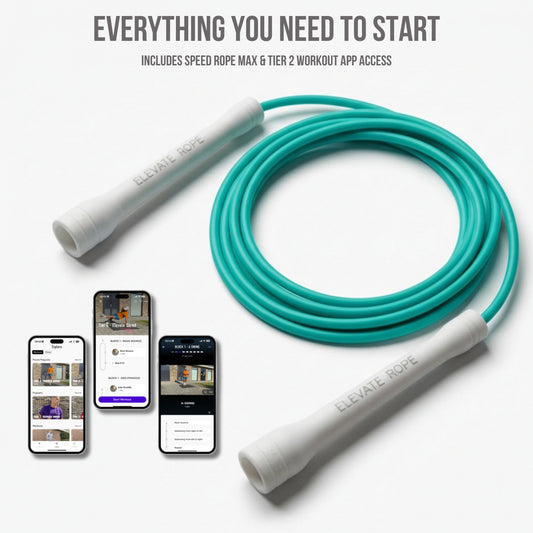
If you have some fitness base—you walk regularly, you have exercised in the past year—the Speed Rope MAX is the right starting point. The faster rotation means you can generate more intensity in a 10-minute window, and the bearing-free design gives you consistent spin without tangling. Elevate's bearing-free approach is a deliberate design choice: the rope moves with your natural rhythm rather than artificially fast, which is particularly useful when you are building the basic bounce for the first time.
If you want the maximum calorie burn and a strength component that addresses desk-worker upper body weakness, the Gravity Heavy Rope adds resistance to every rotation. This makes it the most demanding option and the one best suited to the "I want more intensity, not more time" requirement. A 10-minute session with the Heavy Rope will challenge even fit individuals in a way that 10 minutes of walking never could.
Frequently Asked Questions
Is jump rope better than walking for weight loss if you sit all day?
Yes, for structured sessions. Jump rope burns roughly three times more calories per minute than walking and generates an EPOC effect that keeps your metabolism elevated for up to 90 minutes post-session. For a desk worker with 10 to 15 minutes available, jump rope produces meaningfully more fat loss stimulus. Walking remains valuable as background movement throughout the day—the two are complementary rather than competing.
Can walking alone fix the damage from sitting at a desk all day?
Not fully. Walking at low-to-moderate intensity does not generate sufficient intensity to restore posterior chain strength, stimulate bone remodelling, or produce meaningful EPOC. It reduces blood sugar spikes when done in short breaks throughout the day, which is genuinely valuable, but it does not reverse the musculoskeletal adaptations—shortened hip flexors, weakened glutes, thoracic stiffness—that accumulate from prolonged sitting.
How long should I jump rope each day to offset a desk job?
Research and practical experience both point to 10 minutes as the effective minimum for cardiovascular benefit. The Arizona State University study found 10 minutes of daily jump rope improved cardiovascular fitness as effectively as 30 minutes of jogging per day. For beginners, starting with 5 minutes and building over two to three weeks is more sustainable than jumping straight to 10. Consistency at a lower volume beats occasional longer sessions every time.
Is jump rope bad for your joints if you sit all day and are out of shape?
Jump rope done correctly on appropriate surfaces is low-impact—significantly lower impact than running. The concern about joints typically comes from improper form (landing on the heels or with stiff legs) or inappropriate surfaces (concrete without shoes). On a flat surface with supportive footwear, landing softly on the balls of your feet, jump rope is well-tolerated even by people returning to exercise from a long break. A jump rope mat is recommended for hard floors to further reduce impact. See the full breakdown at Is Jump Rope Bad for Knees?
What is the best time of day for office workers to jump rope?
Morning is the most effective slot for two reasons: it guarantees the session happens before the workday creates competing priorities, and the EPOC effect means your metabolism runs elevated through the first few hours of the workday. That said, any time that is consistent works. Before work, during a lunch break, or immediately after logging off are all viable—the best time is the one you will actually do.
Can I just do walking breaks at work instead of a jump rope session?
Walking breaks throughout the day are valuable and should not be skipped—short breaks every 30 minutes reduce blood sugar spikes significantly and contribute to your total daily movement. But they do not replace a structured cardio session. Think of walking breaks as managing the ongoing damage from sitting; think of jump rope as actively reversing it. You benefit most from doing both rather than treating them as alternatives.
What jump rope should a complete beginner desk worker start with?
The Dignity Beaded Rope is the best starting point for absolute beginners. The weighted beads provide auditory feedback—a rhythmic "tick tick tick"—that makes it much easier to find timing without prior experience. It is also more forgiving when you clip the rope, which will happen in the early sessions and is completely normal. Most people go from clipping every few jumps to consistent 30-second sets within three to five sessions.
Is 10 minutes of jump rope actually enough exercise for someone who sits all day?
As a structured cardio session, yes—10 minutes of jump rope at moderate intensity generates sufficient cardiovascular stimulus to produce meaningful health benefits over time. Combined with regular movement breaks throughout the workday and walking when possible, a 10-minute daily jump rope session puts a desk worker well within the range of the research-backed physical activity recommendations. It is not optimal; it is the effective minimum that fits inside a real working day.
The Bottom Line for Office Workers
Jump rope and walking are not rivals. They address different problems in the desk worker's body and schedule. Walking is the easiest and most accessible way to stay out of prolonged sedentary periods throughout the day. Jump rope is the most time-efficient way to produce actual cardiovascular adaptation and reverse the structural damage that sitting causes. The strongest approach uses both: movement breaks and walking woven through the workday, plus one 10-minute jump rope session that actually loads the system.
If you have been sitting for most of your adult working life and are looking for one thing to add that will make the biggest difference in the least time, the rope wins. The Beaded Rope is the starting point for beginners—its weighted beads give you the rhythm feedback you need to build the basics quickly. The Speed Rope MAX is the natural next step once you have your timing. And the Ascent Bundle gives you both in one purchase, along with access to the free Elevate App and its full library of guided workouts, without the subscription fees that most competitor platforms charge.
The desk job is not going away. The damage it causes does not have to be permanent. Ten minutes a day, a rope that fits in your desk drawer, and a routine that asks nothing of your schedule except showing up—that is the structure. Identity over motivation. The rope is waiting.
Ascent Bundle — Speed Rope MAX + Beaded Rope + Free App
Dignity Beaded Rope — Best for desk worker beginners
Speed Rope MAX — Best for returning exercisers
Sources
- Baker, J.A. (1968). Comparison of rope skipping and jogging as methods of improving cardiovascular efficiency of college men. Research Quarterly for Exercise and Sport. tandfonline.com
- Healthline — Jump Rope vs. Running: How to Choose. healthline.com
- CNN Health — People who mostly sit at work have a 16% higher risk of mortality (2024). cnn.com
- BMC Public Health — Micro-exercise breaks every hour for office workers (2026). link.springer.com
- Columbia University / Weill Cornell — 5-minute walk breaks reduce blood sugar spikes by ~60% (2023). Referenced via CNN Health above.
- Omnicalculator — Jump Rope Calorie Calculator (2024). omnicalculator.com
- PMC — The energy expenditure of using a walk-and-work desk for office workers. pmc.ncbi.nlm.nih.gov
- Herrmann S.D. et al. — The 2024 Compendium of Physical Activities. Journal of Sport and Health Science, 13(1), 1–2. doi.org