





Yes, you can jump rope on carpet. It is the quietest surface in a flat and the gentlest on your cable. The problem is timing: deep pile grabs the rope on the way through and takes the rebound out of your hop, so your rhythm never settles.
This is one of the most common reasons people think they have stopped improving. They have not. The floor is eating the progress.
What carpet gets right
Two things, and they are not small.
Noise. Carpet plus underlay is the best sound absorber most flats have. If you have neighbours below, it removes the single biggest reason people give up on jumping indoors.
Cable life. Carpet fibres are soft and there is no grit in them. A cable that would show a flat worn patch after a month on concrete can go a very long time on carpet without visible wear. If your rope keeps dying and you jump on a hard floor, this is worth knowing.
What carpet gets wrong
The rebound.
Your hop is a push into the ground and something coming back. Carpet, especially with a thick underlay, absorbs a chunk of that return. You end up putting in more work for less height, and the tempo drops without you deciding to drop it.
Then there is the drag. As the cable comes through the bottom of the arc it brushes the pile. On short dense carpet that is barely noticeable. On thick pile it is a genuine brake, and it slows the rope at exactly the point where you need it to be moving fastest.
The result is a turn that feels heavy and a rhythm you cannot lock into. Double unders are much harder on carpet than they need to be, and crossovers time badly because the rope arrives late.
Short pile against deep pile
The two behave completely differently, and lumping them together is why the advice online is contradictory.
Short, dense carpet. Commercial-grade, low pile, thin or no underlay. This is a good surface. Quiet, kind to the cable, and firm enough that the rebound survives. You do not need to change anything.
Thick pile with underlay. Bedroom carpet, shag, anything you sink into. This is where the drag and the lost rebound come from. Something firm needs to go on top.
If you are not sure which you have, stand on it and rock forward onto the balls of your feet. If you feel yourself sinking, it is deep pile.
The fix if you jump rope on carpet
A firm mat on top of the carpet.
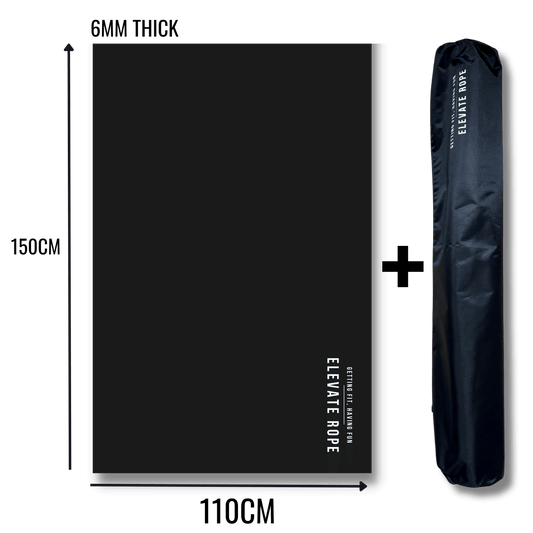
This sounds like it undoes the point of carpet, and it does not. The carpet underneath is still doing the sound absorption, which is the job you actually wanted it for. The mat on top gives you a flat, firm strike surface and puts the rebound back.
Two things decide whether it works. It has to be wider than your rope arc, which is around a metre and a half for most adults. Any narrower and the cable brushes carpet either side of it anyway. And it has to be dense rather than thick. A soft mat on soft carpet is worse than either on its own.
Ours is 150 by 110 centimetres, sized against the arc rather than against a person. On carpet that width is the part that matters, because a narrow mat leaves the two contact points exactly where the drag is.

One thing to check before you blame the floor
Rope length.
A rope that is too long spends more of each rotation on the ground, and on carpet that means more of each rotation in the pile. Before you buy anything, stand on the middle of the cable and pull the handles up along your chest. For most people the handle tops should land between the armpit and the shoulder.
Our cables shorten with a snaplock and a pair of scissors, and the beaded ropes with washers. There is no metal in the rope, so there is nothing to cut through. Take a centimetre at a time.
Half the people who think they need a mat need three centimetres off the cable instead.
If carpet is what you have
It is a better starting surface than most people give it credit for. It is forgiving on your joints, it is quiet, and it will not wreck a cable.
Get the rope length right first. If the rhythm still feels heavy after that, put something firm on top. Neither of those is expensive, and between them they fix almost every carpet complaint we hear.
Geraldo Alken is the founder and CEO of Elevate Rope. He designs jump ropes and works daily with jumpers from beginner to professional.