





Jump rope cables fail in three different ways, and each one has its own cause. Kinks come from how the rope was stored. Fraying comes from abrasion, which mostly means your floor. Snapping is what happens when a fray nobody checked finally gives. None of the three is sudden, and all three give warning.
Knowing which one you're looking at tells you whether the rope is fixable or finished. Here's how to tell the three apart on your own jump rope cables.
Kinks are a shape jump rope cables keep
A kink is not damage, at least not at first. PVC takes a set. Engineers call this slow change of shape under steady load creep. Leave a cable folded, coiled tight or squashed under something for long enough. It keeps that bend, the same way a garden hose does.
Our ropes are stricter about this than most. That's a direct consequence of building without swivel bearings. On a bearing rope the handle turns independently, so a twist works its way out while you jump. Nothing on ours turns independently. So nothing unwinds for you.
We think that's worth it. Bearings spin a rope faster than your body is actually moving. They take the rhythm away from you. The cost is that storage is on you. Full method in how to store a jump rope so it does not tangle.
Most kinks in jump rope cables come out with warmth and gentle tension. A kink that's sat in place for months is a different matter. The cable has usually thinned at the fold by then. At that point you've stopped looking at a shape problem. You're looking at wear.
Fraying is what your floor does to jump rope cables
Every turn, one section of cable hits the ground. Always roughly the same section. That's the strike point. It's where jump rope cables on every rope ever made start to go.
The mechanism is plain abrasion. Rough surfaces cut faster than smooth ones. Grit turns a smooth surface into a rough one. Concrete is the worst common case for jump rope cables by a distance. Heavy users on it tell us about it. Tarmac is similar. Wood, rubber and a jump rope mat are all gentler.
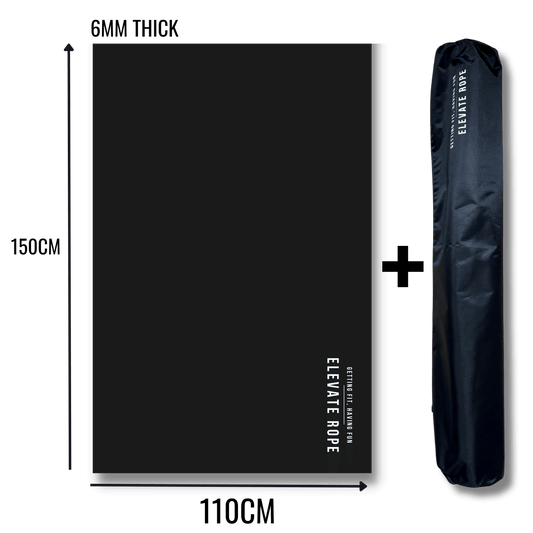
Because it's abrasion rather than stress, fraying shows before it matters. The cable goes flat, then shiny, then visibly narrower, then it starts to fur. Anyone who checks the strike point once a month will see it coming. An Elevate jump rope mat is the direct fix. We set out what different floors do in the jump rope surface guide.

Snapping is usually the end of a fray
Jump rope cables rarely snap out of nowhere. What happens is that the strike point thins until the material can't take the load. Then one ordinary turn finishes it.
Two other causes are worth naming. One is a bad cut at sizing, which leaves a ragged end. That works loose inside the handle over time. Cut square, and cut once. The other is a rope left far too long. It drags extra cable across the floor on every rotation. It wears two points instead of one.
Handles are the part you don't have to worry about in the same way as jump rope cables. They're built light for balance, and tough enough to survive being smashed into the ground during freestyle. A lifetime warranty covers them. If yours have had enough, the replacement short handles are a straight swap.
Why we build jump rope cables in PVC rather than wire
Coated wire cables exist, they're fast, and we don't make one. The reason is how a wire rope behaves in the air. It isn't about how long it lasts.
Wire snaps through the air quicker than most bodies actually move. You get a rope arriving ahead of the arm driving it. The result is more trip-ups, not fewer. Reviewers who came to us from steel say the same thing in their own words. A steel cable doesn't hold its shape as well when it's swinging.
Wear is the second reason. A PVC cable over a nylon core degrades visibly and gradually. You can see and feel it going. A coated wire tends to hold its shape right up until the coating splits. After that the wire itself is exposed. There's no metal anywhere in ours, which also means no rust. Sizing needs no tool either. Just scissors.
None of that makes PVC better for every purpose. It makes it the right material for the feel we build for, on the speed ropes and everything else. For background on that category, see what speed jump ropes are and why athletes use them.
Leather, plastic and the honest comparison
Leather ropes come up whenever cable durability does, usually framed as leather against plastic. It's a fair question with a boring answer.
Leather handles abrasion differently from a PVC cable. It also absorbs moisture and stiffens as it dries. Its weight changes over its life. That's why the boxing gyms that kept using leather did so for the feel. Lifespan wasn't the reason. Our whole range is PVC over a nylon core, so nothing we make is leather. We're not going to pretend to a comparison we don't run.
Thickness changes how jump rope cables wear
Not all our jump rope cables are the same. They don't fail on the same timetable.
- 5mm speed cable. The standard jump rope cable, and the standard case. Everything above applies directly.
- 4mm long handle cable. Thinner and faster, so the strike point works harder. These pair with 20cm handles for crosses and freestyle. They aren't a first-time jumper's rope.
- 10mm heavy cable. Thick, and used for interval work rather than continuous cardio. It sees fewer turns per session than a speed rope does. Storage kinks show up on these more often than fraying.
- 3.5mm polycord with beads. The cord barely touches the floor. Beads take the abrasion instead, so they wear first. More on the cord in 3.5mm polycord vs 3mm.
If you're using 20cm long handles, check the strike point more often than you would otherwise.
What to do about each one
Kinks: straighten them, then fix the storage habit that caused them. Fraying: change your surface, or accept a shorter life and plan for it. Snapping: at that point it's done. There's no spare jump rope cable to fit, which we explained in how long does a jump rope last.
One more thing, since bearings come up in every version of this conversation. Ropes that do have bearings need their own upkeep. That's a separate piece: do jump rope bearings need maintenance. Keeping grit off the cable in the first place is covered in how to clean a jump rope. The whole subject of jump rope care sits together in the jump rope care guide.
Check your jump rope cables at the strike point once a month. Then none of the three catches you out.
Want to meet the person who designs these ropes? Here is Geraldo Alken on his own channel.
Frequently Asked Questions
Why do jump rope cables kink?
Jump rope cables kink because PVC takes a set. Leave a cable folded or coiled tight for long enough and it keeps that bend, like a garden hose. Warmth and gentle tension remove most kinks. A kink left in place for months has usually thinned the cable at the fold, and that damage stays.
What makes jump rope cables fray?
Abrasion at the strike point. One section of cable hits the ground on every turn. Rough floors cut faster than smooth ones, and grit makes any floor rough. Concrete and tarmac are the worst common surfaces. Wood, rubber and a jump rope mat are all much gentler on the cable.
Can a frayed jump rope cable be repaired?
No. Once the strike point is visibly narrow or furred, the cable is on its way out. There is no spare cable to fit. The realistic options are changing your surface to slow the wear, or planning for a new rope. The handles are separate and covered by a lifetime warranty.
Is a rope without bearings worth it if storage matters more?
We think so. Bearings spin a rope faster than your body is actually moving, which takes the rhythm away from you. Without them, nothing unwinds a twist for you. Store the rope loosely and your jump rope cables stay straight. You trade one small habit for better flow on every jump.
How do I know when jump rope cables are about to snap?
Check the strike point once a month. Jump rope cables rarely snap without warning. The cable goes flat, then shiny, then visibly narrower, then it starts to fur. Snapping is usually the last step of that fray. A ragged cut at sizing or a rope left far too long speeds it up.
Geraldo Alken is the founder and CEO of Elevate Rope. He designs jump ropes and works daily with jumpers from beginner to professional.
You May Also Like
- Top 3 Methods on How to Straighten a PVC Jump Rope Cord for Longevity
- Jumping Rope on Concrete: What It Does to Your Cable
- Proper Jump Rope Length: How Long Should Your Jump Rope Be? And How to Size It
- PVC, Cable, or Beaded? How to Pick the Right Jump Rope Material
- How to Choose the Perfect Jump Rope: Speed vs Beaded vs Heavy