






The right jump rope surface is firm with a bit of give. A rubber mat, a sprung wooden floor, or short packed grass. Concrete and tile are hardest on your joints and they chew through a cable fastest. Deep carpet is kind to both and wrecks your timing.
Most people pick their jump rope surface by accident. You jump where there is space, and the space you have is the space you get. Then something starts to hurt, or the rope starts to look tired, and nobody connects it back to the floor.
The ground is doing more work than you think.
What a jump rope surface actually changes
Four things, and they pull against each other.
Joint load.Every landing has to go somewhere. A hard floor gives you less cushioning, while a more forgiving surface absorbs part of the landing impact. Research comparing sports flooring during jumping tasks found that floor properties can influence impact forces and lower-body loading.
Cable wear. The rope touches down once per rotation. On grit, that contact sands the coating off. This is the one people miss.
Noise. Hard and hollow is loud. Soft and dense is quiet. If you have neighbours below, this decides everything.
Rhythm. A surface that gives too much steals your push-off. You end up working harder for a slower turn, and your timing goes with it.
No surface wins all four. That is the whole problem, and it is why the answer depends on which of the four matters most to you.
Concrete and asphalt
Hardest on your body, hardest on your rope.
Concrete gives you nothing back. The landing energy returns straight up your leg, which is fine in small doses and less fine at twenty minutes a day. Asphalt is slightly softer and considerably rougher.
The wear is the part that surprises people. A cable passes the ground once per rotation, so a ten minute session at 130 revolutions a minute is roughly 1,300 contacts. On a surface with grit in it, each one takes a little coating off. You will see it as a flat, dull patch on one section of the cable, and eventually the cable kinks there because the wall is thinner.
Concrete is not off limits. Plenty of good jumpers train on it. Just go in knowing the cable is a consumable, or put something between the two.
Tile, laminate and vinyl
Quiet on the ear, hard underfoot, and slippery when you sweat.
These floors are the most common indoor surface and the least forgiving. There is no give in tile, and laminate over a concrete slab is tile with a thin hat on. The bigger problem is grip. A landing that slides sideways is how ankles get turned.
They are kinder to the cable than concrete, because they are smooth. That is the one thing they have going for them.
Hardwood and sprung floors
The best floor most people already own.
A wooden floor over joists flexes slightly under load. That flex takes a real bite out of the landing, which is why gym and dance floors are built this way. It is smooth, so cable wear is low, and it is warm enough underfoot to jump in bare feet if you want to.
The catch is that the cable tip can mark the finish over time, and downstairs will hear you. A mat solves both without giving up the sprung floor underneath.
Carpet
Kind to your joints, terrible for your timing.
Carpet is the quietest surface in a flat and the gentlest on a cable. It is also the one that makes people think they have stopped improving. Deep pile grabs the cable on the way through and eats the rebound out of your hop. You work harder, the turn slows, and the rhythm never quite settles.
Short, dense carpet is fine. Thick pile is not. If that is all you have, put a firm mat on top of it and you get the quiet without the drag.
Grass and dirt
Good for learning, poor for speed.
Grass is soft, so the joint load is low and a miss does not sting. That makes it a decent place to learn. Two problems come with it. The ground is uneven, so the cable disappears into it and you lose the feedback that tells you where the rope is. And it holds moisture, which gets into the cable and shortens its life.

Short packed grass is much better than long soft grass. If you are learning your first crossovers, a lawn is a friendly place to fall over.
Rubber mats and gym flooring
Firm, dense and dull. Which is exactly what you want.
A proper mat is not a soft mat. Softness kills the push-off in the same way carpet does. What you want is density: something that absorbs the landing without swallowing it, and gives the cable a smooth surface to strike.
Two things decide whether a mat works. Width matters more than thickness, because a rope arc is wider than a body and a cable landing off the edge of the mat is still landing on concrete. And it has to stay put when you land on it.
What we chose to do about it
We build our cables from 5mm PVC over a nylon core, with no metal anywhere in the rope. That decision was about feel, but it changed the surface question too.
The PVC coating is the wear layer. It takes the abrasion and the nylon core keeps the shape, which is why a worn Elevate cable thins before it kinks and gives you some warning. A bare steel cable does not do that. The absence of metal also means a miss on concrete stings and then stops, rather than cutting.
On the beaded ropes we run 2.5cm PVC beads on 3.5mm polycord, where most of the market uses 3mm. Beads take the ground contact instead of the cord, so a beaded rope survives rough ground better than a thin speed cable does. The trade is that the beads themselves wear flat, and on concrete they wear fast. That comes up in our reviews more than any other durability point.
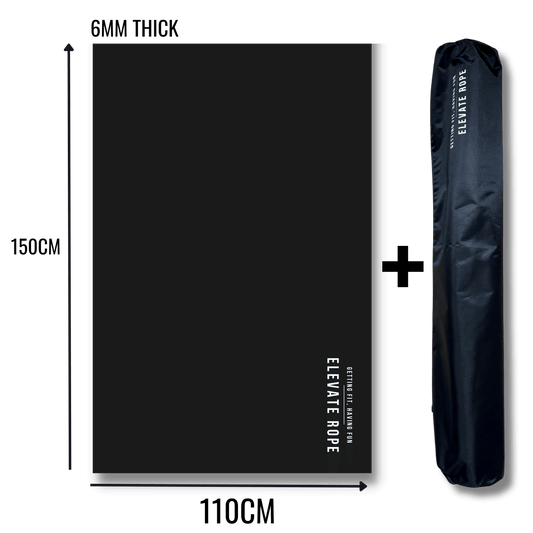
The mat is 150 by 110 centimetres for one reason: we sized it against the arc of a rope rather than the width of a person. A yoga mat is around 60cm wide. The cable clears that on both sides and hits the floor anyway.
How to pick your jump rope surface
Work down this list and stop at the first one that applies.
- Someone lives below you. Firm mat, on whatever floor you have.
- You train on concrete, tile or outdoors on hard ground. Mat, or accept that the cable is a consumable and buy spares.
- Your floor can be marked and you care about it. Mat.
- You have thick carpet. Firm mat on top of it.
- You have a sprung wooden floor and nobody underneath. You are already fine.
Nobody needs to over-think this. The two by two metre patch you jump in is the whole gym, and getting that patch right is most of the equipment problem solved.
The rest of this series
- Jumping Rope on Concrete: What It Does to Your Cable
- Jump Rope Mat for Concrete: Size, Thickness and Setup
- Do You Need a Jump Rope Mat?
- Jump Rope Mat Alternatives: What Works and What Does Not
- Can You Jump Rope on Carpet?
- Jumping Rope Outside: What the Ground Changes
Geraldo Alken is the founder and CEO of Elevate Rope. He designs jump ropes and works daily with jumpers from beginner to professional.