





You need a jump rope mat if you train on concrete, tile or a floor you cannot mark, or if someone lives below you. On carpet or a sprung wooden floor you probably do not, and the money is better spent on a second cable.
We sell one, so read the next part with that in mind. I would rather tell you not to buy it than have it sit in a cupboard.
The four reasons a jump rope mat earns its place
You are on concrete, tile or asphalt. These are abrasive or unforgiving or both. Concrete sands the coating off a cable roughly 1,300 times per ten minute session. Tile gives your joints nothing back and gets slippery when you sweat.
Someone lives below you. This is the reason most of our mats get bought. A hard floor transmits every landing into the ceiling below, and no amount of good technique fixes a concrete slab.
Your floor can be marked. The cable tip catches the floor on the way through, thousands of times. On a finished wooden floor or a good vinyl, that shows up eventually.
You are jumping most days. Volume changes the maths. Twice a week for ten minutes is a different situation from twenty minutes a day.
If none of those four apply to you, keep reading, because the answer is probably no.
When you genuinely do not need one
Short dense carpet. Quiet, forgiving, and no grit to wear a cable. You are already on a good surface.
A sprung wooden floor with nobody underneath. This is the best floor most people already own. It flexes under load, which is exactly what a mat is trying to give you.
Short sessions on any surface, with nobody below. If you jump twice a week for ten minutes on a garage floor, a spare cable costs less than a mat and solves the only problem you have.
Grass. Soft, quiet, and free.
I would rather you spent the money on a rope that fits you properly. Most people's first upgrade should be rope length, not floor.
What actually makes a mat work
Two things, and one of them is the one everyone gets wrong.
Width. Your rope arc is around a metre and a half across. The cable does not land under your feet, it lands out to the side. A mat narrower than the arc leaves the cable striking bare floor at exactly the two points that matter. This is why a yoga mat, at around 60cm, does almost nothing for cable wear.

Density, not thickness. Your hop is a push into the ground and something coming back. Thick foam absorbs the push and gives you a slower, heavier turn. You want enough material to take the edge off a landing, and enough firmness that the floor still pushes back. Research on sports flooring shows that surface cushioning can influence impact forces during jumping and landing.
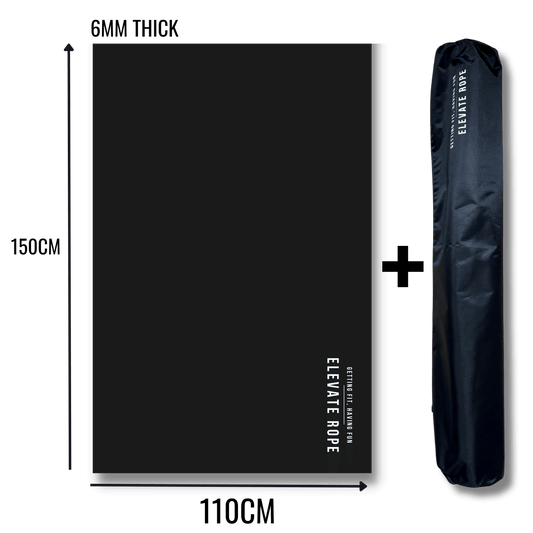
Ours is 150 by 110 centimetres because we sized it against the arc rather than against a person. That number is the entire design decision.
What a mat does not fix
Rope length. If your cable is too long it drags on every rotation and no surface saves it.
Technique. A rope that keeps hitting your feet is a hand position problem and it follows you onto any floor.
Wear, entirely. A mat removes most of the abrasion. It does not make a cable permanent. On hard ground the cable is a consumable, which is why our handles carry a lifetime warranty and the cable does not. That split is deliberate and we would rather say it than let you find out.
The two minute version
Answer these in order and stop at the first yes.
- Does anyone live below you? Buy a mat.
- Do you train on concrete, tile or asphalt more than twice a week? Buy a mat.
- Can your floor be marked, and do you mind? Buy a mat.
- Is your carpet thick enough to sink into? Buy a mat, and put it on top of the carpet.
- None of the above? Do not buy a mat. Check your rope length instead.
That is the honest version. Most people who ask us this question turn out to be number five.
Geraldo Alken is the founder and CEO of Elevate Rope. He designs jump ropes and works daily with jumpers from beginner to professional.