





Finding the best jump rope for beginners who don't exercise yet is harder than it looks. Most buyer's guides assume you already have some fitness base — that you jog occasionally, hit a gym, or at least know what a "HIIT session" feels like. This one doesn't. If your last proper workout was a PE class you'd rather forget, this guide was written specifically for you.
The uncomfortable truth: most people who try jump rope and quit don't quit because they lack willpower. They quit because they started with the wrong rope. A wire cable that spins too fast, a cord with no feedback, a length that's two sizes off — any one of those will make you feel clumsy in the first five minutes and convince you that jumping rope is "just not for you." It isn't. The rope was wrong.
This guide walks through the specific features that matter for complete beginners, compares the rope types available in 2026, and makes an honest recommendation based on what actually works — backed by both research and 1,200+ verified customer reviews from real first-timers across Europe.
What you'll learn in this guide:
Why most "beginner" jump ropes are actually designed for people who already know how to jump
The one rope feature that cuts learning time in half (most brands don't even mention it)
How rope weight, cord type, and handle design affect your ability to find rhythm as a newcomer
A side-by-side comparison of the main rope categories in 2026
The exact rope we recommend for someone who has never exercised before
What to do after you can jump — and how to build from there
How to size a jump rope correctly in under 60 seconds
Why Most Beginner Jump Rope Guides Get This Wrong
There is a specific type of person this article is written for: someone who wants to start exercising, has heard that jump rope is efficient, and has never really done it. Not "hasn't done it in a while." Has never built the habit. Has tried once or twice and found it humiliating. May be out of shape. May have coordination concerns. Is probably overthinking this.
Most "best jump rope for beginners" articles are actually written for people who are beginner jumpers but already active exercisers. There's a difference. A CrossFit athlete picking up their first speed rope is a "beginner" in a technical sense but has body awareness, rhythm, and cardiovascular fitness working in their favour. Someone who has genuinely never exercised before has none of that foundation — and they need a different type of rope entirely.
The features that matter for your situation are not the same features that matter for an athlete. Speed doesn't matter. Rotational efficiency doesn't matter. What matters is feedback — the kind of physical and auditory signal that tells your nervous system where the rope is, when it's coming back around, and whether your timing is right. Almost no manufacturer explains this clearly. Almost no buying guide covers it at all.

The One Feature That Changes Everything for Beginners
If you've ever picked up a basic jump rope and felt like the cord was "too fast" — like the rope reached your feet before your brain could react — you've experienced the core problem with beginner jump rope selection. Wire cables and thin PVC ropes spin at a speed that's appropriate for trained athletes but genuinely difficult for someone whose nervous system hasn't yet learned the timing pattern. This is not a coordination problem. It's a feedback problem.
Why auditory timing matters more than anything else
Your brain learns movement patterns through feedback loops. When you jump, your nervous system needs a signal that tells it when the rope is at the bottom of its arc — so it can calibrate the timing of your next jump. Fast ropes provide that signal visually, which requires quick visual processing and a trained eye. Beaded ropes provide that signal through sound.
The beads on a quality beginner rope create a distinct rhythmic sound each time they contact the ground. For newcomers, this sound functions like an auditory metronome: your brain hears the tick and learns to predict the next rotation before your eyes can even process it. Research on motor learning consistently confirms that multi-sensory feedback accelerates skill acquisition compared to visual feedback alone. This is the mechanism behind why so many first-timers find beaded ropes dramatically easier — not just "more fun" or "less intimidating," but physiologically faster to learn.
Verified customer reviews confirm this with striking consistency. One Elevate Rope customer wrote: "For me as a beginner, the perfect rope. Beads are heavier and the sound makes it easier to anticipate timing." Another: "The beads catch air so you can feel the timing — I actually learned to jump in two sessions." Fifteen or more positive reviews across Europe specifically cite the auditory component as the turning point.
Short answer:
For someone who has never exercised before, a beaded rope is the only type that provides the auditory and tactile feedback your nervous system needs to learn jump rope timing without frustration.
Why it matters:
Wire and thin PVC ropes spin too fast for true beginners to process visually. Without sound and tactile feedback, most newcomers trip repeatedly in the first session and conclude they "can't" jump rope — when the real problem is the rope type.
Best next step:
→ Elevate Dignity Beaded Rope — built specifically around auditory timing feedback for newcomers.

Rope Types Compared: What's Actually Available in 2026
The jump rope market in 2026 offers four main rope categories. Here's what each one means in practical terms for a complete beginner:
| Rope Type | Speed | Feedback | Best For | Beginner Rating |
| Beaded rope | Slow-medium | Auditory + tactile | True beginners, rhythm learners | ⭐⭐⭐⭐⭐ |
| PVC speed rope | Fast | Visual only | Intermediate fitness users | ⭐⭐ |
| Wire / cable rope | Very fast | Minimal | Advanced athletes, double-unders | ⭐ |
| Weighted / heavy rope | Slow | Tactile (weight) | Strength training, conditioning | ⭐⭐⭐ |
Wire ropes are designed for speed. They're used in CrossFit, double-under training, and competitive jump rope — and they move faster than most untrained people can process. PVC ropes sit in the middle: faster than beaded, but without the auditory cue that helps beginners track position. Weighted ropes slow the arc down but work through resistance rather than feedback — useful once you have basic timing, but not ideal for day one.
Beaded ropes are the outlier. They were originally designed for playground and rhythmic use, but the properties that made them popular with children — slower rotation, auditory feedback, tactile awareness of rope position — happen to be exactly what adult beginners need. The difference is engineering quality. A €10 playground rope and a purpose-built beginner rope like the → Elevate Dignity Beaded Rope are both "beaded," but the cord thickness, bead design, and handle construction create a completely different experience.
What to Look For: 5 Features That Matter When You're Starting From Zero
1. Bead design and air-catch properties
Not all beaded ropes use the same bead geometry. Cheaper options use small, lightweight beads that barely make contact with the ground. The Elevate Dignity Beaded Rope uses 2.5cm PVC beads specifically designed to catch air during rotation — meaning as the rope swings around, the beads create a slight drag that stabilizes the arc. This makes the rotation more predictable, gives you tactile awareness of where the rope is mid-swing, and slows the overall speed to a learnable pace. The difference between this and a generic beaded rope is significant.
2. Cord thickness
Industry-standard jump rope cord is 3mm. The Elevate Dignity uses a 3.5mm polypropylene cord — 17% thicker. In practice, this means noticeably better mid-air stability. Thinner cords can kink, collapse, or waver during rotation, which makes timing unpredictable. A thicker cord holds its shape throughout the arc, so the rope behaves consistently every single revolution. For someone learning the movement pattern for the first time, consistency is everything.
3. Length adjustability
A correctly-sized rope is not optional. Jumping with a rope that's two inches too long or too short will actively prevent you from developing proper timing. The general rule is that when you stand in the middle of the rope, both handles should reach approximately your armpits. But body proportions vary, and you need the ability to fine-tune. Look for a rope that adjusts simply — ideally without special tools and without having to buy a new rope if you measure wrong the first time.
4. Handle weight and grip
Heavy handles fatigue your forearms faster, which is a problem in early sessions when your form is still inconsistent. Lightweight handles with a comfortable grip let you focus on foot timing rather than grip strength. Foam grips or textured handles reduce slipping as you warm up.
5. App or guided program inclusion
One of the most overlooked variables in beginner success is having a structured starting point. Without one, most people jump in 30-second bursts, get winded, feel awkward, and stop. A guided program that tells you exactly what to do — day one, day two, week two — removes the guesswork and dramatically increases follow-through. This matters more for true beginners than for people who already have exercise habits.
Short answer:
The five features that matter most for beginners who have never exercised are: bead design, cord thickness, length adjustability, handle weight, and whether a structured program is included.
Why it matters:
Missing any one of these — particularly cord feedback and program structure — is the primary reason first-timers quit within two weeks. The rope shapes the experience.
Best next step:
→ The Elevate Dignity Beaded Rope addresses all five. It includes access to the free Elevate App with 100+ structured beginner workouts — no subscription required.

Sizing Your Jump Rope Correctly (Takes 60 Seconds)
Incorrect rope length is one of the most common reasons beginners trip — and one of the most easily fixed. The standard method: stand in the centre of the rope with both feet together. Pull the handles upward. The tops of the handles should reach your armpits. If they reach your shoulders, the rope is too short. If they reach above your collarbone, it's too long.
For true beginners who are still developing timing, erring slightly longer (reaching the chest rather than armpits) gives you a small timing buffer. As your coordination improves, you can shorten the rope gradually. Most quality ropes allow adjustment with basic scissors and a simple washer or clip system. The → Elevate Dignity Beaded Rope adjusts across a full range from children's sizes to adults over 1.9 metres tall — one rope for everyone in the household.
The Beginner Progression Path: What Comes After the Beaded Rope
Once you can jump consistently — holding 30-second intervals without stopping, finding a rhythm that feels automatic rather than effortful — your starting rope becomes a ceiling rather than a tool. This usually happens somewhere between two and six weeks of regular practice, depending on how often you jump. The progression from this point is straightforward.
Stage 1 (Days 1–30): Beaded rope, foundation building
Focus: learning timing, building to 10-minute sessions, establishing a daily habit. The → Elevate Dignity Beaded Rope is your tool here. Use the free Elevate App to follow structured beginner sessions. Don't worry about speed or intensity — consistency is the only goal in this phase.
Stage 2 (Weeks 4–12): Transition to speed rope
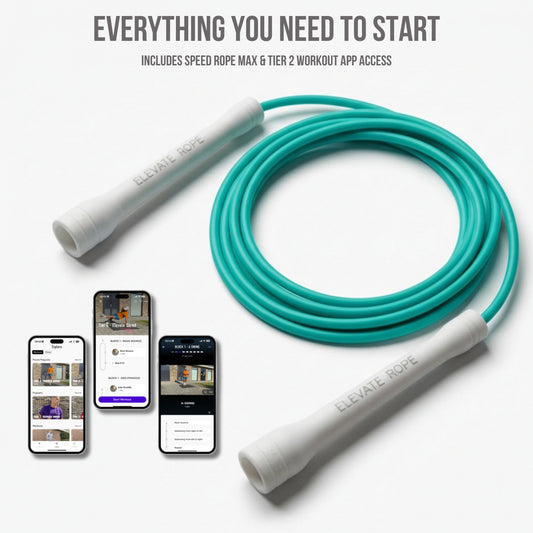
Once rhythm is established, a speed rope opens up higher-intensity work. The → Speed Rope MAX is the natural next step — bearing-free design means no tangling, and it's built for sustained HIIT sessions rather than just warm-up. This is where the Arizona State University finding becomes relevant in your own training: 10 minutes of jump rope at moderate intensity produces cardiovascular benefits equivalent to 30 minutes of jogging.
Stage 3 (Month 3+): Add resistance
If you want to develop upper-body strength and break cardio plateaus, the → Gravity Heavy Rope and → TITAN 7MM Weighted Speed Rope create a different training stimulus. The heavy rope develops shoulder endurance and grip strength simultaneously with your cardio work.
| Stage | Timeline | Rope | Goal |
| Foundation | Days 1–30 | Beaded Rope | Timing, habit, basic fitness |
| Build | Weeks 4–12 | Speed Rope MAX | HIIT, cardiovascular conditioning |
| Strength-Cardio | Month 3+ | Heavy Rope / TITAN 7MM | Resistance, plateau-breaking |

The True Cost of Getting This Wrong
A €10 jump rope from a discount retailer will technically function as a jump rope. It will also spin inconsistently, tangle repeatedly, and give you no feedback on your timing. Most people who buy a cheap rope as their "test" before committing to the habit trip within the first session, assume the problem is their coordination, and abandon the idea entirely. That's not a €10 saving. That's a failed attempt at building a habit that could genuinely change your health trajectory.
Compare the cost differently. A gym membership in the Netherlands averages €40–€60 per month. One year of going twice a week — if you actually go — costs €480–€720. The free Elevate App connects you to over 100 structured workouts for exactly €0 per month after your rope purchase. Competitor apps like Crossrope charge approximately €150 per year just for the guided program. Elevate's app is free, permanently. That changes the arithmetic considerably.
→Ascent Bundle (€49,95)— Includes the Beaded Rope, Speed Rope MAX, free Elevate App access, the Elevate Code guide, nutrition guide, and progress tracker. Everything a true beginner needs to go from day one to month three without buying anything else.
Short answer:
A quality beginner setup costs less than one month of gym membership and includes lifetime app access with no subscription fees — making the total investment dramatically lower than most fitness alternatives.
Why it matters:
Financial friction is a real barrier to starting. When the upfront cost is low and there are no ongoing subscription costs, the decision to start becomes easier and the commitment to continue becomes more rational.
Best next step:
→ Ascent Bundle at €49,95 gives you both starter ropes, a structured program, and zero monthly fees. For context, that's one month of a basic gym membership.

Our Recommendation: The Best Jump Rope for Beginners Who Have Never Exercised
After reviewing the options available in 2026, the recommendation for someone starting from zero is unambiguous: the → Elevate Dignity Beaded Rope.
The reasoning comes down to the physics of learning movement. You need multi-sensory feedback — auditory and tactile — to develop timing without frustration. The Dignity delivers this through a purpose-built combination of 2.5cm air-catching beads, a 3.5mm polypropylene cord (17% thicker than industry standard), and a design that slows the arc to a learnable speed while making the rope's position audible. "Beginner" appears in over 23% of positive reviews — that's not a coincidence or a marketing claim. It's what the design produces in real conditions.
Add the free Elevate App with 100+ guided workouts and you have a complete starting system. If you want both the Beaded Rope and a speed rope for when you're ready to progress, the → Ascent Bundle includes both at a bundled price.
Frequently Asked Questions
What is the best jump rope for a complete beginner who has never exercised?
A beaded rope is the best choice for someone who has genuinely never exercised before. The beads create auditory timing feedback that helps your nervous system learn the jump pattern faster than a silent wire or PVC rope. The Elevate Dignity Beaded Rope is specifically engineered for this purpose — with 2.5cm air-catching beads and a 3.5mm cord that gives you consistent, predictable rotation from session one.
Is jump rope good for beginners who are overweight or out of shape?
Yes — with the right approach. Jump rope is low-impact enough for beginners at most fitness levels when started gradually. The key is not trying to jump for long sessions immediately. A research-backed approach starts with 30-second intervals separated by rest, building over two to four weeks. The Elevate App includes beginner programs specifically structured for this progression. If you have joint concerns, using a jump rope mat reduces impact on knees and ankles.
How long does it take to learn to jump rope as a total beginner?
Most people can establish basic, consistent jumping within two to five sessions using a beaded rope. "Consistent" means being able to complete 30-second intervals without major interruption. Building to 5-minute continuous sessions typically takes two to four weeks of regular practice. With a wire or PVC rope and no structure, that timeline extends significantly — many people give up before reaching that point.
What length jump rope do I need as a beginner?
Stand in the centre of the rope with both feet together and pull the handles up. They should reach your armpits. As a beginner, you can size slightly longer — handles to chest height — to give yourself a small timing buffer. The Elevate Dignity Beaded Rope is fully adjustable for heights from children through adults over 1.9 metres tall.
Can I use a jump rope at home without special equipment?
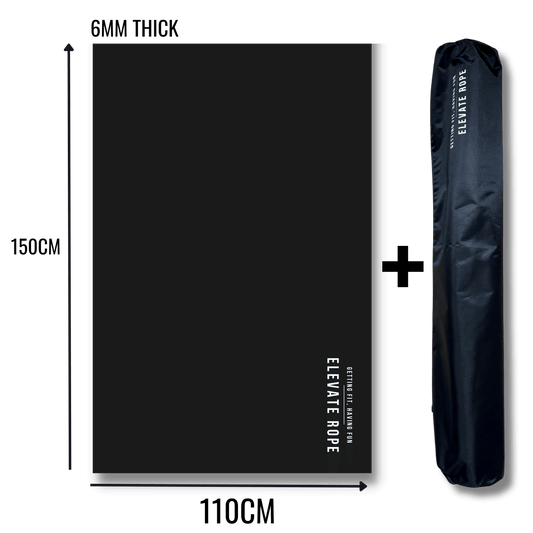
Yes. You need approximately 2.5 metres of ceiling height and enough floor space to swing the rope freely — a 2-metre radius in each direction. Hard floor surfaces are manageable but will wear beaded rope cords faster; the → Elevate Jump Rope Mat protects both your floor and your beads, while also cushioning joint impact. Many beginners start in their living room, a garage, or outdoors.
How is the Elevate Dignity Beaded Rope different from a cheap beaded rope?
The core differences are cord thickness (3.5mm vs the standard 3mm), bead design (2.5cm air-catching PVC vs lightweight decorative beads), and handle construction. A discount rope will tangle, lose shape over time, and provide inconsistent rotation. The Dignity is built with shatterproof PVC beads and a polypropylene cord rated for sustained use on both indoor and outdoor surfaces, plus a lifetime handle warranty.
Do I need an app or program to start with jump rope?
You don't need one, but having one dramatically increases the chance you'll stick to it past the first week. Without structure, most beginners jump until they're winded, feel awkward, and stop — then don't come back. The free Elevate App provides day-by-day guided sessions that tell you exactly what to do, removing the decision fatigue that kills most new habits. It's included at no cost with any Elevate Rope purchase.
What is the Elevate26 Challenge and should I try it as a beginner?
The Elevate26 Challenge is a free 26-day structured jump rope program. It's designed as a progression from day one to day 26 — starting short and building consistency before adding intensity. It's an excellent structure for someone who has never exercised before because it removes all guesswork and gives you a clear daily action. Many Elevate customers cite it as the reason they stayed consistent past the first week.
Your Next Step
If you've never exercised before and you're genuinely considering starting with jump rope, you're making a sound decision — the research on jump rope's time efficiency is solid, and the barrier to starting is low. The biggest variable in your success over the next four weeks isn't motivation. It's whether you start with a rope that gives you feedback, a program that gives you structure, and a length that gives you room to learn without fighting the equipment.
For a complete beginner, the starting path is clear. The → Elevate Dignity Beaded Rope gives you the auditory timing system, the cord thickness, and the adjustability to learn properly. The free Elevate App gives you the program. The → Elevate26 Challenge gives you the daily structure to turn 10 minutes into a habit before you have to rely on motivation.
If you want both a beginner rope and a speed rope for when you're ready to progress — without buying twice — the → Ascent Bundle at €49,95 bundles the Beaded Rope and Speed Rope MAX together with the complete program system. It's the most complete starting point available. You don't need anything else on day one.
Sources
1. Baker, J.S. et al. "Jump rope training: Balance and motor coordination in preadolescent soccer players." Journal of Sports Science and Medicine (2015). tandfonline.com
2. Trecroci, A. et al. "Jump rope training: Balance and motor coordination in preadolescent soccer players." PMC4763838
3. Tabata, I. et al. "Effects of moderate-intensity endurance and high-intensity intermittent training on anaerobic capacity and VO2max." Medicine and Science in Sports and Exercise. PubMed 8897392
4. Ozer, D. et al. "The effects of rope or weighted rope jump training on strength, coordination and proprioception." PMC9760008
5. World Jump Rope Federation — Equipment and Training Standards (2024). worldjumprope.com
6. Arizona State University Jump Rope Cardiovascular Study — referenced in Elevate Rope research documentation (Baker et al., tandfonline).
7. Eurostat European Working Conditions Survey — Sedentary work prevalence data (2023). ec.europa.eu/eurostat
You May Also Like
https://www.elevaterope.com/blogs/crossfit-hiit/jump-rope-home-office-setup
https://www.elevaterope.com/blogs/workouts-tutorials/30-day-desk-worker-jump-rope-challenge
https://www.elevaterope.com/blogs/home-workout-tips/jump-rope-vs-walking-office-workers
https://www.elevaterope.com/blogs/tips-tricks/quick-workout-before-work
https://www.elevaterope.com/blogs/articles/jump-rope-stress-relief