






A jump rope workout can start with twenty seconds of jumping and forty seconds of recovery. You do not need ten uninterrupted minutes. This four-week beginner plan builds from your first controlled turns to comfortable intervals and simple footwork. Repeat any week before moving on.
Maybe your rope has been sitting in a drawer since your first attempt. Three jumps felt manageable, but the fourth ended in a trip. That still gives you a starting point. Your jump rope workout can become practice without turning every stumble into a failed session.
What you’ll get: a realistic first workout, a rope-and-surface checklist, four weekly progressions, and practical ways to measure improvement. Start at your current level, not the level you think you should have reached.
1. What Counts as a Jump Rope Workout?
Short answer: A jump rope workout combines rope turns, planned breaks, and repeatable movement. It can be gentle practice or demanding conditioning. The effort depends on your pace, current fitness, and work-to-rest structure.
The first goal is rhythm, not nonstop jumping
Begin with a basic jump, pause, and start again. Just a handful of clean turns lets you practise your hands and feet together. Try three controlled jumps, take a breath, and repeat the basic jump. As the rhythm becomes familiar, join the repetitions into short intervals.
You can count successful turns or short intervals instead of staring at a timer. A jump rope workout still counts when the rope catches your shoes. Stop, reset, and continue when your movement feels controlled.
What the workout can develop
Rope skipping challenges coordination while asking your heart and lungs to work. The CDC lists jumping rope among examples of vigorous activity. However, the same pace can feel different to two people. Use your breathing and a manageable effort to guide the session. The CDC intensity guide explains the talk test.
One short session cannot guarantee weight loss or replace every other activity. The World Health Organization says some movement is better than none. Adults can gradually work toward broader weekly activity guidance. Your first jump rope workout is a beginning, not the finish line.
Try this today: Find five easy turns and one comfortable recovery period. That is enough to identify your next practice goal.
2. Prepare for Your First Jump Rope Workout

Before adding intensity, check the rope, its length, and the space around you. A frustrating first session may reflect the setup rather than your ability. Make the next jump rope workout easy to begin.
Choose a rope you can control
| Rope type | What it feels like | When to consider it |
| Beaded rope | Moving beads provide noticeable tactile feedback. | Learning a basic jump and changing footwork. |
| PVC speed rope | A smooth, flexible cable supports repeatable turns. | Beginner fitness or familiar conditioning intervals. |
| Heavy rope | A thicker cable adds resistance to each turn. | Shorter, deliberate sets after the basic movement feels comfortable. |
| Long-handle rope | Longer handles change reach and handling. | Later freestyle skills rather than a necessary first purchase. |
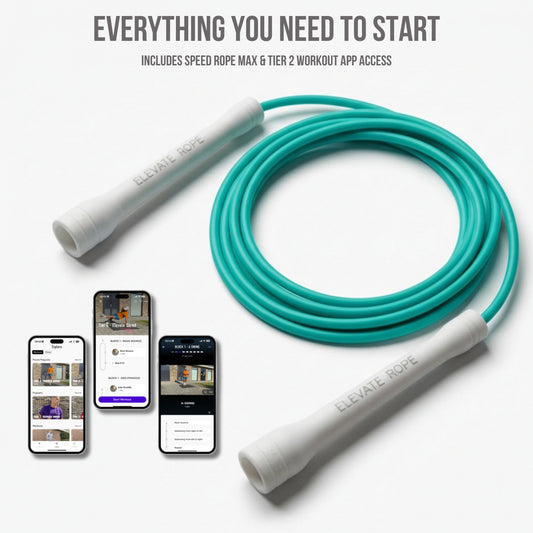
Elevate’s beaded ropes use PVC beads on polycord. Our speed ropes use a flexible PVC cable. Either style can support this plan. The useful choice is the one you can size and turn comfortably.
Fit the rope before trimming
Stand on the middle of the rope and lift both handles beside you. Use the result as an initial fit check, not a universal measurement. Try a few easy turns and make small adjustments. Do not cut the cord before testing the length. Your hand position and rope style affect the final fit.
Use the Elevate rope-length guide for step-by-step sizing. The right arc can make a jump rope workout feel less frustrating.
Set up a comfortable training space
Clear enough room for the rope overhead and on both sides. Keep furniture, people, and low ceilings outside its path. Choose a stable, reasonably forgiving surface when available. Rough pavement may wear beads and cables faster. Read our jump rope surface guide for more context.
Wear shoes that feel secure and allow easy movement. Start with a relaxed basic jump, small wrist-led turns, and shoulders away from your ears. If you have an injury or relevant medical condition, seek appropriate professional advice before vigorous activity.
Ready check: Can you do five comfortable basic jumps with space to spare? If not, practise individual turns first.
3. Your First 10-Minute Jump Rope Workout

This example includes two minutes to warm up, six minutes of intervals, and two minutes to cool down. Start slower if you need to. The purpose is a workable first session, not a maximum-effort test.
Minutes 0–2: warm up
| Time | Movement |
| 0:00–0:30 | March in place. |
| 0:30–1:00 | Move your ankles gently. |
| 1:00–1:30 | Practise small bounces without the rope. |
| 1:30–2:00 | Try a few relaxed jumps with the rope. |
Extend the warm-up when you need more preparation. Do not rush from standing still into fast turns.
Minutes 2–8: six easy intervals
| Action | Time | How often |
| Basic jump | 20 seconds | Six rounds |
| Recovery or easy marching | 40 seconds | After each round |
Each round lasts one minute. Six rounds give you six minutes total, including recovery. Twenty seconds does not mean twenty uninterrupted seconds. Treat each reset as part of your practice. If the rope catches, restart the basic jump when you feel ready.
The plan offers two minutes of active jumping across six rounds when every work period is completed. Your actual jumping time may be shorter. That is normal while you are learning. Keep the basic jump controlled and save harder intervals for later.
Minutes 8–10: cool down
Walk slowly until your breathing settles. Notice how the rope felt in your hands. Did the cable catch your feet? Were the jumps getting higher as you tired? Was the recovery long enough?
Write down one observation and one small change for next time. That note makes your second jump rope workout easier to approach.
Beginner cue: Finish with the feeling that you could return for another session. Exhaustion is not the goal.
4. Follow This 4-Week Jump Rope Workout Plan
The weeks are practice stages, not deadlines. Repeat a stage until your rhythm and recovery feel manageable. Only change one variable at a time. That might be interval length, footwork, or the number of turns you connect.
Week 1: get familiar with the basic jump
Use the ten-minute jump rope workout above. Two or three non-consecutive sessions might suit some beginners, depending on other activity and recovery. You can do less if needed. Between sessions, remember how the handles felt and where your rhythm broke.
Aim to restart calmly after a miss. A short sequence with easy footwork is more useful than frantic speed. Keep recovery generous while learning the basic jump.
Week 1 focus: Repeatable rhythm, not speed or calorie counts.
Week 2: extend the work, if ready
Try 30 seconds of jumping and 30 seconds of recovery for six rounds. Keep the same warm-up and cool-down. That still produces a ten-minute jump rope workout. If your landings become uncomfortable, return to 20/40. You have not fallen behind.
Count how many controlled jumps you can connect during your intervals. Then notice whether you feel ready when the next interval begins.
Week 2 focus: More work without losing the basic jump.
Week 3: introduce one easy footwork pattern
Keep the familiar intervals. During one or two rounds, switch from the basic jump to alternating feet. Use a boxer step instead if that feels clearer. Return to basic turns when your timing slips.
Learning footwork is a skill task. You might complete fewer basic jump turns while learning it. That does not mean the jump rope workout is becoming less useful. Give the movement time to settle.
Want a visual progression? Our beginner jump rope combinations guide shows how simple movements connect.
Week 3 focus: Learn one change of footwork while protecting your rhythm.
Week 4: shape the routine you will keep
Choose the version you can repeat around your actual week. You might stay with 30/30, add a little jumping time, or alternate two easy steps. There is no requirement to attempt double unders. A heavy rope is not necessary either.
By Week 4, your jump rope workout should feel familiar enough to start without lengthy planning. If you still need Week 2, use Week 2. Progress has room for different timelines.
Week 4 focus: Build a routine that fits your life after the plan ends.
| Week | Main goal | Example work / recovery |
| 1 | Learn the basic jump | 20 sec / 40 sec |
| 2 | Connect more controlled turns | 30 sec / 30 sec if ready |
| 3 | Add one footwork pattern | Familiar intervals with easy variation |
| 4 | Build a repeatable routine | Repeat or progress gradually |
These are examples, not mandatory milestones. Adjust your workload around other training and recovery.
Watch the beginner progression: Geraldo Alken demonstrates early combinations in the video below. It illustrates Week 3 skills, not the full four-week timetable.
For help planning rest days, see how often to jump rope. You can also explore the Elevate training app for guided sessions. This free plan works without an app subscription.
5. Make Your Jump Rope Routine Stick
A successful plan should survive an ordinary Tuesday. Choose realistic training times and keep the rope easy to reach. Avoid building a routine around your most energetic day. That manageable jump rope workout is easier to repeat than a punishing session.
Track more than calories
Write down one or two useful observations: clean turns, relaxed wrists, or a new footwork pattern. Notice when recovery felt sufficient. Those details show progress that a calorie estimate cannot capture.
For a simple tracking approach, read our jump rope progress guide. Avoid treating a calorie number as a guaranteed result for your body.
Fix the four most common beginner mistakes
- Starting too hard: Reduce the jumping time and leave more recovery.
- Guessing at rope length: Test the fit before assuming your timing is wrong.
- Forcing nonstop turns: Reset after a catch, then return to the basic jump.
- Adding too much at once: Change interval length or footwork, not everything together.
When you keep catching your shoes, the tripping troubleshooting guide can help. One technical adjustment may make your next jump rope workout smoother.
What if you miss a day?
Do the next manageable session. You do not need to double the work as repayment. You are building a practice, not protecting a perfect streak. The Elevate Code puts this simply: small promises build self-trust.
Choose two possible workout days now. Put the rope where you will see it. Then begin with the warm-up when that day arrives.
Frequently Asked Questions
Is a 10-minute jump rope workout enough for beginners?
Ten minutes can make a jump rope workout manageable for beginners. Your active jumping time, intensity, and broader activity all matter. Begin with intervals you can control and repeat. Over time, you can increase the workload. A short session does not need to deliver every fitness benefit on its own.
Can I do a jump rope workout if I have never done cardio?
Many people can begin with a few relaxed jumps and generous breaks. However, skipping can become vigorous quickly. Start within your current ability and notice how you recover. If you have an injury or relevant medical condition, seek appropriate professional guidance before beginning vigorous exercise.
How many days per week should a beginner jump rope?
Two or three non-consecutive days may be a starting option for some people. Your other activities and recovery can change that choice. If your legs remain sore or your technique worsens, take more recovery time. A workable schedule leaves room for footwork and recovery.
What is the best rope for a beginner jump rope workout?
Beaded ropes may make the moving arc easier to sense. Flexible PVC speed ropes can work for beginners too. Choose based on comfort, control, and proper fit. Neither rope guarantees instant coordination. One well-sized rope is enough to begin the plan.
Do I need to jump continuously for the workout to count?
No. Work and recovery intervals are a valid way to structure practice. Pausing lets you reset the rope and approach the next attempt calmly. Clean turns with rest can give a beginner a useful starting routine. Extend the active periods as your technique improves.
When should I make the jump rope workout harder?
Increase difficulty when your current intervals feel controlled and recovery is comfortable. Try a little more work time, a little less recovery, or one new footwork pattern. Change one element at a time. If technique deteriorates, return to the previous level.
Can a jump rope workout support weight-loss goals?
Your jump rope workout contributes to physical activity and energy expenditure. Weight change depends on several factors, including food intake and overall activity. No single ten-minute routine guarantees a specific result. Track consistency, fitness, and skill alongside any body-weight goals.
Is jump rope better than running for cardio?
Both activities can contribute to cardiovascular fitness. Choose based on your goals, enjoyment, current capacity, and ability to keep exercising. Jumping has repeated landings, so it is not comfortable for everyone. For more context, see our jump rope vs running guide.
Start With One Workout You Can Finish
You do not need to master the rope this week. Start with the basic jump, use the recovery you need, and return another day. This four-week jump rope workout plan should adapt to you. One clean turn, followed by another, is a useful beginning.
Ready to move? Save this workout and try its first ten minutes. If you prefer guidance, explore the Elevate training app. If you are choosing equipment, compare jump rope types before buying more than you need.
About the author: Elevate Rope shares practical jump rope training guidance focused on rhythm, progress, and repeatable habits.