






Best Home Cardio Alternatives in 2026: The Complete Guide
The best home cardio alternatives are jump rope, running, indoor cycling, HIIT bodyweight workouts, resistance bands, and dance-based training. Jump rope is the most efficient home cardio option. It burns the most calories per minute at the lowest cost.
Below is a side-by-side comparison to help you decide which option fits your schedule, space, and budget. Further down, we break each one apart in detail so you can make a confident choice. This helps you choose the right home cardio for your lifestyle.
| Cardio Option | Cal / 10 min | Equipment Cost | Monthly Cost | Space Needed | Beginner Friendly | Noise Level |
| Jump Rope | 150-200 | 25-35 EUR | 0 EUR | 2m x 2m | ★★★★ | Low-Med |
| Running / Jogging | 100-150 | 0-1,500+ EUR | 0 EUR | Outdoors / large | ★★★★★ | Low |
| Indoor Cycling | 80-130 | 300-2,000+ EUR | 0-40 EUR | 1.5m x 0.6m | ★★★★ | Low |
| HIIT Bodyweight | 100-150 | 0 EUR | 0 EUR | 2m x 2m | ★★★ | Med-High |
| Resistance Bands | 50-80 | 10-25 EUR | 0 EUR | 1m x 2m | ★★★★★ | Low |
| Dance Workouts | 80-120 | 0 EUR | 0-20 EUR | 2m x 3m | ★★★★ | Med |
Calorie estimates are based on a 70kg adult at moderate intensity during home cardio. Individual results vary by body weight, effort level, and fitness experience.
A decade ago, effective cardio meant going to the gym. Treadmills, ellipticals, and spin classes were the main options. They required a membership, a commute, and extra preparation time. A 30-minute workout became a 90-minute commitment. Home cardio was rarely considered a serious alternative.
That equation has changed. More people across Europe now build fitness through home cardio. Rising gym costs and shrinking free time drive this shift. Research shows short, intense home cardio can match longer gym sessions.
This guide is for anyone exploring home cardio. Busy parents with 15 free minutes benefit from home cardio. It also helps people who canceled their gym membership. Beginners intimidated by gyms can start safely with home cardio. These six options help you choose home cardio that fits your life.
We will break down each home cardio alternative clearly. You will see calorie burn, cost, space, noise, and beginner difficulty. By the end, you will know which home cardio fits your goals, home, and budget.

Why More People Are Choosing Home Cardio Over the Gym
We will break down each home cardio alternative clearly. You will see calorie burn, cost, space, noise, and beginner difficulty. By the end, you will know which home cardio fits your goals, home, and budget.
The rising cost of showing up
The average gym membership in Europe ranges from 30 to 60 EUR per month. Premium clubs in cities like London, Amsterdam, and Paris exceed 70 EUR monthly. Over a year, even a budget membership costs between 360 and 720 EUR. This does not include initiation fees, locker charges, or parking costs. Group class packages often cost extra and increase the total price further. Many people switch to home cardio to avoid these ongoing expenses.
Compare that to the one-time cost of home cardio equipment. A quality jump rope costs 25 to 35 EUR. A set of resistance bands costs between 10 and 25 EUR. Bodyweight HIIT requires no equipment and works perfectly for home cardio. Even an indoor cycling bike pays for itself within 6 to 12 months. This makes home cardio more cost efficient than a mid-range gym membership.
The hidden time tax
Compare that to the one-time cost of home cardio equipment. A quality jump rope costs 25 to 35 EUR. A set of resistance bands costs between 10 and 25 EUR. Bodyweight HIIT requires no equipment and works perfectly for home cardio. Even an indoor cycling bike pays for itself within 6 to 12 months. This makes home cardio more cost efficient than a mid-range gym membership.
For a 30-minute workout, you need 75 to 90 minutes total commitment. Three weekly sessions equal nearly 4.5 hours. This includes commuting, changing, and waiting for equipment. Busy parents often cannot afford this extra time. Shift workers also struggle with fixed gym schedules. Unpredictable routines make consistency difficult. Home cardio removes commuting and reduces total time needed. This makes home cardio easier to maintain long term.
Home cardio removes the commute, the changing routine, and the scheduling pressure entirely. You roll out of bed and start home cardio immediately. Pick up a rope or play a workout video. You finish your home cardio session in 10 to 20 minutes. The friction between deciding and starting home cardio becomes almost zero.
The consistency gap
Research from IHRSA shows that 50% of new gym members quit within six months. Many people struggle to maintain consistent gym routines. This is one reason people switch to home cardio.
Among January signups, the numbers are worse. An estimated 80% stop going within five months. Motivation alone is often not enough. Home cardio removes many barriers that cause people to quit.
The fitness industry names this annual pattern clearly. January is the surge. February is the fade. By March, only regulars remain. Home cardio helps people stay consistent beyond this cycle.
The top three reasons for quitting are cost, lack of time, and loss of motivation. Home cardio directly solves these problems. Home cardio costs far less than a gym membership. Home cardio also saves significant time. Home cardio removes social pressure that reduces motivation for many people.
The elephant in the weight room
There is a barrier rarely mentioned in gym marketing. This barrier is intimidation. Many beginners feel uncomfortable starting fitness in public gyms. People returning after a break often feel judged. Many choose home cardio to avoid this pressure.
The gym floor can feel like a stage. Unfamiliar equipment creates uncertainty. Experienced regulars make beginners feel out of place. Unspoken rules make everything more stressful. Home cardio removes this social discomfort completely.
Gym intimidation is one of the leading reasons people avoid exercising altogether, not just avoid the gym. The feeling of being watched, judged, or simply not knowing what to do creates a psychological barrier that is far stronger than any physical one.
Working out at home removes that barrier entirely. Your living room does not judge your form. Your garage does not care if you trip over a rope on your third attempt. You can learn at your own pace, in your own clothes, on your own schedule, without an audience.
The shift is not anti-gym. It is pro-consistency.
None of this means gyms are bad. For people who love the environment, the social energy, and the equipment variety, a gym membership is a great investment. But for the millions of people who keep signing up, keep dropping out, and keep feeling frustrated with themselves for not sticking with it, the problem was never willpower. The problem was friction.
Home cardio works because it removes that friction. And the science increasingly confirms what common sense suggests: the best workout is the one you will actually do consistently. Everything else is secondary.
So which home cardio option gives you the best return on your time and money? Let us start with the one that surprised us most.

Jump Rope: The Most Time-Efficient Home Cardio
Jump rope burns more calories per minute than almost any other form of cardio you can do at home. A study from Arizona State University found that 10 minutes of jump rope produced the same cardiovascular benefits as 30 minutes of jogging. At 15-20 calories per minute depending on intensity and body weight, a focused 15-minute session burns 225-300 calories. That is more than swimming, more than cycling, and more than most HIIT routines in the same time frame.
But calorie burn is only part of the story. What makes jump rope stand out from other home cardio options is the combination of efficiency, accessibility, and long-term engagement it offers.
Full-body engagement in a small package
Unlike running (primarily lower body) or cycling (almost exclusively legs), jump rope works your entire body simultaneously. Your calves and quads drive the jump, your shoulders and forearms control the rope and the core stabilizes everything in between. That full-body activation is one of the reasons the calorie burn per minute is so high. More muscles working means more energy spent.
And it all happens in roughly 2m x 2m of space. A corner of your bedroom, a strip of your garden, a hotel room, a parking spot. Anywhere with a little overhead clearance works. There is no other piece of cardio equipment this effective that fits in a drawer when you are done with it. home
The cost equation
A quality jump rope costs 25-35 EUR as a one-time purchase. There are no monthly fees, no subscription apps required, no replacement parts to order. Compare that to a gym membership at 30-60 EUR per month, a spin bike at 300-2,000 EUR, or even a pair of proper running shoes that need replacing every 6-8 months.
Over a year, the math is not close. Jump rope is the most affordable high-intensity cardio option available, and the rope itself lasts for years with regular use.
Why it is easier to learn than you think
Most people's last memory of jump rope involves a playground, tangled ropes, and a lot of tripping. That memory creates a perception that jump rope is hard to pick up as an adult. The reality is different.
Modern beaded ropes are specifically designed for beginners. The beads catch air during rotation, giving your brain tactile feedback about where the rope is at all times. More importantly, the beads create a distinct "tick-tick-tick" sound when they hit the ground. That rhythmic feedback acts like a natural metronome, helping you anticipate each rotation and find your timing without thinking about it. Most beginners using a beaded rope can string together 20-30 consecutive jumps within their first session.
Compare that to learning proper treadmill running form, mastering a spin bike's resistance settings, or executing HIIT exercises like burpees with correct technique. Jump rope has a learning curve, but it is shorter and more intuitive than most people expect.
Built-in progression that keeps you coming back
Here is something most home cardio options cannot offer: a skill tree. Running gets faster or longer, but it is fundamentally the same motion. Cycling adds resistance, but you are still pedaling. Jump rope has layers.
You start with the basic bounce. Then you learn alternating feet, Then side swings, Then crossovers and then double unders. Each new skill unlocks a new challenge, and that progression creates an intrinsic motivation loop that keeps people engaged far longer than repetitive cardio. You are not just burning calories. You are getting better at something. That difference matters more than most people realize when it comes to sticking with a routine long-term.
Who jump rope is best for
Jump rope is ideal for people who want maximum results in minimum time, have limited space, prefer a workout they can do anywhere, and enjoy the feeling of building a skill rather than grinding through repetition. It is particularly well-suited for busy professionals, parents, travelers, and anyone who has tried and abandoned traditional cardio in the past.
Who should consider other options
If you have serious joint issues in your knees or ankles that have not been cleared by a doctor, start with a lower-impact option like cycling or resistance bands first. If you need complete silence (thin apartment floors, sleeping baby in the next room), a speed rope on a mat can work, but cycling will always be quieter. And if you genuinely love running and it works for your lifestyle, there is no reason to switch. The goal is consistency, not perfection.

Running and Jogging at Home (Treadmill or Outdoor)
Running is the most natural form of cardio. No learning curve, no equipment required, and a deep well of community, events, and training plans to draw from. For people who enjoy it, running delivers solid cardiovascular benefits and a meditative quality that few other workouts can match.
At moderate pace, running burns approximately 100-150 calories per 10 minutes depending on your body weight and speed. Over a 30-minute session, that adds up to a meaningful calorie deficit, and the cardiovascular benefits are well-documented across decades of research.
The case for running
The biggest advantage of running is simplicity. You already know how to do it. There is no technique to learn, no equipment to figure out, and no setup time. Lace up your shoes, step outside, and go.
Running also offers something that indoor workouts cannot replicate easily: the mental health benefits of being outdoors. Fresh air, changing scenery, sunlight exposure, and the rhythmic nature of a steady jog have been shown to reduce stress and improve mood. For many people, a morning run is as much about mental clarity as it is about fitness.
The running community is also massive. Parkrun events across Europe are free and welcoming to all paces. Couch to 5K programs have helped millions of beginners build up gradually. If social motivation and structured progression matter to you, running has decades of infrastructure behind it.
The trade-offs
Running at home typically means one of two things: outdoor running (weather-dependent, requires safe routes) or a treadmill (expensive, space-hungry, and often boring).
Treadmills start at around 300 EUR for a basic model and climb to 1,500 EUR or more for one that feels smooth enough to use regularly. They also take up a significant footprint in your home, typically 1.7m x 0.8m even when folded. For small apartments, that is a serious commitment of space.
Outdoor running is free, but it comes with its own constraints. Rain, cold, heat, darkness, and unsafe routes all create friction points that can derail consistency. If you live in a city with good running paths and mild weather, this is less of an issue. If you live in a northern European climate where it is dark and wet for five months of the year, outdoor running takes real commitment to maintain.
The bigger concern for many people is joint impact. Running is a high-impact activity that places repeated stress on your knees, ankles, and hips. For heavier individuals, those returning to fitness after a long break, or anyone with existing joint concerns, that impact can lead to discomfort or injury that interrupts the very consistency you are trying to build.
The honesty test
Running is excellent cardio. But it is worth being honest with yourself about one thing: do you actually enjoy it? A lot of people default to running as their cardio option because it seems like what you are supposed to do. If you have tried running before and found it boring, painful, or something you dread rather than look forward to, that is not a discipline problem. That is useful information telling you to explore other options on this list.
The runners who stick with it long-term almost always share one thing in common: they genuinely like running. If that is you, a good pair of shoes and a safe route are all you need. If it is not you, there is no shame in choosing a form of cardio that actually makes you want to show up.
Best for
People who enjoy running, have access to safe outdoor routes or space for a treadmill, have healthy joints, and find the meditative rhythm of a steady jog rewarding.

Indoor Cycling and Spin Bikes
Indoor cycling is the low-impact powerhouse of home cardio . If your knees, ankles, or hips have ever complained during high-impact exercise, a stationary bike lets you push your cardiovascular system hard without punishing your joints in the process.
At moderate to high intensity, indoor cycling burns approximately 80-130 calories per 10 minutes, placing it in the middle of the pack for efficiency. Where it stands out is sustainability. Because the movement is smooth and non-impact, most people can cycle for longer sessions without discomfort, which can close the calorie gap over a 30-45 minute ride.
The case for indoor cycling
The rise of connected fitness platforms like Peloton, Zwift, and Apple Fitness+ has transformed indoor cycling from a monotonous basement activity into something that genuinely holds people's attention. Guided rides with music, instructor energy, and real-time metrics create an experience that many people find easier to stick with than solo cardio.
Cycling is also one of the quietest home cardio options available. A belt-drive spin bike produces barely any noise, making it ideal for apartment living, early morning sessions before the household wakes up, or late-night rides after the kids are in bed. If noise is a real constraint in your living situation, cycling has a clear edge over jump rope, HIIT, and running on a treadmill.
The other major advantage is multitasking potential. You can watch a show, listen to a podcast, join a video call, or read on a tablet while riding a stationary bike. That is genuinely difficult to do while running, jumping rope, or performing HIIT movements. For people who struggle with boredom during cardio, the ability to pair cycling with entertainment makes consistency significantly easier.
The trade-offs
The biggest barrier to indoor cycling is upfront cost. A decent spin bike starts at around 300 EUR for a basic model. Mid-range options from brands like Keiser or Schwinn run 600-1,200 EUR. A Peloton or equivalent connected bike pushes 1,500-2,000+ EUR. That is a significant investment before you have pedaled a single stroke.
Then there are the ongoing costs. Peloton's guided classes require a subscription of around 13-44 EUR per month depending on your plan. Zwift costs roughly 15 EUR per month. Apple Fitness+ is bundled with Apple One but still represents a recurring expense. Free YouTube cycling workouts exist, but they lack the structure, metrics, and community that make the paid platforms sticky.
Space is another real consideration. Even a compact spin bike takes up roughly 1.2m x 0.5m of permanent floor space. Unlike a jump rope or resistance bands, you cannot toss it in a drawer after your session. If you live in a small apartment, the bike becomes a piece of furniture you need to plan around.
Finally, cycling is primarily a lower-body workout. Your quads, hamstrings, glutes, and calves do the heavy lifting, but your upper body, core, and arms get minimal engagement. For a complete fitness picture, you would need to supplement cycling with upper-body strength work, which adds time and complexity to your routine.
The math over 12 months
Here is where the cost comparison gets interesting. A mid-range spin bike at 700 EUR plus a 15 EUR monthly subscription adds up to 880 EUR in year one. A budget gym membership at 40 EUR per month totals 480 EUR. The bike only breaks even against the gym in year two, and only if you skip the subscription.
Compare that to a jump rope at 30 EUR with no monthly cost. Or bodyweight HIIT at 0 EUR. Indoor cycling is an excellent workout, but it is the most expensive home cardio option by a wide margin. The investment makes sense for people who know they will use it consistently. For people who are not sure yet, starting with a lower-cost option and upgrading later is the safer path.
Best for
People with joint concerns who need low-impact cardio, anyone who enjoys guided classes and structured riding programs, apartment dwellers who need a near-silent workout, and people who like combining cardio with entertainment. Best suited to those who are willing to invest 300+ EUR upfront and have dedicated floor space for the bike.

HIIT Bodyweight Workouts (No Equipment Needed)
HIIT bodyweight training is the zero-barrier entry point to home cardio . No equipment, No cost and no setup. Just you, a small patch of floor, and a willingness to push hard for a short burst of time.
At high intensity, bodyweight HIIT burns approximately 100-150 calories per 10 minutes, matching or exceeding running and approaching jump rope territory. The additional benefit is the "afterburn effect" (excess post-exercise oxygen consumption, or EPOC), where your body continues burning calories at an elevated rate for hours after the session ends. That metabolic boost makes HIIT particularly effective for fat loss relative to time spent.
The case for HIIT
The appeal is obvious: it costs nothing and it works. Burpees, mountain climbers, jump squats, high knees, plank jacks. These movements use your own body weight as resistance, and when structured in short work-rest intervals (typically 30 seconds on, 15-30 seconds off), they deliver a cardiovascular challenge that rivals any gym machine.
The variety available is essentially unlimited. YouTube alone hosts millions of free HIIT workouts ranging from 7 minutes to 45 minutes, targeting every fitness level from absolute beginner to advanced athlete. Channels and apps provide structured programs that progress week by week, removing the guesswork of programming your own sessions.
HIIT also builds functional strength alongside cardio fitness. Movements like squat jumps, push-ups, and lunges develop muscle endurance in your legs, core, chest, and shoulders. You are not just improving your heart rate. You are building a stronger, more capable body that handles daily life better.
The trade-offs
Here is the part that most HIIT advocates gloss over: it is hard to sustain.
The very thing that makes HIIT effective, its intensity, is also what makes it difficult to stick with long-term. When every session requires you to push through discomfort, the psychological barrier to starting each workout grows over time. There is no gentle cruise mode with HIIT. You are either working hard or you are resting. That binary nature wears people down, especially on days when energy is low or motivation is thin.
Form is another serious concern. Movements like burpees, jump lunges, and tuck jumps are technically demanding. Without a coach or mirror providing feedback, it is easy to develop compensatory patterns that lead to knee pain, lower back strain, or shoulder issues. The injury risk is not huge, but it is meaningfully higher than cycling, walking, or basic jump rope, particularly for beginners who have not built the foundational strength to absorb high-impact landings.
Noise is the other practical issue. Jump squats, burpees, and high knees create significant floor impact. If you live in an apartment with downstairs neighbors, or you are trying to work out while a baby sleeps in the next room, HIIT movements can be a problem. Low-impact HIIT modifications exist, but they significantly reduce the calorie burn and intensity that make HIIT attractive in the first place.
The motivation gap
HIIT workouts are easy to start. They are harder to keep doing. Because there is no external pacing mechanism (no rope to turn, no pedals to push, no road pulling you forward), the effort is entirely self-generated. On good days, that feels empowering. On bad days, it is easy to cut a set short, reduce your range of motion, or skip the session entirely.
This is not a flaw with HIIT itself. It is a feature of any workout that depends entirely on internal motivation without an external feedback loop. Some people thrive in that environment. Others find they need something outside themselves, a rhythm, a tool, a skill to practice, to stay engaged when willpower dips.
If you have tried HIIT before and found yourself quietly doing less and less over the weeks until you stopped altogether, the issue probably was not laziness. It was the absence of an external structure to carry you through low-motivation days.
Best for
People who enjoy high-intensity effort, want zero cost and zero equipment, have a solid foundation of movement quality (or are willing to learn proper form first), and are self-motivated enough to push through tough sessions consistently. Particularly well-suited for people who enjoy variety and get bored doing the same workout repeatedly.

Resistance Bands for Cardio and Conditioning
Resistance bands are the quiet achiever on this list. They will never win a calorie-burn contest against jump rope or HIIT, but they fill a role that no other option here covers quite as well: low-impact, low-noise, full-body conditioning that you can do in the smallest spaces imaginable.
At moderate effort, resistance band workouts burn approximately 50-80 calories per 10 minutes. That places them at the bottom of this list for pure cardio output. But framing resistance bands purely as a cardio tool misses the point. Their real strength is building muscular endurance, improving joint stability, and providing a form of active recovery that complements higher-intensity training days.
The case for resistance bands
The entry price is almost impossible to beat. A quality set of looped resistance bands with multiple tension levels costs 10-25 EUR. That gives you enough resistance variation to work every major muscle group, from shoulder presses and chest flyes to squats, glute bridges, and rows. No other piece of equipment this affordable offers that range.
Portability is another standout. A full set of bands weighs less than 500 grams and rolls up to fit in a jacket pocket. If you travel regularly for work, keep a set in your laptop bag, and you have a gym available in every hotel room, airport lounge, or Airbnb you step into. Jump ropes are portable too, but they need ceiling clearance. Bands need nothing but you.
The low-impact nature makes bands particularly valuable for two groups: people recovering from injuries who need controlled resistance without jarring their joints, and older adults who want to maintain strength and mobility without the strain of high-impact exercise. Physical therapists prescribe band exercises for a reason. The resistance curve is smooth, the risk of injury is minimal, and the movements can be scaled from very gentle to genuinely challenging depending on band thickness and technique.
Noise is effectively zero. You can do a full resistance band session at 5 AM in an apartment with paper-thin walls and not disturb a soul. For parents working out during naptime or anyone sharing space with light sleepers, this matters more than most workout comparisons acknowledge.
The trade-offs
The honest truth is that resistance bands are not a standalone cardio solution. If your primary goal is cardiovascular fitness, fat loss, or calorie burn, bands alone will not get you there efficiently. The heart rate elevation from a band session is moderate at best, and the sustained aerobic demand is lower than any other option on this list.
Durability is another consideration. Bands degrade over time, especially latex bands exposed to sunlight, heat, or repeated stretching at maximum tension. A cheap set might last 6-12 months of regular use before developing small tears or losing their elasticity. Higher-quality fabric bands last longer, but they also cost more and offer less resistance variety.
The resistance curve itself can feel unfamiliar. Unlike free weights, where the load is constant through the full range of motion, bands get harder as they stretch. That means the easiest part of the movement (where you are often weakest) gets the least resistance, and the hardest part (where you are strongest) gets the most. This is not necessarily bad, but it does feel different, and some people find it less satisfying than lifting actual weight.
Finally, progressive overload is harder to track and implement with bands than with dumbbells or machines. You cannot add 1 kg to a band the way you can add a plate to a barbell. Progression happens through changing band thickness, adjusting body position, or increasing reps, which is less precise and harder to measure over time.
Where bands fit in a home cardio routine
The smartest way to use resistance bands is not as your primary cardio tool, but as a complement to one. Pair them with jump rope sessions for upper-body strength on alternating days. Use them for warm-up activation before a HIIT workout. Add a band pull-apart set between cycling sessions to counteract the hunched riding posture.
Bands are the supporting cast, not the lead actor. But every good routine needs both. If you are building a complete home fitness setup on a tight budget, a jump rope plus a set of resistance bands gives you high-intensity cardio and full-body strength training for under 60 EUR total. That is hard to argue with.
Best for
People on a tight budget who want a versatile strength and conditioning tool, travelers who need something ultra-portable, anyone recovering from injury or managing joint issues, and people looking to complement a primary home cardio activity (like jump rope, cycling, or HIIT) with resistance training. Not ideal as your only form of exercise if cardiovascular fitness is the main goal.

Dance and Rhythm-Based Workouts
Dance workouts are the option on this list that nobody takes seriously until they try one and realize they are drenched in sweat 15 minutes later. Zumba, 305 Fitness, The Fitness Marshall, MadFit, or even just freestyling to a playlist in your kitchen. When your body moves to music, something shifts. The workout stops feeling like a workout.
At moderate to high intensity, dance-based cardio burns approximately 80-120 calories per 10 minutes. That places it in the same range as indoor cycling, and closer to running than most people expect. The variance is wider than other options because effort level depends heavily on how much you commit to the movements. A half-hearted shuffle burns far less than a fully engaged routine with jumps, arm movements, and directional changes.
The case for dance workouts
The single biggest advantage of dance-based cardio is enjoyment. And enjoyment is not a soft metric. It is the strongest predictor of long-term exercise adherence. Research consistently shows that people who find their workouts fun stick with them at dramatically higher rates than people who view exercise as a chore to endure.
This matters more than calorie-per-minute comparisons for a simple reason: a workout that burns 80 calories per 10 minutes and you do it five days a week beats a workout that burns 150 calories per 10 minutes and you quit after three weeks. For people who have bounced off running, dreaded the treadmill, or treated every gym session like a punishment to survive, dance offers something genuinely different. Movement that feels like play rather than obligation.
The barrier to entry is also remarkably low. You need no equipment, no special shoes, and no prior experience. YouTube and fitness apps offer thousands of free dance cardio routines ranging from 10 minutes to an hour, covering every music genre and intensity level. You do not need to be a good dancer., You do not need coordination and you just need to be willing to move and not care how it looks.
Dance also delivers mental health benefits that go beyond the standard exercise endorphin boost. The combination of music, rhythm, and expressive movement has been shown to reduce cortisol levels, improve mood, and increase feelings of self-expression and confidence. For people dealing with stress, anxiety, or low self-esteem around fitness, dance can be a genuine entry point back into a positive relationship with their body.
The trade-offs
The biggest weakness of dance workouts is measurability. It is hard to know exactly how hard you are working. With jump rope, you can count rotations, With cycling, you can track watts and distance and with running, you have pace per kilometer. Dance has none of those built-in metrics. You are relying on perceived effort and heart rate (if you wear a monitor), which makes it harder to structure progressive training or know whether you are actually improving.
Effectiveness is also highly variable based on effort. The same 20-minute routine can be a serious cardio session or a gentle warm-up depending on how much energy you put into each movement. There is no external mechanism forcing intensity the way a spinning rope or a set interval timer does. If you are having a low-energy day, it is very easy to go through the motions without actually challenging your cardiovascular system.
Space requirements are slightly larger than other home options. Lateral movements, arm extensions, and turns mean you ideally want a clear area of roughly 2m x 3m. That is achievable in most living rooms, but it is more space than jump rope or resistance bands need, and it means you may need to rearrange furniture before each session.
The final consideration is social perception. Some people, particularly men, feel self-conscious about dance-based exercise even in the privacy of their own home. That is worth acknowledging honestly. If the idea of doing a Zumba routine in your living room makes you cringe rather than smile, this probably is not the right option for you, and that is fine. The other five options on this list do not require any dancing whatsoever.
The surprising connection to long-term fitness
There is a philosophy gaining traction in the fitness world that exercise should feel like play, not punishment. That the fastest way to build a lasting fitness habit is not through discipline and suffering, but through finding movement you genuinely look forward to. Dance workouts are the purest expression of that idea.
For people who have spent years forcing themselves through workouts they hated, only to quit and feel guilty about quitting, dance offers a fundamentally different starting point. You are not earning your health through pain. You are reclaiming it through joy. That reframe alone can be the difference between a fitness habit that lasts three weeks and one that lasts three years.
Best for
People who have struggled to enjoy traditional exercise, anyone who responds to music and rhythm, people dealing with exercise-related anxiety or negative body image, and anyone who prioritizes fun and sustainability over maximum calorie efficiency. Particularly well-suited for people who want to work out with family members or friends, since dance routines are naturally social even at home. Not ideal for people who want precise metrics, structured progressive overload, or maximum calorie burn per minute.

Home Cardio Alternatives Compared: The Full Breakdown
Now that we have covered each option individually, here is the definitive side-by-side comparison. This table consolidates everything into a single reference so you can compare the factors that matter most to your situation without scrolling back through each section.
| Factor | Jump Rope | Running | Indoor Cycling | HIIT Bodyweight | Resistance Bands | Dance Workouts |
| Cal / 10 min | 150-200 | 100-150 | 80-130 | 100-150 | 50-80 | 80-120 |
| Equipment Cost | 25-35 EUR | 0 EUR (outdoor) / 300-1,500+ EUR (treadmill) | 300-2,000+ EUR | 0 EUR | 10-25 EUR | 0 EUR |
| Monthly Cost | 0 EUR | 0 EUR | 0-44 EUR (app subscriptions) | 0 EUR | 0 EUR | 0-20 EUR (optional apps) |
| Space Required | 2m x 2m + overhead clearance | Outdoors or 1.7m x 0.8m (treadmill) | 1.2m x 0.5m (permanent) | 2m x 2m | 1m x 2m | 2m x 3m |
| Noise Level | Low-Medium | Low (outdoor) / Medium (treadmill) | Very Low | Medium-High | Silent | Medium |
| Beginner Friendly | ★★★★ | ★★★★★ | ★★★★ | ★★★ | ★★★★★ | ★★★★ |
| Joint Impact | Low-Medium | High | Very Low | High | Very Low | Low-Medium |
| Full-Body Engagement | Yes (upper + lower + core) | Primarily lower body | Primarily lower body | Yes (varies by exercise) | Yes (with full routine) | Yes (varies by routine) |
| Skill Progression | High (tricks, speed, styles) | Low (pace and distance) | Low (resistance and duration) | Medium (movement variety) | Low (band thickness) | Medium (choreography) |
| Portability | Excellent (fits in a bag) | No equipment needed | Not portable | No equipment needed | Excellent (fits in a pocket) | No equipment needed |
| Year 1 Total Cost | 30 EUR | 0-1,500+ EUR | 400-2,500+ EUR | 0 EUR | 15-25 EUR | 0-240 EUR |
All calorie estimates are for a 70kg adult at moderate intensity. Individual results vary based on body weight, effort level, and fitness experience. Joint impact ratings assume proper form and appropriate surfaces.
Category winners at a glance
Highest calorie burn: Jump rope (150-200 cal per 10 min)
Lowest cost: HIIT bodyweight and outdoor running (0 EUR)
Best for joints: Indoor cycling and resistance bands (very low impact)
Quietest: Resistance bands (silent) and indoor cycling (very low)
Most portable: Resistance bands and jump rope (both fit in a bag)
Most beginner-friendly: Running and resistance bands (no learning curve)
Best full-body workout: Jump rope (simultaneous upper, lower, and core engagement)
Best skill progression: Jump rope (built-in trick and style development)
The best overall value: Jump rope scores the highest or near-highest in 6 of 8 categories while only costing 30 EUR with no recurring fees. No other option matches that combination of efficiency, affordability, portability, and full-body engagement.
That does not mean jump rope is the right choice for everyone. The table above exists so you can weigh the factors that matter most to your life, not to declare a universal winner. Someone with chronic knee pain should prioritize joint impact over calorie burn. while someone in a thin-walled apartment at 6 AM should prioritize noise level over everything else and someone who hates structured exercise should prioritize enjoyment above efficiency.
The best cardio is personal. The table gives you the data. The next section helps you make the decision.
How to Choose the Best Home Cardio for Your Goals
U have seen the data. You know what each option offers and where it falls short. Now the question is: which one is actually right for you? Not in theory. In practice. Based on your specific goals, your living situation, and the honest reality of what you will stick with when the initial excitement fades.
Rather than ranking options by a single metric, here is a decision framework based on what matters most to you right now.
If your main goal is weight loss
Go with jump rope or HIIT bodyweight training. Both deliver the highest calorie burn per minute on this list, meaning you get the most fat-loss benefit from the least amount of time. Jump rope has the edge for sustainability because the skill element keeps you engaged longer than pure HIIT, and the external rhythm of the rope provides pacing you do not have to generate yourself. But if you genuinely enjoy high-intensity bodyweight circuits and can maintain effort consistently, HIIT is equally effective and costs nothing.
The key principle: calorie burn matters, but only if you actually do the workout regularly. A 10-minute jump rope session you do five days a week burns far more over a month than a 30-minute HIIT session you do twice and then abandon.
If you have joint concerns
Start with indoor cycling or resistance bands. Both are very low impact and allow you to build cardiovascular fitness and muscular endurance without stressing your knees, ankles, or hips. Indoor cycling is the stronger cardio option of the two. Resistance bands are better for overall conditioning and mobility.
Worth noting: jump rope done correctly (low jumps of 2-3cm, landing on the balls of your feet, on a forgiving surface) is lower impact than running. A 2019 study published in the Gait and Posture journal found that jump rope places less stress on the knees compared to running. If your joint concerns are moderate rather than severe, jump rope may still be an option after consulting with a healthcare professional.
If you have less than 15 minutes per day
Jump rope is the clear winner here. No other option delivers as much cardiovascular benefit in such a short window. Ten minutes of jump rope matches thirty minutes of jogging for cardiovascular improvement. You can be done with a meaningful workout before most people have finished lacing up their running shoes.
HIIT is the runner-up for time efficiency, but it requires a warm-up period to reduce injury risk, which eats into your limited time. Jump rope serves as its own warm-up, since the first few minutes at a gentle pace prepare your body naturally.
If you live in an apartment and need to stay quiet
Choose indoor cycling or resistance bands. A belt-drive spin bike is nearly silent. Resistance bands are completely silent. Both can be done at any hour without disturbing neighbors, housemates, or sleeping children.
Jump rope can work in apartments with a mat and low-bounce technique, but it will never be as quiet as cycling. HIIT bodyweight exercises with any jumping component (burpees, jump squats, high knees) are the worst option for noise-sensitive environments. Dance workouts fall in the middle, depending on whether the routine includes jumping or stays grounded.
If you are on a tight budget
Your best options are bodyweight HIIT (free), outdoor running (free), or jump rope (25-35 EUR one-time). All three deliver serious cardiovascular benefits without recurring costs.
If you can invest 30-60 EUR total, a jump rope plus a set of resistance bands gives you both high-intensity cardio and full-body strength training. That combination covers more fitness bases than any single piece of equipment at any price point.
If you hate exercise and need it to feel enjoyable
Look at dance workouts or jump rope. Both offer something that running, cycling, and HIIT typically do not: a sense of play. Dance makes movement feel like expression rather than obligation. Jump rope engages your brain through coordination and skill progression, which reduces the perception of effort and transforms the experience from grinding through minutes into practicing something you are getting better at.
If you have tried multiple forms of exercise and always ended up quitting because it felt like punishment, the issue was not your discipline. It was the format. Find movement that does not require willpower to start, and consistency takes care of itself.
If you want a complete full-body workout
Jump rope is the only option on this list that engages your upper body, lower body, and core simultaneously in a single continuous movement. Cycling is almost entirely lower body. Running is primarily lower body. HIIT varies by exercise selection. Dance varies by routine. Resistance bands can work everything, but only through a series of different exercises rather than one integrated movement.
For the most complete workout in the shortest time with the least equipment, jump rope is difficult to beat.
The honest bottom line
For most people looking for effective, affordable, portable, and time-efficient home cardio , jump rope offers the strongest combination across the board. It is not the best in every single category. Cycling is quieter. Running has a lower learning curve. HIIT costs nothing. Dance is more fun for some people. But no other option scores as consistently high across as many factors.
That said, the best workout is always the one you will actually do. If you read through this guide and something other than jump rope resonated with you, trust that instinct. Consistency beats optimization every time. Pick the option that made you think "I could see myself doing that three times a week" and start there. You can always add or switch later.

How to Get Started with Jump Rope (Even If You Have Not Jumped Since Childhood)
If you have read this far and jump rope is looking like the right fit, here is exactly how to go from zero to a consistent routine in five steps. No prior experience needed. No athletic background required. Just a rope, a small patch of space, and ten minutes.
Step 1: Pick the right rope for your level
This is where most people go wrong before they even start. They grab a cheap, lightweight speed rope from a discount store, trip repeatedly, and conclude that jump rope is not for them. The problem was never their coordination. It was the rope.
If you are a complete beginner, start with a beaded rope. The segmented beads serve two critical functions. First, they catch air during rotation, giving your brain constant feedback about where the rope is in space. You can feel the rope's position even when you cannot see it. Second, and this is the part most people do not expect, the beads create a rhythmic "tick-tick-tick" sound each time they contact the ground. That auditory feedback acts as a natural metronome. Your brain learns to anticipate the timing of each rotation through sound before your eyes can even process the visual. It is the single biggest reason beginners succeed faster with beaded ropes than with any other type.
If you already have basic coordination and want speed-focused cardio, a PVC speed rope with a nylon core is the right choice. These are lighter and faster, ideal for building up your heart rate quickly and eventually working toward skills like double unders.
If your goal is strength and conditioning, a weighted heavy rope (typically 7-10mm thickness) adds resistance to every rotation, turning a cardio session into a full-body strength workout.
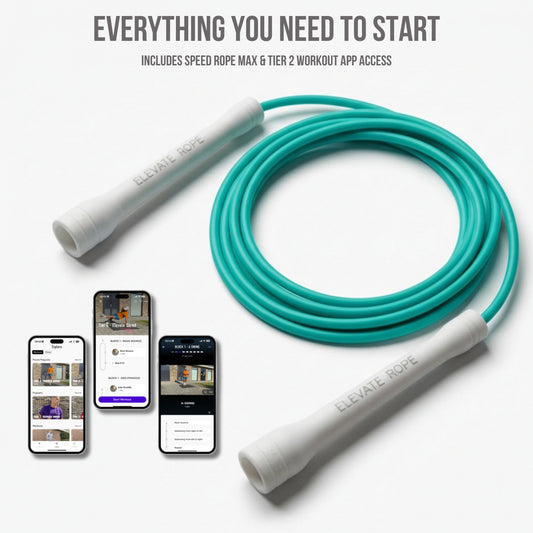
At Elevate Rope, we designed each of these rope types for their specific purpose. Our beaded Dignity Rope is built specifically for beginners with a 3.5mm polycord that is 17% thicker than the industry standard, providing noticeably better control and stability during those first learning sessions. Our Speed Rope MAX uses a bearing-free flow design that rotates with your natural rhythm rather than spinning artificially fast. And every rope comes with free access to the Elevate App with 100+ guided workouts, an accountability tracker, and a nutrition guide. No subscription fees. No hidden costs. Everything included from day one.
If you are not sure which type suits your goals, our Ascent Max Bundle pairs a beaded rope with a speed rope so you can start with rhythm training and progress to speed work as your skills develop.
Step 2: Size your rope correctly
Stand on the center of the rope with one foot. Pull both handles straight up alongside your body. For beginners, the handles should reach your armpits. For more experienced jumpers, chest height works better as you develop a tighter, more efficient rotation.
Most quality ropes come adjustable, so you can dial in the perfect length with just a pair of scissors. No special tools, no YouTube tutorial required. If you are sharing the rope with family members of different heights, look for a rope with an easy adjustment system that lets you resize in under a minute.
Step 3: Find your space
You need roughly 2m x 2m of open floor with enough overhead clearance that the rope does not hit the ceiling. A garage, patio, driveway, spare bedroom corner, or even a cleared section of your living room works. The surface matters more than you might think. Concrete is fine but hard on joints over time. A rubber mat, wooden floor, or gym tile provides a slight cushion that reduces impact and protects both your joints and the rope.
Avoid thick carpet. The rope catches on the fibers and disrupts your rhythm. Grass works for casual sessions but wears down beaded ropes faster and creates an uneven surface that can trip you up.
Step 4: Follow the 10-minute rule
This is the most important step, and the one most beginners ignore. Do not try to jump for 30 minutes on your first day, Do not try to learn tricks and do not set a calorie target. Just show up for 10 minutes.
Here is what a first session looks like: jump for 20-30 seconds. Rest for 15-30 seconds. Repeat. That is it. You will trip, You will miss and you will feel uncoordinated. All of that is normal and expected. The goal of the first week is not performance. It is proving to yourself that you are someone who shows up. Ten minutes, done, move on with your day.
Most beginners using a beaded rope can string together 20-30 consecutive jumps by the end of their first session. Within a week of daily 10-minute practice, 50+ consecutive jumps becomes normal. Within two weeks, you stop counting because it just flows. The learning curve is real, but it is far shorter than most people expect.
Step 5: Follow a structured program
Having a plan removes the two biggest consistency killers: decision fatigue ("what should I do today?") and plateaus ("I feel like I am not improving"). A structured program tells you exactly what to do each session and builds progressive challenge so you are always moving forward without overwhelming yourself.
The Elevate App includes programs for every level, from absolute beginner to advanced freestyle. If you want a focused starting point, the Elevate26 challenge is a 26-day guided program designed to build the jump rope habit from scratch. Each day includes a specific workout, form tips, and progression milestones that keep you engaged and accountable.
Over 50,000 people across Europe have started their jump rope journey with Elevate Rope. Not because they were athletes. Not because they had natural coordination. Because they picked up a rope, gave themselves permission to be bad at it for a few days, and discovered that something shifted. The workout stopped feeling like a chore and started feeling like ten minutes they actually looked forward to.
That shift is available to you too. It starts with step one.

Frequently Asked Questions About Home Cardio
What is the best cardio to do at home without equipment?
Bodyweight HIIT and jump rope are the top two options for home cardio . HIIT requires zero equipment and costs nothing. Jump rope requires a one-time purchase of 25-35 EUR but delivers higher calorie burn per minute and better long-term engagement through skill progression. If you want truly zero cost, bodyweight HIIT is the answer. If you can invest the price of a single takeaway meal, jump rope gives you more return per minute.
How many calories does jump rope burn compared to running?
Jump rope burns approximately 15-20 calories per minute at moderate to high intensity, compared to 10-15 calories per minute for running at a steady pace. That makes jump rope roughly 30-50% more efficient for calorie burn. A study from Arizona State University found that 10 minutes of jump rope produced cardiovascular benefits equivalent to 30 minutes of jogging. In practical terms, a 15-minute jump rope session delivers a comparable calorie burn to a 25-30 minute run.
Is jump rope bad for your knees?
When done with proper form, jump rope is actually lower impact than running. A 2019 study published in the Gait and Posture journal found that jump rope places less stress on the knees compared to running. The NIH has described the movement as "hip and knee protective" due to lower joint loads. The keys to keeping it low-impact are staying on the balls of your feet, keeping jumps small (2-3cm off the ground), and using an appropriate surface like a rubber mat or wooden floor rather than bare concrete. If you have existing knee issues, consult with a healthcare professional before starting, but for most people, jump rope is gentler on the joints than they expect.
Can you lose weight with home cardio alone?
Yes. Weight loss comes from maintaining a calorie deficit, and home cardio is just as effective as gym cardio for burning calories. Whether you jump rope in your garage or run on a treadmill at a health club, the calories burned are determined by the intensity and duration of the exercise, not the location. The advantage of home cardio for weight loss is consistency. Because it removes barriers like commute time, cost, and scheduling conflicts, most people find it easier to maintain a regular routine at home than at a gym. Pair any home cardio option with a balanced approach to nutrition, and the results will follow.
How much space do you need for jump rope?
Approximately 2m x 2m of floor space with enough overhead clearance for the rope to pass over your head without hitting the ceiling. For most adults, that means a ceiling height of at least 25-30cm above your head. A small bedroom, garage corner, patio, driveway, or cleared living room section works. You do not need a dedicated workout space. Any area where you can stand and extend your arms to the sides without hitting anything is large enough.
What is the cheapest effective home cardio option?
Bodyweight HIIT costs nothing at all. Jump rope costs 25-35 EUR as a one-time purchase with no recurring fees. Resistance bands cost 10-25 EUR. All three are significantly cheaper than a gym membership (360-720 EUR per year) or home equipment like a treadmill (300-1,500+ EUR) or spin bike (300-2,000+ EUR). For the best value per euro spent, jump rope delivers the highest calorie burn per minute at the lowest total cost of any equipment-based option.
Is 10 minutes of jump rope a day enough?
Yes. Research from Arizona State University confirmed that 10 minutes of jump rope provides cardiovascular benefits comparable to 30 minutes of jogging. The American Journal of Cardiology found that 10 minutes of jumping was as effective as 30 minutes of running at reducing risk factors for heart disease. For general cardiovascular health and weight management, a daily 10-minute jump rope session is a meaningful and effective workout. As your fitness improves, you can extend to 15-20 minutes or increase intensity rather than duration.
Which type of jump rope is best for beginners?
A beaded rope is the best choice for beginners. The segmented beads provide two forms of feedback that accelerate learning. First, the beads catch air during rotation, giving you a physical sense of where the rope is at all times. Second, the beads create an audible "tick-tick-tick" rhythm when they hit the ground, which helps your brain anticipate the timing of each jump. This auditory feedback is the single most effective learning aid for new jumpers. Speed ropes (thin PVC cables) are better for intermediate and advanced jumpers who have already mastered basic timing and want to increase pace.
Can I do jump rope in an apartment?
Yes, with a few adjustments. Use a thin exercise mat or rubber surface to absorb impact and protect the floor. Keep your jumps low, around 2-3cm off the ground, which is enough for the rope to pass under but reduces floor impact significantly. Choose a beaded rope over a heavy rope for less ground vibration. Avoid jumping during early morning or late night hours if you have neighbors below. While jump rope in an apartment will never be as silent as indoor cycling or resistance bands, the noise level with a mat and proper technique is comparable to walking firmly across the room. Many people in apartments across Europe jump rope regularly without complaints.
How long does it take to learn jump rope as an adult?
Most beginners can do 30 or more consecutive jumps within one to two weeks of daily 10-minute practice. The first two to three sessions are the steepest part of the learning curve, where tripping is frequent and coordination feels awkward. By session four or five, most people experience a noticeable click where the timing starts to feel natural rather than forced. Within a month of consistent practice, basic skills like alternating feet, boxer step, and side swings become comfortable. The learning curve is real, but it is significantly shorter than most adults expect, especially when using a beaded rope that provides auditory and tactile feedback.
The Verdict: Which Home Cardio Alternative Should You Choose?
You have seen the data, You have read the breakdowns, You have compared every option across calories, cost and space maybe noise or joint impact, and beginner accessibility. So what is the answer?
There is no single perfect cardio option for every person. But there is a clear pattern in the data.
Jump rope scores highest or near-highest in more categories than any other option on this list. Highest calorie burn per minute. Lowest year-one cost of any equipment-based option. Smallest space requirement alongside HIIT. Full-body engagement that no other single activity matches. A built-in skill progression that keeps people training months and years after the novelty fades. And a portability that means your workout travels with you wherever life takes you.
Indoor cycling is quieter. Running has a lower learning curve. HIIT costs nothing. Dance is more fun for some people. Resistance bands are gentler on joints. Every option on this list is a legitimate path to better cardiovascular health, and choosing any of them over doing nothing is a decision your future self will thank you for.
But if you are looking for the one option that delivers the most across the most categories for the least investment of money, time, and space, the data points to jump rope. Not by a slim margin. By a wide one.
The part the data does not capture
There is something about jump rope that does not show up in a comparison table. It is the reason people stick with it after the initial curiosity wears off, and it goes beyond calorie counts and cost savings.
Jump rope is a skill. Every session, you get a little better. Your timing sharpens, Your feet get lighter and Your breathing settles. One day you land your first set of 100 without stopping and you feel something that a treadmill or stationary bike never gave you. Not just the satisfaction of finishing a workout. The quiet proof that you are improving at something. That you are capable of more than you thought.
That feeling compounds. It bleeds into other areas of your life. You start to see yourself differently. Not as someone who is trying to get fit, but as someone who follows through. Someone who shows up for ten minutes every morning and keeps the promise they made to themselves. The rope becomes less about cardio and more about identity. About becoming someone who trusts themselves to do what they said they would do.
That transformation, from someone who keeps starting over to someone who keeps going, is worth more than any calorie deficit.
Where to start
If you are ready to try it, here is the simplest path forward.
If you are a complete beginner, start with the Elevate Ascent Max Bundle. It pairs our Dignity Beaded Rope (the one with auditory timing feedback that teaches your brain when to jump) with our Speed Rope MAX (for when your rhythm clicks and you want to push the pace). Two ropes that cover your entire progression from first jump to advanced training, plus free access to the Elevate App with 100+ workouts and the Elevate26 challenge to guide your first 26 days.
If you already know you want a beaded rope to learn the fundamentals, the Dignity Beaded Rope on its own is the best starting point. Pick from 18+ colors, size it with scissors in under a minute, and follow the beginner program in the app.
If you are not sure which rope is right for you, take our Start Here quiz. Five quick questions about your goals, experience level, and training preferences, and it recommends the exact rope and program for your situation.
Every Elevate Rope comes with a 90-day satisfaction guarantee. If it does not work for you, send it back for a full refund, no questions asked. Lifetime handle warranty included. No subscriptions. No hidden fees. Just a rope, a plan, and the ten minutes that can change everything.
Fifty thousand people across Europe started exactly where you are now. Not as athletes. Not as fitness enthusiasts. Just as people who decided that today was the day they stopped waiting for the perfect moment and picked up a rope instead.
Your turn.
> Get your first Elevate Rope here
Sources and Further Reading
The research and statistics referenced throughout this guide come from the following sources. We have included direct links so you can explore the original data and dig deeper into any topic that interests you.
Exercise science and calorie burn data
Arizona State University Jump Rope Study - The foundational research showing that 10 minutes of jump rope produces cardiovascular benefits equivalent to 30 minutes of jogging. This study is widely cited across exercise science literature and remains one of the most referenced comparisons between jump rope and running efficiency.
American Journal of Cardiology - Published research confirming that 10 minutes of jump rope was as effective as 30 minutes of running at reducing risk factors for heart disease. https://www.ajconline.org
Gait and Posture Journal (2019) - The study comparing joint loads during jump rope versus running, finding that jump rope places less stress on the knees. Referenced by the NIH, which described the bounce rope-skip movement as "hip and knee protective due to lower hip and knee joint loads compared to running." https://pubmed.ncbi.nlm.nih.gov
Arthritis Foundation - Research showing that women with mild knee osteoarthritis who performed controlled impact movements three times a week experienced a 7% increase in knee cartilage quality after one year. https://www.arthritis.org
Gym membership and fitness industry data
IHRSA (International Health, Racquet & Sportsclub Association) - Industry body providing the data on gym member retention rates, including the finding that 50% of new members quit within six months and that the average annual retention rate for health clubs is approximately 71.4%. https://www.ihrsa.org
WodGuru Gym Membership Statistics 2026 - Comprehensive industry report covering membership trends, seasonal attendance patterns, the January enrollment surge of 12%, and the finding that 67% of gym memberships go unused. https://wod.guru/blog/gym-membership-statistics
Glofox New Year's Resolution Statistics - Research analysis showing that 80% of January gym joiners quit within five months, with data on retention strategies and the cost of member acquisition versus retention. https://www.glofox.com/blog/6-new-years-resolution-gym-statistics-you-need-to-know
University of Scranton Resolution Study - Research finding that while 45% of Americans make New Year's resolutions, only 8% achieve them, highlighting the gap between fitness intention and execution.
Gym costs and affordability
Mandoe Media Global Gym Membership Cost Study - Comparative analysis of gym membership costs across 45 European countries, including the finding that the Netherlands ranked first in Europe for gym affordability. https://mandoemedia.com/revealed-the-true-cost-of-gym-membership-across-the-globe
Xplor Gym UK Membership Report 2026 - Detailed breakdown of gym membership costs across the UK market, finding the average cost of a gym membership is £48.45 per month, with regional variation from £35.79 in Northern Ireland to £76.26 in London. https://xplorgym.co.uk/blog/average-cost-of-gym-membership-uk
Exercise adherence and behavioral science
Penn State University Group Fitness Study - Research demonstrating that participants in a structured 30-week group fitness program achieved a 98.8% adherence rate, compared to the typical 60% dropout rate in solo training programs. Referenced in the IHRSA 2018 report on member retention.
Smart Health Clubs Retention Statistics 2025 - Collection of 100+ gym membership and retention statistics, including data showing that members who sign up during January sales events have a 45% higher churn rate and that the top three reasons for dropout are high cost, lack of time, and loss of motivation. https://smarthealthclubs.com/blog/100-gym-membership-retention-statistics
This guide was last updated in February 2026. We review and refresh all statistics and recommendations every six months to ensure accuracy. If you notice any data that needs updating or have questions about specific sources, contact us at support@elevaterope.com.